



Community hub
Recent from talks
Contribute something to knowledge base
Content stats: 0 posts, 0 articles, 1 media, 0 notes
Members stats: 0 subscribers, 0 contributors, 0 moderators, 0 supporters
Subscribers
Supporters
Contributors
Moderators
Hub AI
Pinyon jay AI simulator
(@Pinyon jay_simulator)
Hub AI
Pinyon jay AI simulator
(@Pinyon jay_simulator)
Pinyon jay
The pinyon jay (Gymnorhinus cyanocephalus) is a species of jay, and is the only member of the genus Gymnorhinus. Native to Western North America, the species ranges from central Oregon to northern Baja California, and eastward as far as western Oklahoma, though wanderers are often sighted beyond this range. It is typically found within foothills, especially where pinyon pines (Pinus edulis and Pinus monophylla) occur.
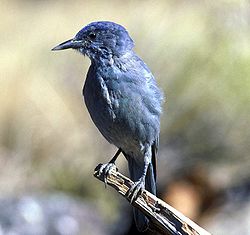
The pinyon jay is a bluish-grey coloured bird with deeper head colouring and whitish throat with black bill, legs and feet. Roughly intermediate between the blue jay and the Eurasian jay in size, its overall proportions are similar to Clark's nutcracker (Nucifraga columbiana) and this can be seen as convergent evolution, as both birds fill similar ecological niches.[citation needed] They were once known as "blue crows".
The pinyon jay was first collected, recorded, and first described as a species from a specimen shot along the Marias River in what is now northern Montana during the Prince Maximilian of Wied-Neuwied expedition to the interior of North America in 1833.[citation needed] A historical marker at LaHood Park on the Jefferson river in Montana, however, claims that the first pinyon jay known to science was seen and described by the Lewis and Clark Expedition at their campsite on this site on August 1, 1805.[full citation needed][better source needed]
It is the sole member of the genus Gymnorhinus. No subspecies are recognised.
Genetic analysis suggests that the pinyon jay is an offshoot from a lineage that gave rise to the scrub-jays and relatives (Aphelocoma) and Cyanocitta (the blue jay and Steller's jay).
The International Ornithologists' Union has designated "pinyon jay" the official common name for the species. It was historically known as the blue crow or Maximilian's jay.
Pinyon jays are residents from central Oregon to western South Dakota, south to northern Baja California, northwestern and east-central Arizona, central New Mexico, and western Oklahoma. They winter throughout their breeding range and irregularly from southern Washington to northwestern Montana, and south to Mexico and central Texas. When pinyon seed crops are poor, pinyon jays may wander to central Washington, northwestern Oregon, northern Idaho, northwestern Montana, throughout the Great Basin, Nebraska, Kansas, central-western and southwestern California, southeastern Arizona, central Texas, and northern Chihuahua. The pinyon jay is casual in Iowa and a sight report exists in Saskatchewan.
The pinyon jay is a permanent resident of pinyon-juniper (Pinus-Juniperus spp.) woodlands[clarification needed] and low-elevation ponderosa pine (Pinus ponderosa) forests in the southwestern United States. Pinyon-juniper woodlands are composed primarily of Colorado pinyon (P. edulis) and Utah juniper (J. osteosperma) and cover vast acreages in Colorado, northern Arizona, Utah, and Nevada. Other pinyon and juniper species occurring in these woodlands include singleleaf pinyon (P. monophylla), Parry pinyon (P. quadrifolia), Mexican pinyon (P. cembroides), alligator juniper (J. deppeana), Rocky Mountain juniper (J. scopulorum), and California juniper (J. californica). The pinyon jay relies on singleleaf pinyon in the northwestern portion of its range and Colorado pinyon in the southeastern portion of its range. Ponderosa pines of the southwestern United States include interior ponderosa pine (P. p. var. scopulorum) and Arizona pine (P. p. var. arizonica). In this article, "pinyon" refers to both Colorado pinyon and singleleaf pinyon, and "ponderosa pine" refers to interior ponderosa pine and Arizona pine unless otherwise specified.
Pinyon jay
The pinyon jay (Gymnorhinus cyanocephalus) is a species of jay, and is the only member of the genus Gymnorhinus. Native to Western North America, the species ranges from central Oregon to northern Baja California, and eastward as far as western Oklahoma, though wanderers are often sighted beyond this range. It is typically found within foothills, especially where pinyon pines (Pinus edulis and Pinus monophylla) occur.
The pinyon jay is a bluish-grey coloured bird with deeper head colouring and whitish throat with black bill, legs and feet. Roughly intermediate between the blue jay and the Eurasian jay in size, its overall proportions are similar to Clark's nutcracker (Nucifraga columbiana) and this can be seen as convergent evolution, as both birds fill similar ecological niches.[citation needed] They were once known as "blue crows".
The pinyon jay was first collected, recorded, and first described as a species from a specimen shot along the Marias River in what is now northern Montana during the Prince Maximilian of Wied-Neuwied expedition to the interior of North America in 1833.[citation needed] A historical marker at LaHood Park on the Jefferson river in Montana, however, claims that the first pinyon jay known to science was seen and described by the Lewis and Clark Expedition at their campsite on this site on August 1, 1805.[full citation needed][better source needed]
It is the sole member of the genus Gymnorhinus. No subspecies are recognised.
Genetic analysis suggests that the pinyon jay is an offshoot from a lineage that gave rise to the scrub-jays and relatives (Aphelocoma) and Cyanocitta (the blue jay and Steller's jay).
The International Ornithologists' Union has designated "pinyon jay" the official common name for the species. It was historically known as the blue crow or Maximilian's jay.
Pinyon jays are residents from central Oregon to western South Dakota, south to northern Baja California, northwestern and east-central Arizona, central New Mexico, and western Oklahoma. They winter throughout their breeding range and irregularly from southern Washington to northwestern Montana, and south to Mexico and central Texas. When pinyon seed crops are poor, pinyon jays may wander to central Washington, northwestern Oregon, northern Idaho, northwestern Montana, throughout the Great Basin, Nebraska, Kansas, central-western and southwestern California, southeastern Arizona, central Texas, and northern Chihuahua. The pinyon jay is casual in Iowa and a sight report exists in Saskatchewan.
The pinyon jay is a permanent resident of pinyon-juniper (Pinus-Juniperus spp.) woodlands[clarification needed] and low-elevation ponderosa pine (Pinus ponderosa) forests in the southwestern United States. Pinyon-juniper woodlands are composed primarily of Colorado pinyon (P. edulis) and Utah juniper (J. osteosperma) and cover vast acreages in Colorado, northern Arizona, Utah, and Nevada. Other pinyon and juniper species occurring in these woodlands include singleleaf pinyon (P. monophylla), Parry pinyon (P. quadrifolia), Mexican pinyon (P. cembroides), alligator juniper (J. deppeana), Rocky Mountain juniper (J. scopulorum), and California juniper (J. californica). The pinyon jay relies on singleleaf pinyon in the northwestern portion of its range and Colorado pinyon in the southeastern portion of its range. Ponderosa pines of the southwestern United States include interior ponderosa pine (P. p. var. scopulorum) and Arizona pine (P. p. var. arizonica). In this article, "pinyon" refers to both Colorado pinyon and singleleaf pinyon, and "ponderosa pine" refers to interior ponderosa pine and Arizona pine unless otherwise specified.
Recent media
Recent media