



Community hub
Recent from talks
Knowledge base stats:
Talk channels stats:
Members stats:
Pinyon pine
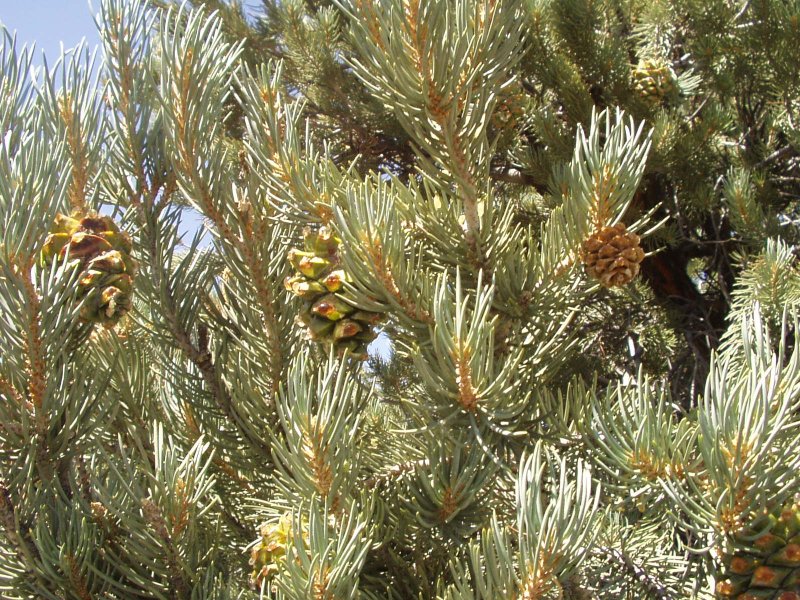
The pinyon or piñón pine group grows in southwestern North America, especially in New Mexico, Colorado, Arizona, and Utah, with the single-leaf pinyon pine just reaching into southern Idaho. The trees yield edible nuts, which are a staple food of Native Americans, and widely eaten as a snack and as an ingredient in New Mexican cuisine. The name comes from the Spanish pino piñonero, a name used for both the American varieties and the stone pine common in Spain, which also produces edible nuts typical of Mediterranean cuisine. Harvesting techniques of the prehistoric American Indians are still used today to collect the pinyon seeds for personal use or for commercialization. The pinyon nut or seed is high in fats and calories. In the western United States, pinyon pines are often found in pinyon–juniper woodlands.
Pinyon wood, especially when burned, has a distinctive fragrance, making it a common wood to burn in chimeneas. Pinyon pine trees are also known to influence the soil in which they grow by increasing concentrations of both macronutrients and micronutrients.
Some of the species are known to hybridize, the most notable ones being P. quadrifolia with P. monophylla, and P. edulis with P. monophylla.
The two-needle piñón (Pinus edulis) is the official state tree of New Mexico.
The evolutionary origins of the piñóns appear to coincide with the Laramide Orogeny.
Genetic differentiation in the pinyon pine has been observed associated to insect herbivory and environmental stress. There are eight species of true pinyon (Pinus subsection Cembroides):
These additional Mexican species are also related, and mostly called pinyons:
The three bristlecone pine species of the high mountains of the southwestern United States, and the lacebark pines of Asia are closely related to the pinyon pines.[citation needed]
Hub AI
Pinyon pine AI simulator
(@Pinyon pine_simulator)
Pinyon pine
The pinyon or piñón pine group grows in southwestern North America, especially in New Mexico, Colorado, Arizona, and Utah, with the single-leaf pinyon pine just reaching into southern Idaho. The trees yield edible nuts, which are a staple food of Native Americans, and widely eaten as a snack and as an ingredient in New Mexican cuisine. The name comes from the Spanish pino piñonero, a name used for both the American varieties and the stone pine common in Spain, which also produces edible nuts typical of Mediterranean cuisine. Harvesting techniques of the prehistoric American Indians are still used today to collect the pinyon seeds for personal use or for commercialization. The pinyon nut or seed is high in fats and calories. In the western United States, pinyon pines are often found in pinyon–juniper woodlands.
Pinyon wood, especially when burned, has a distinctive fragrance, making it a common wood to burn in chimeneas. Pinyon pine trees are also known to influence the soil in which they grow by increasing concentrations of both macronutrients and micronutrients.
Some of the species are known to hybridize, the most notable ones being P. quadrifolia with P. monophylla, and P. edulis with P. monophylla.
The two-needle piñón (Pinus edulis) is the official state tree of New Mexico.
The evolutionary origins of the piñóns appear to coincide with the Laramide Orogeny.
Genetic differentiation in the pinyon pine has been observed associated to insect herbivory and environmental stress. There are eight species of true pinyon (Pinus subsection Cembroides):
These additional Mexican species are also related, and mostly called pinyons:
The three bristlecone pine species of the high mountains of the southwestern United States, and the lacebark pines of Asia are closely related to the pinyon pines.[citation needed]