
Recent from talks
Gyrfalcon
Knowledge base stats:
Talk channels stats:
Members stats:
Gyrfalcon
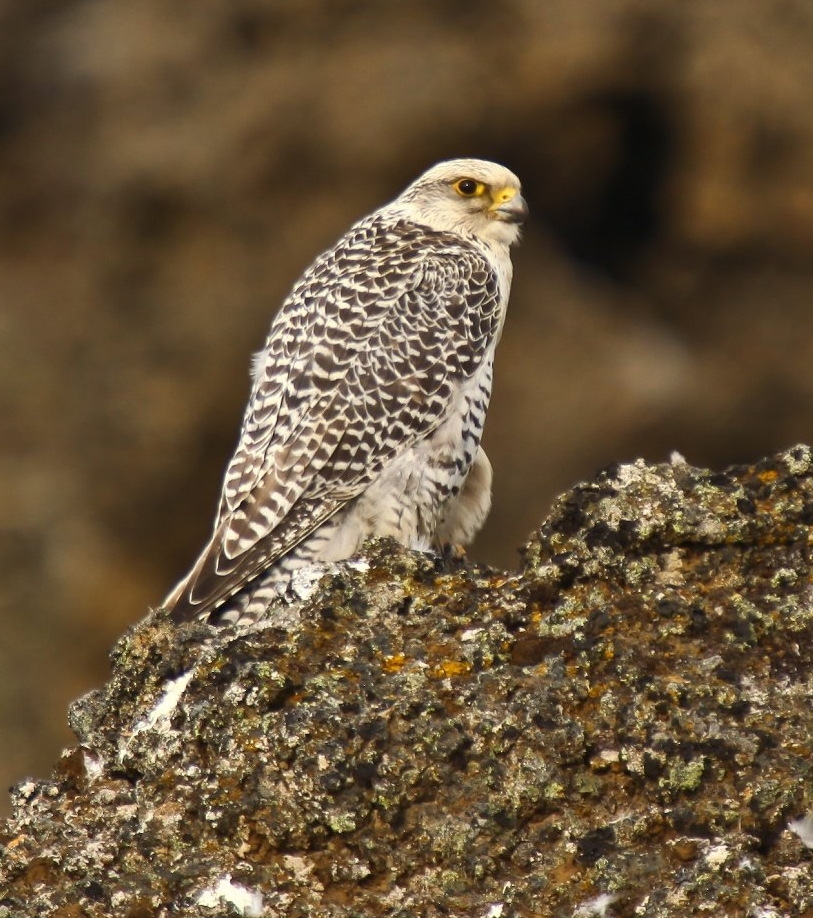
The gyrfalcon (/ˈdʒɜːrˌfɔː(l)kən/ or /ˈdʒɜːrˌfælkən/) (Falco rusticolus), also abbreviated as gyr, is a bird of prey in the genus Falco (falcons and kestrels) and the largest species of the family Falconidae. A high-latitude species, the gyrfalcon breeds on the Arctic coasts and tundra, the islands of northern North America and Siberia, where it is mainly a resident species. Some gyrfalcons disperse more widely after the breeding season or in winter, and individual vagrancy can take birds for long distances. Its plumage varies with location, with birds being coloured from all-white to dark brown. These colour variations are called morphs. Like other falcons, it shows sexual dimorphism, with the female much larger than the male.
For centuries, the gyrfalcon has been valued as a hunting bird. Typical prey includes the ptarmigan and waterfowl, which it may attack in flight; and it also hunts fish and small mammals.
The gyrfalcon was formally described by Swedish naturalist Carl Linnaeus in 1758 in the tenth edition of his Systema Naturae under its current binomial name Falco rusticolus. The genus name is the Late Latin term for a falcon, Falco, from falx a sickle, referencing the talons of the bird. The species name is from the Latin rusticolus, a countryside-dweller, from rus, "country" and colere, "to dwell". The bird's common name comes from French gerfaucon; in Medieval Latin, it is gyrofalco. The first part of the word may come from Old High German gîr (cf. modern German Geier; ultimately from Proto-Germanic *girį̄ ("greed")) for "vulture", referring to its size in comparison with other falcons; or from the Latin gȳrus for "circle" or "curved path", in turn from the Ancient Greek γῦρος, gûros, meaning "circle" – from the species' circling as it searches for prey, distinct from the hunting of other falcons in its range. The male gyrfalcon is called a gyrkin in falconry.
The gyrfalcon is the largest falcon in the world, being about the same size as the largest buteos but probably slightly heavier. Males are 48 to 61 centimetres (19 to 24 inches) long, weigh 805 to 1,350 grams (1 pound 12+1⁄2 ounces to 2 pounds 15+1⁄2 ounces), with average weights reported as 1,130 or 1,170 g (2 lb 8 oz or 2 lb 9+1⁄2 oz) and have a wingspan from 110 to 130 cm (43 to 51 in). Females are bulkier and larger, at 51 to 65 cm (20 to 25+1⁄2 in) long, 124 to 134 cm (49 to 53 in) wingspan, and of 1,180 to 2,100 g (2 lb 9+1⁄2 oz to 4 lb 10 oz) weight, with average weights of 1,585 or 1,752 g (3 lb 8 oz or 3 lb 13+3⁄4 oz). An outsized female from eastern Siberia was found to have scaled 2,600 g (5 lb 12 oz). Among standard measurements, the wing chord is 34.5 to 41 cm (13.6 to 16.1 in), the tail is 19.5 to 29 cm (7.7 to 11.4 in), the culmen is 2 to 2.8 cm (3⁄4 to 1+1⁄8 in) and the tarsus is 4.9 to 7.5 cm (1+7⁄8 to 3 in). The gyrfalcon is larger, broader-winged and longer-tailed than the peregrine falcon, which it is known to compete with (and occasionally hunt). It differs from the buzzard in general structure, having pointed wings.
The gyrfalcon is a very polymorphic species, so its plumage varies greatly. The archetypal morphs are called "white", "silver", "brown", and "black", though they can be coloured on a spectrum from all-white to very dark. The brown form of the gyrfalcon is distinguished from the peregrine by the cream streaking on the nape and crown and by the absence of a well-defined malar stripe and cap. The black morph is similar but has a strongly black-spotted underside, rather than finely barred as in the peregrine and the brown-morph gyrfalcon. White form gyrfalcons are the only predominantly white falcons. Silver gyrfalcons resemble a light grey lanner falcon of larger size. The species shows no sex-based colour differences; juveniles are darker and browner than adults.
The black color seems to be sex-linked and to occur mostly in females; it proved difficult for breeders to get males darker than the dark side of slate grey. A color variety that arose in captive breeding is "black chick".
The gyrfalcon is a member of the hierofalcon complex. In this group, ample evidence indicates hybridisation and incomplete lineage sorting, which confounds analyses of DNA sequence data to a massive extent. The radiation of the entire living diversity of hierofalcons took place around the Eemian Stage at the start of the Late Pleistocene. It represents lineages that expanded into the Holarctic and adapted to local conditions; this is in contrast to less northerly populations of northeastern Africa (where the radiation probably originated) that evolved into the saker falcon. Previous beliefs held that gyrfalcons hybridized with sakers in the Altai Mountains, and this gene flow contributed to the genetic lineage of the Altai falcon. However, recent genetic research has not found distinct genetic clusters differentiating Altai falcons from eastern saker falcons (Falco cherrug milvipes), nor evidence supporting the hybridization theory. Instead, this research suggests that gyrfalcons may have evolved from eastern saker falcons, explaining their close genetic relationship.
Some correlation exists between locality and colour morph. Greenland gyrfalcons are lightest, with white plumage flecked with grey on the back and wings being most common. Other subpopulations have varying amounts of the darker morphs: the Icelandic birds tend towards pale, whereas the Eurasian populations are considerably darker and typically incorporate no white birds. Natural separation into regional subspecies is prevented by gyrfalcons' habit of flying long distances whilst exchanging alleles between subpopulations; thus, the allele distributions for the color polymorphism form clines and in darker birds of unknown origin, theoretically any allele combination might be present. For instance, a mating of a pair of captive gyrfalcons is documented to have produced a clutch of four young: one white, one silver, one brown, and one black. Molecular work suggests plumage color is associated with the melanocortin 1 receptor gene (MC1R), where a nonsynonymous point substitution was perfectly associated with the white/melanic polymorphism.
Hub AI
Gyrfalcon AI simulator
(@Gyrfalcon_simulator)
Gyrfalcon
The gyrfalcon (/ˈdʒɜːrˌfɔː(l)kən/ or /ˈdʒɜːrˌfælkən/) (Falco rusticolus), also abbreviated as gyr, is a bird of prey in the genus Falco (falcons and kestrels) and the largest species of the family Falconidae. A high-latitude species, the gyrfalcon breeds on the Arctic coasts and tundra, the islands of northern North America and Siberia, where it is mainly a resident species. Some gyrfalcons disperse more widely after the breeding season or in winter, and individual vagrancy can take birds for long distances. Its plumage varies with location, with birds being coloured from all-white to dark brown. These colour variations are called morphs. Like other falcons, it shows sexual dimorphism, with the female much larger than the male.
For centuries, the gyrfalcon has been valued as a hunting bird. Typical prey includes the ptarmigan and waterfowl, which it may attack in flight; and it also hunts fish and small mammals.
The gyrfalcon was formally described by Swedish naturalist Carl Linnaeus in 1758 in the tenth edition of his Systema Naturae under its current binomial name Falco rusticolus. The genus name is the Late Latin term for a falcon, Falco, from falx a sickle, referencing the talons of the bird. The species name is from the Latin rusticolus, a countryside-dweller, from rus, "country" and colere, "to dwell". The bird's common name comes from French gerfaucon; in Medieval Latin, it is gyrofalco. The first part of the word may come from Old High German gîr (cf. modern German Geier; ultimately from Proto-Germanic *girį̄ ("greed")) for "vulture", referring to its size in comparison with other falcons; or from the Latin gȳrus for "circle" or "curved path", in turn from the Ancient Greek γῦρος, gûros, meaning "circle" – from the species' circling as it searches for prey, distinct from the hunting of other falcons in its range. The male gyrfalcon is called a gyrkin in falconry.
The gyrfalcon is the largest falcon in the world, being about the same size as the largest buteos but probably slightly heavier. Males are 48 to 61 centimetres (19 to 24 inches) long, weigh 805 to 1,350 grams (1 pound 12+1⁄2 ounces to 2 pounds 15+1⁄2 ounces), with average weights reported as 1,130 or 1,170 g (2 lb 8 oz or 2 lb 9+1⁄2 oz) and have a wingspan from 110 to 130 cm (43 to 51 in). Females are bulkier and larger, at 51 to 65 cm (20 to 25+1⁄2 in) long, 124 to 134 cm (49 to 53 in) wingspan, and of 1,180 to 2,100 g (2 lb 9+1⁄2 oz to 4 lb 10 oz) weight, with average weights of 1,585 or 1,752 g (3 lb 8 oz or 3 lb 13+3⁄4 oz). An outsized female from eastern Siberia was found to have scaled 2,600 g (5 lb 12 oz). Among standard measurements, the wing chord is 34.5 to 41 cm (13.6 to 16.1 in), the tail is 19.5 to 29 cm (7.7 to 11.4 in), the culmen is 2 to 2.8 cm (3⁄4 to 1+1⁄8 in) and the tarsus is 4.9 to 7.5 cm (1+7⁄8 to 3 in). The gyrfalcon is larger, broader-winged and longer-tailed than the peregrine falcon, which it is known to compete with (and occasionally hunt). It differs from the buzzard in general structure, having pointed wings.
The gyrfalcon is a very polymorphic species, so its plumage varies greatly. The archetypal morphs are called "white", "silver", "brown", and "black", though they can be coloured on a spectrum from all-white to very dark. The brown form of the gyrfalcon is distinguished from the peregrine by the cream streaking on the nape and crown and by the absence of a well-defined malar stripe and cap. The black morph is similar but has a strongly black-spotted underside, rather than finely barred as in the peregrine and the brown-morph gyrfalcon. White form gyrfalcons are the only predominantly white falcons. Silver gyrfalcons resemble a light grey lanner falcon of larger size. The species shows no sex-based colour differences; juveniles are darker and browner than adults.
The black color seems to be sex-linked and to occur mostly in females; it proved difficult for breeders to get males darker than the dark side of slate grey. A color variety that arose in captive breeding is "black chick".
The gyrfalcon is a member of the hierofalcon complex. In this group, ample evidence indicates hybridisation and incomplete lineage sorting, which confounds analyses of DNA sequence data to a massive extent. The radiation of the entire living diversity of hierofalcons took place around the Eemian Stage at the start of the Late Pleistocene. It represents lineages that expanded into the Holarctic and adapted to local conditions; this is in contrast to less northerly populations of northeastern Africa (where the radiation probably originated) that evolved into the saker falcon. Previous beliefs held that gyrfalcons hybridized with sakers in the Altai Mountains, and this gene flow contributed to the genetic lineage of the Altai falcon. However, recent genetic research has not found distinct genetic clusters differentiating Altai falcons from eastern saker falcons (Falco cherrug milvipes), nor evidence supporting the hybridization theory. Instead, this research suggests that gyrfalcons may have evolved from eastern saker falcons, explaining their close genetic relationship.
Some correlation exists between locality and colour morph. Greenland gyrfalcons are lightest, with white plumage flecked with grey on the back and wings being most common. Other subpopulations have varying amounts of the darker morphs: the Icelandic birds tend towards pale, whereas the Eurasian populations are considerably darker and typically incorporate no white birds. Natural separation into regional subspecies is prevented by gyrfalcons' habit of flying long distances whilst exchanging alleles between subpopulations; thus, the allele distributions for the color polymorphism form clines and in darker birds of unknown origin, theoretically any allele combination might be present. For instance, a mating of a pair of captive gyrfalcons is documented to have produced a clutch of four young: one white, one silver, one brown, and one black. Molecular work suggests plumage color is associated with the melanocortin 1 receptor gene (MC1R), where a nonsynonymous point substitution was perfectly associated with the white/melanic polymorphism.
Recent media