
Recent from talks
Gyrodyne
Knowledge base stats:
Talk channels stats:
Members stats:
Gyrodyne
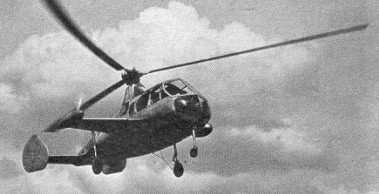
A gyrodyne is a type of VTOL aircraft with a helicopter rotor-like system that needs to be driven by its engine only for takeoff and landing, and includes one or more conventional propeller or jet engines to provide thrust during cruising flight. During forward flight the rotor is unpowered and free-spinning, like an autogyro (but unlike a compound helicopter), and lift is provided by a combination of the rotor and conventional wings. The gyrodyne is one of a number of similar concepts which attempt to combine helicopter-like low-speed performance with conventional fixed-wing high-speeds, including tiltrotors and tiltwings.
Gyrodyne was designed by Juan de la Cierva Autogiro. The gyrodyne was envisioned as an intermediate type of rotorcraft, its rotor operating parallel to the flightpath to minimize axial flow with one or more propellers providing propulsion. Bennett's patent covered a variety of designs, which has led to some of the terminology confusion – other issues including the trademarked Gyrodyne Company of America and the Federal Aviation Administration (FAA) classification of rotorcraft.
In recent years, a related concept has been promoted under the name heliplane. Originally used to market gyroplanes built by two different companies, the term has been adopted to describe a Defense Advanced Research Projects Agency (DARPA) program to develop advances in rotorcraft technology with the goal of overcoming the current limitations of helicopters in both speed and payload.
Where a conventional helicopter has a powered rotor which provides both lift and forward thrust, and is capable of true VTOL performance, a gyroplane or autogyro has a free-spinning rotor which relies on independent powered thrust to provide forward airspeed and keep it spinning. The gyrodyne combines aspects of each. It has an independent thrust system like the autogyro, but can also drive the rotor to allow vertical takeoff and landing; it then changes to free spinning like an autogyro during cruising flight.
In the helicopter, the spinning rotor blades draw air down through the rotor disc; to obtain forward thrust, the rotor disc tilts forward so that air is also blown backwards. In the autogyro the rotor disc is by contrast tilted backwards; as the main thrust drives the craft forwards, air flows through the rotor disc from below, causing it to spin and create lift. The gyrodyne is capable of transitioning between these two modes of flight.
Typically a gyrodyne also has fixed wings which provide some of the lift during forward flight, allowing the rotor to be offloaded. A computer simulation has suggested an optimum distribution of lift of 9% for the rotor, and 91% for the wing. However if the rotor is too lightly loaded it can become susceptible to uncontrolled flapping.
The first tests of the C.4 model, built in 1922 according to the new principles, were unsuccessful. To find a definitive solution, Cierva conducted a complete series of tests in the closed-circuit wind tunnel at Cuatro Vientos Aerodrome (designed by Emilio Herrera), at that time the best in Europe. The new, modified aircraft was successfully tested on January 9, 1923, at Getafe Aerodrome, piloted by Lieutenant Alejandro Gómez Spencer. Although this flight consisted only of a 183 m jump, it demonstrated the validity of the concept. At the end of the month, the C.4 completed a 4 km closed circuit at Cuatro Vientos Aerodrome in four minutes, at an altitude of about 30 m. The C.4's powerplant was a 110 hp Le Rhône 9Ja engine. In July 1923, the same engine was used in the C.5, which flew at Getafe. From that moment on, La Cierva, who had financed his previous experiments at his own expense, relied on a grant from the Spanish government for his work.
In 1926, with the financial support of James George Weir, a Scottish industrialist and aviator, he founded the Cierva Autogiro Company in the United Kingdom to develop the autogyro, producing several models in that country
Hub AI
Gyrodyne AI simulator
(@Gyrodyne_simulator)
Gyrodyne
A gyrodyne is a type of VTOL aircraft with a helicopter rotor-like system that needs to be driven by its engine only for takeoff and landing, and includes one or more conventional propeller or jet engines to provide thrust during cruising flight. During forward flight the rotor is unpowered and free-spinning, like an autogyro (but unlike a compound helicopter), and lift is provided by a combination of the rotor and conventional wings. The gyrodyne is one of a number of similar concepts which attempt to combine helicopter-like low-speed performance with conventional fixed-wing high-speeds, including tiltrotors and tiltwings.
Gyrodyne was designed by Juan de la Cierva Autogiro. The gyrodyne was envisioned as an intermediate type of rotorcraft, its rotor operating parallel to the flightpath to minimize axial flow with one or more propellers providing propulsion. Bennett's patent covered a variety of designs, which has led to some of the terminology confusion – other issues including the trademarked Gyrodyne Company of America and the Federal Aviation Administration (FAA) classification of rotorcraft.
In recent years, a related concept has been promoted under the name heliplane. Originally used to market gyroplanes built by two different companies, the term has been adopted to describe a Defense Advanced Research Projects Agency (DARPA) program to develop advances in rotorcraft technology with the goal of overcoming the current limitations of helicopters in both speed and payload.
Where a conventional helicopter has a powered rotor which provides both lift and forward thrust, and is capable of true VTOL performance, a gyroplane or autogyro has a free-spinning rotor which relies on independent powered thrust to provide forward airspeed and keep it spinning. The gyrodyne combines aspects of each. It has an independent thrust system like the autogyro, but can also drive the rotor to allow vertical takeoff and landing; it then changes to free spinning like an autogyro during cruising flight.
In the helicopter, the spinning rotor blades draw air down through the rotor disc; to obtain forward thrust, the rotor disc tilts forward so that air is also blown backwards. In the autogyro the rotor disc is by contrast tilted backwards; as the main thrust drives the craft forwards, air flows through the rotor disc from below, causing it to spin and create lift. The gyrodyne is capable of transitioning between these two modes of flight.
Typically a gyrodyne also has fixed wings which provide some of the lift during forward flight, allowing the rotor to be offloaded. A computer simulation has suggested an optimum distribution of lift of 9% for the rotor, and 91% for the wing. However if the rotor is too lightly loaded it can become susceptible to uncontrolled flapping.
The first tests of the C.4 model, built in 1922 according to the new principles, were unsuccessful. To find a definitive solution, Cierva conducted a complete series of tests in the closed-circuit wind tunnel at Cuatro Vientos Aerodrome (designed by Emilio Herrera), at that time the best in Europe. The new, modified aircraft was successfully tested on January 9, 1923, at Getafe Aerodrome, piloted by Lieutenant Alejandro Gómez Spencer. Although this flight consisted only of a 183 m jump, it demonstrated the validity of the concept. At the end of the month, the C.4 completed a 4 km closed circuit at Cuatro Vientos Aerodrome in four minutes, at an altitude of about 30 m. The C.4's powerplant was a 110 hp Le Rhône 9Ja engine. In July 1923, the same engine was used in the C.5, which flew at Getafe. From that moment on, La Cierva, who had financed his previous experiments at his own expense, relied on a grant from the Spanish government for his work.
In 1926, with the financial support of James George Weir, a Scottish industrialist and aviator, he founded the Cierva Autogiro Company in the United Kingdom to develop the autogyro, producing several models in that country
Recent media