


Community hub
Recent from talks
Contribute something
Nothing was collected or created yet.
Helicopter
View on Wikipedia
 | This article needs additional citations for verification. (August 2025) |

.jpg)
.jpg)

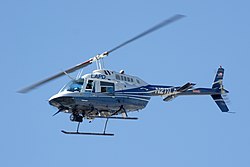
A helicopter is a type of rotorcraft in which lift and thrust are supplied by horizontally spinning rotors. This allows the helicopter to take off and land vertically, to hover, and to fly forward, backward and laterally. These attributes allow helicopters to be used in congested or isolated areas where fixed-wing aircraft and many forms of short take-off and landing (STOL) or short take-off and vertical landing (STOVL) aircraft cannot perform without a runway.
The Focke-Wulf Fw 61 was the first successful, practical, and fully controllable helicopter in 1936, while in 1942, the Sikorsky R-4 became the first helicopter to reach full-scale production. Starting in 1939 and through 1943, Igor Sikorsky worked on the development of the VS-300, which over four iterations, became the basis for modern helicopters with a single main rotor and a single tail rotor.
Although most earlier designs used more than one main rotor, the configuration of a single main rotor accompanied by a vertical anti-torque tail rotor (i.e. unicopter, not to be confused with the single-blade monocopter) has become the most common helicopter configuration. However, twin-rotor helicopters (bicopters), in either tandem or transverse rotors configurations, are sometimes in use due to their greater payload capacity than the monorotor design, and coaxial-rotor, tiltrotor and compound helicopters are also all flying today. Four-rotor helicopters (quadcopters) were pioneered as early as 1907 in France, and along with other types of multicopters, have been developed mainly for specialized applications such as commercial unmanned aerial vehicles (drones) due to the rapid expansion of drone racing and aerial photography markets in the early 21st century, as well as recently weaponized utilities such as artillery spotting, aerial bombing and suicide attacks.
Etymology
[edit]The English word helicopter is adapted from the French word hélicoptère, coined by Gustave Ponton d'Amécourt in 1861, which originates from the Greek helix (ἕλιξ), genitive helikos (ἕλῐκος), "helix, spiral, whirl, convolution"[1] and pteron (πτερόν) "wing".[2][3] In a process of rebracketing, the word is often (erroneously, from an etymological point of view) perceived by English speakers as consisting of heli- and -copter, leading to words like helipad and quadcopter.[4][5] English language nicknames for "helicopter" include "chopper", "copter", "heli", and "whirlybird". In the United States military, the common slang is "helo" pronounced /ˈhiː.loʊ/.
Design
[edit]
A helicopter is a type of rotorcraft in which lift and thrust are supplied by one or more horizontally-spinning rotors.[6] By contrast the autogyro (or gyroplane) and gyrodyne have a free-spinning rotor for all or part of the flight envelope, relying on a separate thrust system to propel the craft forwards, so that the airflow sets the rotor spinning to provide lift. The compound helicopter also has a separate thrust system, but continues to supply power to the rotor throughout normal flight.[citation needed] U.S. federal regulations state that "helicopter" means a rotorcraft that, for its horizontal motion, depends principally on its engine-driven rotors.[7]
Rotor system
[edit]The rotor system, or more simply rotor, is the rotating part of a helicopter that generates lift. A rotor system may be mounted horizontally, as main rotors are, providing lift vertically, or it may be mounted vertically, such as a tail rotor, to provide horizontal thrust to counteract torque from the main rotors. The rotor consists of a mast, hub and rotor blades.[citation needed]
The mast is a cylindrical metal shaft that extends upwards from the transmission. At the top of the mast is the attachment point for the rotor blades called the hub. Main rotor systems are classified according to how the rotor blades are attached and move relative to the hub. There are three basic types: hingeless, fully articulated, and teetering; although some modern rotor systems use a combination of these.[citation needed]
Anti-torque
[edit]
Most helicopters have a single main rotor, but torque created by its aerodynamic drag must be countered by an opposed torque. The design that Igor Sikorsky settled on for his VS-300 was a smaller tail rotor. The tail rotor pushes or pulls against the tail to counter the torque effect, and this has become the most common configuration for helicopter design, usually at the end of a tail boom.[citation needed]
Some helicopters use other anti-torque controls instead of the tail rotor, such as the ducted fan (called Fenestron or FANTAIL) and NOTAR. NOTAR provides anti-torque similar to the way a wing develops lift through the use of the Coandă effect on the tail boom.[8]
.jpg)
The use of two or more horizontal rotors turning in opposite directions is another configuration used to counteract the effects of torque on the aircraft without relying on an anti-torque tail rotor. This allows the power normally required to be diverted for the tail rotor to be applied fully to the main rotors, increasing the aircraft's power efficiency and lifting capacity. There are several common configurations that use the counter-rotating effect to benefit the rotorcraft:
- Tandem rotors are two counter-rotating rotors with one mounted behind the other.[9]
- Transverse rotors are pair of counter-rotating rotors transversely mounted at the ends of fixed wings or outrigger structures. Now used on tiltrotors, some early model helicopters had used them.
- Coaxial rotors are two counter-rotating rotors mounted one above the other with the same axis.
- Intermeshing rotors are two counter-rotating rotors mounted close to each other at a sufficient angle to let the rotors intermesh over the top of the aircraft without colliding. An aircraft utilizing this is known as a synchropter.
- Multirotors make use of three or more rotors. Specific terms are also used depending on the exact amount of rotors, such as tricopter, quadcopter, hexacopter and octocopter for three rotors, four rotors, six rotors and eight rotors respectively, of which quadcopter is the most common. Multirotors are primarily used on drones and use on aircraft with a human pilot is rare.[citation needed]
Tip jet designs let the rotor push itself through the air and avoid generating torque.[10]
Engines
[edit]

The number, size and type of engine(s) used on a helicopter determines the size, function and capability of that helicopter design. The earliest helicopter engines were simple mechanical devices, such as rubber bands or spindles, which relegated the size of helicopters to toys and small models. For a half century before the first airplane flight, steam engines were used to forward the development of the understanding of helicopter aerodynamics, but the limited power did not allow for manned flight. The introduction of the internal combustion engine at the end of the 19th century became the watershed for helicopter development as engines began to be developed and produced that were powerful enough to allow for helicopters able to lift humans.[citation needed]
Early helicopter designs utilized custom-built engines or rotary engines designed for airplanes, but these were soon replaced by more powerful automobile engines and radial engines. The single, most-limiting factor of helicopter development during the first half of the 20th century was that the amount of power produced by an engine was not able to overcome the engine's weight in vertical flight. This was overcome in early successful helicopters by using the smallest engines available. When the compact, flat engine was developed, the helicopter industry found a lighter-weight powerplant easily adapted to small helicopters, although radial engines continued to be used for larger helicopters.[citation needed]
Turbine engines revolutionized the aviation industry; and the turboshaft engine for helicopter use, pioneered in December 1951 by the aforementioned Kaman K-225, finally gave helicopters an engine with a large amount of power and a low weight penalty. Turboshafts are also more reliable than piston engines, especially when producing the sustained high levels of power required by a helicopter. The turboshaft engine was able to be scaled to the size of the helicopter being designed, so that all but the lightest of helicopter models are powered by turbine engines today.[citation needed]
Special jet engines developed to drive the rotor from the rotor tips are referred to as tip jets. Tip jets powered by a remote compressor are referred to as cold tip jets, while those powered by combustion exhaust are referred to as hot tip jets. An example of a cold jet helicopter is the Sud-Ouest Djinn, and an example of the hot tip jet helicopter is the YH-32 Hornet.[citation needed]
Some radio-controlled helicopters and smaller, helicopter-type unmanned aerial vehicles, use electric motors or motorcycle engines.[11] Radio-controlled helicopters may also have piston engines that use fuels other than gasoline, such as nitromethane. Some turbine engines commonly used in helicopters can also use biodiesel instead of jet fuel.[12][13]
There are also human-powered helicopters.
Transmission
[edit]The transmission is a mechanical system that transmits power from the engine(s) to the rotors. The transmission is a system of gears, bearings, clutches and shafts that performs several functions (1) Translates the alignment of the drive shaft to match the alignment of the rotor shafts; (2) Reduces the RPM of the drive shaft to the lower RPMs of the rotors; and (3) Enables the engine to engage or disengage from the rotors. For helicopters with tail rotors, the transmission drivetrain forks into two paths: one leading to the main rotor, and one leading to the tail rotor.[14]: 4-10 to 4-13 [15][16]
The drive shafts of helicopter engines are typically not aligned with the rotor shafts, so the transmission must translate the alignment of the drive shaft to match the shafts of the rotors. Many engine drive shafts are aligned horizontally, yet the main rotor shaft ("mast") is usually vertical, and the tail rotor shaft is often perpendicular to the engine's drive shaft. The transmission contains a series of gears, usually bevel gears, that translate the alignment of the drive shaft to the alignment of the rotor shafts.[14]: 4–12 [17]
The transmission also reduces the RPMs of the engine to the lower RPMs required by the rotors. The output drive shaft of the engine, before any gearing is applied, is typically between 3,000 and 50,000 RPM (turbine engines typically have higher RPM than piston engines). The main rotor typically rotates between 300 and 600 RPM. The tail rotor, if present, usually rotates between 1,000 and 5,000 RPM. (The RPMs of a given model of helicopter are usually fixed — the RPM ranges listed above represent a variety of helicopter models).[18] The transmission contains a series of reduction gears to reduce the engine RPM to the rotor RPMs. Several types of reduction gears may be used, including bevel gears, planetary gears, helical gears, and spur gears. Most transmissions contain several reduction gears: the engine itself may contain reduction gears (often spur gears) between the engine's internal shaft and the output drive shaft; the main rotor may have a reduction gear at its base (typically a planetary gear); and there may be reduction gears at the tail rotor, and on the shaft leading to the tail rotor.[14]: 4–11
The transmission often includes one or more clutches, which permit the rotors to engage or disengage from the engine. A clutch is required so the engine can start up and gain speed before taking the load of the rotors. A clutch is also required in the case of engine failure: in that situation, the rotors must disengage from the engine so that the rotors can continue spinning and perform autorotation. Helicopter clutches are usually freewheel clutches relying on centrifugal forces (sprag clutchs are commonly used), but belt drive clutches are also used.[14]: 4–7, 4-12 to 4-13
Flight controls
[edit]
A helicopter has four flight control inputs. These are the cyclic, the collective, the anti-torque foot pedals, and the throttle.
The cyclic control is usually located between the pilot's legs and is commonly called the cyclic stick or just cyclic or stick and moves forwards and backwards and side to side. On most helicopters, the cyclic is similar to a joystick. However, the Robinson R22, Robinson R44 and Robinson R66 have a unique teetering-bar cyclic control system and a few helicopters have a cyclic control that descends into the cockpit from overhead.[citation needed]
The cyclic is called the cyclic because it cyclically changes the pitch of the main rotor blades. In a forward flight state, as the blades rotate, the blade rotating forward will see higher speed and a corresponding increase in lift compared to the retreating blade. As such, the angle of attack of the forward rotating blade has to be lower than the retreating blade or the helicopter will roll to the retreating blade side. This happens cyclically as the blades rotate through a complete rotation leading to the naming of this control as the cyclic. The cyclic controls this differential angle.
The cyclic controls the tilt of the rotor. In hover, the cyclic controls motion of the helicopter over the ground. In flight, the cyclic controls the pitch and roll of the helicopter.
In a hover, if the pilot pushes the cyclic forward, the rotor disk tilts forward, and the rotor produces a thrust in the forward direction. If the pilot pushes the cyclic to the side, the rotor disk tilts to that side and produces thrust in that direction, causing the helicopter to move sideways.[citation needed]
Because of precession, the cyclic moves the swashplate 90 degrees before the desired main rotor tilt. This can be seen when the rotor is stopped. With the blades aligned fore/aft, moving the cyclic forward does not change the blade angle but moving the cyclic to the side will change the blade angle.
In flight, the cyclic acts like the stick in an airplane. Moving the cyclic forward pitches the nose down for more speed. Moving the cyclic aft lifts the nose to slow the aircraft. Moving the cyclic to the side rolls the helicopter in that direction which generally leads to turning in that direction, assuming coordinated flight.
The collective pitch control or collective is located on the left side of the pilot's seat with an adjustable friction control to prevent inadvertent movement freeing the pilot's left hand for other uses. The collective changes the pitch angle of all the main rotor blades collectively (i.e. all at the same time) and independently of their rotational position. Therefore, if an up collective input is made, all the blades increase angle of attack equally, and the result is additional lift (power) to the main rotor system which can increase helicopter speed or altitude.[citation needed] Lowering the collective results in less lift from the main rotor system.
A swashplate controls the collective and cyclic pitch of the main blades. The swashplate moves up and down, along the main shaft, to change the pitch of the blades. The stick is connected to the swash plate through the collective and cyclic systems allowing both systems to independently control the angle of the blades.
The anti-torque pedals are located in the same position as the rudder pedals in a fixed-wing aircraft, and serve a similar purpose, namely to control the yaw or direction in which the nose of the aircraft is pointed. Application of the pedal in a given direction changes the pitch of the tail rotor blades, increasing or reducing the thrust produced by the tail rotor and causing the nose to yaw in the direction of the applied pedal. The pedals mechanically change the pitch of the tail rotor altering the amount of thrust produced.[citation needed] Helicopters do not exhibit adverse yaw as seen in airplanes and the pedals are not generally required when turning in forward flight. Use of the pedals is closely related to the collective in hover. For example, increasing collective increases aerodynamic drag on the main rotor system causing a yaw of the helicopter. The pedals are used to counter that yaw.
Both the cyclic and collective can have a wide variety of toggles and switches available to the pilot to control such things as aerodynamic trim, engine speed trim, radio and intercom, hook release, water release, etc. This allows the pilot to control these functions without removing their hands from the controls.
Helicopter rotors are designed to operate in a narrow range of RPM.[19][20][21][22][18] The throttle controls the power produced by the engine, which is connected to the rotor by a fixed ratio transmission. The purpose of the throttle is to maintain enough engine power to keep the rotor RPM within allowable limits so that the rotor produces enough lift for flight. The throttle control is a motorcycle-style twist grip mounted on the collective control.
Compound helicopter
[edit]
A compound helicopter has an additional system for thrust and, typically, small stub fixed wings. This offloads the rotor in cruise, which allows its rotation to be slowed down, thus increasing the maximum speed of the aircraft. The Lockheed AH-56A Cheyenne diverted up to 90% of its engine power to a pusher propeller during forward flight.[23]
Flight
[edit]There are three basic flight conditions for a helicopter: hover, forward flight and the transition between the two.
Hover
[edit].jpg)
Hovering is the most challenging part of flying a helicopter. Required are constant control inputs and corrections by the pilot to keep the helicopter where it is required to be.[24] Despite the complexity of the task, the control inputs in a hover are simple. The cyclic is used to eliminate drift in the horizontal plane, that is to control forward and back, right and left. The collective is used to maintain altitude. The pedals are used to control nose direction or heading. It is the interaction of these controls that makes hovering so difficult, since an adjustment in any one control requires an adjustment of the other two, creating a cycle of constant correction.[citation needed] In addition, the center of lift of the main rotor system is significantly above the center of gravity (CG) of the helicopter. Thus, any lateral perturbation of the helicopter in a hover will tend to increase as the rotor lift will increasingly roll or pitch the helicopter in a positive-feedback rotor-lift versus helicopter CG situation. The lateral motion of the helicopter lags behind the roll induced by the rotor lift side vector which will lead an inexperienced pilot into a pilot induced oscillation (PIO) and eventual loss of control.
Transition from hover to forward flight
[edit]A hovering helicopter is surrounded by a vortex of air pushing the helicopter down. This can be a hover in ground effect or out of ground effect. Thus, when in a hover, the engine needs to provide enough power to both counter helicopter weight as well as counter this downward flow of air into the rotor system. As a helicopter moves from hover to forward flight it flies out of this downward flowing vortex and enters a state called translational lift which provides extra lift without increasing power. This state, most typically, occurs when the airspeed reaches approximately 16–24 knots (30–44 km/h; 18–28 mph), and may be necessary for a helicopter to obtain flight.[citation needed] A maneuver called a running take off involves sliding the helicopter on the ground at increasing speed until sufficient lift is achieved for flight.
Forward flight
[edit]In forward flight a helicopter's flight controls behave more like those of a fixed-wing aircraft. Applying forward pressure on the cyclic will cause the nose to pitch down, with a resultant increase in airspeed and loss of altitude. Aft cyclic will cause the nose to pitch up, slowing the helicopter and causing it to climb. Increasing collective (power) while maintaining a constant airspeed will induce a climb while decreasing collective will cause a descent. Coordinating these two inputs, down collective plus aft cyclic or up collective plus forward cyclic, will result in airspeed changes while maintaining a constant altitude. Helicopters do not exhibit adverse yaw and the pedals are not generally needed for forward flight, even when turning.
Autorotation
[edit]If the engine fails or is disconnected from the rotor system, the helicopter will enter an autorotation, where the helicopter's main rotor turns due to air moving up through the rotor, instead of engine power driving the rotor.
Uses
[edit]
Due to the operating characteristics of the helicopter—its ability to take off and land vertically, and to hover for extended periods of time, as well as the aircraft's handling properties under low airspeed conditions—it has proved advantageous to conduct tasks that were previously not possible with other aircraft, or were time- or work-intensive to accomplish on the ground. Today, helicopter uses include transportation of people and cargo, military uses, construction, firefighting, search and rescue, tourism, medical transport, law enforcement, agriculture, news and media, and aerial observation, among others.[25]
.jpg)
A helicopter used to carry loads connected to long cables or slings is called an aerial crane. Aerial cranes are used to place heavy equipment, like radio transmission towers and large air conditioning units, on the tops of tall buildings, or when an item must be raised up in a remote area, such as a radio tower raised on the top of a hill or mountain. Helicopters are used as aerial cranes in the logging industry to lift trees out of terrain where vehicles cannot travel and where environmental concerns prohibit the building of roads.[26] These operations are referred to as longline because of the long, single sling line used to carry the load.[27] In military service helicopters are often useful for delivery of outsized slung loads that would not fit inside ordinary cargo aircraft: artillery pieces, large machinery (field radars, communications gear, electrical generators), or pallets of bulk cargo. In military operations these payloads are often delivered to remote locations made inaccessible by mountainous or riverine terrain, or naval vessels at sea.[citation needed]

In electronic news gathering, helicopters have provided aerial views of some major news stories, and have been doing so, from the late 1960s. Helicopters have also been used in films, both in front and behind the camera.[28]
The largest single non-combat helicopter operation in history was the disaster management operation following the 1986 Chernobyl nuclear disaster. Hundreds of pilots were involved in airdrop and observation missions, making dozens of sorties a day for several months.[citation needed]
.jpg)
"Helitack" is the use of helicopters to combat wildland fires.[29] The helicopters are used for aerial firefighting (water bombing) and may be fitted with tanks or carry helibuckets. Helibuckets, such as the Bambi bucket, are usually filled by submerging the bucket into lakes, rivers, reservoirs, or portable tanks. Tanks fitted onto helicopters are filled from a hose while the helicopter is on the ground or water is siphoned from lakes or reservoirs through a hanging snorkel as the helicopter hovers over the water source. Helitack helicopters are also used to deliver firefighters, who rappel down to inaccessible areas, and to resupply firefighters. Common firefighting helicopters include variants of the Bell 205 and the Erickson S-64 Aircrane helitanker.[citation needed]

Helicopters are used as air ambulances for emergency medical assistance in situations when an ambulance cannot easily or quickly reach the scene, or cannot transport the patient to a medical facility in time. Helicopters are also used when patients need to be transported between medical facilities and air transportation is the most practical method. An air ambulance helicopter is equipped to stabilize and provide limited medical treatment to a patient while in flight. The use of helicopters as air ambulances is often referred to as "MEDEVAC", and patients are referred to as being "airlifted", or "medevaced". This use was pioneered in the Korean War, when time to reach a medical facility was reduced to three hours from the eight hours needed in World War II, and further reduced to two hours by the Vietnam War.[30] In naval service a prime function of rescue helicopters is to promptly retrieve downed aircrew involved in crashes occurring upon launch or recovery aboard aircraft carriers. In past years this function was performed by destroyers escorting the carrier, but since then helicopters have proved vastly more effective.[citation needed]
Police departments and other law enforcement agencies use helicopters to pursue suspects and patrol the skies. Since helicopters can achieve a unique aerial view, they are often used in conjunction with police on the ground to report on suspects' locations and movements. They are often mounted with lighting and heat-sensing equipment for night pursuits.
.jpg)
Military forces use attack helicopters to conduct aerial attacks on ground targets. Such helicopters are mounted with missile launchers and miniguns. Transport helicopters are used to ferry troops and supplies where the lack of an airstrip would make transport via fixed-wing aircraft impossible. The use of transport helicopters to deliver troops as an attack force on an objective is referred to as "air assault". Unmanned aerial systems (UAS) helicopter systems of varying sizes are developed by companies for military reconnaissance and surveillance duties. Naval forces also use helicopters equipped with dipping sonar for anti-submarine warfare, since they can operate from small ships.[citation needed]
Oil companies charter helicopters to move workers and parts quickly to remote drilling sites located at sea or in remote locations. The speed advantage over boats makes the high operating cost of helicopters cost-effective in ensuring that oil platforms continue to operate. Various companies specialize in this type of operation.[citation needed]
NASA developed Ingenuity, a 1.8 kg (4.0 lb) helicopter used to survey Mars (along with a rover). It began service in February 2021 and was retired due to sustained rotor blade damage in January 2024 after 73 sorties. As the Martian atmosphere is 100 times thinner than Earth's, its two blades spin at close to 3,000 revolutions a minute, approximately 10 times faster than that of a terrestrial helicopter.[31]
Market
[edit]
In 2017, 926 civil helicopters were shipped for $3.68 billion, led by Airbus Helicopters with $1.87 billion for 369 rotorcraft, Leonardo Helicopters with $806 million for 102 (first three-quarters only), Bell Helicopter with $696 million for 132, then Robinson Helicopter with $161 million for 305.[32]
By October 2018, the in-service and stored helicopter fleet of 38,570 with civil or government operators was led by Robinson Helicopter with 24.7% followed by Airbus Helicopters with 24.4%, then Bell with 20.5 and Leonardo with 8.4%, Russian Helicopters with 7.7%, Sikorsky Aircraft with 7.2%, MD Helicopters with 3.4% and other with 2.2%. The most widespread model is the piston Robinson R44 with 5,600, then the H125/AS350 with 3,600 units, followed by the Bell 206 with 3,400. Most were in North America with 34.3% then in Europe with 28.0% followed by Asia-Pacific with 18.6%, Latin America with 11.6%, Africa with 5.3% and Middle East with 1.7%.[33]
History
[edit]Early design
[edit]
The earliest references for vertical flight came from China. Since around 400 BC,[34] Chinese children have played with bamboo flying toys (or Chinese top).[35][36][37] This bamboo-copter is spun by rolling a stick attached to a rotor. The spinning creates lift, and the toy flies when released.[34] The 4th-century AD Daoist book Baopuzi by Ge Hong (抱朴子 "Master who Embraces Simplicity") reportedly describes some of the ideas inherent to rotary wing aircraft.[38]
Designs similar to the Chinese helicopter toy appeared in some Renaissance paintings and other works.[39] In the 18th and early 19th centuries Western scientists developed flying machines based on the Chinese toy.[40]
It was not until the early 1480s, when Italian polymath Leonardo da Vinci created a design for a machine that could be described as an "aerial screw", that any recorded advancement was made towards vertical flight. His notes suggested that he built small flying models, but there were no indications for any provision to stop the rotor from making the craft rotate.[41][42] As scientific knowledge increased and became more accepted, people continued to pursue the idea of vertical flight.[citation needed]
In July 1754, Russian Mikhail Lomonosov had developed a small coaxial modeled after the Chinese top but powered by a wound-up spring device[40] and demonstrated it to the Russian Academy of Sciences. It was powered by a spring, and was suggested as a method to lift meteorological instruments. In 1783, Christian de Launoy, and his mechanic, Bienvenu, used a coaxial version of the Chinese top in a model consisting of contrarotating turkey flight feathers[40] as rotor blades, and in 1784, demonstrated it to the French Academy of Sciences. Sir George Cayley, influenced by a childhood fascination with the Chinese flying top, developed a model of feathers, similar to that of Launoy and Bienvenu, but powered by rubber bands. By the end of the century, he had progressed to using sheets of tin for rotor blades and springs for power. His writings on his experiments and models would become influential on future aviation pioneers.[41] Alphonse Pénaud would later develop coaxial rotor model helicopter toys in 1870, also powered by rubber bands. One of these toys, given as a gift by their father, would inspire the Wright brothers to pursue the dream of flight.[43]

In 1861, the word "helicopter" was coined by Gustave de Ponton d'Amécourt, a French inventor who demonstrated a small steam-powered model. While celebrated as an innovative use of a new metal, aluminum, the model never lifted off the ground. D'Amecourt's linguistic contribution would survive to eventually describe the vertical flight he had envisioned. Steam power was popular with other inventors as well. In 1877, the Italian engineer, inventor and aeronautical pioneer Enrico Forlanini developed an unmanned helicopter powered by a steam engine. It rose to a height of 13 meters (43 feet), where it remained for 20 seconds, after a vertical take-off from a park in Milan.[44] Milan has dedicated its city airport to Enrico Forlanini, also named Linate Airport,[45] as well as the nearby park, the Parco Forlanini.[46] Emmanuel Dieuaide's steam-powered design featured counter-rotating rotors powered through a hose from a boiler on the ground.[41] In 1887 Parisian inventor, Gustave Trouvé, built and flew a tethered electric model helicopter.[citation needed]
In July 1901, the maiden flight of Hermann Ganswindt's helicopter took place in Berlin-Schöneberg; this was probably the first heavier-than-air motor-driven flight carrying humans. A movie covering the event was taken by Max Skladanowsky, but it remains lost.[47]
In 1885, Thomas Edison was given US$1,000 (equivalent to $35,000 today) by James Gordon Bennett, Jr., to conduct experiments towards developing flight. Edison built a helicopter and used the paper for a stock ticker to create guncotton, with which he attempted to power an internal combustion engine. The helicopter was damaged by explosions and one of his workers was badly burned. Edison reported that it would take a motor with a ratio of three to four pounds per horsepower produced to be successful, based on his experiments.[48] Ján Bahýľ, a Slovak inventor, adapted the internal combustion engine to power his helicopter model that reached a height of 0.5 meters (1.6 feet) in 1901. On 5 May 1905, his helicopter reached 4 meters (13 feet) in altitude and flew for over 1,500 meters (4,900 feet).[49] In 1908, Edison patented his own design for a helicopter powered by a gasoline engine with box kites attached to a mast by cables for a rotor,[50] but it never flew.[51]
First flights
[edit]In 1906, two French brothers, Jacques and Louis Breguet, began experimenting with airfoils for helicopters. In 1907, those experiments resulted in the Gyroplane No.1, possibly as the earliest known example of a quadcopter. Although there is some uncertainty about the date, sometime between 14 August and 29 September 1907, the Gyroplane No. 1 lifted its pilot into the air about 0.6 metres (2 ft) for a minute.[52][53] The Gyroplane No. 1 proved to be extremely unsteady and required a man at each corner of the airframe to hold it steady. For this reason, the flights of the Gyroplane No. 1 are considered to be the first manned flight of a helicopter, but not a free or untethered flight.[citation needed]

That same year, fellow French inventor Paul Cornu designed and built the Cornu helicopter which used two 6.1-metre (20 ft) counter-rotating rotors driven by a 24 hp (18 kW) Antoinette engine. On 13 November 1907, it lifted its inventor to 0.3 metres (1 ft) and remained aloft for 20 seconds. Even though this flight did not surpass the flight of the Gyroplane No. 1, it was reported to be the first truly free flight with a pilot.[n 1] Cornu's helicopter completed a few more flights and achieved a height of nearly 2.0 metres (6.5 ft), but it proved to be unstable and was abandoned.[52]
In 1909, J. Newton Williams of Derby, Connecticut, and Emile Berliner of Washington, D.C., flew a helicopter "on three occasions" at Berliner's lab in Washington's Brightwood neighborhood.[54]
In 1911, Slovenian philosopher and economist Ivan Slokar patented a helicopter configuration.[55][56][57]
The Danish inventor Jacob Ellehammer built the Ellehammer helicopter in 1912. It consisted of a frame equipped with two counter-rotating discs, each of which was fitted with six vanes around its circumference. After indoor tests, the aircraft was demonstrated outdoors and made several free take-offs. Experiments with the helicopter continued until September 1916, when it tipped over during take-off, destroying its rotors.[58]
During World War I, Austria-Hungary developed the PKZ, an experimental helicopter prototype, with two aircraft built.[citation needed]
Early development
[edit]In the early 1920s, Argentine Raúl Pateras-Pescara de Castelluccio, while working in Europe, demonstrated one of the first successful applications of cyclic pitch.[52] Coaxial, contra-rotating, biplane rotors could be warped to cyclically increase and decrease the lift they produced. The rotor hub could also be tilted forward a few degrees, allowing the aircraft to move forward without a separate propeller to push or pull it. Pateras-Pescara was also able to demonstrate the principle of autorotation. By January 1924, Pescara's helicopter No. 1 was tested but was found to be underpowered and could not lift its own weight. His 2F fared better and set a record.[59] The British government funded further research by Pescara which resulted in helicopter No. 3, powered by a 250-horsepower (190 kW) radial engine which could fly for up to ten minutes.[60][61]
In March 1923 Time magazine reported Thomas Edison sent George de Bothezat a congratulations for a successful helicopter test flight. Edison wrote, "So far as I know, you have produced the first successful helicopter." The helicopter was tested at McCook's Field and remained airborne for 2 minutes and 45 seconds at a height of 15 feet.[62]
On 14 April 1924, Frenchman Étienne Oehmichen set the first helicopter world record recognized by the Fédération Aéronautique Internationale (FAI), flying his quadrotor helicopter 360 meters (1,180 ft).[63] On 18 April 1924, Pescara beat Oemichen's record, flying for a distance of 736 meters (2,415 ft)[59] (nearly 0.80 kilometers or .5 miles) in 4 minutes and 11 seconds (about 13 km/h or 8 mph), maintaining a height of 1.8 meters (6 feet).[64] On 4 May, Oehmichen completed the first one-kilometer (0.62 mi) closed-circuit helicopter flight in 7 minutes 40 seconds with his No. 2 machine.[52][65]
In the US, George de Bothezat built the quadrotor helicopter de Bothezat helicopter for the United States Army Air Service but the Army cancelled the program in 1924, and the aircraft was scrapped.[citation needed]
Albert Gillis von Baumhauer, a Dutch aeronautical engineer, began studying rotorcraft design in 1923. His first prototype "flew" ("hopped" and hovered in reality) on 24 September 1925,[66] with Dutch Army-Air arm Captain Floris Albert van Heijst at the controls. The controls that van Heijst used were von Baumhauer's inventions, the cyclic and collective.[67][68] Patents were granted to von Baumhauer for his cyclic and collective controls by the British ministry of aviation on 31 January 1927, under patent number 265,272.[citation needed]
In 1927,[69] Engelbert Zaschka from Germany built a helicopter, equipped with two rotors, in which a gyroscope was used to increase stability and serves as an energy accumulator for a gliding flight to make a landing. Zaschka's aircraft, the first helicopter, which ever worked so successfully in miniature, not only rises and descends vertically, but is able to remain stationary at any height.[70][71]
In 1928, Hungarian aviation engineer Oszkár Asbóth constructed a helicopter prototype that took off and landed at least 182 times, with a maximum single flight duration of 53 minutes.[72][73]
In 1930, the Italian engineer Corradino D'Ascanio built his D'AT3, a coaxial helicopter. His relatively large machine had two, two-bladed, counter-rotating rotors. Control was achieved by using auxiliary wings or servo-tabs on the trailing edges of the blades,[74] a concept that was later adopted by other helicopter designers, including Bleeker and Kaman. Three small propellers mounted to the airframe were used for additional pitch, roll, and yaw control. The D'AT3 held modest FAI speed and altitude records for the time, including altitude (18 m or 59 ft), duration (8 minutes 45 seconds) and distance flown (1,078 m or 3,540 ft).[74][75]
First practical rotorcraft
[edit]
Spanish aeronautical engineer and pilot Juan de la Cierva invented the autogyro in the early 1920s, becoming the first practical rotorcraft.[76] In 1928, de la Cierva successfully flew an autogyro across the English Channel, from London to Paris.[77] In 1934, an autogyro became the first rotorcraft to successfully take off and land on the deck of a ship.[78] That same year, the autogyro was employed by the Spanish military during the Asturias revolt, becoming the first military deployment of a rotocraft. Autogyros were also employed in New Jersey and Pennsylvania for delivering mail and newspapers prior to the invention of the helicopter.[79] Though lacking true vertical flight capability, work on the autogyro forms the basis for helicopter analysis.[80]
Single lift-rotor success
[edit]In the Soviet Union, Boris N. Yuriev and Alexei M. Cheremukhin, two aeronautical engineers working at the Tsentralniy Aerogidrodinamicheskiy Institut (TsAGI or the Central Aerohydrodynamic Institute), constructed and flew the TsAGI 1-EA single lift-rotor helicopter, which used an open tubing framework, a four-blade main lift rotor, and twin sets of 1.8-meter (5.9-foot) diameter, two-bladed anti-torque rotors: one set of two at the nose and one set of two at the tail. Powered by two M-2 powerplants, up-rated copies of the Gnome Monosoupape 9 Type B-2 100 CV output rotary engine of World War I, the TsAGI 1-EA made several low altitude flights.[81] By 14 August 1932, Cheremukhin managed to get the 1-EA up to an unofficial altitude of 605 meters (1,985 feet), shattering d'Ascanio's earlier achievement. As the Soviet Union was not yet a member of the FAI, however, Cheremukhin's record remained unrecognized.[82]
Nicolas Florine, a Russian engineer, built the first twin tandem rotor machine to perform a free flight. It flew in Sint-Genesius-Rode, at the Laboratoire Aérotechnique de Belgique (now von Karman Institute) in April 1933, and attained an altitude of six meters (20 feet) and an endurance of eight minutes. Florine chose a co-rotating configuration because the gyroscopic stability of the rotors would not cancel. Therefore, the rotors had to be tilted slightly in opposite directions to counter torque. Using hingeless rotors and co-rotation also minimised the stress on the hull. At the time, it was one of the most stable helicopters in existence.[83]
The Bréguet-Dorand Gyroplane Laboratoire was built in 1933. It was a coaxial helicopter, contra-rotating. After many ground tests and an accident, it first took flight on 26 June 1935. Within a short time, the aircraft was setting records with pilot Maurice Claisse at the controls. On 14 December 1935, he set a record for closed-circuit flight with a 500-meter (1,600-foot) diameter.[84] The next year, on 26 September 1936, Claisse set a height record of 158 meters (518 feet).[85] And, finally, on 24 November 1936, he set a flight duration record of one hour, two minutes and 50 seconds[86] over a 44 kilometers (27 miles) closed circuit at 44.7 kilometres per hour (27.8 mph). The aircraft was destroyed in 1943 by an Allied airstrike at Villacoublay airport.[87]
American single-rotor beginnings
[edit]American inventor Arthur M. Young started work on model helicopters in 1928 using converted electric hover motors to drive the rotor head. Young invented the stabilizer bar and patented it shortly after. A mutual friend introduced Young to Lawrence Dale, who once seeing his work asked him to join the Bell Aircraft company. When Young arrived at Bell in 1941, he signed his patent over and began work on the helicopter. His budget was US$250,000 (equivalent to $5.3 million today) to build two working helicopters. In just six months they completed the first Bell Model 1, which spawned the Bell Model 30, later succeeded by the Bell 47.[88]
Birth of an industry
[edit]
Heinrich Focke at Focke-Wulf had purchased a license from Cierva Autogiro Company, which according to Frank Kingston Smith Sr., included "the fully controllable cyclic/collective pitch hub system". In return, Cierva Autogiro received a cross-license to build the Focke-Achgelis helicopters. Focke designed the world's first practical helicopter, the transverse twin-rotor Focke-Wulf Fw 61, which first flew in June 1936. It was demonstrated by Hanna Reitsch in February 1938 inside the Deutschlandhalle in Berlin.[89] The Fw 61 set a number of FAI records from 1937 to 1939, including: maximum altitude of 3,427 metres (11,243 ft), maximum distance of 230 kilometres (140 mi), and maximum speed of 124 kilometres per hour (77 mph).[90] Autogiro development was now being bypassed by a focus on helicopters.[91]
During World War II, Nazi Germany used helicopters in small numbers for observation, transport, and medical evacuation. The Flettner Fl 282 Kolibri synchropter—using the same basic configuration as Anton Flettner's own pioneering Fl 265—was used in the Baltic, Mediterranean, and Aegean Seas.[92] The Focke-Achgelis Fa 223 Drache, like the Fw 61, used two transverse rotors, and was the largest rotorcraft of the war.[93] Extensive bombing by the Allied forces prevented Germany from producing helicopters in large quantities during the war.

In the United States, Russian-born engineer Igor Sikorsky and Wynn Laurence LePage competed to produce the U.S. military's first helicopter. LePage received the patent rights to develop helicopters patterned after the Fw 61, and built the XR-1[94] in 1941. Meanwhile, Sikorsky settled on a simpler, single-rotor design, the VS-300 of 1939, which turned out to be the first practical single lifting-rotor helicopter design. After experimenting with configurations to counteract the torque produced by the single main rotor, Sikorsky settled on a single, smaller rotor mounted on the tail boom.[citation needed]
Developed from the VS-300, Sikorsky's R-4 of 1942 was the first large-scale mass-produced helicopter, with a production order for 100 aircraft. The R-4 was the only Allied helicopter to serve in World War II, used primarily for search and rescue (by the USAAF 1st Air Commando Group) in the Burma campaign;[95] in Alaska; and in other areas with harsh terrain. Total production reached 131 helicopters before the R-4 was replaced by other Sikorsky helicopters such as the R-5 and the R-6. In all, Sikorsky produced over 400 helicopters before the end of World War II.[96]
While LePage and Sikorsky built their helicopters for the military, Bell Aircraft hired Arthur Young to help build a helicopter using Young's two-blade teetering rotor design, which used a weighted stabilizer bar placed at a 90° angle to the rotor blades. The subsequent Model 30 helicopter of 1943 showed the design's simplicity and ease of use. The Model 30 was developed into the Bell 47 of 1945, which became the first helicopter certified for civilian use in the United States (March 1946). Produced in several countries, the Bell 47 was the most popular helicopter model for nearly 30 years.[citation needed]
Turbine age
[edit].jpg)
In 1951, at the urging of his contacts at the Department of the Navy, Charles Kaman modified his K-225 synchropter—a design for a twin-rotor helicopter concept first pioneered by Anton Flettner in 1939, with the aforementioned Fl 265 piston-engined design in Germany—with a new kind of engine, the turboshaft engine. This adaptation of the turbine engine provided a large amount of power to Kaman's helicopter with a lower weight penalty than piston engines, with their heavy engine blocks and auxiliary components. On 11 December 1951, the Kaman K-225 became the first turbine-powered helicopter in the world. Two years later, on 26 March 1954, a modified Navy HTK-1, another Kaman helicopter, became the first twin-turbine helicopter to fly.[97] However, it was the Sud Aviation Alouette II that would become the first helicopter to be produced with a turbine-engine.[98]
Reliable helicopters capable of stable hover flight were developed decades after fixed-wing aircraft. This is largely due to higher engine power density requirements than fixed-wing aircraft. Improvements in fuels and engines during the first half of the 20th century were a critical factor in helicopter development. The availability of lightweight turboshaft engines in the second half of the 20th century led to the development of larger, faster, and higher-performance helicopters. While smaller and less expensive helicopters still use piston engines, turboshaft engines are the preferred powerplant for helicopters today.[citation needed]
Safety
[edit]Maximum speed limit
[edit]
There are several reasons a helicopter cannot fly as fast as a fixed-wing aircraft. When the helicopter is hovering, the outer tips of the rotor travel at a speed determined by the length of the blade and the rotational speed. In a moving helicopter, however, the speed of the blades relative to the air depends on the speed of the helicopter as well as on their rotational speed. The airspeed of the advancing rotor blade is much higher than that of the helicopter itself. It is possible for this blade to exceed the speed of sound, and thus produce vastly increased drag and vibration.[citation needed]
At the same time, the advancing blade creates more lift traveling forward, the retreating blade produces less lift. If the aircraft were to accelerate to the air speed that the blade tips are spinning, the retreating blade passes through air moving at the same speed of the blade and produces no lift at all, resulting in very high torque stresses on the central shaft that can tip down the retreating-blade side of the vehicle, and cause a loss of control. Dual counter-rotating blades prevent this situation due to having two advancing and two retreating blades with balanced forces.[citation needed]

Because the advancing blade has higher airspeed than the retreating blade and generates a dissymmetry of lift, rotor blades are designed to "flap" – lift and twist in such a way that the advancing blade flaps up and develops a smaller angle of attack. Conversely, the retreating blade flaps down, develops a higher angle of attack, and generates more lift. At high speeds, the force on the rotors is such that they "flap" excessively, and the retreating blade can reach too high an angle and stall. For this reason, the maximum safe forward airspeed of a helicopter is given a design rating called VNE, velocity, never exceed.[99] In addition, it is possible for the helicopter to fly at an airspeed where an excessive amount of the retreating blade stalls, which results in high vibration, pitch-up, and roll into the retreating blade.[citation needed]
Noise
[edit]At the end of the 20th century, designers began working on helicopter noise reduction. Urban communities have often expressed great dislike of noisy aviation or noisy aircraft, and police and passenger helicopters can be unpopular because of the sound. The redesigns followed the closure of some city heliports and government action to constrain flight paths in national parks and other places of natural beauty.[citation needed]
Vibration
[edit]
To reduce vibration, all helicopters have rotor adjustments for height and weight. A maladjusted helicopter can easily vibrate so much that it will shake itself apart. Blade height is adjusted by changing the pitch of the blade. Weight is adjusted by adding or removing weights on the rotor head and/or at the blade end caps. Most also have vibration dampers for height and pitch. Some also use mechanical feedback systems to sense and counter vibration. Usually the feedback system uses a mass as a "stable reference" and a linkage from the mass operates a flap to adjust the rotor's angle of attack to counter the vibration. Adjustment can be difficult in part because measurement of the vibration is hard, usually requiring sophisticated accelerometers mounted throughout the airframe and gearboxes. The most common blade vibration adjustment measurement system is to use a stroboscopic flash lamp, and observe painted markings or coloured reflectors on the underside of the rotor blades. The traditional low-tech system is to mount coloured chalk on the rotor tips, and see how they mark a linen sheet. Health and Usage Monitoring Systems (HUMS) provide vibration monitoring and rotor track and balance solutions to limit vibration.[100] Gearbox vibration most often requires a gearbox overhaul or replacement. Gearbox or drive train vibrations can be extremely harmful to a pilot. The most severe effects are pain, numbness, and loss of tactile discrimination or dexterity.[citation needed]
Loss of tail-rotor effectiveness
[edit]For a standard helicopter with a single main rotor, the tips of the main rotor blades produce a vortex ring in the air, which is a spiraling and circularly rotating airflow. As the craft moves forward, these vortices trail off behind the craft.[citation needed]
When hovering with a forward diagonal crosswind, or moving in a forward diagonal direction, the spinning vortices trailing off the main rotor blades will align with the rotation of the tail rotor and cause an instability in flight control.[101]
When the trailing vortices colliding with the tail rotor are rotating in the same direction, this causes a loss of thrust from the tail rotor. When the trailing vortices rotate in the opposite direction of the tail rotor, thrust is increased. Use of the foot pedals is required to adjust the tail rotor's angle of attack, to compensate for these instabilities.[citation needed]
These issues are due to the exposed tail rotor cutting through open air around the rear of the vehicle. This issue disappears when the tail is instead ducted, using an internal impeller enclosed in the tail and a jet of high pressure air sideways out of the tail, as the main rotor vortices can not impact the operation of an internal impeller.[citation needed]
Critical wind azimuth
[edit]For a standard helicopter with a single main rotor, maintaining steady flight with a crosswind presents an additional flight control problem, where strong crosswinds from certain angles will increase or decrease lift from the main rotors. This effect is also triggered in a no-wind condition when moving the craft diagonally in various directions, depending on the direction of main rotor rotation.[102]
This can lead to a loss of control and a crash or hard landing when operating at low altitudes, due to the sudden unexpected loss of lift, and insufficient time and distance available to recover.[citation needed]
Transmission
[edit]Conventional rotary-wing aircraft use a set of complex mechanical gearboxes to convert the high rotation speed of gas turbines into the low speed required to drive main and tail rotors. Unlike powerplants, mechanical gearboxes cannot be duplicated (for redundancy) and have always been a major weak point in helicopter reliability. In-flight catastrophic gear failures often result in gearbox jamming and subsequent fatalities, whereas loss of lubrication can trigger onboard fire.[citation needed] Another weakness of mechanical gearboxes is their transient power limitation, due to structural fatigue limits. Recent EASA studies point to engines and transmissions as prime cause of crashes just after pilot errors.[103]
By contrast, electromagnetic transmissions do not use any parts in contact; hence lubrication can be drastically simplified, or eliminated. Their inherent redundancy offers good resilience to single point of failure. The absence of gears enables high power transient without impact on service life. The concept of electric propulsion applied to helicopter and electromagnetic drive was brought to reality by Pascal Chretien who designed, built and flew world's first man-carrying, free-flying electric helicopter. The concept was taken from the conceptual computer-aided design model on 10 September 2010 to the first testing at 30% power on 1 March 2011 – less than six months. The aircraft first flew on 12 August 2011. All development was conducted in Venelles, France.[104][105]
Hazards
[edit]
As with any moving vehicle, unsafe operation could result in loss of control, structural damage, or loss of life. The following is a list of some of the potential hazards for helicopters:
- Settling with power is when the aircraft has insufficient power to arrest its descent. This hazard can develop into vortex ring state if not corrected early.[106]
- Vortex ring state is a hazard induced by a combination of low airspeed, high power setting, and high descent rate. Rotor-tip vortices circulate from the high pressure air below the rotor disk to low pressure air above the disk, so that the helicopter settles into its own descending airflow.[106] Adding more power increases the rate of air circulation and aggravates the situation. It is sometimes confused with settling with power, but they are aerodynamically different.
- Retreating blade stall is experienced during high speed flight and is the most common limiting factor of a helicopter's forward speed.
- Ground resonance is a self-reinforcing vibration that occurs when the lead/lag spacing of the blades of an articulated rotor system becomes irregular.
- Low-G condition is an abrupt change from a positive G-force state to a negative G-force state that results in loss of lift (unloaded disc) and subsequent roll over. If aft cyclic is applied while the disc is unloaded, the main rotor could strike the tail causing catastrophic failure.[107]
- Dynamic rollover in which the helicopter pivots around one of the skids and 'pulls' itself onto its side (almost like a fixed-wing aircraft ground loop).
- Powertrain failures, especially those that occur within the shaded area of the height–velocity diagram.
- Tail rotor failures which occur from either a mechanical malfunction of the tail rotor control system or a loss of tail rotor thrust authority, called "loss of tail-rotor effectiveness" (LTE).
- Brownout in dusty conditions or whiteout in snowy conditions.
- Low rotor RPM, is when the engine cannot drive the blades at sufficient RPM to maintain flight.
- Rotor overspeed, which can over-stress the rotor hub pitch bearings (brinelling) and, if severe enough, cause blade separation from the aircraft.
- Wire and tree strikes due to low altitude operations and take-offs and landings in remote locations.[108]
- Controlled flight into terrain in which the aircraft is flown into the ground unintentionally due to a lack of situational awareness.
- Mast bumping in some helicopters[109]
List of fatal crashes
[edit]| Date | Operator | Aircraft | Event and location | Death toll |
|---|---|---|---|---|
| 19 August 2002 | Russia | Mil Mi-26 | Shot down over Chechnya | 127[110] |
| 9 December 1982 | Nicaragua | Mil Mi-8 | Shot down by Sandinistan rebels while carrying 88 people. All 84 passengers were killed and all four crew members survived.[111] | 84 |
| 4 February 1997 | Israel | Sikorsky CH-53 Sea Stallion (x2) | Collision over Israel | 73 |
| 14 December 1992 | Russia (Russian Air Force) | Mil Mi-8 | Shot down by Georgian forces in Abkhazia using SA-14 MANPADs, despite heavy escort. Three crew and 58 passengers, composed of mainly Russian refugees.[112] | 61 |
| 4 October 1993 | Georgia | Mil Mi-8 | Shot down when transporting 60 refugees from eastern Abkhazia; all on board were killed.[112][failed verification] | 60 |
| 10 May 1977 | Israel | CH-53 | Crash near Yitav in the Jordan Valley | 54 |
| 8 January 1968 | United States | Sikorsky CH-53A Sea Stallion, USMC | Crash near Đông Hà Combat Base in South Vietnam. All five crew and 41 passengers were killed. | 46[113] |
| 11 July 1972 | United States | Sikorsky CH-53D Sea Stallion, USMC | Shot down by missile near Quảng Trị in South Vietnam. Six U.S. Marines and 50 Vietnamese Marines on board. Three U.S. Marines and 43 Vietnamese Marines were killed. | 46[114] |
| 11 September 1982 | United States | Boeing CH-47 Chinook, U.S. Army | Crash at an air show in Mannheim, then located in West Germany. | 46[115] |
| 6 November 1986 | British International Helicopters | Boeing 234LR Chinook | Crash in the Shetland Islands | 45 |
| 28 January 1992 | Azerbaijan | Mil Mi-8 | Shootdown | 44 |
| 3 July 2009 | Pakistan (Pakistan Army) | Mil Mi-17 | Crash | 41 |
| 6 August 2011 | United States | CH-47 Chinook | Shootdown, Afghanistan | 38[116] |
| 18 August 1971 | United States | CH-47 Chinook, U.S. Army | Crash near Pegnitz, then located in West Germany. All four crew and 33 passengers were killed. | 37[117] |
| 26 January 2005 | United States | Sikorsky CH-53E Super Stallion, USMC | Crash landed near Ar Rutbah, Iraq | 31[118] |
World records
[edit]| Record type | Record | Helicopter | Pilot(s) | Date | Location | Note | Ref. |
|---|---|---|---|---|---|---|---|
| Speed | 400.87 km/h (249.09 mph) | Westland Lynx | John Trevor Egginton (UK) | 11 August 1986 | UK | [119] | |
| Distance without landing | 3,561.55 km (2,213.04 mi) | Hughes YOH-6A | Robert G. Ferry (USA) | 6 April 1966 | United States | [120] | |
| Around-the-world speed | 136.7 km/h (84.9 mph) | Agusta A109S Grand | Scott Kasprowicz (USA) | 18 August 2008 | From and to New York City via Europe, Russia, Alaska, Canada |
No in-flight refueling | [121] |
| Highest altitude without payload | 12,442 m (40,820 ft) | Aerospatiale Lama | Jean Boulet (France) | 21 June 1972 | France | [122] | |
| Highest level flight altitude | 11,010 m (36,120 ft) | Sikorsky CH-54 Tarhe | James K. Church | 4 November 1971 | United States | [123] | |
| Altitude with 40-tonne payload | 2,255 m (7,398 ft) | Mil V-12 | Vasily Kolochenko, et al. | 6 August 1969 | USSR | [124] | |
| Highest takeoff (turbine) | 8,848 m (29,029 ft) | Eurocopter AS350 | Didier Delsalle | 14 May 2005 | Nepal | Mount Everest | [125] |
| Highest takeoff (piston) | 4,300.7 m (14,110 ft) | Robinson R44 | Mark Young | 12 October 2009 | United States | Pike's Peak, Colorado | [126] |
| First manned electric flight | Purely electric hover | Solution F Prototype | Pascal Chretien | 12 August 2011 | France | Venelles | [127] |
| Longest human-powered lift | Pedalling, lift 64 s endurance, 3.3 m height; diagonal width: 46.9 m | AeroVelo Atlas, 4 rotors | Todd Reichert | 13 June 2013 | Canada | Indoor soccer stadium; Igor I. Sikorsky Competition winner | [128] |
See also
[edit]

- Attack helicopter
- Backpack helicopter
- Cyclogyro
- Disk loading
- Helicopter dynamics
- Helicopter height–velocity diagram
- Helicopter manufacturer
- Helicopter Underwater Escape Training
- Jesus nut, the top central big nut that holds the rotor on
- List of helicopter airlines
- List of rotorcraft
- Transverse flow effect
- Utility helicopter
- Wire strike protection system
- Tiltrotor
References
[edit]Notes
[edit]- ^ Leishman, J. Gordon, Technical Fellow of AHS International. "Paper". Archived 1 October 2008 at the Wayback Machine 64th Annual Forum of the American Helicopter Society International, on the aerodynamic capability of Cornu's design, arguing that the aircraft lacked the power and rotor loading to lift free of the ground in manned flight.
Footnotes
[edit]- ^ GEN ἕλικος helikos (the κ being romanised as a c); see ἕλιξ and ἕλιξ (as an adjective). Liddell, Henry George; Scott, Robert; A Greek–English Lexicon at the Perseus Project.
- ^ πτερόν in Liddell and Scott.
- ^ Harper, Douglas. "helicopter". Online Etymology Dictionary.
- ^ "helicopter". The Free Dictionary. Archived from the original on 31 October 2014. Retrieved 30 October 2014.
- ^ Cottez 1980, p. 181.
- ^ "What Is a Helicopter? (Grades 5-8) NASA". 21 May 2014. Archived from the original on 14 September 2024. Retrieved 18 November 2024.
- ^ [1] (Definitions and Abbreviations) of Subchapter A of Chapter I of Title 14 of the U.S. Code of Federal Regulations
- ^ Frawley 2003, p. 151.
- ^ "FM 1-514 Chptr 3 – Rotor System Operation". 18 February 2014. Archived from the original on 18 February 2014. Retrieved 3 May 2024.
- ^ "Helicopter Yaw Control Methods". aerospaceweb.org. Archived from the original on 19 September 2015. Retrieved 1 April 2015.
- ^ "Kawasaki successfully tests the Ninja H2R-powered unmanned helicopter". UASweekly.com. 29 October 2020. Archived from the original on 1 November 2020. Retrieved 31 October 2020.
- ^ "Jay Leno's EcoJet Concept". businessweek.com, 2 November 2006. Retrieved 12 December 2010.
- ^ Skinner, Tony. "Eurosatory 2010: Industry celebrates first helicopter biofuel flight". shephard.co.uk, 17 June 2010. Retrieved 12 December 2010.
- ^ a b c d Helicopter Flying Handbook, FAA, 2024, Chaper 4 "Helicopter Components, Sections, and Systems" https://www.faa.gov/regulations_policies/handbooks_manuals/aviation/helicopter_flying_handbook
- ^ Helicopter Instructor's Handbook, FAA, 2014, ISBN 9781629141442, 1629141445
- ^ Bailey, Norman (2014) 'Helicopter Pilot's Manual Crowood, ISBN 9781847979230, 1847979238
- ^ Bevel Gear Fundamentals and Applications, Jan Klingelnberg, 2015, Springer Berlin Heidelberg, ISBN 9783662438930, 3662438933
- ^ a b John M. Seddon, Simon Newman. Basic Helicopter Aerodynamics Archived 30 April 2016 at the Wayback Machine p. 216, John Wiley and Sons, 2011. Retrieved 25 February 2012. ISBN 1-119-99410-1. Quote: "The rotor is best served by rotating at a constant rotor speed"
- ^ Croucher, Phil. Professional helicopter pilot studies Archived 27 November 2015 at the Wayback Machine page 2-11. ISBN 978-0-9780269-0-5. Quote: [Rotor speed] "is constant in a helicopter".
- ^ Johnson, Pam. Delta D2 Archived 16 February 2011 at the Wayback Machine page 44 Pacific Wings. Retrieved 2 January 2010
- ^ "Helicopters". Archived 11 July 2011 at the Wayback Machine Helicopter Vietnam. Retrieved: 16 February 2011.
- ^ The UH-60 permits 95–101% rotor RPM UH-60 limits Archived 18 August 2016 at the Wayback Machine US Army Aviation. Retrieved 2 January 2010
- ^ Kenneth Munson; Helicopters: And Other Rotorcraft since 1907, Blandford, revised edition 1973, pp. 55, 144-5.
- ^ Lombardi, Frank (April 2015). "Under the big top". Rotor & Wing. p. 48. Archived from the original on 13 April 2015. Retrieved 12 April 2015.
- ^ "Helicopter Pilot Training Schools, Careers – Heliventures". heliventuresnc.com. Archived from the original on 2 April 2015. Retrieved 1 April 2015.
- ^ Day, Dwayne A. "Skycranes" Archived 4 February 2014 at the Wayback Machine. Centennial of Flight Commission. Retrieved 1 October 2008.
- ^ Webster, L.F. The Wiley Dictionary of Civil Engineering and Construction. New York: Wiley, 1997. ISBN 0-471-18115-3.
- ^ "Rotary inaction". rotaryaction.com. Archived from the original on 7 October 2014. Retrieved 27 October 2021.
- ^ Butler, Bret W. et al. "Appendix A: Glossary: Fire Behavior Associated with the 1994 South Canyon Fire on Storm King Mountain, Colorado research paper". Archived 2 October 2008 at the Wayback Machine U.S. Dept. of Agriculture, Forest Service, September 1998. Retrieved 2 November 2008.
- ^ Kay, Marcia Hillary. "40 Years Retrospective: It's Been a Wild Ride" Rotor & Wing, August 2007. Accessed: 8 June 2014. Archived 8 June 2014 at the Wayback Machine.
- ^ n/a, n/a (11 May 2018). "Nasa will send helicopter to Mars to test otherworldly flight". BBC. Archived from the original on 6 July 2018. Retrieved 11 May 2018.
- ^ "GAMA General Aviation Shipment Report 2017" (PDF). General Aviation Manufacturers Association. 21 February 2018. Archived from the original (PDF) on 4 March 2018. Retrieved 4 March 2018.
- ^ "Helicopter market report Q3 2018". Flightglobal. 17 October 2018. Archived from the original on 18 October 2018. Retrieved 18 October 2018.
- ^ a b Leishman, J. Gordon. Principles of Helicopter Aerodynamics. Cambridge aerospace series, 18. Cambridge: Cambridge University Press, 2006. ISBN 978-0-521-85860-1. "A History of Helicopter Flight". Archived from the original on 13 July 2014. Retrieved 15 July 2014. Web extract
- ^ "Early Helicopter History". Archived 5 December 2004 at the Wayback Machine Aerospaceweb.org. Retrieved: 12 December 2010
- ^ Taking Flight: Inventing the Aerial Age, from Antiquity Through the First World War. Oxford University Press. 8 May 2003. pp. 22–23. ISBN 978-0-19-516035-2.
- ^ Goebel, Greg. "The Invention of the Helicopter". VectorSite.net. Archived from the original on 29 June 2011. Retrieved 11 November 2008.
- ^ Fay, John. "Helicopter Pioneers – Evolution of Rotary Wing Aircraft". Archived 7 November 2006 at the Wayback Machine Helicopter History Site. Retrieved: 28 November 2007
- ^ Donald F. Lach. (1977). Asia in the making of Europe. Volume II, A Century of Wonder Archived 15 September 2015 at the Wayback Machine. p. 403
- ^ a b c Leishman, J. Gordon (2006). Principles of Helicopter Aerodynamics Archived 25 September 2015 at the Wayback Machine. Cambridge University Press. p. 8. ISBN 0-521-85860-7
- ^ a b c Rumerman, Judy. "Early Helicopter Technology". Archived 20 February 2014 at the Wayback Machine Centennial of Flight Commission, 2003. Retrieved 12 December 2010
- ^ Pilotfriend.com "Leonardo da Vinci's Helical Air Screw". Archived 24 September 2015 at the Wayback Machine Pilotfriend.com. Retrieved 12 December 2010
- ^ "The Inventive Wright Brothers" (PDF). Library of Congress. Archived (PDF) from the original on 18 October 2017. Retrieved 29 December 2017.
- ^ "Enrico Forlanini" (in Italian). Mille anni di scienza in Italia. Archived from the original on 18 January 2020. Retrieved 13 March 2024.
- ^ "L'aeroporto di Milano Linate" (in Italian). Aeroporto di Milano Linate. Archived from the original on 12 March 2024. Retrieved 13 March 2024.
- ^ "Scheda del Parco Forlanini" (in Italian). Comune di Milano. Archived from the original on 21 April 2024. Retrieved 13 March 2024.
- ^ "Moments in Helicopter History (9) – Hermann Ganswindt". helikopterhysteriezwo.blogspot.jp. Archived from the original on 10 August 2016. Retrieved 23 May 2016.
- ^ Bryan, George S. Edison: the Man and His Work. New York: Garden City Publishers, 1926. p. 249
- ^ "Pioneers – 1900/1930". Archived 4 May 2007 at the Wayback Machine Helicopter History Site. Retrieved: 3 May 2007
- ^ "Patent US970616 – Flying-machine". Archived from the original on 13 April 2016. Retrieved 30 March 2016.
- ^ Dowd, George L. "Flops of famous inventors". Popular Science, December 1930
- ^ a b c d Munson 1968.
- ^ Hirschberg, Michael J. and David K. Dailey, "Sikorsky" Archived 18 December 2007 at the Wayback Machine. US and Russian Helicopter Development in the 20th Century, American Helicopter Society, International. 7 July 2000.
- ^ "Helicoptre Lifts Itself and Man". Youngstown Vindicator. 1 July 1909. Retrieved 23 November 2022.
- ^ Slovenska akademija znanosti in umetnosti. "Slokar, Ivan (1884–1970)". Archived from the original on 4 March 2016. Retrieved 30 March 2016.
- ^ Občina Ajdovščina. "Ivan Slokar – letalski izumitelj, gospodarstvenik, jezikoslovec (1884–1970)". Archived from the original on 4 March 2016. Retrieved 30 March 2016.
- ^ Sto slovenskih znanstvenikov, zdravnikov in tehnikov (Open Library). OL 19750086M.
- ^ Taylor, Michael J. H. Jane's Encyclopedia of Aviation, p. 348. London: Studio Editions, 1989.
- ^ a b "FAI Record ID #13094 – Straight distance. Class E former G (Helicopters), piston Archived 6 October 2014 at the Wayback Machine" Fédération Aéronautique Internationale. Retrieved: 21 September 2014.
- ^ "New Helicopter Rises in Vertical Flight". Popular Science. Bonnier Corporation. March 1931. p. 70.
- ^ "Helicopter with Six Blades Succeeds in Tests". Popular Mechanics. Hearst Magazines. March 1931. p. 460.
- ^ "A Successful Helicopter". Time. 3 March 1923. p. 23. Archived from the original on 11 April 2021. Retrieved 2 March 2021.
- ^ "FAI Record ID #13093 – Straight distance. Class E former G (Helicopters), piston Archived 5 March 2016 at the Wayback Machine" Fédération Aéronautique Internationale. Retrieved: 21 September 2014.
- ^ Rumerman, Judy. "Helicopter Development in the Early Twentieth Century" Archived 20 February 2014 at the Wayback Machine. Centennial of Flight Commission. Retrieved 28 November 2007.
- ^ The JAviator Quadrotor[permanent dead link] – Rainer K. L. Trummer, University of Salzburg, Austria, 2010, p. 21
- ^ Relly Victoria Petrescu and Florian Ioon Petrescu The Aviation History, p. 74. USA, 2013, ISBN 978-3-8482-6639-5.
- ^ H.J.G.C. Vodegel and K.P. Jessurun. A Historical Review of Two Helicopters Designed in the Netherlands. 21st European Rotocraft Forum, 1995, Saint Petersburg, Russia. web extract[permanent dead link]
- ^ Alex de Voogt. The Transmission of Helicopter Technology, 1920-1939: Exchanges with von Baumhauer. Int. j. for the history of eng. & tech., Vol. 83 No. 1, January 2013, 119–40. web extract Archived 25 October 2021 at the Wayback Machine
- ^ "Smithsonian National Air and Space Museum Washington: Zaschka Helicopter (1927)". Archived from the original on 29 May 2016. Retrieved 11 November 2016.
- ^ "German Plane Promises New Stunts in Air, The Bee. Danville, Virginia, USA, June 25, 1927, p. 16".
- ^ Zaschka, Engelbert (18 May 2016), "HD Engelbert Zaschka – ein Universalgenie und Erfinder: Musik, Fahrzeuge & Flugzeuge [SWR-Doku 2016]", The Zaschka Innovation, archived from the original on 6 November 2016, retrieved 11 November 2016 – via Youtube.com
- ^ "Asboth Helicopter". Archived 25 November 2011 at the Wayback Machine The Evening Post (New Zealand), 27 April 1935.
- ^ The first Hungarian helicopter (1929) on YouTube Retrieved: 12 December 2010.
- ^ a b Spenser 1998
- ^ "FAI Record ID #13086 – Straight distance. Class E former G (Helicopters), piston Archived 22 December 2015 at the Wayback Machine" Fédération Aéronautique Internationale. Retrieved: 21 September 2014.
- ^ Wayne Johnson, Rotorcraft Aeromechanics, Cambridge University Press, p. 19 (2013)
- ^ "Channel Flight By Autogiro. Spanish Airman's Success". The Times (45002). London. 19 September 1928. col F, p. 14.
- ^ "The first Dedalo was an aircraft transportation ship and the first in the world from which an autogyro took off and landed." Naval Ship Systems Command, US: Naval Ship Systems Command technical news.1966, v. 15–16, p. 40
- ^ Pulle, Matt (5 July 2007). "Blade Runner". Dallas Observer. 27 (27). Dallas, Tx. pp. 19–27.
- ^ Johnson, Wayne. Rotorcraft Aeromechanics, p. 21. Cambridge University Press, 2013.
- ^ Cheryomukhin TsAGI 1-EA (ЦАГИ 1-ЭА) first Soviet helicopter. 30 April 2012. Archived from the original on 29 August 2016. Retrieved 30 March 2016 – via YouTube.
- ^ Savine, Alexandre. "TsAGI 1-EA". Archived 26 January 2009 at the Wayback Machine ctrl-c.liu.se, 24 March 1997. Retrieved 12 December 2010.
- ^ Watkinson 2004, p. 358.
- ^ "FAI Record ID #13059 – Straight distance. Class E former G (Helicopters), piston Archived 22 December 2015 at the Wayback Machine" Fédération Aéronautique Internationale. Retrieved: 21 September 2014.
- ^ "FAI Record ID #13084 – Altitude. Class E former G (Helicopters), piston Archived 7 February 2015 at the Wayback Machine" Fédération Aéronautique Internationale. Retrieved: 21 September 2014.
- ^ "FAI Record ID #13062 – Duration in closed circuit. Class E former G (Helicopters), piston Archived 7 March 2016 at the Wayback Machine" Fédération Aéronautique Internationale. Retrieved: 21 September 2014.
- ^ Day, Dwayne A. "Jacques Bréguet—Gyroplane-Laboratoire Archived 24 February 2014 at the Wayback Machine". Paragraph 10. Centennial of Flight. Retrieved 24 September 2015.
- ^ "American airplanes:Bell". aerofiles.com. 20 April 2009. Archived from the original on 2 January 2010. Retrieved 23 December 2009.
- ^ Wall, Berend G. van der; Harris, Franklin D. (September 2022). "Henrich Focke — Inventor of the First Successful Helicopter" (PDF). ntrs.nasa.gov. Archived (PDF) from the original on 30 March 2023. Retrieved 1 June 2024.
- ^ Hirschberg, Michael J. (1999). "A Perspective on the First Century of Vertical Flight". SAE Transactions. 108: 1120. ISSN 0096-736X. JSTOR 44729509. Archived from the original on 31 May 2024. Retrieved 1 June 2024.
- ^ Smith, Frank (1981). Legacy of Wings; The Harold F. Pitcairn Story. New York: Jason Aronson, Inc. pp. 253–254. ISBN 0876684851.
- ^ "World War II German Helicopters – Flettner Fl 265 and Fl 282". Defense Media Network. Archived from the original on 31 May 2024. Retrieved 31 May 2024.
- ^ "Focke-Achgelis Fa 330A-1 Bachstelze (Water Wagtail) | National Air and Space Museum". airandspace.si.edu. Retrieved 31 May 2024.
- ^ Francillon 1997
- ^ "Sikorsky R-4B Hoverfly". Archived from the original on 3 December 2013.
- ^ Day, Dwayne A. "Igor Sikorsky – VS 300". Archived 20 February 2014 at the Wayback Machine Centennial of Flight Commission, 2003. Retrieved 9 December 2007.
- ^ "Twin Turborotor Helicopter". Archived 15 September 2015 at the Wayback Machine Popular Mechanics, August 1954, p. 139.
- ^ Connor, R.D; Lee, R.E. (27 July 2001). "Kaman K-225". Smithsonian National Air and Space Museum. Archived from the original on 1 January 2008. Retrieved 9 December 2007.
- ^ Rotorcraft Flying Handbook 2007, pp. 3–7.
- ^ "HUMS: Not Just for Heavy Iron Anymore". Helicopter Association International. Archived from the original on 19 September 2020. Retrieved 3 December 2020.
- ^ Loss of Tail Rotor Effectiveness Archived 4 June 2016 at the Wayback Machine, Dynamic Flight Inc. Accessed 11 May 2016.
- ^ Helicopter pedal turns, LTE and the Critical Wind Azimuth Archived 4 June 2016 at the Wayback Machine, Helicopter Flight Inc, Accessed 11 May 2016.
- ^ "EASA-Annual-Safety-Review-2011" (PDF). Archived (PDF) from the original on 24 March 2014. Retrieved 18 May 2013.
- ^ "Challenges of Aircraft Hybridization". IDTechEx. Archived from the original on 24 March 2014. Retrieved 29 April 2013.
- ^ "Vertiflite, March/April 2012 – AHS Online Store". Vtol.org. Archived from the original on 24 March 2014. Retrieved 28 April 2013.
- ^ a b "Model for Vortex Ring State Influence on Rotorcraft Flight Dynamics" (PDF). Archived (PDF) from the original on 25 February 2014. Retrieved 22 February 2014.
- ^ "Safety Notice SN-11" (PDF). Robinson Helicopter Company. October 1982. Archived from the original (PDF) on 11 August 2013. Retrieved 22 February 2014.
- ^ "Helicopter Accidents in Hawaii". Archived 10 January 2016 at the Wayback Machine kauaihelicoptertoursafety.com. Retrieved: 12 December 2010.
- ^ FAA RFH, page 11-10
- ^ "Chechen gets life for killing 127 Russian soldiers". theguardian.com. 30 April 2004. Archived from the original on 22 January 2018. Retrieved 12 November 2021.
- ^ "Accident Details (1982 Nicaragua Mi-8 crash)". PlaneCrashInfo.com. Archived from the original on 29 November 2017. Retrieved 13 April 2018.
- ^ a b Cooper, Tom (29 September 2003). "Georgia and Abkhazia, 1992–1993: the War of Datchas". acig.org. Archived from the original on 3 March 2008. Retrieved 12 December 2010.
- ^ "ASN Wikibase Occurrence #76027". Aviation Safety Network. Archived from the original on 4 October 2017. Retrieved 4 October 2017.
- ^ "Incident Date 19720711 HMM-165 CH-53D 156658+ – Hostile Fire". Marine Corps Combat Helicopter Association (via popasmoke). Retrieved 9 February 2020.
- ^ "Crash Death, 3rd in 8 Years, Not Expected to Halt Future Shows". Los Angeles Times. 3 May 1993. Archived from the original on 6 December 2010. Retrieved 12 December 2010.
- ^ "31 U.S. troops, 7 Afghans killed as insurgents down NATO chopper". Los Angeles Times. 6 August 2011. Archived from the original on 7 August 2011. Retrieved 6 August 2011.
- ^ "2nd Battalion, 4th Infantry Regiment honors 33 of their own". dvids. Archived from the original on 12 August 2020. Retrieved 10 February 2020.
- ^ "Incident Date 050126 HMH-361 CH-53D – BuNo unknown – incident not yet classified – near Ar Rutbah, Iraq". Marine Corps Combat Helicopter Association (via popasmoke). 20 November 2007. Archived from the original on 2 July 2010. Retrieved 12 December 2010.
- ^ "Record File n°11659". Fédération Aéronautique Internationale. Archived from the original on 3 December 2013. Retrieved 5 June 2013.
- ^ "Record File n°784". Fédération Aéronautique Internationale. Archived from the original on 5 January 2015. Retrieved 5 June 2013.
- ^ "Record File n°15171". Fédération Aéronautique Internationale. Archived from the original on 5 January 2015. Retrieved 5 June 2013.
- ^ "Record File n°754". Fédération Aéronautique Internationale. Archived from the original on 3 December 2013. Retrieved 10 September 2013.
- ^ "Record File n°9918". Fédération Aéronautique Internationale. Archived from the original on 5 January 2015. Retrieved 5 June 2013.
- ^ "Record File n°9917". Fédération Aéronautique Internationale. Archived from the original on 5 January 2015. Retrieved 5 June 2013.
- ^ "Record File n°11597". Fédération Aéronautique Internationale. Archived from the original on 5 January 2015. Retrieved 17 August 2012.
- ^ "Record File n°15629". Fédération Aéronautique Internationale. Archived from the original on 5 January 2015. Retrieved 17 August 2012.
- ^ "First electric helicopter". Guinness World Record. 4 August 2011. Archived from the original on 17 April 2014. Retrieved 4 August 2011.
- ^ "Video: Canadians win long-unclaimed $250,000 prize for pedal-powered helicopter". John Stevenson. 22 July 2013. Archived from the original on 7 March 2014. Retrieved 6 February 2014.
Bibliography
[edit]- Chiles, James R. The God Machine: From Boomerangs to Black Hawks: The Story of the Helicopter. New York: Bantam Books, 2007. ISBN 0-553-80447-2.
- Cottez, Henri. Dictionnaire des structures du vocabulaire savant. Paris: Les Usuels du Robert. 1980. ISBN 0-85177-827-5.
- Francillon, René J. McDonnell Douglas Aircraft since 1920: Volume II. London: Putnam, 1997. ISBN 0-85177-827-5.
- Frawley, Gerard. The International Directory of Civil Aircraft, 2003–2004. Fyshwick, Canberra, Act, Australia: Aerospace Publications Pty Ltd., 2003, p. 155. ISBN 1-875671-58-7.
- Munson, Kenneth. Helicopters and other Rotorcraft since 1907. London: Blandford Publishing, 1968. ISBN 978-0-7137-0493-8.
- Rotorcraft Flying Handbook. Washington: Skyhorse Publishing, Inc., 2007. ISBN 1-60239-060-6.
- Rotorcraft Flying Handbook: FAA Manual H-8083-21. Washington, D.C.: Federal Aviation Administration (Flight Standards Division), U.S. Dept. of Transportation, 2001. ISBN 1-56027-404-2.
- Thicknesse, P. Military Rotorcraft (Brassey's World Military Technology series). London: Brassey's, 2000. ISBN 1-85753-325-9.
- Watkinson, John. Art of the Helicopter. Oxford: Elsevier Butterworth-Heinemann, 2004. ISBN 0-7506-5715-4
- Wragg, David W. Helicopters at War: A Pictorial History. London: R. Hale, 1983. ISBN 0-7090-0858-9.
- Zaschka, Engelbert. Drehflügelflugzeuge. Trag- und Hubschrauber. Berlin-Charlottenburg: C. J. E. Volckmann Nachf. E. Wette, 1936. OCLC 20483709.
External links
[edit]

- "Helicopterpage.com – How Helicopters Work" Complete site explaining different aspects of helicopters and how they work.
- "Planes That Go Straight Up". 1935 article about early development and research into helicopters.
- "Flights — of the Imagination". 1918 article on helicopter design concepts.
- "Twin Windmill Blades Fly Wingless Ship" Popular Mechanics, April 1936
- Silent (Russian-language intertitled) video about the Cheremukhin/Yuriev TsAGI 1-EA pioneer helicopter
- American Helicopter Society
- Graham Warwick (17 June 2016). "How The Helicopter Has Developed". Aviation Week & Space Technology. Getting from idea to reality took far longer for the helicopter than for the fixed-wing aircraft.
Helicopters and other rotorcraft | ||||||
|---|---|---|---|---|---|---|
| Helicopters |
|  | ||||
| Other rotorcraft |
| |||||
| Hazards | ||||||
| Related | ||||||


| International | |
|---|---|
| National | |
| Other | |

Helicopter
View on GrokipediaDesign
Rotor system
The main rotor system serves as the primary source of lift and thrust in a helicopter, comprising a central hub to which two or more blades are attached, rotating to generate aerodynamic forces that enable vertical flight.[8] Most helicopters utilize a single main rotor configuration, which interacts with anti-torque devices to maintain directional stability.[8] The system's design influences handling qualities, vibration levels, and overall performance, with variations in blade attachment mechanisms allowing for different degrees of freedom in motion.[8] Rotor systems are classified into four primary types based on their mechanical articulation: semirigid, rigid, fully articulated, and bearingless. In a semirigid rotor, the blades are rigidly attached to the hub but connected via a teetering (flapping) hinge that allows the entire rotor disk to tilt up and down as a unit, with a separate feathering hinge enabling pitch changes; this design is common in two-bladed systems and provides simplicity but risks mast bumping under excessive lateral loads.[8] A rigid rotor fixes the blades directly to the hub without hinges, relying on the inherent flexibility of the blade structure to accommodate flapping and lead-lag motions; this reduces weight and drag while enhancing responsiveness, though it can amplify vibrations, and is exemplified in helicopters like the MBB Bo 105.[8] The fully articulated rotor, prevalent in multi-bladed designs such as the Sikorsky UH-60, equips each blade with independent hinges: a flapping hinge (horizontal pivot) permits up-and-down movement to equalize lift, a lead-lag hinge allows fore-and-aft motion to dampen in-plane vibrations and prevent ground resonance, and feathering provisions adjust pitch; modern variants incorporate elastomeric bearings to minimize maintenance.[8] Finally, the bearingless rotor eliminates traditional hinges and bearings entirely, using flexible composite flexbeams and cuffs in the hub and blade root to absorb stresses through material deflection; this configuration, seen in aircraft like the Eurocopter EC135, lowers weight and complexity while hubs are typically constructed from fiber-reinforced composites.[8] Aerodynamically, lift is produced as the rotating blades function as airfoils, with the angle of attack determined by the collective blade pitch angle and the relative airflow from rotation, creating lower pressure on the upper surface and higher pressure below to generate upward force opposing the helicopter's weight.[9] In forward flight, dissymmetry of lift emerges because the advancing blade experiences higher relative wind speed (rotational speed plus forward velocity), yielding greater lift, while the retreating blade encounters lower speed (rotational minus forward), producing less; this imbalance is inherently mitigated by blade flapping, where the advancing blade rises to decrease its angle of attack and the retreating blade descends to increase it, thereby balancing lift across the rotor disk without requiring control inputs.[9] At higher speeds, retreating blade stall can occur on the retreating side due to insufficient relative airflow necessitating excessive pitch angles, leading to airflow separation, sudden loss of lift, vibrations, and potential rolling tendencies; mitigation relies on design-imposed speed limits, such as the never-exceed velocity (V_NE), to keep relative speeds within safe margins.[9] The evolution of rotor blade materials has progressed from early constructions of wood spars covered in fabric, akin to pioneer fixed-wing aircraft, to metal-based designs with aluminum or steel spars and fabric skins by the mid-20th century for improved strength and rigidity.[10] Contemporary blades predominantly employ composite materials, including glass fiber-reinforced plastics and carbon fiber, often with honeycomb cores, to achieve significant weight reductions (up to 30% lighter than metal equivalents), enhanced fatigue resistance, and tailored stiffness; pioneering adoption occurred in the MBB Bo 105 with full glass fiber blades in the 1960s, paving the way for widespread use in modern designs. [8] For medium-sized helicopters, such as the Bell 412 or Sikorsky UH-60, main rotor diameters typically range from 10 to 20 meters, providing sufficient disk area for payloads of 1,000 to 5,000 kg.[8] Blade tip speeds generally operate between 200 and 250 m/s to balance lift efficiency with compressibility effects and noise.[9] During low-altitude hover, ground effect enhances performance by compressing the rotor downwash against the surface, reducing induced velocity and increasing lift by 10-20% compared to out-of-ground-effect conditions, with the strongest influence when hovering less than one rotor diameter above smooth, hard terrain.[11] [9]Anti-torque devices
Helicopters with a single main rotor require anti-torque devices to counteract the torque reaction produced by the main rotor, which would otherwise cause the fuselage to rotate in the opposite direction. The most common anti-torque device is the tail rotor, a smaller rotor mounted vertically or near-vertically at the rear of the fuselage, generating sideward thrust typically amounting to 5-10% of the main rotor's torque. This thrust is achieved through adjustable-pitch blades that allow for variable thrust magnitude and direction, enabling precise control. Tail rotors draw approximately 5-15% of the engine's output power via a drive shaft connected to the main transmission, with efficiency influenced by factors such as blade design and rotational speed.[8] Tail rotor designs vary in configuration, primarily between pusher and tractor orientations. In the pusher configuration, which is more prevalent and efficient, the rotor is positioned such that its wake flows away from the vertical fin, minimizing interference and providing higher net thrust with lower power consumption compared to the tractor setup, where the wake impinges on the fin. Thrust vectoring is accomplished by collectively adjusting blade pitch angles, allowing the rotor to direct force not only laterally but also with minor vertical components for enhanced stability. These systems evolved from early exposed tail rotors in the 1940s, such as those on the Sikorsky R-4, to more protected designs aimed at reducing hazards to ground personnel and terrain strikes.[12][13] Alternatives to the conventional tail rotor address safety, noise, and maintenance concerns. The Fenestron, or fan-in-tail, is a ducted fan with multiple shrouded blades integrated into the tail boom, offering improved ground clearance and reduced exposure risks; it was first implemented on the Sud Aviation SA 341 Gazelle in 1967 and typically requires 3-4% more power in hover than an open tail rotor but less in forward flight due to duct efficiency. The NOTAR (NO TAil Rotor) system eliminates moving parts by utilizing the Coanda effect—where high-pressure air blown over curved fuselage surfaces adheres and provides up to 60% of anti-torque thrust in hover—supplemented by direct jet thrusters from a fuselage-mounted fan for directional control; developed by McDonnell Douglas in the 1980s, it enhances safety in confined areas. Tandem rotor configurations, featuring two counter-rotating main rotors offset longitudinally, inherently cancel torque without a dedicated anti-torque device, as seen in the Boeing CH-47 Chinook, though they require complex synchronization. These devices collectively ensure yaw control during hovering by modulating thrust to maintain heading.[8][13]Engines
Helicopters primarily rely on two main types of engines for propulsion: reciprocating piston engines for light models and gas turbine engines, particularly turboshafts, for medium and heavy variants. Piston engines, often air-cooled and horizontally opposed or radial in configuration, power smaller helicopters due to their simplicity and lower cost, typically delivering 100 to 400 horsepower (hp). These engines convert chemical energy from fuel combustion into mechanical motion via pistons connected to a crankshaft, which drives the rotor through a transmission. In contrast, turboshaft engines dominate larger helicopters, providing shaft power to turn the rotors rather than generating direct thrust; they differ from turboprops, which are optimized for propeller-driven fixed-wing aircraft and are rarely used in helicopters because rotor speeds require specialized gearing not suited to propeller designs.[14][15] Engine power output is specified in shaft horsepower (shp) for turbines and brake horsepower (bhp) for pistons, with ratings including takeoff power for short bursts, maximum continuous power for sustained operation, and contingency power for emergencies. Typical turboshaft outputs range from 500 shp in light-to-medium helicopters to over 5,000 shp per engine in heavy-lift models, such as the GE T700 series at around 1,900 shp or the Lotarev D-136 at 11,400 shp. Power derates with increasing altitude and temperature due to reduced air density, potentially dropping 20-30% or more at high-hot conditions (e.g., 5,000 feet and 95°F), ensuring engine longevity and safety margins. These ratings integrate with the helicopter's transmission to deliver consistent rotor speed, typically around 300-500 rpm, regardless of engine variations.[16][17][18] Fuel systems vary by engine type, with piston engines using aviation gasoline (Avgas, typically 100LL with lead additives for anti-knock properties) and turbines employing kerosene-based jet fuels like JP-8 for military applications (meeting MIL-DTL-83133 specifications) or Jet A-1 for civil use. Military helicopters often standardize on JP-8 or JP-5 (for naval operations) to simplify logistics, while piston fuels ensure compatibility with lower compression ratios. Efficiency is measured by specific fuel consumption (SFC), with turboshafts achieving 0.5-0.6 pounds per shaft horsepower-hour (lb/shp-hr) under cruise conditions, reflecting their high power-to-weight advantages but higher fuel use compared to pistons at around 0.4-0.5 lb/hp-hr.[14][18] Early helicopter development in the 1930s featured radial piston engines, such as the Wright R-1820 Cyclone, which powered prototypes like Igor Sikorsky's VS-300 in 1939, offering reliable but heavy power for initial flights. The transition to turbines began in the 1950s, with the Kaman K-225 achieving the first gas turbine-powered helicopter flight in 1951 using a Boeing YT50 turboshaft, dramatically improving power-to-weight ratios from about 1 hp/lb in radials to over 4 hp/lb in modern turbines, enabling larger payloads and better performance. This shift, driven by post-World War II advancements in jet technology, revolutionized helicopter design by reducing vibration, weight, and maintenance needs while boosting overall efficiency.[19][20][21]Transmission
The transmission system in a helicopter serves as the drivetrain that transfers power from the engine(s) to the main and tail rotors, while accommodating differences in rotational speeds and managing torque loads.[8] Its primary components include the main gearbox, which houses gears to reduce engine speed; the tail rotor drive shaft, a series of shafts and couplings that transmit power rearward; the freewheeling unit, which disengages the engine from the rotors during autorotation to prevent drag; and the clutch, which allows the engine to accelerate without initially loading the rotors during startup.[8] These elements ensure efficient power distribution in a compact, high-stress environment.[22] Gear ratios in the main gearbox typically provide a reduction from engine output speeds of 3,000 to 6,000 RPM to main rotor speeds of 200 to 500 RPM, resulting in overall ratios ranging from approximately 6:1 to 30:1 depending on the helicopter model and multi-stage gearing.[8][23] This reduction multiplies torque to drive the rotors, governed by the relation , where gear ratio = RPM_in / RPM_out, assuming conserved power (Power = Torque × RPM).[22] For example, in the UH-60 Black Hawk, the main transmission achieves an 80:1 overall reduction through spiral bevel and planetary stages to match the rotor at around 258 RPM from higher engine speeds.[22] In multi-engine helicopters, redundancy is achieved through splitter or combining gearboxes that allow dual or triple engines to share loads equally, often using sprag clutches to isolate a failed engine while the others continue driving the rotors.[24][22] Designs like split-torque configurations distribute power across multiple gear paths, reducing individual component stress and enhancing reliability in high-power applications such as the CH-47 Chinook's combining transmission.[25] Lubrication presents significant challenges due to the high loads and speeds in the gearbox, where oil loss can rapidly increase friction and temperatures, leading to bearing, gear, and shaft failures.[26] Systems typically use pressurized synthetic oils with chip detectors and sight gauges for monitoring, but endurance under lubrication failure is limited to 30 minutes in current certification standards, prompting proposals for extended testing to 36 minutes for safer emergency operations.[8][26] Overhaul intervals for transmissions generally range from 2,000 to 5,000 flight hours, varying by model; for instance, the Robinson R66 gearbox components have been extended from 2,000 to 4,000 hours, while the NH90's interval increased from 1,200 to 1,800 hours through design improvements.[27][28] The transmission accounts for 10-20% of the helicopter's empty weight, with specific weights of 0.30-0.50 lb/hp reflecting the heavy gearing needed for torque multiplication.[22][29]Flight controls
Helicopter flight controls enable pilots to maneuver the aircraft by adjusting the pitch of the main and tail rotor blades, primarily through three inputs: the collective pitch lever, the cyclic control stick, and the anti-torque pedals. The collective, operated by the pilot's left hand, simultaneously increases or decreases the pitch angle of all main rotor blades to control overall lift and vertical movement, with mechanical linkages transmitting motion to the rotor hub.[30] The cyclic stick, positioned between the pilot's legs, tilts the swashplate to vary blade pitch cyclically as the rotor rotates, shifting the plane of rotation to direct the helicopter's pitch and roll.[30] Anti-torque pedals, controlled by the feet, adjust the pitch of the tail rotor blades to counteract main rotor torque and manage yaw, maintaining directional stability.[30] The swashplate assembly serves as the core mechanism for translating these pilot inputs into rotor blade adjustments, consisting of a stationary swashplate connected to the controls via pushrods and a rotating swashplate linked to the blades by pitch links, allowing non-rotating commands to affect the spinning rotor.[8] In traditional designs, mechanical linkages such as control rods, bellcranks, and levers provide the connection from cockpit inputs to the swashplate, often incorporating a mechanical advantage ratio of approximately 5:1 to amplify pilot effort against aerodynamic loads.[31] These systems ensure precise blade pitch cycling, with the collective affecting uniform pitch and the cyclic introducing differential pitch timed to the rotor's position. To assist with the significant forces involved in rotor control, hydraulic boost systems employ servo actuators powered by a transmission-driven pump, summing pilot inputs with hydraulic assistance to reduce control efforts while maintaining full authority in case of failure.[8] Modern helicopters incorporate stability augmentation systems (SAS), which use limited-authority actuators (typically ±10% authority) to dampen oscillations and provide attitude hold, such as in attitude-command-attitude-hold (ACAH) configurations that improve handling qualities in various visual environments.[32] Fly-by-wire (FBW) systems further evolve these controls by replacing mechanical linkages with electronic signals from sensors to actuators, enabling advanced features like model-following control laws that enhance precision and reduce pilot workload.[32] Trim systems, including force trim mechanisms, incorporate feedback loops to hold control positions against aerodynamic forces, allowing pilots to release inputs while maintaining attitude, often integrated with SAS for automatic adjustments.[33] The evolution from direct mechanical controls to integrated digital systems includes full authority digital engine control (FADEC), which links engine throttle management directly to collective inputs, automatically optimizing fuel flow and rotor RPM in response to pitch changes up to 70 times per second for efficient power delivery.[34] This progression enhances safety and performance, particularly in military and advanced civilian helicopters.Compound and hybrid designs
Compound helicopters represent an evolution in rotorcraft design, where the primary rotor system is augmented by fixed wings and auxiliary propulsion to overcome speed limitations inherent in conventional helicopters. The main rotor continues to provide vertical lift, particularly during hover and low-speed operations, while short-span stub wings generate additional lift in forward flight, offloading the rotor to reduce its advance ratio and prevent issues like retreating blade stall. A rear-mounted pusher propeller or ducted fan then supplies the majority of forward thrust, decoupling propulsion from the rotor and enabling higher velocities.[35] A prominent example is the Eurocopter X3 demonstrator, unveiled in 2010, which combined a lifting main rotor with low-drag stub wings and dual pusher propellers driven by auxiliary engines. This configuration allowed the X3 to achieve an unofficial helicopter speed record of 255 knots (293 mph) in level flight during 2013 tests, demonstrating the potential for compound designs to exceed 250 knots while maintaining vertical takeoff and landing capabilities.[36][37] The Sikorsky S-97 Raider further illustrates this approach, featuring contrarotating coaxial main rotors for lift and anti-torque elimination, paired with a tail-mounted pusher propeller for thrust. Designed for scout and attack roles, the Raider attains speeds over 220 knots—nearly double the 120-150 knots of traditional helicopters—while supporting operations in high-altitude, hot environments through its rigid rotor system.[38][39] In August 2025, images emerged of a Chinese coaxial compound helicopter prototype developed by Aviation Industry Corporation of China (AVIC) affiliates, closely resembling the S-97 Raider with stacked contrarotating rotors and a pusher propeller. Flight tests of this design, reportedly conducted earlier in 2025, have demonstrated speeds exceeding 200 knots, highlighting China's pursuit of advanced rotorcraft for military applications.[40][41] Hybrid and electric compound designs extend these principles by incorporating battery packs, fuel cells, or hybrid-electric systems to power both rotors and auxiliary propulsors, often integrated into electric vertical takeoff and landing (eVTOL) architectures. In lift-plus-cruise configurations, dedicated lift rotors handle vertical phases, while separate cruise propellers or fans provide efficient forward thrust, with power distributed such that total required power approximates the sum of rotor lift power and auxiliary thrust power.[42] The Airbus Helicopters RACER, a 2024-2025 demonstrator, exemplifies this with its main rotor for lift, box-wing for partial offloading, and lateral pusher rotors driven by a hybrid propulsion chain including electric generation, achieving cruise speeds above 220 knots and up to 25% improved fuel efficiency over conventional helicopters of similar weight.[43][44] These configurations yield significant speed gains—up to 250-300 knots versus 150 knots for standard helicopters—by alleviating rotor loading and enhancing forward flight efficiency through lift and thrust sharing. However, they introduce added complexity in transitions between hover and high-speed cruise, including challenges in power allocation, structural weight, and control integration.[45][35]Flight Dynamics
Hovering
Hovering is the state of stationary flight in which a helicopter maintains a constant altitude and position using vertical thrust from its main rotor system to counteract weight. The aerodynamics of hovering rely primarily on induced power, which arises from the acceleration of air downward through the rotor disk to generate lift. The ideal induced power required for hover, , is given by the formula , where is the thrust (equal to the helicopter's weight in steady hover), is air density, and is the rotor disk area.[46] This power increases with the cube of the induced velocity at the rotor disk, making hover efficiency sensitive to altitude and atmospheric conditions, as lower air density at higher elevations demands more power for the same thrust.[46] A key factor in hovering performance is ground effect, which occurs when the helicopter is within approximately one rotor diameter of the surface, typically reducing induced power requirements by 10-20% compared to out-of-ground-effect (OGE) conditions.[47] In ground effect (IGE), the ground impedes the downward flow of air, decreasing induced velocity and drag while increasing rotor efficiency; for example, induced flow might drop from 60 ft/s OGE to 45 ft/s IGE, allowing higher gross weights or altitudes for the same power output.[9] OGE hovering, by contrast, requires significantly more power due to unrestricted downwash, limiting performance; typical OGE hover ceilings for medium helicopters, such as the Bell 412, range from 5,000 to 10,000 feet, depending on weight, temperature, and engine power, while IGE ceilings can exceed these by several thousand feet.[48][11] Rotor efficiency in hover is quantified by the figure of merit (FM), defined as the ratio of ideal induced power to actual total power required, with typical values of 0.7-0.8 for modern helicopters indicating good performance.[46] Higher FM values reflect minimized profile drag and nonuniform induced velocities across the rotor disk. Maintaining stable hover presents control challenges, particularly in responding to wind and gusts, where pilots use cyclic inputs to counter translating tendencies and positional drift, often requiring precise adjustments to hold a fixed point.[9] Additionally, avoidance of vortex ring state—a condition of turbulent downwash during high-power, low-speed operations—is critical, as it can cause sudden loss of lift and rapid descent if the helicopter settles into its own rotor wake.[33]Forward flight
In forward flight, the rotor blades experience asymmetric airflow due to the helicopter's horizontal velocity, creating a dissymmetry of lift between the advancing and retreating sides. The advancing blade, moving in the direction of flight, has a higher relative tip speed given by , where is the angular velocity, is the rotor radius, and is the forward speed; this increased velocity generates more lift, causing the blade to flap upward and reduce its angle of attack. Conversely, the retreating blade, moving opposite to the flight direction, has a lower relative speed of , producing less lift and causing it to flap downward, which increases its angle of attack to compensate and maintain balanced rotor thrust. This flapping motion, enabled by articulated or semi-rigid rotor systems, equalizes lift across the rotor disk without pilot input. Profile power, required to overcome blade drag, is calculated as , where is the drag force and is the local relative velocity, and it varies azimuthally due to these speed differences, contributing to overall power demands.[9][49] The efficiency of forward flight is characterized by the advance ratio , which quantifies the ratio of forward speed to tip speed and influences aerodynamic performance; typical values range from 0.2 to 0.3 during cruise. Conventional helicopters achieve economical cruise speeds of 100 to 150 knots, balancing power requirements where induced drag—dominant at low speeds due to high inflow angles—decreases as forward speed rises, while parasite drag from the fuselage and other components increases with the cube of velocity, creating a trade-off that determines optimal cruise conditions. Inflow angles, representing the tilt of the induced velocity vector relative to the rotor plane, decrease from near 90° in hover to shallower values in forward flight, improving efficiency by reducing vertical downwash and allowing the rotor thrust vector to tilt forward for propulsion.[9][49][50] The maximum forward speed for conventional helicopters is limited to approximately 200 knots by retreating blade stall, where the retreating blade's low relative speed and high angle of attack cause airflow separation, leading to a sudden loss of lift and potential rolling moment. Additionally, H-forces—horizontal shear loads at the rotor hub arising from uneven blade drag and flapping—generate 2-per-revolution vibrations that can affect structural integrity and passenger comfort at higher speeds. Helicopter airspeed indicators are calibrated as indicated airspeed (IAS) corrected for installation and instrument errors specific to rotorcraft, such as pitot-static positioning affected by downwash and rotational flow, ensuring accurate readings for safe operation within never-exceed speed (VNE) limits.[51][52][53]Transition and maneuvering
The transition from hover to forward flight begins with the pilot applying forward cyclic control to tilt the main rotor disk, generating a horizontal component of lift that accelerates the helicopter. As airspeed builds, translational lift develops, enhancing rotor efficiency by reducing the downwash and induced velocity through the rotor plane. This culminates in effective translational lift (ETL) at airspeeds of approximately 16 to 24 knots, where the rotor fully outruns its own tip vortices and operates in undisturbed airflow, leading to a marked decrease in induced power requirements and an increase in available thrust.[9] During the initial acceleration phase, the power required curve features a noticeable increase above hover levels due to rising profile drag on the rotor blades before the full efficiency gains from forward motion take effect; this demand is typically 20-30% higher than in steady cruise, necessitating careful throttle and collective management to avoid excessive rotor loading. To maintain altitude throughout the transition, pilots must adjust the collective control to compensate for these power variations and sustain rotor RPM, while applying additional left cyclic input to counteract the natural rightward drift caused by tail rotor thrust. Beyond ETL, the helicopter experiences a surge in excess power, allowing smoother acceleration, though transient vibrations from the transverse flow effect may occur around 10 to 15 knots.[9] Maneuvering in helicopters involves coordinated use of cyclic, collective, and antitorque controls to execute turns and directional changes while managing altitude and airspeed. In a coordinated level turn, the pilot banks the helicopter using lateral cyclic input, with the bank angle determined by the relationship , where is the true airspeed, is gravitational acceleration, and is the turn radius; this ensures the horizontal lift component provides the necessary centripetal force without sideslip. The resulting load factor , which is the ratio of total lift to weight, increases with bank angle as , reaching up to 2G in steep turns around 60 degrees of bank, thereby doubling the effective weight and requiring additional collective input to prevent descent.[54] Sideward and rearward flight, used for precise positioning, are achieved by tilting the rotor disk laterally or aft with cyclic control, but are limited to speeds of 20 to 40 knots depending on the helicopter model, power available, and wind conditions to avoid exceeding control authority or tail rotor effectiveness. These maneuvers demand precise antitorque pedal adjustments to maintain heading against dissymmetry of lift and inflow effects.[9]Autorotation
Autorotation is a flight mode in helicopters where the main rotor is driven by upward airflow through the rotor disk rather than by engine power, allowing controlled descent and potential safe landing following a loss of power. This process relies on the aerodynamic forces acting on the rotor blades to maintain rotation, converting the helicopter's descent energy into rotor kinetic energy. The freewheeling unit disengages the engine from the rotor system, permitting the blades to windmill freely in the relative wind.[9] The mechanism involves three distinct airflow regions across the rotor disk: the driven region near the blade root where airflow opposes rotation, the stall region near the blade tips where airflow causes stalling, and the driving region in the middle where airflow propels the blades forward, generating autorotative torque. By adjusting collective pitch, pilots alter the size of these regions to balance torques and sustain rotor RPM, typically achieving a steady descent rate of 500 to 1,000 feet per minute. In forward autorotation, the helicopter achieves a glide ratio of approximately 4:1, meaning it travels four feet horizontally for every foot of vertical descent.[9] Autorotation proceeds through three phases: entry, steady autorotation, and flare. During entry, typically triggered by an engine-out emergency, the pilot lowers the collective to reduce blade pitch and minimize drag torque, allowing upward airflow to accelerate the rotor to autorotative speed within seconds. In the steady phase, the pilot maintains a constant airspeed and descent rate while monitoring rotor RPM, with operations bounded by the height-velocity diagram that delineates minimum safe altitudes and speeds to avoid the "dead man's curve" where recovery is impossible. The flare phase occurs near touchdown, where the pilot applies aft cyclic to decelerate forward speed and increase rotor RPM, followed by a gradual collective increase to cushion the landing and arrest descent.[9] The dynamics of rotor speed during autorotation are governed by the torque balance equation: where is the rotor angular speed, is the drag torque, is the autorotative torque, and is the rotor system moment of inertia; positive net torque accelerates the rotor, while imbalance leads to RPM decay if autorotative forces are insufficient. Minimum safe altitude curves from the height-velocity diagram ensure adequate time for these phases, varying by helicopter model and loading. Autorotation serves as a critical safety feature in engine-out emergencies, enabling pilots to reach suitable landing areas.[55] Training in autorotation is mandatory for all helicopter pilot certifications, with pilots required to demonstrate proficiency in full and powered-recovery autorotations during practical tests as outlined in FAA standards. This ensures 100% of certified pilots can execute the maneuver effectively, starting from higher altitudes and progressing to low-level entries around 700 feet above ground level.[56]Applications
Military uses
Helicopters play critical roles in military operations, including attack, transport, and utility missions. Attack helicopters like the AH-64 Apache are designed for close air support and anti-armor engagements, equipped with AGM-114 Hellfire anti-tank missiles capable of engaging targets beyond line-of-sight.[57] Transport helicopters such as the CH-47 Chinook provide heavy-lift capabilities, transporting over 40 troops or substantial cargo in tactical insertions.[58] Utility helicopters, exemplified by the UH-60 Black Hawk, support special operations forces with rapid infiltration, exfiltration, and resupply in contested environments.[59] Military helicopters are armed with a range of offensive systems, including 30mm chain guns, Hydra 70 unguided rockets, and anti-tank guided missiles like the Hellfire, enabling precision strikes against ground targets.[57] These platforms integrate advanced defensive technologies, such as night vision systems like the AN/AVS goggles, which enhance low-light operations by amplifying ambient light for pilots.[60] Electronic countermeasures (ECM), including pods like the AN/ALQ-131, jam enemy radar and infrared threats to protect against surface-to-air missiles.[61] During the Vietnam War, the escalation of helicopter use saw nearly 12,000 aircraft deployed across U.S. forces, with over 5,000 lost to combat and accidents, revolutionizing mobility in dense jungle terrain.[62] Modern advancements include stealth features in prototypes like the RAH-66 Comanche, which incorporated radar-absorbent materials and infrared suppression for reduced detectability.[63] Recent multirole developments feature Sikorsky's unmanned UH-60 variant, the U-HAWK, tested in 2025 for autonomous logistics and combat support, alongside Bell's upgrades to attack platforms like the AH-1Z for enhanced survivability.[64] In combat zones, these helicopters also overlap briefly with search-and-rescue roles to evacuate wounded personnel under fire. Key tactics employed include nap-of-the-earth (NOE) flight, where helicopters skim terrain at low altitudes to evade radar and anti-aircraft fire using natural cover.[65] Air assault operations leverage synchronized helicopter formations to rapidly deploy troops and seize objectives, coordinating utility and transport assets for overwhelming force projection.[66]Civilian and commercial uses
Helicopters play a vital role in civilian transport, providing efficient alternatives to ground travel in scenarios where fixed-wing aircraft or roads are impractical. Executive shuttle services often utilize medium-sized helicopters like the Airbus H175, which can accommodate 9 to 12 passengers in a luxurious configuration for business travel between urban centers or remote sites.[67][68] In offshore operations, helicopters support oil and gas platforms by ferrying crews and light equipment, with typical mission ranges of 300 to 500 nautical miles depending on the model, such as the Airbus H145's 351-nautical-mile capability.[69][70] Industrial applications leverage helicopters' vertical lift capabilities for tasks inaccessible to traditional machinery. In logging, helicopters employ external load slings to extract timber from rugged terrain, with capacities reaching up to 10 tons for heavy-lift models in medium to heavy categories.[71] For construction, helicopters serve as alternatives to tower cranes by precisely placing materials like steel beams or modules on high-rise structures or bridges, enabling faster assembly in urban or constrained environments.[72] In firefighting, specialized buckets such as the Bambi Bucket allow helicopters to scoop water from nearby sources and drop it on wildfires, enhancing rapid response in remote areas.[73] Emerging civilian uses include urban air mobility initiatives, exemplified by the Volocopter's 2019 manned test flights over Singapore's Marina Bay, which demonstrated the feasibility of electric vertical takeoff and landing (eVTOL) vehicles for short-haul city commuting.[74] Tourism represents another key sector, with helicopter flights offering aerial views of natural wonders; for instance, Grand Canyon tours carried approximately 600,000 passengers annually in the years leading up to 2020.[75] These operations, including brief references to commercial medical evacuations, must adhere to strict regulations to ensure safety and environmental compliance. In the United States, commercial helicopter operations fall under FAA Part 135, which governs commuter and on-demand services, including requirements for pilot qualifications, aircraft maintenance, and operational limits for aircraft with 30 or fewer seats.[76] Internationally, noise certification aligns with ICAO Annex 16, Volume 1, Chapter 8, which sets limits for takeoff, flyover, and approach noise levels to minimize community disturbance from helicopter activities.[77]Medical and search-and-rescue
Helicopters play a critical role in emergency medical services (EMS), particularly through helicopter emergency medical services (HEMS), where specialized configurations enable rapid transport of critically ill or injured patients. These aircraft are typically equipped with modular interiors that accommodate stretchers, advanced life support systems including ventilators, oxygen supplies, suction devices, and monitoring equipment to maintain patient stability during flight. For instance, the Eurocopter EC135 is widely used in HEMS operations due to its compact size, allowing for quick reconfiguration to carry one or two patients alongside medical crews.00030-5/fulltext)[78][79] In urban areas, HEMS response times often fall under 15 minutes from dispatch to scene arrival, significantly reducing transport delays compared to ground ambulances and enabling interventions within the critical "golden hour" for trauma care.00173-6/fulltext) The global HEMS fleet exceeded 2,000 aircraft in 2024, supporting operations across diverse terrains and contributing to improved patient outcomes. Rapid aerial evacuation via helicopter has been associated with survival rate improvements of 20-30% in trauma cases by facilitating timely access to definitive care, particularly in scenarios where ground transport would exceed vital time thresholds.[80][81] This is exemplified in air ambulance missions, where onboard systems provide continuous monitoring and interventions, such as during inter-facility transfers for organ transplants or high-risk neonatal transports.[79] In search-and-rescue (SAR) operations, helicopters are indispensable for accessing remote or hazardous locations, often employing hoists with capabilities ranging from 200 to 600 feet of cable length to extract individuals from cliffs, water, or wreckage. The U.S. Coast Guard's MH-65 Dolphin, a twin-engine model optimized for short-range recovery, exemplifies this with its hoist system and integrated sensors for over-water missions. Infrared sensors, such as forward-looking infrared (FLIR) cameras, enhance detection in low-visibility conditions by identifying heat signatures of survivors, even through smoke or foliage, thereby expanding effective search radii.[82][83][84] Operational challenges in medical and SAR missions include conducting flights at night and in adverse weather, where night vision goggles (NVG) are essential for maintaining situational awareness amid reduced illumination. NVG-equipped helicopters enable safe navigation in low-light environments, supporting around-the-clock responses, though they require specialized pilot training to mitigate risks like disorientation. Additionally, instrument flight rules (IFR) capabilities allow operations in instrument meteorological conditions, with weather minima typically set at a 600-foot cloud ceiling and 1,000-meter visibility for dispatch in performance class 3 helicopters, varying by region and terrain to ensure safe approaches.[85][86][87] Emerging autonomous SAR prototypes, such as Sikorsky's Nomad 50 VTOL tested in 2025, are being developed to augment these missions by providing unmanned scouting and delivery in high-risk areas, potentially reducing crew exposure while maintaining rapid response.[88]Market trends
The global helicopter market was valued at approximately USD 35.27 billion in 2024 and is projected to reach USD 45.33 billion by 2030, growing at a compound annual growth rate (CAGR) of 4.27% driven by demand in civil, commercial, and military sectors.[89] Annual deliveries of new helicopters have hovered between 800 and 1,000 units in recent years, with general aviation helicopter shipments valued at USD 4.5 billion in 2024, reflecting a 7.6% increase from the prior year according to the General Aviation Manufacturers Association (GAMA).[90] The market is segmented by weight class, with light helicopters dominating at around 55-60% of the share due to their versatility in training, personal use, and short-range operations, followed by medium and heavy variants used primarily for transport and utility roles.[91] Regionally, North America holds the largest portion at over 40% of the market in 2024, supported by robust infrastructure and defense investments, while Europe accounts for about 30%, fueled by offshore and emergency services demand.[92] Pre-owned helicopter sales have faced headwinds in 2025, declining in the first half of the year with single-engine transactions at a four-year low, amid broader economic uncertainties reported by AvBuyer.[93] Persistent supply chain disruptions since 2020, including material shortages and labor constraints, have constrained production and increased lead times for manufacturers.[94] Meanwhile, the integration of electric vertical takeoff and landing (eVTOL) technologies is accelerating growth in the urban mobility segment, with projections for 30,000 aircraft opportunities and USD 280 billion in passenger revenue by 2045 as urban populations expand.[95] Key trends include a strong push toward sustainability, with hybrid-electric models gaining traction to reduce emissions and align with global aviation fuel standards, as evidenced by increasing adoption of sustainable aviation fuel (SAF) and propulsion innovations from leading OEMs.[96] Defense spending continues to bolster the sector, particularly benefiting top manufacturers such as Airbus Helicopters, Bell Textron, and Leonardo S.p.A., which reported combined revenues exceeding USD 10 billion in military rotorcraft programs in 2024 amid geopolitical tensions.[97] This growth in medical applications, including air ambulances, further supports overall market expansion by enhancing operational efficiency in remote and urban settings.[98]History
Early concepts and designs
The concept of vertical flight through rotating mechanisms dates back to ancient China, where children played with bamboo-copter toys around 400 BC. These simple devices, consisting of a bamboo rotor attached to a stick, were launched by spinning and demonstrated the principle of autorotation for lift as they ascended briefly before gliding down.[99] Similar toys, known as "bamboo dragonflies," persisted and influenced later inventors by illustrating how rotational motion could generate upward force without forward propulsion.[100] In the Renaissance era, Leonardo da Vinci sketched an "aerial screw" design around 1480, envisioning a linen-covered, helical rotor powered by human or mechanical means to compress air and achieve vertical lift. This concept represented an early theoretical shift toward powered rotary-wing flight, contrasting with fixed-wing gliders by emphasizing rotation to produce lift in place. Da Vinci's drawings, preserved in his Codex Atlanticus, highlighted the potential for a screw-shaped blade to act as a rudimentary helicopter rotor, though no prototype was built due to material and power limitations of the time.[101][102] By the 19th century, experimenters advanced these ideas with small-scale models, often constrained by lightweight materials like bamboo for rotors and emerging steel for frames, which proved too heavy for sustained lift. Early designs grappled with torque reaction—the counter-rotational force generated by the main rotor—necessitating counter-rotating coaxial rotors to balance stability, as seen in Henry Bright's 1859 British patent for a coaxial helicopter configuration. These prototypes underscored the challenge of achieving controlled hover, as torque imbalances caused uncontrolled spinning, while material fragility limited scale-up from toys to manned vehicles.[103][46] Into the early 1900s, Igor Sikorsky produced initial helicopter drawings in 1909, incorporating a single rotor with stabilizing features inspired by prior coaxial experiments, though his early H-1 model faced severe stability issues from torque and insufficient power. In 1911, Russian engineering student Boris Nikolaevich Yuryev proposed the swashplate mechanism, enabling cyclic variation of rotor blade pitch to control the direction of lift for maneuvering in pitch and roll. His 1912 single-rotor helicopter design attempt incorporated this innovation along with a tail rotor for anti-torque but did not achieve successful flight.[104] Meanwhile, the Breguet-Richet I gyroplane of 1907 achieved the first manned, untethered liftoff to about 1.5 meters using four counter-rotating rotors, but it remained tethered for control and highlighted ongoing problems with directional stability and power efficiency. These designs pivoted from fixed-wing reliance on forward speed to rotational lift for vertical operations, yet early steel components and rudimentary engines restricted practical viability.[105][106][107]Pioneering flights
One of the earliest manned attempts at powered vertical flight occurred on November 13, 1907, when French engineer Paul Cornu achieved a brief tethered hover in his twin-rotor helicopter, lifting off the ground to about 1 foot (0.3 meters) for approximately 20 seconds while supported by four assistants to maintain stability.[108] This fragile machine, powered by a 24-horsepower Antoinette engine driving two 20-foot-diameter (6-meter) rotors, demonstrated the potential for human-carrying rotorcraft but highlighted challenges in control and free flight due to inadequate power and structural rigidity.[46] In the 1920s, French inventor Étienne Oehmichen advanced experimental rotorcraft with his No. 2 quadrotor, which achieved its first successful flight on November 11, 1922, featuring four main rotors and eight smaller propellers for attitude control.[109] On May 4, 1924, Oehmichen's No. 2 completed the first recorded helicopter flight in a closed 360-degree circle, lasting 7 minutes and 40 seconds while covering about 1 kilometer, marking a milestone in directional control despite limited forward speed of around 32 kilometers per hour (20 miles per hour). Earlier that year, on April 14, it set the first Fédération Aéronautique Internationale (FAI) rotorcraft distance record of 360 meters (1,181 feet) in straight-line flight. The transition from autogyros to true helicopters gained momentum through Spanish engineer Juan de la Cierva's innovations in the early 1920s. His C.4 autogyro achieved the first successful free flight on January 9, 1923, at Cuatro Vientos airfield near Madrid, using a fixed-pitch, unpowered rotor autorotating in forward flight while a pusher propeller provided thrust.[110] Cierva's key contribution was the articulated rotor system, incorporating flapping and dragging hinges to compensate for dissymmetry of lift—the uneven aerodynamic forces between advancing and retreating blades in forward motion—which enabled stable controlled flight and influenced subsequent helicopter designs.[46] In the Soviet Union, the TsAGI 1-EA represented an early breakthrough in helicopter development, initiated in 1928 by Alexey Cheremukhin and Boris Yuryev at the Central Aerohydrodynamic Institute (TsAGI). This single-rotor, open-framework helicopter, powered by a 24-horsepower engine, achieved its first tethered flights in August 1930, followed by untethered low-altitude flights. On August 14, 1932, Cheremukhin piloted the 1-EA to an unofficial world altitude record of 605 meters (1,985 feet) for rotorcraft, surpassing previous achievements and holding until 1937, though not officially recognized by the FAI due to the USSR's non-membership at the time.[111][112] French efforts in coaxial rotor configurations addressed stability issues in the 1930s, as seen in the Breguet-Dorand Gyroplane Laboratoire, which made its maiden flight in 1936 with counter-rotating coaxial rotors to inherently balance torque and enhance hover stability without a tail rotor. This design, powered by a 350-horsepower Salmson engine, demonstrated improved controllability during tests, reaching speeds of 100 kilometers per hour (62 miles per hour) and altitudes over 150 meters (492 feet), though mechanical complexity limited production.[113] A breakthrough in fully controlled helicopter flight came with German engineer Heinrich Focke's Focke-Wulf Fw 61, a twin-rotor design that achieved its first untethered flight on June 26, 1936, piloted by Ewald Rohlfs in Delmenhorst, Germany. The Fw 61's intermeshing transverse rotors, mounted on outriggers and driven by a 160-horsepower Siemens engine, allowed complete freedom in pitch, roll, and yaw, enabling the first fully controllable free flights, including sideways and backward maneuvers.[114] By 1937, it set endurance records exceeding 1 hour 20 minutes and altitudes of 2,439 meters (8,000 feet), proving the viability of practical rotorcraft and paving the way for wartime developments in the United States.[115]Development of practical helicopters
The development of practical helicopters accelerated during World War II, driven by military demands for reconnaissance and utility aircraft. In the United States, Igor Sikorsky's VS-300 prototype achieved the first successful single-rotor flight on May 13, 1940, marking a pivotal advancement in rotorcraft design by demonstrating stable vertical flight with a single main lifting rotor.[116] This configuration addressed torque reaction—the counter-rotational force generated by the main rotor—through the introduction of a dedicated tail rotor for directional control and stability, a innovation Sikorsky pioneered in the late 1930s and refined during the 1940s.[117] Building on the VS-300, Sikorsky's R-4 (also designated HNS-1 for the Navy) first flew in 1942 and entered U.S. military service in 1943 as the first helicopter produced for and used by the U.S. military, equipped with a 200 horsepower Warner R-550 radial engine and featuring a three-bladed main rotor.[5] Over 130 R-4 variants were built, enabling initial operational roles such as pilot rescue and message delivery in the Pacific theater, though limited by payload and range.[118] In Germany, Anton Flettner's Fl 282 Kolibri emerged as the world's first operational military helicopter, entering naval trials with the Kriegsmarine in 1942 for shipboard reconnaissance and anti-submarine spotting.[119] Utilizing an intermeshing twin-rotor synchropter design powered by a 140 horsepower Siemens engine, approximately 24 Fl 282s were produced before Allied bombing halted further manufacturing in 1944, despite plans for up to 1,000 units.[120][121] Post-war, Arthur M. Young's design for the Bell 47 received the first U.S. Civil Aeronautics Administration certification for civilian use on March 8, 1946, featuring an open-frame structure and a single main rotor with tail anti-torque rotor.[122] Production of the Bell 47 ramped up rapidly, exceeding 1,000 units by the early 1950s and establishing it as a foundational model for civil and military applications.[123] Early practical helicopters faced significant engineering challenges, including excessive vibration from rotor dynamics that threatened structural integrity and pilot endurance during prolonged flights.[124] Designers addressed this through refined blade articulation and damping systems, while transitioning from wooden to all-metal rotor blades—first successfully implemented in U.S. models like the Sikorsky S-52 in 1947—improved durability and reduced maintenance but required precise balancing to mitigate resonance issues.[125] These advancements laid the groundwork for the post-war helicopter industry's expansion.Post-war expansion
Following World War II, the Korean War (1950–1953) marked a pivotal demonstration of helicopters' practical value, particularly in medical evacuation, where the Bell H-13 Sioux transported over 18,000 casualties from battlefields to medical facilities, earning it the nickname "Angel of Mercy." This wartime role accelerated the transition to civilian applications, with the Bell 47 achieving the first FAA certification for civilian use in March 1946, enabling commercial operations such as aerial surveying and transport. By the early 1950s, over 1,000 Bell 47s had entered civilian service worldwide, fueling an industry boom as manufacturers adapted military designs for peacetime markets like agriculture and utility work. New entrants expanded production capacity during the 1950s. In 1955, Hughes Tool Company's Aircraft Division was established, focusing on affordable light helicopters; its Model 269, later known as the TH-55 Osage, became a staple for training and utility roles after FAA certification in 1959. Meanwhile, Vertol Aircraft (later acquired by Boeing) developed the H-21 Workhorse, a tandem-rotor helicopter that first flew in 1952 and entered production as a heavy-lift transport capable of carrying up to 20 troops or rescue litters in Arctic conditions, with over 700 units built for military and civilian use by the late 1950s. The 1960s Vietnam War escalation dramatically scaled helicopter deployment, with approximately 12,000 U.S. military helicopters serving in the conflict, enabling airmobile tactics and rapid troop insertions that transformed warfare. Concurrently, civilian adoption grew in resource extraction; starting in the mid-1950s, helicopters supported offshore oil drilling in the Gulf of Mexico, where the piston-engined Sikorsky S-55 became the first transport-category model to ferry workers to platforms, conducting thousands of flights annually by the early 1960s. Key innovations enhanced reliability and versatility, including early all-weather systems with Doppler radar and automatic stabilization, as seen in the Sikorsky SH-3 Sea King, which entered naval service in 1961 for anti-submarine warfare in adverse conditions. Larger twin-engine designs like the civil Sikorsky S-61, certified in 1961, offered greater payload and range for commercial airline routes and offshore shuttles, setting the stage for broader turbine adoption in subsequent decades.Turbine era and modern advancements
The transition to turbine-powered helicopters in the late 1950s marked a pivotal advancement in rotorcraft capabilities, primarily driven by the introduction of the Lycoming T53 turboshaft engine in the Bell UH-1 Iroquois, commonly known as the Huey. Selected in 1956 for the experimental Bell XH-40, which evolved into the UH-1, the initial T53-L-1A variant delivered 770 shaft horsepower (shp), with subsequent upgrades like the T53-L-13 reaching 1,400 shp by 1966, effectively doubling power output compared to earlier piston engines and enabling greater speed, payload, and reliability in military operations.[126][127] This power increase facilitated the development of heavier-lift designs, such as the Sikorsky CH-53 Sea Stallion, which entered service in 1966 powered by two General Electric T64-GE-6 turboshaft engines each rated at 2,850 shp, allowing it to transport up to 16 tons externally and revolutionizing heavy-lift logistics. Building on turbine foundations, the 1980s saw the widespread adoption of composite materials to reduce weight and enhance performance, with programs like Sikorsky's Advanced Composite Airframe Program (ACAP) demonstrating up to 24% weight savings in primary structures through carbon fiber and epoxy resins.[128][129] By the 1990s, digital fly-by-wire systems emerged as a key innovation, exemplified by the Boeing-Sikorsky RAH-66 Comanche, which featured the most advanced rotorcraft flight control system of its era, integrating quadruplex-redundant actuators for precise handling and reduced pilot workload during its first flight in 1996.[130] The 2000s further expanded into unmanned systems, with the Northrop Grumman MQ-8 Fire Scout achieving initial operational capability in 2009; derived from the Schweizer 333, it used a Rolls-Royce 250-C20W turboshaft for autonomous reconnaissance, extending mission endurance to over 5 hours.[131] Recent advancements from 2023 to 2025 have focused on electrification, autonomy, and high-speed configurations, addressing efficiency and versatility. The Pipistrel Nuuva V300, a hybrid-electric VTOL cargo drone, achieved its first hover flight on January 31, 2025, and made its public debut at the Paris Air Show in June 2025, demonstrating potential for 10 times the economic efficiency of traditional helicopters with a range up to 322 nautical miles.[132] Airbus Helicopters advanced hybrid propulsion through its PioneerLab demonstrator, announced in 2024 based on the H145 platform in collaboration with RTX, targeting up to 30% fuel efficiency gains with test flights of the hybrid-electric system scheduled to begin in 2027.[133] In autonomy, Airbus completed the first fully autonomous flight of an H145 helicopter in August 2025 using Shield AI's Hivemind software, enabling GPS-denied operations and collaborative missions with uncrewed systems.[134] High-speed innovations include China's Harbin manned tiltrotor demonstrator, which conducted its maiden flight in August 2025, featuring dual tilting rotors for speeds exceeding 300 knots in a design rivaling the U.S. V-280 Valor.[135] These technological evolutions have had significant global impacts, including Lockheed Martin's $9 billion acquisition of Sikorsky in 2015, which consolidated expertise in turbine and advanced rotorcraft design to enhance military programs like the CH-53K.[136] The helicopter market has shown robust post-COVID recovery, with global valuations reaching $34.8 billion in 2025 and projected compound annual growth of 6% through 2035, driven by renewed demand in commercial and defense sectors.[137]Safety Features and Risks
Aerodynamic limitations
Helicopters face inherent aerodynamic constraints that restrict their flight envelope, primarily due to the unique dynamics of rotary-wing systems operating in varying airflow conditions. These limitations arise from interactions between the rotor disk, forward speed, descent rates, and environmental factors like wind, necessitating strict adherence to operational boundaries to prevent loss of control or structural stress. The never-exceed velocity (V_NE), typically 150-200 knots for most single-rotor helicopters, represents a critical speed limit imposed to avoid retreating blade stall and advancing blade compressibility effects. Retreating blade stall develops when forward speed reduces the relative airflow over the retreating blade below the stall threshold, causing uneven lift distribution, vibration, and potential pitch-up or roll moments that degrade control authority. Advancing blade compressibility occurs as tip speeds approach transonic regimes (around Mach 0.8-0.9), generating shock waves that increase drag and noise while reducing lift efficiency on the forward-moving side. These phenomena collectively cap achievable forward speeds, with V_NE set as a conservative threshold to incorporate safety margins against inadvertent excursions. Loss of tail-rotor effectiveness (LTE) is a low-speed hazard characterized by sudden, uncommanded yaw—typically to the right in counterclockwise main-rotor systems—stemming from asymmetric thrust imbalances during hover or slow maneuvers. Contributing factors include high power demands, crosswinds altering tail-rotor inflow, or main-rotor downwash interference, which can overwhelm the antitorque system's capacity and lead to rapid heading deviations. A related issue is critical wind azimuth, where tailwinds or crosswinds exceeding 30 knots from the right rear quadrant induce tail-rotor stall by increasing the angle of attack beyond aerodynamic limits, severely reducing thrust and exacerbating yaw instability. Vortex ring state (VRS) emerges in vertical or near-vertical descents surpassing 300 feet per minute at low forward airspeeds (below 20-30 knots), as the main rotor ingests its own recirculating wake, forming a toroidal vortex that diminishes lift and accelerates sink rates up to 2,000 fpm or more. This condition traps the helicopter in a high-descent spiral, with cyclic inputs initially ineffective due to the disrupted airflow. Dissymmetry of lift in forward flight exacerbates these challenges by creating unequal aerodynamic loading across the rotor disk, where the advancing blade experiences higher relative velocity (and thus greater dynamic pressure) than the retreating blade. This imbalance can be expressed as: where is air density, is rotor disk area, is advancing blade velocity, and is retreating blade velocity; without compensation via blade flapping, it would induce severe rolling moments and instability. Mitigation strategies focus on proactive design and operational practices. Rotor systems incorporate structural margins in V_NE calculations, typically 10-20% below theoretical onset speeds for stall or compressibility, to account for gusts or pilot error. Pilot training, mandated by aviation authorities, emphasizes avoidance techniques such as maintaining minimum airspeeds above 20 knots during low-altitude operations to preclude LTE and VRS, monitoring wind azimuths to sidestep tail-rotor stall, and executing prompt recoveries like forward cyclic to exit VRS or left pedal for LTE. In power-loss scenarios, autorotation provides a means to regain control by transitioning to unpowered descent.Noise and vibration
Helicopter noise primarily arises from aerodynamic interactions involving the rotor systems. The blade-vortex interaction (BVI) generates impulsive peaks, particularly during descent maneuvers, with sound pressure levels reaching up to 110 dB on the advancing side. Broadband noise results from turbulence in the inflow to the main rotor blades, dominating at low- and mid-frequencies for typical operating conditions. Tail rotor harmonics contribute distinct tonal components, often amplified by the disturbed wake from the main rotor.[138][139][140] Vibration in helicopters stems from mechanical imbalances and dynamic forces in the drivetrain. Main rotor imbalance produces low-frequency oscillations at the 1-per-revolution (1P) rate, typically in the 4-8 Hz range, which can propagate through the airframe if unaddressed. Transmission gear mesh generates higher-frequency excitations, often between 500 and 4000 Hz, though lower-order harmonics around 20-100 Hz are prominent in structural responses. Isolation mounts, such as elastomeric supports for the gearbox and engine, attenuate these vibrations to levels below 0.5 inches per second (in/s), preventing excessive crew discomfort and component fatigue.[141][142] Regulatory efforts have addressed these disturbances through evolving standards. The International Civil Aviation Organization (ICAO) Annex 16, Volume I, Chapter 11 establishes noise certification limits for new helicopter models, with progressive stringency increases since the 1980s leading to effective reductions of 5-10 dB in allowable noise levels across flyover, approach, and hover conditions. Prolonged exposure to these noise levels poses health risks, including noise-induced hearing loss among pilots, which correlates strongly with cumulative flight hours at intensities up to 100 dBA.[143][144] Mitigation strategies focus on both passive and active technologies to curb noise and vibration. Active control systems, such as higher harmonic pitch control or trailing-edge flaps, modulate blade airloads to suppress BVI impulses and reduce overall noise by several decibels. Quiet designs incorporate slower rotor tip speeds, typically below 650 ft/s, which diminish high-speed impulsive noise while maintaining lift efficiency. The NOTAR (NO Tail Rotor) system exemplifies anti-torque innovation, eliminating tail rotor noise and achieving reductions of 14-16 dB in overall sound pressure levels compared to conventional configurations.[145][146]Common failure modes
Transmission issues represent one of the primary mechanical failure modes in helicopters, often stemming from gear fatigue, oil starvation, and bearing failures under overload conditions. Gear fatigue occurs due to repeated stress cycles in the main gearbox, leading to cracking and eventual spallation, which compromises power transfer to the rotors. Oil starvation, caused by leaks, blockages, or inadequate lubrication, can result in overheating and seizure of components, contributing to approximately 10-15% of mechanical-related accidents in civil fleets. Bearing failures under overload are exacerbated by high torque demands during maneuvers, with studies indicating they account for a significant portion of drivetrain incidents, such as 20 gearbox failures in single-piston helicopters from 1963 to 1997.[147][148][147] Tail rotor drive shaft fractures pose another critical risk, typically resulting from fatigue cracks propagating from manufacturing defects, corrosion, or misalignment, leading to loss of anti-torque control and uncontrolled yaw. In U.S. civil rotorcraft accidents from 1963 to 1997, tail rotor drive shaft failures caused 73 incidents in single-piston helicopters and 19 in twin-turbine models, representing about 60% of tail rotor drivetrain problems. Engine flameout, often triggered by fuel contamination, compressor stalls, or ingestion of debris, accounts for a substantial share of power loss events, with 2,408 total engine power failures (28.5% of all accidents) in the same period, including flameouts from fuel-air mixture issues in 985 cases. Wire strikes during low-altitude flight, particularly in hover or approach, frequently damage the main or tail rotors, with 720 wire-pole collisions recorded in U.S. civil accidents from 1963 to 1997, comprising 15.7% of in-flight collisions and often occurring below 100 feet.[147][147][147] Loss of tail-rotor effectiveness can manifest as a symptom of drive shaft fractures or control system issues, causing sudden yaw deviations during low-speed operations. Mast bumping, prevalent in teetering rotor systems during improper low-G maneuvers, results in violent rotor hub impacts against the mast, leading to structural failure; the National Transportation Safety Board has documented 15 such incidents since 2000, many fatal due to rapid disintegration. Prevention strategies emphasize redundant systems, such as dual hydraulic circuits and backup transmissions in larger models, alongside rigorous inspections; Federal Aviation Administration regulations mandate 100-hour checks for high-utilization helicopters, focusing on torque tube integrity and lubrication levels, which have reduced transmission faults to about 15% of hull-loss accidents through early detection of wear. Autorotation training equips pilots to safely land following engine flameouts by converting inertial rotor energy into lift.[149][150]Accident statistics
Helicopter accident rates vary by region and operation type, but in the United States, the overall accident rate has hovered around 3.22 per 100,000 flight hours in recent years, according to Federal Aviation Administration (FAA) data for fiscal year 2025.[151] The fatal accident rate stands at approximately 0.56 per 100,000 flight hours as of August 2025, per the U.S. Helicopter Safety Team (USHST), approaching the goal of 0.55 by the end of 2025.[151] Globally, civil helicopter accidents have trended downward at about 2% annually since 2006, averaging 515 incidents per year, though comprehensive worldwide flight hour data remains limited.[152] A breakdown of causes reveals pilot error as the leading factor, accounting for roughly 55-68% of incidents, followed by mechanical failures at about 20%, and weather-related issues at 8-15%, based on analyses from aviation safety organizations.[153][154] For instance, the April 2025 Hudson River sightseeing helicopter crash, which resulted in six fatalities, was preliminarily linked to a catastrophic mechanical failure and mid-air breakup during low-altitude flight, according to the NTSB.[155] Military helicopter operations exhibit higher accident rates than civilian ones, particularly during training flights, with the U.S. Army reporting 1.9 mishaps per 100,000 flight hours in 2024—nearly four times its previous worst year.[156] In contrast, civilian rates are lower, though helicopter emergency medical services (HEMS) face elevated risks, with fatal accident rates around 0.57 per 100,000 flight hours in 2023 (FAA data for HAA operations), historically higher than the overall U.S. helicopter average of approximately 0.6 and up to twice as high in some studies due to night operations and controlled flight into terrain.[157][158] Post-2020, U.S. helicopter incidents have shown recovery with an overall reduction, including a drop in total accidents in 2023 compared to prior years, amid broader safety enhancements.[159] Safety improvements have contributed to these trends, including mandates for flight data recorders (black boxes) in certain operations to aid investigations, expanded simulator-based training programs that replicate real-world scenarios, and emerging autonomous flight aids tested in 2025, such as Sikorsky's MATRIX system on UH-60 Black Hawk helicopters, which enabled optionally piloted flights in military exercises during October 2025 to mitigate human error by automating navigation and decision-making.[160][161][162] The U.S. fatal accident rate has declined by about 50% since the 1990s, from 1.27 to 0.63 per 100,000 flight hours, reflecting these advancements and increased regulatory oversight.[163]Records
Speed and altitude records
Helicopter speed records are certified by the Fédération Aéronautique Internationale (FAI) in various classes based on factors such as engine type, weight, and configuration, with the absolute record held by a conventional rotorcraft standing at 216.5 knots (400.87 km/h). On August 11, 1986, a Westland Lynx AH.Mk 1, piloted by Commander Trevor Egginton and Lieutenant Commander Peter Howard, achieved this mark over a 15/25 km course in the United Kingdom, certified under FAI class E-1 (helicopters over 700 kg).[164] This record highlights the limitations of retreating blade stall in conventional helicopters, where forward speed is constrained by aerodynamic imbalances. In class-specific categories, turbine helicopters in FAI subclass E-1f (4,500-6,000 kg) have seen speeds up to 214.28 km/h over closed 100 km circuits, as demonstrated by various utility models.[165] Compound helicopters, which incorporate fixed wings to offload lift from the main rotor and enable higher speeds, have pushed boundaries beyond pure rotorcraft limits, though they fall outside absolute helicopter records. The Eurocopter X³ demonstrator achieved 255 knots (472 km/h) in level flight on June 7, 2013, over southern France, setting an unofficial benchmark for hybrid designs during its test program.[37] Recent advancements include the Airbus Racer, a high-speed compound demonstrator that exceeded its target fast cruise speed of 220 knots (407 km/h) during early 2024 flight trials and achieved 240 knots (444 km/h) in level flight in June 2025, underscoring ongoing efforts to enhance efficiency in medium-lift categories.[166][167] For heavy-lift helicopters over 10,000 kg in FAI class E-1h, speeds are typically lower due to payload demands, with maximums around 150-170 knots, as seen in models like the Sikorsky CH-53K during operational evaluations.[165] Altitude records similarly emphasize FAI certifications, where high elevations challenge engine power and rotor efficiency due to reduced air density, known as density altitude, which can decrease available power by up to 3-4% per 1,000 feet above standard conditions. The absolute altitude record for helicopters remains 40,820 feet (12,442 meters), set on June 21, 1972, by Jean Boulet in an Aérospatiale SA 315B Lama turbine helicopter near Istres, France; Boulet autorotated to a safe landing after engine flameout from fuel exhaustion at the peak.[168] This single-engine light helicopter feat, in FAI class E-1, has endured for over 50 years, illustrating the trade-offs between lightweight design and high-altitude performance. In twin-engine categories, such as FAI class E-1e for helicopters between 2,500-4,500 kg, time-to-climb records include reaching 6,000 meters in 6 minutes 54 seconds and 3,000 meters in 3 minutes 10 seconds, as achieved by the Eurocopter EC175 in 2013, reflecting improved power redundancy for sustained high-altitude operations.[169] For heavier classes, altitude achievements focus on payload integration rather than absolute height, with the Mil Mi-38 setting a 2012 record of 8,620 meters (28,280 feet) without payload in class E-1h, certified by FAI for its transport capabilities.[170] These records demonstrate how density altitude reductions—where thin air at elevation diminishes lift and thrust—necessitate specialized high-altitude adaptations, such as augmented rotors or turbocharged engines, to approach theoretical ceilings around 20,000-25,000 feet for most operational helicopters.[11]Endurance and lift records
Helicopter endurance records, as certified by the Fédération Aéronautique Internationale (FAI), are typically evaluated through distance flown without landing rather than pure duration, due to fuel limitations and safety protocols that discourage extended crewed flights. These records are divided into classes based on takeoff weight, with the E-1 class (under 500 kg) featuring the most notable achievements. On April 6–7, 1966, U.S. Army Major Robert G. Ferry established the E-1a class record for distance without landing at 3,561.55 kilometers (2,213 miles), piloting a modified Hughes YOH-6A Light Observation Helicopter from Culver City, California, to Ormond Beach, Florida. This 20-hour, 45-minute flight, supported by aerial refueling, highlighted advancements in light helicopter efficiency and remains unbroken.[171] In heavier classes, such as E-3 (over 1,000 kg), endurance records reflect greater payload and range capabilities but shorter relative distances due to increased fuel demands. For instance, a Sikorsky R-4 set an early benchmark of 703.6 miles in 1946, later surpassed by flights like the Bell 47's 1,234 miles in 1952. Modern turbine-powered helicopters in this class have pushed closed-circuit distances to over 300 km without landing, as demonstrated by a 315.88 km record in an E-1a variant in 1985, emphasizing operational reliability over extreme duration.[165] Lift records focus on maximum payload capacity, often measured by greatest mass carried to specific altitudes, showcasing heavy-lift helicopters' role in transport and rescue. The Mil Mi-26 holds the FAI-certified record for the heaviest load lifted, raising 56,768.8 kg (125,153 lb) to a hover in 1982, crewed by G.V. Alfeurov and L.A. Indeyev; this underscores the rotorcraft's dominance in external load operations.[172] In altitude-specific categories, the prototype Mil V-12 achieved the E-1h class record for greatest mass to 2,000 meters at 25,105 kg on May 28, 1965, piloted by G. Alfierov, while later lifting 44,205 kg to 2,255 meters in 1969—feats that established benchmarks for tandem-rotor designs before production challenges halted further development.[165] The Mi-26 continues to hold multiple payload-to-height records, including 16,332 kg to 2,000 meters, demonstrating sustained advancements in rotor efficiency and power.[173]| Record Type | Aircraft | Performance | Date | Class | Source |
|---|---|---|---|---|---|
| Distance without landing (E-1a) | Hughes YOH-6A | 3,561.55 km | 6–7 Apr 1966 | <500 kg | FAI via thisdayinaviation.com |
| Greatest mass carried (absolute) | Mil Mi-26 | 56,768.8 kg | 1982 | E-3 | Guinness/FAI |
| Greatest mass to 2,000 m (E-1h) | Mil V-12 | 25,105 kg | 28 May 1965 | >1,000 kg turbine | FAI |