
Recent from talks
HMAS Brisbane (1915)
Knowledge base stats:
Talk channels stats:
Members stats:
HMAS Brisbane (1915)
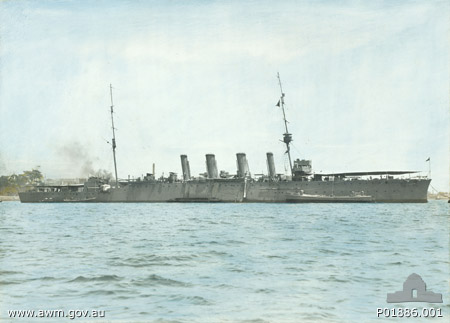
HMAS Brisbane was a Town class light cruiser of the Royal Australian Navy (RAN). Built in Sydney between 1913 and 1916 to the Chatham subtype design, Brisbane operated in the Indian Ocean, Pacific Ocean, and Australian coastal waters during World War I.
Following the end of the war, the cruiser was decommissioned and recommissioned on several occasions, and was reclassified as a training ship in late 1925. In 1935, Brisbane was reactivated to transport personnel to Britain for training on the new cruiser HMAS Sydney, after which she was decommissioned and sold for breaking up as scrap.
Brisbane was built by Cockatoo Island Dockyard to the Chatham subtype of the Town class cruiser design. Laid down on 25 January 1913, the cruiser was launched on 30 September 1915 by the wife of Andrew Fisher; Prime Minister of Australia on three occasions. Brisbane was commissioned into the RAN on 31 October 1916, although she was not completed until 12 December. The ship cost A£746,624 to build; unlike her Australian sister ships, the cost of adding armour was included in the original estimate.
She was 456 feet 8+3⁄8 inches (139.202 m) long overall, with a beam of 49 feet 10 inches (15.19 m) and a maximum draught of 19 feet 11 inches (6.07 m). The cruiser had a standard displacement of 5,400 tons. Brisbane was propelled by Parsons steam turbines, which provided 25,000 shaft horsepower (19,000 kW) to four propellers. Although designed with a maximum speed of 25 knots (46 km/h), Brisbane once reached 25.67 knots (47.54 km/h) during full speed trials. Her standard cruising speed was 11.5 knots (21.3 km/h), which could be maintained for 4,000 nautical miles (7,400 km). The ship was fuelled by a combination of coal (1,196 tons at full load) and oil (260 tons). Her ship's company consisted of 31 officers and 454 sailors.
The cruiser's primary armament consisted of eight BL 6-inch (152.4 mm) Mk XI* guns, arranged in single mountings behind open-backed gunshields. A single quick-firing 3-inch (76 mm) gun was used to protect the ship from air attack. Brisbane carried a 12-pounder field gun for ashore deployment. Four 3-pounder (47-mm, 1.9-in) quick-firing Hotchkiss guns were used as saluting guns. Ten .303-inch machine guns were carried for close defence work (eight Lewis guns and two Maxim guns). Two submerged 18-inch (450-mm) torpedo tubes were fitted: one on each side, firing broadside. Armour plating consisted of side belts 3-inch (76 mm) thick amidships, tapering to 1.5-inch (38 mm) thick at the bow and stern, along with protective decking over the engineering and magazine spaces, and an armoured conning tower.
On 13 December 1916, Brisbane departed on a voyage to the Mediterranean. After reaching Malta on 4 February, the ship was fitted with equipment not available in Australia at the time. Soon after, the ship was redeployed to Colombo, and employed on Indian Ocean patrols to search for the German raiders Wolf and Seeadler.
In February 1917, a Sopwith Baby seaplane was acquired from HMS Raven II for reconnaissance work; the first aircraft to be used by a RAN ship. This remained aboard until June, when Brisbane was sent back to Australia with orders to patrol the Western Australian coast. From October 1917, the cruiser was assigned to operations in the western Pacific in response to reports of German raider activity. Initially deployed to the Solomon Islands, Brisbane visited Nauru, the Gilbert Islands, and Fiji, before returning to duties in Australian waters in January 1918.
On 21 October 1918, Brisbane departed for the eastern Mediterranean, and was between Colombo and Suez when World War I ended. The battle honour "Indian Ocean 1917" recognises the cruiser's wartime service. The ship reached Moudros in late November, and spent most of December operating with the Australian Destroyer Squadron, before visiting Smyrna and the Dardanelles.
Hub AI
HMAS Brisbane (1915) AI simulator
(@HMAS Brisbane (1915)_simulator)
HMAS Brisbane (1915)
HMAS Brisbane was a Town class light cruiser of the Royal Australian Navy (RAN). Built in Sydney between 1913 and 1916 to the Chatham subtype design, Brisbane operated in the Indian Ocean, Pacific Ocean, and Australian coastal waters during World War I.
Following the end of the war, the cruiser was decommissioned and recommissioned on several occasions, and was reclassified as a training ship in late 1925. In 1935, Brisbane was reactivated to transport personnel to Britain for training on the new cruiser HMAS Sydney, after which she was decommissioned and sold for breaking up as scrap.
Brisbane was built by Cockatoo Island Dockyard to the Chatham subtype of the Town class cruiser design. Laid down on 25 January 1913, the cruiser was launched on 30 September 1915 by the wife of Andrew Fisher; Prime Minister of Australia on three occasions. Brisbane was commissioned into the RAN on 31 October 1916, although she was not completed until 12 December. The ship cost A£746,624 to build; unlike her Australian sister ships, the cost of adding armour was included in the original estimate.
She was 456 feet 8+3⁄8 inches (139.202 m) long overall, with a beam of 49 feet 10 inches (15.19 m) and a maximum draught of 19 feet 11 inches (6.07 m). The cruiser had a standard displacement of 5,400 tons. Brisbane was propelled by Parsons steam turbines, which provided 25,000 shaft horsepower (19,000 kW) to four propellers. Although designed with a maximum speed of 25 knots (46 km/h), Brisbane once reached 25.67 knots (47.54 km/h) during full speed trials. Her standard cruising speed was 11.5 knots (21.3 km/h), which could be maintained for 4,000 nautical miles (7,400 km). The ship was fuelled by a combination of coal (1,196 tons at full load) and oil (260 tons). Her ship's company consisted of 31 officers and 454 sailors.
The cruiser's primary armament consisted of eight BL 6-inch (152.4 mm) Mk XI* guns, arranged in single mountings behind open-backed gunshields. A single quick-firing 3-inch (76 mm) gun was used to protect the ship from air attack. Brisbane carried a 12-pounder field gun for ashore deployment. Four 3-pounder (47-mm, 1.9-in) quick-firing Hotchkiss guns were used as saluting guns. Ten .303-inch machine guns were carried for close defence work (eight Lewis guns and two Maxim guns). Two submerged 18-inch (450-mm) torpedo tubes were fitted: one on each side, firing broadside. Armour plating consisted of side belts 3-inch (76 mm) thick amidships, tapering to 1.5-inch (38 mm) thick at the bow and stern, along with protective decking over the engineering and magazine spaces, and an armoured conning tower.
On 13 December 1916, Brisbane departed on a voyage to the Mediterranean. After reaching Malta on 4 February, the ship was fitted with equipment not available in Australia at the time. Soon after, the ship was redeployed to Colombo, and employed on Indian Ocean patrols to search for the German raiders Wolf and Seeadler.
In February 1917, a Sopwith Baby seaplane was acquired from HMS Raven II for reconnaissance work; the first aircraft to be used by a RAN ship. This remained aboard until June, when Brisbane was sent back to Australia with orders to patrol the Western Australian coast. From October 1917, the cruiser was assigned to operations in the western Pacific in response to reports of German raider activity. Initially deployed to the Solomon Islands, Brisbane visited Nauru, the Gilbert Islands, and Fiji, before returning to duties in Australian waters in January 1918.
On 21 October 1918, Brisbane departed for the eastern Mediterranean, and was between Colombo and Suez when World War I ended. The battle honour "Indian Ocean 1917" recognises the cruiser's wartime service. The ship reached Moudros in late November, and spent most of December operating with the Australian Destroyer Squadron, before visiting Smyrna and the Dardanelles.
Recent media