



Community hub
Recent from talks
Knowledge base stats:
Talk channels stats:
Members stats:
HMLA-267
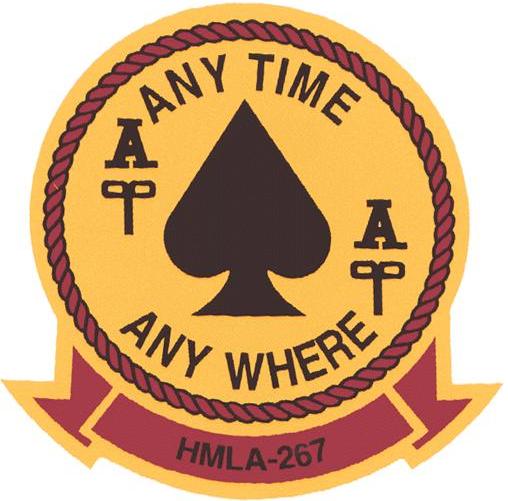
Marine Light Attack Helicopter Squadron 267 (HMLA-267) is a United States Marine Corps helicopter squadron consisting of Bell AH-1Z Viper attack helicopters and Bell UH-1Y Venom utility helicopters. Nicknamed the "Stingers", the squadron is based at Marine Corps Air Station Camp Pendleton in California, and falls under the command of Marine Aircraft Group 39 (MAG-39) and the 3rd Marine Aircraft Wing (3rd MAW).
Marine Light Attack Helicopter Squadron (HMLA) 267 supports the Marine Air-Ground Task Force (MAGTF) Commander by providing offensive air support, utility support, armed escort, and airborne supporting arms coordination; day or night; under all weather conditions; during expeditionary, joint, or combined operations. This has included detachments to Marine Amphibious Units (MAUs) and Marine Expeditionary Units (MEUs).
The squadron was commissioned on 15 February 1944 at Marine Corps Base Quantico in Virginia as Marine Observation Squadron 5 (VMO-5), the "Black Aces." The operational aircraft at the time was the OY-1 Sentinel. VMO-5's primary tasks were providing aerial fire support spotting and observation in support of ground forces. Following several months of training at MCB Camp Pendleton in California and Marine Corps Air Station Ewa in Hawaii, the squadron deployed with the 3d Marine Aircraft Wing (3d MAW) to the Pacific Theater. The squadron split into two echelons, staging at Saipan and Guam in preparation for the Iwo Jima Campaign. On 26 February 1945, the first VMO-5 OY-1 Sentinels took off from the USS Wake Island and landed on South Field during the Battle of Iwo Jima. Beginning the next day squadron aircraft began spotting for the artillery of the 13th Marine Regiment. After Iwo Jima, the squadron redeployed to Hilo, Hawaii, and was attached to Marine Observation Group 1, 2d Marine Aircraft Wing (2d MAW). Following victory in World War II, VMO-5 deployed to Sasebo, Japan, for occupation duty from September 1945 to January 1946. Upon completion of this tour, VMO-5 returned to San Diego and was decommissioned on 31 January 1946.
As Marine Corps participation in the Vietnam War continued to increase, the subunit of Headquarters and Maintenance Squadron 30 (H&MS-30) at Marine Corps Base Camp Pendleton was re-designated as VMO-5 on 15 December 1966 becoming a full-fledged training squadron. The squadron originally fell under the command of Marine Helicopter Training Group 30 (MHTG-30), 3rd Marine Aircraft Wing and was equipped with a complement of UH-1E Hueys and OV-10 Broncos. In March 1968, the squadron was re-designated HML-267 and remained on alert status while training replacement pilots and crew for the rest of the war. In 1971, reorganization left the squadron with only UH-1E helicopters, and by the end of 1976 only UH-1N aircraft were flown.
Beginning in the 1970s, every six months HML-267 rotated one-third of its assets to Marine Corps Air Station Futenma on Okinawa, Japan. The Hueys were joined by another aircraft in 1982 as the new AH-1J Cobras were deployed. As part of the Unit Deployment Program (UDP) starting in 1983, HML-267 began a regular cycle of six months in Okinawa, 18 months on Camp Pendleton. During this time the squadron participated in numerous training exercises including detachments to Korea, Guam, the Philippines, Hong Kong, Iwo Jima, and Australia. The squadron was again re-designated as HMLA-267 in 1987, the squadron received its first complement of AH-1W SuperCobras. In 1988, the squadron split into three groups: a detachment on UDP to Okinawa, a detachment as part of a Marine expeditionary unit, and a detachment aboard USS Dubuque.
In 1990, HMLA-267 split into two groups: a detachment on UDP in Okinawa and another attached to HMM-164. The group attached to HMM-164 boarded the USS Okinawa on a routine WestPac deployment. USS Okinawa eventually ended up in the Persian Gulf for Operation Desert Shield and Operation Desert Storm, spending a total of 354 days away from their home port for this deployment.
In 1992, HMLA-267 split into two groups: a detachment on land in Okinawa and another attached to HMM-164. The group attached to HMM-164 boarded USS Tripoli on a routine West Pac. USS Tripoli went back to the Persian Gulf for Operation Desert Sweep. The next stop for USS Tripoli was Mogadishu, Somalia, and was part of the original insertion of Marines (primarily those from HMLA-267) and the beginning of Operation Restore Hope.
In January 1995 HMLA-267 embarked on LHA-3 as the Aviation Combat Element of SPMAGTF 1-95 to provide air support for Operation United Shield in Somalia.
Hub AI
HMLA-267 AI simulator
(@HMLA-267_simulator)
HMLA-267
Marine Light Attack Helicopter Squadron 267 (HMLA-267) is a United States Marine Corps helicopter squadron consisting of Bell AH-1Z Viper attack helicopters and Bell UH-1Y Venom utility helicopters. Nicknamed the "Stingers", the squadron is based at Marine Corps Air Station Camp Pendleton in California, and falls under the command of Marine Aircraft Group 39 (MAG-39) and the 3rd Marine Aircraft Wing (3rd MAW).
Marine Light Attack Helicopter Squadron (HMLA) 267 supports the Marine Air-Ground Task Force (MAGTF) Commander by providing offensive air support, utility support, armed escort, and airborne supporting arms coordination; day or night; under all weather conditions; during expeditionary, joint, or combined operations. This has included detachments to Marine Amphibious Units (MAUs) and Marine Expeditionary Units (MEUs).
The squadron was commissioned on 15 February 1944 at Marine Corps Base Quantico in Virginia as Marine Observation Squadron 5 (VMO-5), the "Black Aces." The operational aircraft at the time was the OY-1 Sentinel. VMO-5's primary tasks were providing aerial fire support spotting and observation in support of ground forces. Following several months of training at MCB Camp Pendleton in California and Marine Corps Air Station Ewa in Hawaii, the squadron deployed with the 3d Marine Aircraft Wing (3d MAW) to the Pacific Theater. The squadron split into two echelons, staging at Saipan and Guam in preparation for the Iwo Jima Campaign. On 26 February 1945, the first VMO-5 OY-1 Sentinels took off from the USS Wake Island and landed on South Field during the Battle of Iwo Jima. Beginning the next day squadron aircraft began spotting for the artillery of the 13th Marine Regiment. After Iwo Jima, the squadron redeployed to Hilo, Hawaii, and was attached to Marine Observation Group 1, 2d Marine Aircraft Wing (2d MAW). Following victory in World War II, VMO-5 deployed to Sasebo, Japan, for occupation duty from September 1945 to January 1946. Upon completion of this tour, VMO-5 returned to San Diego and was decommissioned on 31 January 1946.
As Marine Corps participation in the Vietnam War continued to increase, the subunit of Headquarters and Maintenance Squadron 30 (H&MS-30) at Marine Corps Base Camp Pendleton was re-designated as VMO-5 on 15 December 1966 becoming a full-fledged training squadron. The squadron originally fell under the command of Marine Helicopter Training Group 30 (MHTG-30), 3rd Marine Aircraft Wing and was equipped with a complement of UH-1E Hueys and OV-10 Broncos. In March 1968, the squadron was re-designated HML-267 and remained on alert status while training replacement pilots and crew for the rest of the war. In 1971, reorganization left the squadron with only UH-1E helicopters, and by the end of 1976 only UH-1N aircraft were flown.
Beginning in the 1970s, every six months HML-267 rotated one-third of its assets to Marine Corps Air Station Futenma on Okinawa, Japan. The Hueys were joined by another aircraft in 1982 as the new AH-1J Cobras were deployed. As part of the Unit Deployment Program (UDP) starting in 1983, HML-267 began a regular cycle of six months in Okinawa, 18 months on Camp Pendleton. During this time the squadron participated in numerous training exercises including detachments to Korea, Guam, the Philippines, Hong Kong, Iwo Jima, and Australia. The squadron was again re-designated as HMLA-267 in 1987, the squadron received its first complement of AH-1W SuperCobras. In 1988, the squadron split into three groups: a detachment on UDP to Okinawa, a detachment as part of a Marine expeditionary unit, and a detachment aboard USS Dubuque.
In 1990, HMLA-267 split into two groups: a detachment on UDP in Okinawa and another attached to HMM-164. The group attached to HMM-164 boarded the USS Okinawa on a routine WestPac deployment. USS Okinawa eventually ended up in the Persian Gulf for Operation Desert Shield and Operation Desert Storm, spending a total of 354 days away from their home port for this deployment.
In 1992, HMLA-267 split into two groups: a detachment on land in Okinawa and another attached to HMM-164. The group attached to HMM-164 boarded USS Tripoli on a routine West Pac. USS Tripoli went back to the Persian Gulf for Operation Desert Sweep. The next stop for USS Tripoli was Mogadishu, Somalia, and was part of the original insertion of Marines (primarily those from HMLA-267) and the beginning of Operation Restore Hope.
In January 1995 HMLA-267 embarked on LHA-3 as the Aviation Combat Element of SPMAGTF 1-95 to provide air support for Operation United Shield in Somalia.