



Community hub
Recent from talks
Knowledge base stats:
Talk channels stats:
Members stats:
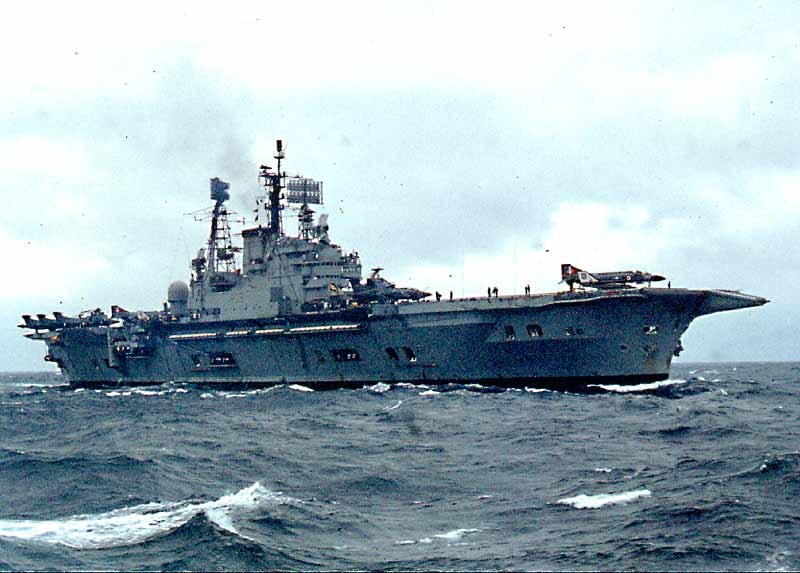
HMS Ark Royal (R09)
HMS Ark Royal (R09) was an Audacious-class aircraft carrier of the Royal Navy and, when she was decommissioned in 1979, was the Royal Navy's last remaining conventional catapult and arrested-landing aircraft carrier. She was the first aircraft carrier to be equipped with an angled flight deck at its commissioning; her sister ship, HMS Eagle, was the Royal Navy's first angle-decked aircraft carrier after modification in 1954. Ark Royal was the only non-United States vessel to operate the McDonnell Douglas Phantom at sea.
Ark Royal was the sister ship to HMS Eagle, which was initially named HMS Audacious, hence the name of the class. Four Audacious-class ships were laid down, but two (HMS Africa and the original HMS Eagle) were cancelled when the Second World War ended, and construction of the other two was suspended for several years. Both completed ships were extensively upgraded throughout their lifetimes.
A contract was placed with Cammell Laird on the River Mersey on 19 March 1942, to build the first ship of the class. While it had been originally planned to name the ship Irresistible, this was changed to Ark Royal before ordering to commemorate the aircraft carrier lost in 1941. The ship, which was the largest warship ever to be built by Cammell Laird, was laid down at Laird's Birkenhead shipyard on 3 May 1943, as yard number 1119. Construction was slow, and was suspended after the end of the Second World War to allow the ship's design to be updated to better suit her for the operation of modern aircraft. Ark Royal was launched by Queen Elizabeth, wife of King George VI, on 3 May 1950. She was completed on 25 February 1952, and commissioned the next day at Devonport.
In this time, she underwent redesign and, when completed, she was markedly different from her sister ship. Shortly before her launch from the Cammell Laird shipyard, an image of the ship painted with her white undercoat was captured by the pictorialist photographer E. Chambré Hardman. This has been exhibited many times under the name 'Where Great Ships Are Built' and later 'Birth of the Ark Royal'. When commissioned, she had a 5.5° partially angled flight deck, two steam catapults capable of launching aircraft weighing up to 30,000 pounds (14,000 kilograms), a deck-edge lift on the port side (the first British ship to be fitted with such a device), modified armament, and the new mirror landing system. Ark Royal was the first ship to be constructed with an angled flight deck and steam catapults, as opposed to having them added after launching. These innovations allowed aircraft to land and take off from the carrier at the same time. Her flight deck as built was 800 by 112 feet (244 by 34 metres).
A further four years passed before she commenced her sea trials.
About a year after commissioning, her forward port 4.5 inches (110 mm) guns were removed to improve aircraft operations over the angled deck. Four years later, the port deck-edge lift and the forward starboard 4.5 inch guns were also removed. After the 1964 refit, only one twin 4.5 inch gun mount remained aft on port and starboard side. From 1967 to February 1970, she underwent a refit which was a major rebuild to her structure, but only an austere update to her electronic equipment, and was confined to changes needed to operate the RN's version of the Phantom. Prior to, and during the refit, concerns over costs, the age of the hull, and changing political opinions over naval requirements threatened the refit, and even a possibility that the ship could be scrapped. However, convincing arguments to retain and upgrade the carrier won through.
The refit cost around £30 million, far less than the modernisation of Eagle, but also added several improvements, which allowed her to comfortably operate the larger Phantom and Buccaneer Mk.2 aircraft. Her modifications included a full 8.5° angled flight deck, new and far more powerful steam catapults, bridle-catchers, heavy-grade jet-blast deflectors (both of which Eagle did not receive), and heavy-weight arrestor cables. Twelve hundred miles of new cabling was installed, but the ship was not completely rewired and retained old DC electrics. A modified island (with a different arrangement from Eagle), and a partially new electronic suite were also added, though some of her original radars, such as 983 height-finders were retained, and she did not receive the 3-D air-search radar set that her sister had fitted, instead two double-array 966 versions of the standard RN 965 long-range system were fitted and one of the new 986 sets. Significantly, Ark Royal was the first and only RN carrier fitted with a USN carrier approach system, the AN/SPN-35 radar, increasing night aircraft operational capability and safety. Her flight deck size was increased port aft, giving her extra deck-park space for her air group that Eagle did not have. She was also fitted for four Seacat missile launchers, which were never installed, so she emerged from refit with no defensive armament except for Corvus decoy launchers. Significantly, there was little more than an overhaul of her steam turbines and boilers, meaning that mechanically she was very dated; however, the stripping-out of Eagle meant that for a time essential spares were available. Ark Royal was then scheduled for at the most only five years' more service by a new government policy to scrap the carriers by 1975. Intensive maintenance as well as a new programme of continuous servicing and repair (with RN maintenance ships always in her task groups) kept her going until late 1978, though increasing mechanical and electrical failures led to her decommissioning in early 1979.
At her entry into service, the ship had a complement of up to 50 aircraft, comprising Sea Hawks, Sea Venoms, Gannets, Skyraiders, and various helicopters. As later aircraft types grew in size and complexity, her air group fell to below 40 when she left service in 1978.
Hub AI
HMS Ark Royal (R09) AI simulator
(@HMS Ark Royal (R09)_simulator)
HMS Ark Royal (R09)
HMS Ark Royal (R09) was an Audacious-class aircraft carrier of the Royal Navy and, when she was decommissioned in 1979, was the Royal Navy's last remaining conventional catapult and arrested-landing aircraft carrier. She was the first aircraft carrier to be equipped with an angled flight deck at its commissioning; her sister ship, HMS Eagle, was the Royal Navy's first angle-decked aircraft carrier after modification in 1954. Ark Royal was the only non-United States vessel to operate the McDonnell Douglas Phantom at sea.
Ark Royal was the sister ship to HMS Eagle, which was initially named HMS Audacious, hence the name of the class. Four Audacious-class ships were laid down, but two (HMS Africa and the original HMS Eagle) were cancelled when the Second World War ended, and construction of the other two was suspended for several years. Both completed ships were extensively upgraded throughout their lifetimes.
A contract was placed with Cammell Laird on the River Mersey on 19 March 1942, to build the first ship of the class. While it had been originally planned to name the ship Irresistible, this was changed to Ark Royal before ordering to commemorate the aircraft carrier lost in 1941. The ship, which was the largest warship ever to be built by Cammell Laird, was laid down at Laird's Birkenhead shipyard on 3 May 1943, as yard number 1119. Construction was slow, and was suspended after the end of the Second World War to allow the ship's design to be updated to better suit her for the operation of modern aircraft. Ark Royal was launched by Queen Elizabeth, wife of King George VI, on 3 May 1950. She was completed on 25 February 1952, and commissioned the next day at Devonport.
In this time, she underwent redesign and, when completed, she was markedly different from her sister ship. Shortly before her launch from the Cammell Laird shipyard, an image of the ship painted with her white undercoat was captured by the pictorialist photographer E. Chambré Hardman. This has been exhibited many times under the name 'Where Great Ships Are Built' and later 'Birth of the Ark Royal'. When commissioned, she had a 5.5° partially angled flight deck, two steam catapults capable of launching aircraft weighing up to 30,000 pounds (14,000 kilograms), a deck-edge lift on the port side (the first British ship to be fitted with such a device), modified armament, and the new mirror landing system. Ark Royal was the first ship to be constructed with an angled flight deck and steam catapults, as opposed to having them added after launching. These innovations allowed aircraft to land and take off from the carrier at the same time. Her flight deck as built was 800 by 112 feet (244 by 34 metres).
A further four years passed before she commenced her sea trials.
About a year after commissioning, her forward port 4.5 inches (110 mm) guns were removed to improve aircraft operations over the angled deck. Four years later, the port deck-edge lift and the forward starboard 4.5 inch guns were also removed. After the 1964 refit, only one twin 4.5 inch gun mount remained aft on port and starboard side. From 1967 to February 1970, she underwent a refit which was a major rebuild to her structure, but only an austere update to her electronic equipment, and was confined to changes needed to operate the RN's version of the Phantom. Prior to, and during the refit, concerns over costs, the age of the hull, and changing political opinions over naval requirements threatened the refit, and even a possibility that the ship could be scrapped. However, convincing arguments to retain and upgrade the carrier won through.
The refit cost around £30 million, far less than the modernisation of Eagle, but also added several improvements, which allowed her to comfortably operate the larger Phantom and Buccaneer Mk.2 aircraft. Her modifications included a full 8.5° angled flight deck, new and far more powerful steam catapults, bridle-catchers, heavy-grade jet-blast deflectors (both of which Eagle did not receive), and heavy-weight arrestor cables. Twelve hundred miles of new cabling was installed, but the ship was not completely rewired and retained old DC electrics. A modified island (with a different arrangement from Eagle), and a partially new electronic suite were also added, though some of her original radars, such as 983 height-finders were retained, and she did not receive the 3-D air-search radar set that her sister had fitted, instead two double-array 966 versions of the standard RN 965 long-range system were fitted and one of the new 986 sets. Significantly, Ark Royal was the first and only RN carrier fitted with a USN carrier approach system, the AN/SPN-35 radar, increasing night aircraft operational capability and safety. Her flight deck size was increased port aft, giving her extra deck-park space for her air group that Eagle did not have. She was also fitted for four Seacat missile launchers, which were never installed, so she emerged from refit with no defensive armament except for Corvus decoy launchers. Significantly, there was little more than an overhaul of her steam turbines and boilers, meaning that mechanically she was very dated; however, the stripping-out of Eagle meant that for a time essential spares were available. Ark Royal was then scheduled for at the most only five years' more service by a new government policy to scrap the carriers by 1975. Intensive maintenance as well as a new programme of continuous servicing and repair (with RN maintenance ships always in her task groups) kept her going until late 1978, though increasing mechanical and electrical failures led to her decommissioning in early 1979.
At her entry into service, the ship had a complement of up to 50 aircraft, comprising Sea Hawks, Sea Venoms, Gannets, Skyraiders, and various helicopters. As later aircraft types grew in size and complexity, her air group fell to below 40 when she left service in 1978.