
Recent from talks
HMS King George V (41)
Knowledge base stats:
Talk channels stats:
Members stats:
HMS King George V (41)
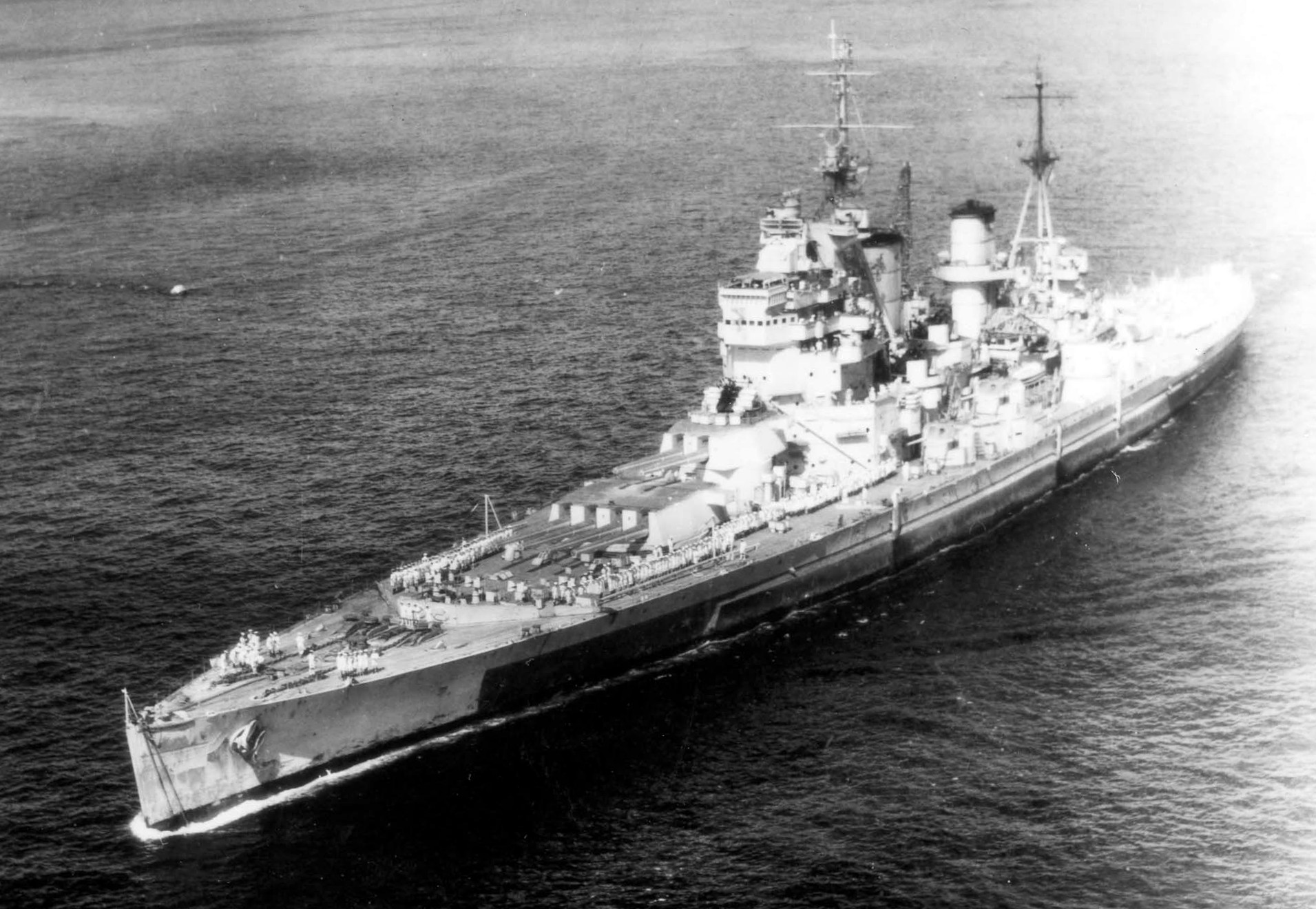
HMS King George V (pennant number 41) was the lead ship of the five British King George V-class battleships of the Royal Navy. Laid down in 1937 and commissioned in 1940, King George V operated during the Second World War in all three major naval theatres of war, the Atlantic, Mediterranean and Pacific, as part of the British Home Fleet and Pacific Fleets. In May 1941, along with HMS Rodney, King George V was involved in the hunt for and pursuit of the German battleship Bismarck, eventually inflicting severe damage which led to the German vessel's sinking. On 1 May 1942 the destroyer HMS Punjabi sank after a collision with King George V in foggy conditions. King George V took part in Operation Husky (the allied landings in Sicily) and bombarded the island of Levanzo and the port of Trapani. She also escorted part of the surrendered Italian Fleet, which included the battleships Andrea Doria and Duilio, to Malta. In 1945 King George V took part in operations against the Japanese in the Pacific.
King George V was made flagship of the British Home Fleet on 1 April 1941, she remained so during the rest of the war and became a training battleship in November 1947.
King George V was built by Vickers-Armstrong at Walker Naval Yard, Newcastle upon Tyne; she was laid down on 1 January 1937, launched on 21 February 1939 and commissioned on 11 December 1940. The ship had an overall length of 745 ft (227 m), a beam of 112 ft (34 m) and a draught of 34 ft (10 m). She displaced 38,031 tons at normal load and 42,237 tons at full load. After her refit in 1944, she displaced 39,100 tons at standard load, and 44,460 tons at full load. She could carry 3,918 tons of fuel oil, 192 tons of diesel oil, 256 tons of reserve feed water and 444 tons of freshwater. Based on the designed fuel consumption, range was: 4,000 nautical miles (7,400 km; 4,600 mi) at 25 knots (46 km/h; 29 mph), 10,250 nautical miles (18,980 km; 11,800 mi) at 15 knots (28 km/h; 17 mph) and 14,400 nautical miles (26,700 km; 16,600 mi) at 10 knots (19 km/h; 12 mph). However, in practice fuel consumption was much higher, and at 16 knots (30 km/h) the actual range was about 6,300 nautical miles (11,700 km) with a five per cent reserve allowance. Designed within the tight 35,000 ton limitations of the Washington Naval Treaty, wartime service necessitated increases over the design displacement, seriously reducing freeboard and affecting seaworthiness. This was most acute at the already low bow. With too little buoyancy forward the bows were easily buried even in moderate seas, with spray washing up over both forward turrets. Heavy seas could flood 'A' turret, drenching both men and machinery within.
King George V was equipped with eight Admiralty boilers. This configuration was a little more conventional than the preceding Nelson class, with boiler rooms placed side by side and with each pair associated with a turbine room astern of them. The total heating surface of the boiler plants in King George V was 78,144 sq ft (7,259.8 m2). The 416-ton boiler installation produced more than 100,000 shaft horsepower (75,000 kW), giving a top speed of 28 knots. The eight boilers were more economic in space and fuel than the twenty-four boilers in the battlecruiser HMS Hood. Fewer, but larger, boilers lowered the weight per unit of heat delivered, as did increased boiler efficiency and consumption of fuel per unit area of heating surface. This made King George V the fastest battleship in the British fleet but slower than the German, French or the new Italian capital ships, or the battlecruisers HMS Hood, Repulse and Renown.
King George V had four sets of Parsons geared turbines. Two main turbines were arranged in series and drove a shaft through double helical gears. An astern turbine was incorporated in the exhaust casing of the low-pressure turbine, and a cruising turbine was coupled directly to the high-pressure turbine. A speed of 28.5 knots was expected at standard displacement and 27.5 knots at full-load displacement on normal output; corresponding speeds at overload condition were 29.25 and 28.25 knots respectively. The turbine unit was a low-speed type (2,257 rpm) coupled to a single reduction gear which produced 236 rpm at the propeller shaft.
The tight limitations of the Washington Naval Treaty raised many challenges and required difficult compromises if they were to be met. To avoid the class being outgunned by the new ships of foreign navies, especially as by the mid-1930s the Treaty had been renounced by Japan and Italy, Churchill wrote to the First Lord of the Admiralty in 1936, voicing strong objections to the proposed armament of ten 14-inch guns. His proposal was for nine 16-inch guns.
When completed King George V mounted ten 14-inch (356 mm) guns. They were mounted in one Mark II twin turret forward and two Mark III quadruple turrets, one forward and one aft. They could be elevated 40 degrees and depressed 3 degrees. Training arcs were: "A" turret, 286 degrees; "B" turret, 270 degrees and "Y" turret, 270 degrees. Training and elevating was achieved through a hydraulic drive, with rates of two and eight degrees per second, respectively. A full gun broadside weighed 15,950 pounds; a salvo could be fired every 30 seconds. The quadruple turrets weighed 1,582 tons, the twin turret 915 tons.
The turrets were designed by the Vickers Armstrong's Elswick Works, but sets of each type of equipment were manufactured by Vickers Armstrongs in Barrow. A considerable amount of design effort was expended to make the turrets as flashtight as possible. This complicated the mechanical design of the turrets, particularly the quadruple mountings. Due to insufficient clearances and slightly distorted link mechanisms, failures in the intricate safety interlocks in the loading sequence for antiflash precautions caused jams during drills and practice firing. During the summer of 1941 the King George V-class battleships had their main armament turrets and turret linkages modified to correct the operational faults revealed during Bismarck's final operation. HMS King George V used an Admiralty Fire Control Table Mark IX to control her main armament.
Hub AI
HMS King George V (41) AI simulator
(@HMS King George V (41)_simulator)
HMS King George V (41)
HMS King George V (pennant number 41) was the lead ship of the five British King George V-class battleships of the Royal Navy. Laid down in 1937 and commissioned in 1940, King George V operated during the Second World War in all three major naval theatres of war, the Atlantic, Mediterranean and Pacific, as part of the British Home Fleet and Pacific Fleets. In May 1941, along with HMS Rodney, King George V was involved in the hunt for and pursuit of the German battleship Bismarck, eventually inflicting severe damage which led to the German vessel's sinking. On 1 May 1942 the destroyer HMS Punjabi sank after a collision with King George V in foggy conditions. King George V took part in Operation Husky (the allied landings in Sicily) and bombarded the island of Levanzo and the port of Trapani. She also escorted part of the surrendered Italian Fleet, which included the battleships Andrea Doria and Duilio, to Malta. In 1945 King George V took part in operations against the Japanese in the Pacific.
King George V was made flagship of the British Home Fleet on 1 April 1941, she remained so during the rest of the war and became a training battleship in November 1947.
King George V was built by Vickers-Armstrong at Walker Naval Yard, Newcastle upon Tyne; she was laid down on 1 January 1937, launched on 21 February 1939 and commissioned on 11 December 1940. The ship had an overall length of 745 ft (227 m), a beam of 112 ft (34 m) and a draught of 34 ft (10 m). She displaced 38,031 tons at normal load and 42,237 tons at full load. After her refit in 1944, she displaced 39,100 tons at standard load, and 44,460 tons at full load. She could carry 3,918 tons of fuel oil, 192 tons of diesel oil, 256 tons of reserve feed water and 444 tons of freshwater. Based on the designed fuel consumption, range was: 4,000 nautical miles (7,400 km; 4,600 mi) at 25 knots (46 km/h; 29 mph), 10,250 nautical miles (18,980 km; 11,800 mi) at 15 knots (28 km/h; 17 mph) and 14,400 nautical miles (26,700 km; 16,600 mi) at 10 knots (19 km/h; 12 mph). However, in practice fuel consumption was much higher, and at 16 knots (30 km/h) the actual range was about 6,300 nautical miles (11,700 km) with a five per cent reserve allowance. Designed within the tight 35,000 ton limitations of the Washington Naval Treaty, wartime service necessitated increases over the design displacement, seriously reducing freeboard and affecting seaworthiness. This was most acute at the already low bow. With too little buoyancy forward the bows were easily buried even in moderate seas, with spray washing up over both forward turrets. Heavy seas could flood 'A' turret, drenching both men and machinery within.
King George V was equipped with eight Admiralty boilers. This configuration was a little more conventional than the preceding Nelson class, with boiler rooms placed side by side and with each pair associated with a turbine room astern of them. The total heating surface of the boiler plants in King George V was 78,144 sq ft (7,259.8 m2). The 416-ton boiler installation produced more than 100,000 shaft horsepower (75,000 kW), giving a top speed of 28 knots. The eight boilers were more economic in space and fuel than the twenty-four boilers in the battlecruiser HMS Hood. Fewer, but larger, boilers lowered the weight per unit of heat delivered, as did increased boiler efficiency and consumption of fuel per unit area of heating surface. This made King George V the fastest battleship in the British fleet but slower than the German, French or the new Italian capital ships, or the battlecruisers HMS Hood, Repulse and Renown.
King George V had four sets of Parsons geared turbines. Two main turbines were arranged in series and drove a shaft through double helical gears. An astern turbine was incorporated in the exhaust casing of the low-pressure turbine, and a cruising turbine was coupled directly to the high-pressure turbine. A speed of 28.5 knots was expected at standard displacement and 27.5 knots at full-load displacement on normal output; corresponding speeds at overload condition were 29.25 and 28.25 knots respectively. The turbine unit was a low-speed type (2,257 rpm) coupled to a single reduction gear which produced 236 rpm at the propeller shaft.
The tight limitations of the Washington Naval Treaty raised many challenges and required difficult compromises if they were to be met. To avoid the class being outgunned by the new ships of foreign navies, especially as by the mid-1930s the Treaty had been renounced by Japan and Italy, Churchill wrote to the First Lord of the Admiralty in 1936, voicing strong objections to the proposed armament of ten 14-inch guns. His proposal was for nine 16-inch guns.
When completed King George V mounted ten 14-inch (356 mm) guns. They were mounted in one Mark II twin turret forward and two Mark III quadruple turrets, one forward and one aft. They could be elevated 40 degrees and depressed 3 degrees. Training arcs were: "A" turret, 286 degrees; "B" turret, 270 degrees and "Y" turret, 270 degrees. Training and elevating was achieved through a hydraulic drive, with rates of two and eight degrees per second, respectively. A full gun broadside weighed 15,950 pounds; a salvo could be fired every 30 seconds. The quadruple turrets weighed 1,582 tons, the twin turret 915 tons.
The turrets were designed by the Vickers Armstrong's Elswick Works, but sets of each type of equipment were manufactured by Vickers Armstrongs in Barrow. A considerable amount of design effort was expended to make the turrets as flashtight as possible. This complicated the mechanical design of the turrets, particularly the quadruple mountings. Due to insufficient clearances and slightly distorted link mechanisms, failures in the intricate safety interlocks in the loading sequence for antiflash precautions caused jams during drills and practice firing. During the summer of 1941 the King George V-class battleships had their main armament turrets and turret linkages modified to correct the operational faults revealed during Bismarck's final operation. HMS King George V used an Admiralty Fire Control Table Mark IX to control her main armament.
Recent media