
Recent from talks
HMS Monmouth (1901)
Knowledge base stats:
Talk channels stats:
Members stats:
HMS Monmouth (1901)
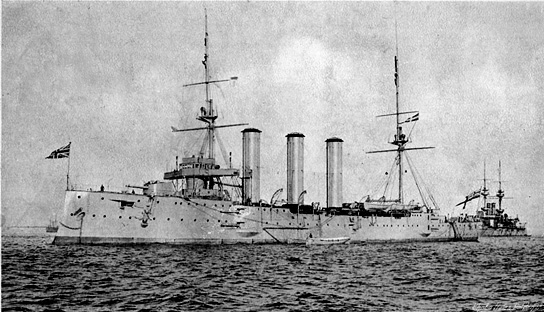
HMS Monmouth was the name ship of her class of 10 armoured cruisers built for the Royal Navy in the first decade of the 20th century. The ships were also known as the County Cruisers (each being named after a British county).
She was assigned to the 1st Cruiser Squadron of the Channel Fleet upon completion in 1903. She was transferred to the China Station in 1906, and remained there until she returned home in 1913 and was assigned to the reserve Third Fleet. When World War I began in August 1914, the ship was recommissioned and assigned to the 5th Cruiser Squadron in the Central Atlantic to search for German commerce raiders and protect Allied shipping. She was detached upon arrival to patrol the Brazilian coast for German ships, and was later ordered to the South Atlantic to join Rear Admiral Christopher Cradock's squadron in their search for the German East Asia Squadron. He found the German squadron on 1 November off the coast of Chile. The German squadron outnumbered Cradock's force and were individually more powerful; they sank Cradock's two armoured cruisers in the Battle of Coronel. Monmouth was lost with all hands.
The Monmouths were intended to protect British merchant shipping from fast cruisers like the French Guichen, Châteaurenault or the Dupleix classes. The ships were designed to displace 9,800 long tons (10,000 t). They had an overall length of 463 feet 6 inches (141.3 m), a beam of 66 feet (20.1 m) and a deep draught of 25 feet (7.6 m). They were powered by two 4-cylinder triple-expansion steam engines, each driving one shaft using steam provided by 31 Belleville boilers. The engines produced a total of 22,000 indicated horsepower (16,000 kW) which was designed to give the ships a maximum speed of 23 knots (43 km/h; 26 mph). Monmouth, however, was one of three of the ships of the class that failed to meet their designed speed. She carried a maximum of 1,600 long tons (1,600 t) of coal and her complement consisted of 678 officers and ratings.
The Monmouth-class ships' main armament consisted of fourteen breech-loading (BL) 6-inch (152 mm) Mk VII guns. Four of these guns were mounted in two twin-gun turrets, one each fore and aft of the superstructure, and the others were positioned in casemates amidships. Six of these were mounted on the main deck and were only usable in calm weather. Ten quick-firing (QF) 12-pounder (3-inch (76 mm)) 12-cwt guns were fitted for defence against torpedo boats. Monmouth also carried three 3-pounder 1.9 in (47 mm) Hotchkiss guns and two submerged 18-inch (450 mm) torpedo tubes.
The ship's waterline armour belt was four inches (102 mm) thick amidships and two-inch (51 mm) forward. The armour of the gun turrets, their barbettes and the casemates was four inches thick. The protective deck armour ranged in thickness from 0.75–2 inches (19–51 mm) and the conning tower was protected by ten inches (254 mm) of armour.
Monmouth, named for the Welsh county, was laid down by London and Glasgow Shipbuilding at their shipyard in Govan on 29 August 1899, and launched on 13 November 1901. Her completion was delayed due to a collision with the liner Assyria in Glasgow harbour in late March 1902. She arrived at Devonport in late August that year for trials, but was not finally completed and accepted until 2 December 1903, when she was initially assigned to the 1st Cruiser Squadron of the Channel Fleet. She was briefly placed in reserve in Devonport at the end of January 1906, before being recommissioned in April for service on the China Station. During 1913 Monmouth paid a courtesy visit to the German treaty port of Tsingtao on the Chinese Mainland. Later in the same year she returned home and was assigned to the reserve Third Fleet.
She was mobilised on 4 August 1914 with a crew of 738 personnel consisting of 570 ratings and 29 officers in addition to 25 members of the Royal Marine band and 69 Royal Marines. In many sources, it is stated her crew mostly consisted of reservists; however, according to a ship's crew list, only 8 crew members were part of the Royal Naval Reserve in addition to 26 members of the Coast Guard. Post mobilisation, she was sent to the 5th Cruiser Squadron of Rear Admiral Archibald Stoddart on the Cape Verde – Canary Islands station. Upon her arrival on 13 August, Stoddart detached her to the Brazilian coast to search for the German light cruisers known to be in the area. She came under Cradock's command in mid-September. At the end of September, Cradock made his first fruitless search of the Tierra del Fuego area and later detached Monmouth and two other ships to search up the Chilean coast, reaching Valparaiso on 15 October, while his flagship, Good Hope returned to Port Stanley, in the Falkland Islands, to recoal and to reestablish communications with the Admiralty. He received word on 7 October that German Vice Admiral Spee's ships were definitely bound for the Cape Horn region and waited for the elderly predreadnought battleship Canopus to reinforce his squadron. She was in poor mechanical condition when she arrived at Port Stanley and required time to make repairs. Good Hope sailed on 22 October without her, going around Cape Horn, while Canopus and three colliers departed the following day, taking the shorter route through the Strait of Magellan.
Good Hope rendezvoused with the rest of the squadron at Vallenar Roads, in the remote Chonos Archipelago of Chile on 27 October 1914 to recoal. They departed two days later, just as Canopus arrived, Cradock ordering the battleship to follow as soon as possible. He sent the light cruiser Glasgow to scout ahead and to enter Coronel, Chile to pick up any messages from the Admiralty and acquire intelligence regarding German activities. The cruiser began to pick up German radio signals from the light cruiser SMS Leipzig on the afternoon of 29 October, and delayed entering Coronel for two days with Cradock's permission to avoid being trapped by the fast German ships. A German supply ship was already there and radioed Spee that Glasgow had entered the harbour around twilight. The cruiser departed on the morning of 1 November, but Spee had already made plans to catch her when informed of her presence the previous evening.
Hub AI
HMS Monmouth (1901) AI simulator
(@HMS Monmouth (1901)_simulator)
HMS Monmouth (1901)
HMS Monmouth was the name ship of her class of 10 armoured cruisers built for the Royal Navy in the first decade of the 20th century. The ships were also known as the County Cruisers (each being named after a British county).
She was assigned to the 1st Cruiser Squadron of the Channel Fleet upon completion in 1903. She was transferred to the China Station in 1906, and remained there until she returned home in 1913 and was assigned to the reserve Third Fleet. When World War I began in August 1914, the ship was recommissioned and assigned to the 5th Cruiser Squadron in the Central Atlantic to search for German commerce raiders and protect Allied shipping. She was detached upon arrival to patrol the Brazilian coast for German ships, and was later ordered to the South Atlantic to join Rear Admiral Christopher Cradock's squadron in their search for the German East Asia Squadron. He found the German squadron on 1 November off the coast of Chile. The German squadron outnumbered Cradock's force and were individually more powerful; they sank Cradock's two armoured cruisers in the Battle of Coronel. Monmouth was lost with all hands.
The Monmouths were intended to protect British merchant shipping from fast cruisers like the French Guichen, Châteaurenault or the Dupleix classes. The ships were designed to displace 9,800 long tons (10,000 t). They had an overall length of 463 feet 6 inches (141.3 m), a beam of 66 feet (20.1 m) and a deep draught of 25 feet (7.6 m). They were powered by two 4-cylinder triple-expansion steam engines, each driving one shaft using steam provided by 31 Belleville boilers. The engines produced a total of 22,000 indicated horsepower (16,000 kW) which was designed to give the ships a maximum speed of 23 knots (43 km/h; 26 mph). Monmouth, however, was one of three of the ships of the class that failed to meet their designed speed. She carried a maximum of 1,600 long tons (1,600 t) of coal and her complement consisted of 678 officers and ratings.
The Monmouth-class ships' main armament consisted of fourteen breech-loading (BL) 6-inch (152 mm) Mk VII guns. Four of these guns were mounted in two twin-gun turrets, one each fore and aft of the superstructure, and the others were positioned in casemates amidships. Six of these were mounted on the main deck and were only usable in calm weather. Ten quick-firing (QF) 12-pounder (3-inch (76 mm)) 12-cwt guns were fitted for defence against torpedo boats. Monmouth also carried three 3-pounder 1.9 in (47 mm) Hotchkiss guns and two submerged 18-inch (450 mm) torpedo tubes.
The ship's waterline armour belt was four inches (102 mm) thick amidships and two-inch (51 mm) forward. The armour of the gun turrets, their barbettes and the casemates was four inches thick. The protective deck armour ranged in thickness from 0.75–2 inches (19–51 mm) and the conning tower was protected by ten inches (254 mm) of armour.
Monmouth, named for the Welsh county, was laid down by London and Glasgow Shipbuilding at their shipyard in Govan on 29 August 1899, and launched on 13 November 1901. Her completion was delayed due to a collision with the liner Assyria in Glasgow harbour in late March 1902. She arrived at Devonport in late August that year for trials, but was not finally completed and accepted until 2 December 1903, when she was initially assigned to the 1st Cruiser Squadron of the Channel Fleet. She was briefly placed in reserve in Devonport at the end of January 1906, before being recommissioned in April for service on the China Station. During 1913 Monmouth paid a courtesy visit to the German treaty port of Tsingtao on the Chinese Mainland. Later in the same year she returned home and was assigned to the reserve Third Fleet.
She was mobilised on 4 August 1914 with a crew of 738 personnel consisting of 570 ratings and 29 officers in addition to 25 members of the Royal Marine band and 69 Royal Marines. In many sources, it is stated her crew mostly consisted of reservists; however, according to a ship's crew list, only 8 crew members were part of the Royal Naval Reserve in addition to 26 members of the Coast Guard. Post mobilisation, she was sent to the 5th Cruiser Squadron of Rear Admiral Archibald Stoddart on the Cape Verde – Canary Islands station. Upon her arrival on 13 August, Stoddart detached her to the Brazilian coast to search for the German light cruisers known to be in the area. She came under Cradock's command in mid-September. At the end of September, Cradock made his first fruitless search of the Tierra del Fuego area and later detached Monmouth and two other ships to search up the Chilean coast, reaching Valparaiso on 15 October, while his flagship, Good Hope returned to Port Stanley, in the Falkland Islands, to recoal and to reestablish communications with the Admiralty. He received word on 7 October that German Vice Admiral Spee's ships were definitely bound for the Cape Horn region and waited for the elderly predreadnought battleship Canopus to reinforce his squadron. She was in poor mechanical condition when she arrived at Port Stanley and required time to make repairs. Good Hope sailed on 22 October without her, going around Cape Horn, while Canopus and three colliers departed the following day, taking the shorter route through the Strait of Magellan.
Good Hope rendezvoused with the rest of the squadron at Vallenar Roads, in the remote Chonos Archipelago of Chile on 27 October 1914 to recoal. They departed two days later, just as Canopus arrived, Cradock ordering the battleship to follow as soon as possible. He sent the light cruiser Glasgow to scout ahead and to enter Coronel, Chile to pick up any messages from the Admiralty and acquire intelligence regarding German activities. The cruiser began to pick up German radio signals from the light cruiser SMS Leipzig on the afternoon of 29 October, and delayed entering Coronel for two days with Cradock's permission to avoid being trapped by the fast German ships. A German supply ship was already there and radioed Spee that Glasgow had entered the harbour around twilight. The cruiser departed on the morning of 1 November, but Spee had already made plans to catch her when informed of her presence the previous evening.
Recent media