
Recent from talks
SMS Leipzig (1905)
Knowledge base stats:
Talk channels stats:
Members stats:
SMS Leipzig (1905)
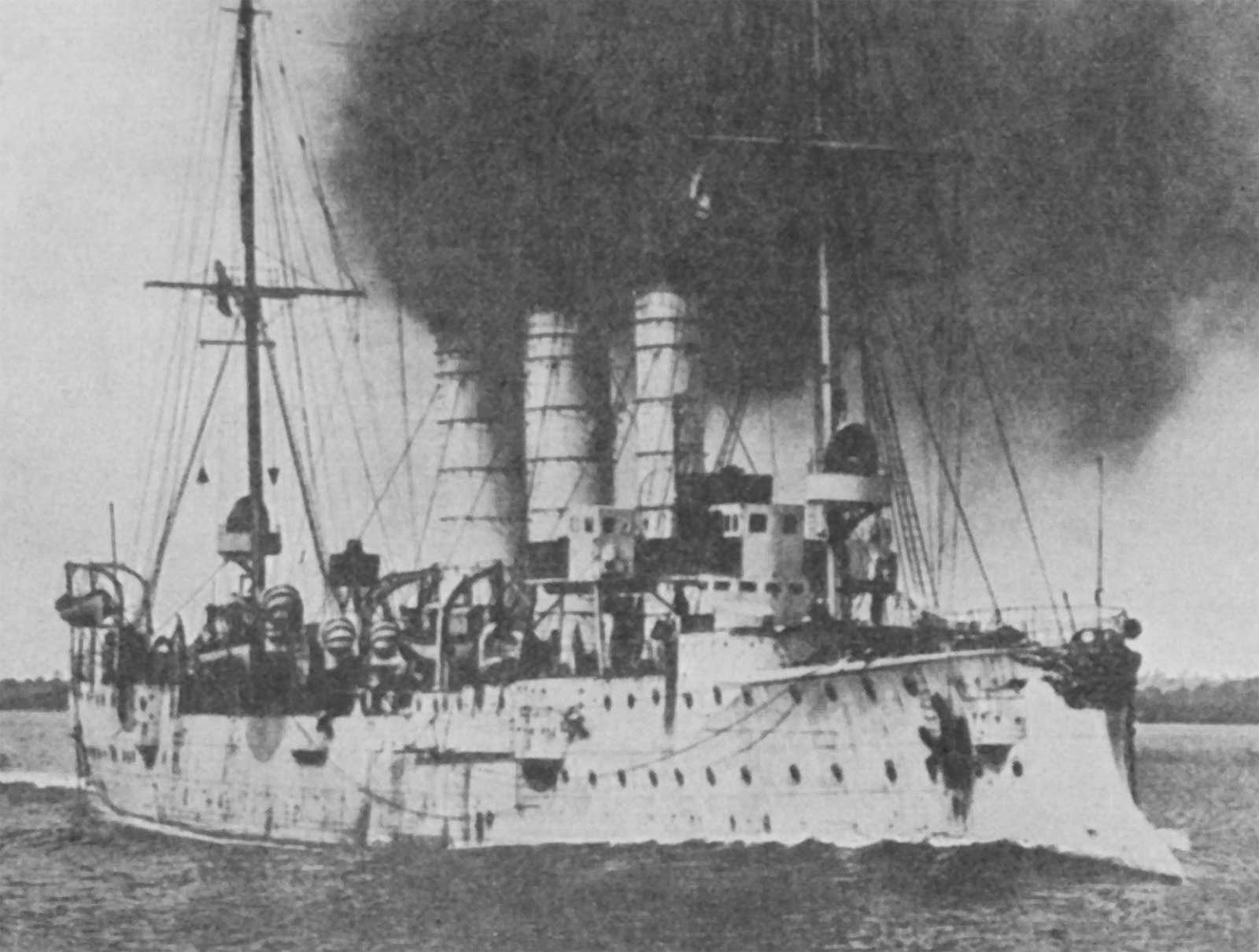
SMS Leipzig ("His Majesty's Ship Leipzig") was the sixth of seven Bremen-class cruisers of the Imperial German Navy, named after the city of Leipzig. She was begun by AG Weser in Bremen in 1904, launched in March 1905 and commissioned in April 1906. Armed with a main battery of ten 10.5 cm (4.1 in) guns and two 45 cm (18 in) torpedo tubes, Leipzig was capable of a top speed of 22.5 knots (41.7 km/h; 25.9 mph).
Leipzig spent her career on overseas stations; at the outbreak of World War I in August 1914, she was cruising off the coast of Mexico. After rejoining with the East Asia Squadron, she proceeded to South American waters, where she participated in the Battle of Coronel, where the German squadron overpowered and sank a pair of British armored cruisers. A month later, she again saw action at the Battle of the Falkland Islands, which saw the destruction of the East Asia Squadron. Leipzig was chased down and sunk by the cruisers HMS Glasgow and HMS Cornwall; the majority of her crew was killed in the battle, with only 18 survivors.
The German 1898 Naval Law called for the replacement of the fleet's older cruising vessels—steam corvettes, unprotected cruisers, and avisos—with modern light cruisers. The first tranche of vessels to fulfill this requirement, the Gazelle class, were designed to serve both as fleet scouts and as station ships in Germany's colonial empire. They provided the basis for subsequent designs, beginning with the Bremen class that was designed in 1901–1903. The principle improvements consisted of a larger hull that allowed for an additional pair of boilers and a higher top speed.
Leipzig was 111.1 meters (365 ft) long overall and had a beam of 13.3 m (44 ft) and a draft of 5.61 m (18.4 ft) forward. She displaced 3,278 metric tons (3,226 long tons) as designed and up to 3,816 t (3,756 long tons) at full load. The ship had a minimal superstructure, which consisted of a small conning tower and bridge structure. Her hull had a raised forecastle and quarterdeck, along with a pronounced ram bow. She was fitted with two pole masts. She had a crew of 14 officers and 274–287 enlisted men.
Her propulsion system consisted of two triple-expansion steam engines driving a pair of screw propellers. Steam was provided by ten coal-fired Marine-type water-tube boilers, which were vented through three funnels located amidships. Her propulsion system was rated at 10,000 metric horsepower (9,900 ihp) for a top speed of 22 knots (41 km/h; 25 mph). Leipzig carried up to 860 t (850 long tons) of coal, which gave her a range of 4,690 nautical miles (8,690 km; 5,400 mi) at 12 knots (22 km/h; 14 mph).
The ship was armed with a main battery of ten 10.5 cm (4.1 in) SK L/40 guns in single mounts. Two were placed side by side forward on the forecastle; six were located on the broadside, three on either side; and two were placed side by side aft. The guns could engage targets out to 12,200 m (13,300 yd). They were supplied with 1,500 rounds of ammunition, for 150 shells per gun. For defense against torpedo boats, she carried ten 3.7 cm (1.5 in) Maxim guns in individual mounts. She was also equipped with two 45 cm (17.7 in) torpedo tubes with five torpedoes. They were submerged in the hull on the broadside. She was also fitted to carry fifty naval mines.
The ship was protected by a curved armored deck that was up to 80 mm (3.1 in) thick; it sloped down at the sides to provide a measure of protection against enemy fire. The conning tower had 100 mm (3.9 in) thick sides, and the guns were protected by 50 mm (2 in) thick gun shields.
Leipzig was ordered under the contract name "N", and was laid down at the AG Weser shipyard in Bremen on 12 July 1904 and launched on 21 March 1905, after which fitting-out work commenced. Work on the ship was completed, save the installation of her armament, by February 1906, when she underwent builder's trials. The ship then moved to Wilhelmshaven to have her guns installed. She was commissioned into the High Seas Fleet on 20 April 1906 for sea trials that lasted until mid-June. During this period, Fregattenkapitän (FK—Frigate Captain) Franz von Hipper served as the ship's first commanding officer. The ship concluded the initial period of service as the escort for Kaiser Wilhelm II, who was traveling on his annual summer cruise aboard the HAPAG steamer Hamburg. Hipper thereafter left the ship.
Hub AI
SMS Leipzig (1905) AI simulator
(@SMS Leipzig (1905)_simulator)
SMS Leipzig (1905)
SMS Leipzig ("His Majesty's Ship Leipzig") was the sixth of seven Bremen-class cruisers of the Imperial German Navy, named after the city of Leipzig. She was begun by AG Weser in Bremen in 1904, launched in March 1905 and commissioned in April 1906. Armed with a main battery of ten 10.5 cm (4.1 in) guns and two 45 cm (18 in) torpedo tubes, Leipzig was capable of a top speed of 22.5 knots (41.7 km/h; 25.9 mph).
Leipzig spent her career on overseas stations; at the outbreak of World War I in August 1914, she was cruising off the coast of Mexico. After rejoining with the East Asia Squadron, she proceeded to South American waters, where she participated in the Battle of Coronel, where the German squadron overpowered and sank a pair of British armored cruisers. A month later, she again saw action at the Battle of the Falkland Islands, which saw the destruction of the East Asia Squadron. Leipzig was chased down and sunk by the cruisers HMS Glasgow and HMS Cornwall; the majority of her crew was killed in the battle, with only 18 survivors.
The German 1898 Naval Law called for the replacement of the fleet's older cruising vessels—steam corvettes, unprotected cruisers, and avisos—with modern light cruisers. The first tranche of vessels to fulfill this requirement, the Gazelle class, were designed to serve both as fleet scouts and as station ships in Germany's colonial empire. They provided the basis for subsequent designs, beginning with the Bremen class that was designed in 1901–1903. The principle improvements consisted of a larger hull that allowed for an additional pair of boilers and a higher top speed.
Leipzig was 111.1 meters (365 ft) long overall and had a beam of 13.3 m (44 ft) and a draft of 5.61 m (18.4 ft) forward. She displaced 3,278 metric tons (3,226 long tons) as designed and up to 3,816 t (3,756 long tons) at full load. The ship had a minimal superstructure, which consisted of a small conning tower and bridge structure. Her hull had a raised forecastle and quarterdeck, along with a pronounced ram bow. She was fitted with two pole masts. She had a crew of 14 officers and 274–287 enlisted men.
Her propulsion system consisted of two triple-expansion steam engines driving a pair of screw propellers. Steam was provided by ten coal-fired Marine-type water-tube boilers, which were vented through three funnels located amidships. Her propulsion system was rated at 10,000 metric horsepower (9,900 ihp) for a top speed of 22 knots (41 km/h; 25 mph). Leipzig carried up to 860 t (850 long tons) of coal, which gave her a range of 4,690 nautical miles (8,690 km; 5,400 mi) at 12 knots (22 km/h; 14 mph).
The ship was armed with a main battery of ten 10.5 cm (4.1 in) SK L/40 guns in single mounts. Two were placed side by side forward on the forecastle; six were located on the broadside, three on either side; and two were placed side by side aft. The guns could engage targets out to 12,200 m (13,300 yd). They were supplied with 1,500 rounds of ammunition, for 150 shells per gun. For defense against torpedo boats, she carried ten 3.7 cm (1.5 in) Maxim guns in individual mounts. She was also equipped with two 45 cm (17.7 in) torpedo tubes with five torpedoes. They were submerged in the hull on the broadside. She was also fitted to carry fifty naval mines.
The ship was protected by a curved armored deck that was up to 80 mm (3.1 in) thick; it sloped down at the sides to provide a measure of protection against enemy fire. The conning tower had 100 mm (3.9 in) thick sides, and the guns were protected by 50 mm (2 in) thick gun shields.
Leipzig was ordered under the contract name "N", and was laid down at the AG Weser shipyard in Bremen on 12 July 1904 and launched on 21 March 1905, after which fitting-out work commenced. Work on the ship was completed, save the installation of her armament, by February 1906, when she underwent builder's trials. The ship then moved to Wilhelmshaven to have her guns installed. She was commissioned into the High Seas Fleet on 20 April 1906 for sea trials that lasted until mid-June. During this period, Fregattenkapitän (FK—Frigate Captain) Franz von Hipper served as the ship's first commanding officer. The ship concluded the initial period of service as the escort for Kaiser Wilhelm II, who was traveling on his annual summer cruise aboard the HAPAG steamer Hamburg. Hipper thereafter left the ship.
Recent media