
Recent from talks
HMT Dunera
Knowledge base stats:
Talk channels stats:
Members stats:
HMT Dunera
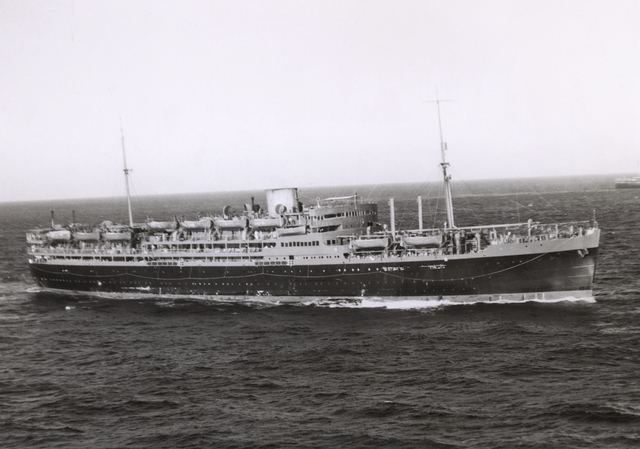
HMT (Hired Military Transport) Dunera was a British passenger ship which, in 1940, became involved in a controversial transportation of thousands of "enemy aliens" to Australia. The British India Steam Navigation Company had operated a previous Dunera (1891), which served as a troopship during the Second Boer War.
After sea trial in 1937, she was handed over to the British India Steam Navigation Company and served as a passenger liner and an educational cruise ship before seeing extensive service as a troopship throughout World War II. She was taken over by the Royal Navy as a troopship before hostilities started, and was taking troops to the Far East when her crew heard the news of war at Malta on 3 September 1939. Dunera carried New Zealand troops to Egypt in January 1940.
After Britain declared war on Germany, the government set up aliens tribunals to distinguish Nazi sympathisers from refugees who had fled from Nazism. As a result, 568 were classified as unreliable, 6,800 were left at liberty but subject to restrictions, and 65,000 were regarded as "friendly". However, after the fall of France, the loss of the Low Countries and Italy's declaration of war, Britain stood alone against the Axis and anxieties became acute. In what Winston Churchill later regretted as "a deplorable and regrettable mistake",[quote needs citation] all Austrians and Germans, and many Italians, were suspected of being enemy agents, potentially helping to plan the invasion of Britain, and a decision was made to deport them. Canada agreed to take some of them and Australia others, though, "not since the middle of the nineteenth century had Australia received the unwanted of Britain transported across the world for the purposes of incarceration".
On 10 July 1940, 2,542 detainees, all classified as "enemy aliens", were embarked aboard Dunera at Liverpool. While the detainees included 200 Italian and 251 German prisoners of war, as well as several dozen Nazi sympathizers, the majority were 2,036 Italian and German civilians who were anti-Nazi, most of them Jewish refugees. Some had already been to sea but their ship, the SS Arandora Star, had been torpedoed en route to Canada, with great loss of life. In addition to the passengers were 309 poorly trained guards, mostly from the Auxiliary Military Pioneer Corps, as well as seven officers and the ship's crew, creating a total complement of almost twice the Dunera's capacity as a troop carrier of 1,600.
Using the tune of "My Bonnie Lies over the Ocean" learned from their British warders, internees composed and sang "regularly on board the ship", "My luggage went into the ocean, My luggage went into the sea, My luggage was thrown in the ocean, Oh, bring back my luggage to me!" Most internees were kept below decks throughout the voyage, except for daily 10-minute exercise periods, during which internees would walk around the deck under heavy guard; during one such period, a guard smashed beer bottles on the deck so that the internees would have to walk on the shards. In contrast to the Army personnel, the ship's crew and officers showed kindness to the internees, and some later testified at the soldiers' courts-martial.
The ship was an overcrowded Hell-hole. Hammocks almost touched, many men had to sleep on the floor or on tables. There was only one piece of soap for twenty men, and one towel for ten men, water was rationed, and luggage was stowed away so there was no change of clothing. As a consequence, skin diseases were common. There was a hospital on board but no operating theatre. Toilet facilities were far from adequate, even with makeshift latrines erected on the deck and sewage flooded the decks. Dysentery ran through the ship. Blows with rifle butts and beatings from the soldiers were daily occurrences. One refugee tried to go to the latrines on deck during the night – which was out-of-bounds. He was bayoneted in the stomach by one of the guards and spent the rest of the voyage in the hospital.
While passing through the Irish Sea, the Dunera was struck by a torpedo that failed to detonate; a second torpedo passed underneath the vessel, which was lifted out of its path by the rough seas. After the war it was discovered, partly from a German submarine captain's diary, that, on another occasion, the Dunera was saved from being destroyed because of the German-language items tossed overboard, "and picked up ... to inspect" by that captain's divers who concluded that the ship was carrying prisoners of war.
On arrival in Sydney on 6 September 1940, the first Australian on board was an army medical officer Alan Frost. He was appalled and his subsequent report led to a court martial at Chelsea Barracks, London, in May 1941. The officer in charge, Major William Patrick Scott, was "severely reprimanded" as was Sergeant Arthur Helliwell; RSM Charles Albert Bowles was reduced to the ranks and given a twelve-month prison sentence and then discharged from the British Army. Lieutenant John O'Neill VC was an officer of the Pioneers, who appeared as a witness.
Hub AI
HMT Dunera AI simulator
(@HMT Dunera_simulator)
HMT Dunera
HMT (Hired Military Transport) Dunera was a British passenger ship which, in 1940, became involved in a controversial transportation of thousands of "enemy aliens" to Australia. The British India Steam Navigation Company had operated a previous Dunera (1891), which served as a troopship during the Second Boer War.
After sea trial in 1937, she was handed over to the British India Steam Navigation Company and served as a passenger liner and an educational cruise ship before seeing extensive service as a troopship throughout World War II. She was taken over by the Royal Navy as a troopship before hostilities started, and was taking troops to the Far East when her crew heard the news of war at Malta on 3 September 1939. Dunera carried New Zealand troops to Egypt in January 1940.
After Britain declared war on Germany, the government set up aliens tribunals to distinguish Nazi sympathisers from refugees who had fled from Nazism. As a result, 568 were classified as unreliable, 6,800 were left at liberty but subject to restrictions, and 65,000 were regarded as "friendly". However, after the fall of France, the loss of the Low Countries and Italy's declaration of war, Britain stood alone against the Axis and anxieties became acute. In what Winston Churchill later regretted as "a deplorable and regrettable mistake",[quote needs citation] all Austrians and Germans, and many Italians, were suspected of being enemy agents, potentially helping to plan the invasion of Britain, and a decision was made to deport them. Canada agreed to take some of them and Australia others, though, "not since the middle of the nineteenth century had Australia received the unwanted of Britain transported across the world for the purposes of incarceration".
On 10 July 1940, 2,542 detainees, all classified as "enemy aliens", were embarked aboard Dunera at Liverpool. While the detainees included 200 Italian and 251 German prisoners of war, as well as several dozen Nazi sympathizers, the majority were 2,036 Italian and German civilians who were anti-Nazi, most of them Jewish refugees. Some had already been to sea but their ship, the SS Arandora Star, had been torpedoed en route to Canada, with great loss of life. In addition to the passengers were 309 poorly trained guards, mostly from the Auxiliary Military Pioneer Corps, as well as seven officers and the ship's crew, creating a total complement of almost twice the Dunera's capacity as a troop carrier of 1,600.
Using the tune of "My Bonnie Lies over the Ocean" learned from their British warders, internees composed and sang "regularly on board the ship", "My luggage went into the ocean, My luggage went into the sea, My luggage was thrown in the ocean, Oh, bring back my luggage to me!" Most internees were kept below decks throughout the voyage, except for daily 10-minute exercise periods, during which internees would walk around the deck under heavy guard; during one such period, a guard smashed beer bottles on the deck so that the internees would have to walk on the shards. In contrast to the Army personnel, the ship's crew and officers showed kindness to the internees, and some later testified at the soldiers' courts-martial.
The ship was an overcrowded Hell-hole. Hammocks almost touched, many men had to sleep on the floor or on tables. There was only one piece of soap for twenty men, and one towel for ten men, water was rationed, and luggage was stowed away so there was no change of clothing. As a consequence, skin diseases were common. There was a hospital on board but no operating theatre. Toilet facilities were far from adequate, even with makeshift latrines erected on the deck and sewage flooded the decks. Dysentery ran through the ship. Blows with rifle butts and beatings from the soldiers were daily occurrences. One refugee tried to go to the latrines on deck during the night – which was out-of-bounds. He was bayoneted in the stomach by one of the guards and spent the rest of the voyage in the hospital.
While passing through the Irish Sea, the Dunera was struck by a torpedo that failed to detonate; a second torpedo passed underneath the vessel, which was lifted out of its path by the rough seas. After the war it was discovered, partly from a German submarine captain's diary, that, on another occasion, the Dunera was saved from being destroyed because of the German-language items tossed overboard, "and picked up ... to inspect" by that captain's divers who concluded that the ship was carrying prisoners of war.
On arrival in Sydney on 6 September 1940, the first Australian on board was an army medical officer Alan Frost. He was appalled and his subsequent report led to a court martial at Chelsea Barracks, London, in May 1941. The officer in charge, Major William Patrick Scott, was "severely reprimanded" as was Sergeant Arthur Helliwell; RSM Charles Albert Bowles was reduced to the ranks and given a twelve-month prison sentence and then discharged from the British Army. Lieutenant John O'Neill VC was an officer of the Pioneers, who appeared as a witness.
Recent media