
Recent from talks
HNoMS Olav Tryggvason
Knowledge base stats:
Talk channels stats:
Members stats:
HNoMS Olav Tryggvason
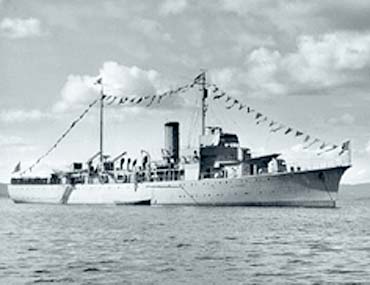
HNoMS Olav Tryggvason was a minelayer that was built by the naval shipyard at Horten in the early 1930s with the yard number 119. She served in the Royal Norwegian Navy until captured by the Germans in 1940. The Germans renamed her first Albatros II, and a few days later Brummer. She was wrecked in a British bombing raid in northern Germany in April 1945.
The Olav Tryggvason was considered a well armed and balanced ship, with an engine plant consisting of both steam turbines and diesel engines. Olav Tryggvason was the first Norwegian warship equipped with a basic gun computer, allowing all four main guns to be fired at the same time at one target with some degree of accuracy.
Before the outbreak of the Second World War, the Olav Tryggvason served as a cadet training ship in the summer season, taking aboard 55 cadets and showing the flag around Western Europe on training cruises. One of the cadets serving on board in the 1930s was Crown Prince Olav of Norway.
At the outbreak of the Second World War, the Olav Tryggvason took part in neutrality protection duties. Her first armed action came on 3 November 1939, when the US merchant ship City of Flint entered Norwegian territorial waters. The City of Flint had been taken as a prize by the German pocket battleship Deutschland in the Atlantic and was on its way to Germany with the American crew as prisoners. According to public international law, the ship could have passed through Norwegian waters without interference, but when she stopped and anchored in the port of Haugesund, the Germans broke Norwegian neutrality regulations. The German prize crew had brought the City of Flint into Haugesund to escape the British naval forces which searched for them. When the British cruiser HMS Glasgow approached the City of Flint on 2 November the escorting Olav Tryggvason had confronted the British warship and made it leave Norwegian waters. Olav Tryggvason boarded the City of Flint with one officer and thirty armed sailors, who returned control of the ship to the American captain, Joseph H. Gainard, on 6 November. He unloaded his cargo in Bergen and set sail in ballast for the US. The German prize crew was interned at Kongsvinger Fortress. In response, the Norwegian Ministry of Foreign Affairs received several strongly worded and threatening notes from its German counterpart.
The Olav Tryggvason was at Horten for minor engine repairs, manned only by a skeleton crew, when the Germans invaded on 9 April 1940. Along with the minesweeper HNoMS Rauma, she defended the harbour against the German torpedo boats Albatros and Kondor, and two 120-ton räumboot minesweepers; the R 17 and the R 27.
"All through the chilly night of April 8–9 a happy welcoming party from the German legation had stood at quayside in Oslo Harbor waiting for the arrival of a German fleet troop transport. It was the strongest naval force sent to Norway, led by the pocket battle ship Lützow (its name changed from Deutschland because Hitler didn't want to risk losing a ship by that name), with six eleven-inch guns, and the new 10,000-ton heavy cruiser Blucher, flagship of the squadron, carrying 8 eigh- inch guns. The happy little party waited in vain. The big ships never arrived. They had been challenged at the very entrance to Oslo Fjord, where the Norwegian mine layer, Olav Trygverson, sank a German torpedo boat and damaged the light cruiser Emden"
The minelayer's commander, kommandørkaptein T. Briseid, had received warning of the intruding foreign naval forces and at 0215hrs anchored his ship to a buoy in the inner harbour to cover the harbour entrance with her guns. At 0435hrs two ships with no lights entered to harbour. At a range of 60 metres (66 yd) the Reichskriegsflagge was spotted and the ships identified as German. Much of the Norwegian defensive advantage was however lost as Briseid then decided to continue following neutrality protection guidelines and first blew a steam horn, then fired a blank shot, then two live warning shots at the foreign warships before opening up on them in earnest.
During the confusing battle at close range, R 17 was sunk by the Olav Tryggvason's 12 cm guns off Apeneskaia quay. Of the forty-five strong German landing unit on board R 17, only fifteen made it ashore unwounded. Despite the best efforts of the Norwegian ships, the R 27 managed to get to the cover of a peninsula and land her force of forty-five infantry in the harbour, having suffered several hits in the process. After landing her infantry the R 27 ran aground, then dislodged herself and suffered more hits before making her escape from the area. At the same time as the German minesweepers made their charge into the harbour, the Albatros tried to engage the Norwegian ships, but suffered hits from Olav Tryggvason and was forced to take cover behind some nearby islands. The cruiser Emden also tried to interfere from a distance out in the Oslofjord, but without result.
Hub AI
HNoMS Olav Tryggvason AI simulator
(@HNoMS Olav Tryggvason_simulator)
HNoMS Olav Tryggvason
HNoMS Olav Tryggvason was a minelayer that was built by the naval shipyard at Horten in the early 1930s with the yard number 119. She served in the Royal Norwegian Navy until captured by the Germans in 1940. The Germans renamed her first Albatros II, and a few days later Brummer. She was wrecked in a British bombing raid in northern Germany in April 1945.
The Olav Tryggvason was considered a well armed and balanced ship, with an engine plant consisting of both steam turbines and diesel engines. Olav Tryggvason was the first Norwegian warship equipped with a basic gun computer, allowing all four main guns to be fired at the same time at one target with some degree of accuracy.
Before the outbreak of the Second World War, the Olav Tryggvason served as a cadet training ship in the summer season, taking aboard 55 cadets and showing the flag around Western Europe on training cruises. One of the cadets serving on board in the 1930s was Crown Prince Olav of Norway.
At the outbreak of the Second World War, the Olav Tryggvason took part in neutrality protection duties. Her first armed action came on 3 November 1939, when the US merchant ship City of Flint entered Norwegian territorial waters. The City of Flint had been taken as a prize by the German pocket battleship Deutschland in the Atlantic and was on its way to Germany with the American crew as prisoners. According to public international law, the ship could have passed through Norwegian waters without interference, but when she stopped and anchored in the port of Haugesund, the Germans broke Norwegian neutrality regulations. The German prize crew had brought the City of Flint into Haugesund to escape the British naval forces which searched for them. When the British cruiser HMS Glasgow approached the City of Flint on 2 November the escorting Olav Tryggvason had confronted the British warship and made it leave Norwegian waters. Olav Tryggvason boarded the City of Flint with one officer and thirty armed sailors, who returned control of the ship to the American captain, Joseph H. Gainard, on 6 November. He unloaded his cargo in Bergen and set sail in ballast for the US. The German prize crew was interned at Kongsvinger Fortress. In response, the Norwegian Ministry of Foreign Affairs received several strongly worded and threatening notes from its German counterpart.
The Olav Tryggvason was at Horten for minor engine repairs, manned only by a skeleton crew, when the Germans invaded on 9 April 1940. Along with the minesweeper HNoMS Rauma, she defended the harbour against the German torpedo boats Albatros and Kondor, and two 120-ton räumboot minesweepers; the R 17 and the R 27.
"All through the chilly night of April 8–9 a happy welcoming party from the German legation had stood at quayside in Oslo Harbor waiting for the arrival of a German fleet troop transport. It was the strongest naval force sent to Norway, led by the pocket battle ship Lützow (its name changed from Deutschland because Hitler didn't want to risk losing a ship by that name), with six eleven-inch guns, and the new 10,000-ton heavy cruiser Blucher, flagship of the squadron, carrying 8 eigh- inch guns. The happy little party waited in vain. The big ships never arrived. They had been challenged at the very entrance to Oslo Fjord, where the Norwegian mine layer, Olav Trygverson, sank a German torpedo boat and damaged the light cruiser Emden"
The minelayer's commander, kommandørkaptein T. Briseid, had received warning of the intruding foreign naval forces and at 0215hrs anchored his ship to a buoy in the inner harbour to cover the harbour entrance with her guns. At 0435hrs two ships with no lights entered to harbour. At a range of 60 metres (66 yd) the Reichskriegsflagge was spotted and the ships identified as German. Much of the Norwegian defensive advantage was however lost as Briseid then decided to continue following neutrality protection guidelines and first blew a steam horn, then fired a blank shot, then two live warning shots at the foreign warships before opening up on them in earnest.
During the confusing battle at close range, R 17 was sunk by the Olav Tryggvason's 12 cm guns off Apeneskaia quay. Of the forty-five strong German landing unit on board R 17, only fifteen made it ashore unwounded. Despite the best efforts of the Norwegian ships, the R 27 managed to get to the cover of a peninsula and land her force of forty-five infantry in the harbour, having suffered several hits in the process. After landing her infantry the R 27 ran aground, then dislodged herself and suffered more hits before making her escape from the area. At the same time as the German minesweepers made their charge into the harbour, the Albatros tried to engage the Norwegian ships, but suffered hits from Olav Tryggvason and was forced to take cover behind some nearby islands. The cruiser Emden also tried to interfere from a distance out in the Oslofjord, but without result.
Recent media