
Recent from talks
German cruiser Emden
Knowledge base stats:
Talk channels stats:
Members stats:
German cruiser Emden
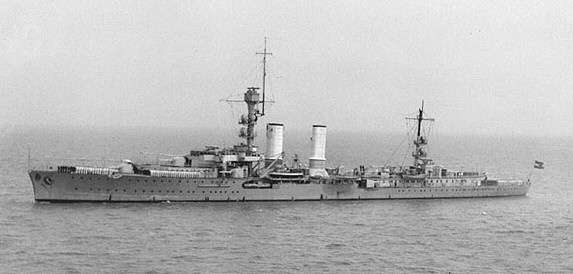
Emden was a light cruiser built for the German Navy (Reichsmarine) in the early 1920s. She was the only ship of her class and was the first large warship built in Germany after the end of World War I. She was built at the Reichsmarinewerft in Wilhelmshaven; her keel was laid down in December 1921 and her completed hull was launched in January 1925. Emden was commissioned into the fleet in October 1925. Her design was heavily informed by the restrictions of the Treaty of Versailles and the dictates of the Allied disarmament commission. Displacement was capped at 6,000 long tons (6,100 t), though like all German warships built in the period, Emden exceeded the size limitations. She was armed with a main battery of surplus 15 cm (5.9 in) guns left over from World War I, mounted in single gun turrets, as mandated by the Allied powers. She had a top speed of 29 knots (54 km/h; 33 mph).
Emden spent the majority of her career as a training ship; in the inter-war period, she conducted several world cruises to train naval cadets, frequently visiting East Asia, the Americas, and the Indian Ocean region. In 1937 and 1938, she briefly participated in the non-intervention patrols during the Spanish Civil War. At the outbreak of war, she laid minefields off the German coast and was damaged by a British bomber that crashed into her. She participated in the invasion of Norway in April 1940 as part of the force that captured the Norwegian capital at Oslo.
The ship thereafter resumed training duties in the Baltic Sea. These lasted with minor interruptions until September 1941, when she was assigned to the Baltic Fleet and tasked with supporting German operations during the invasion of the Soviet Union. Training duties resumed in 1942 and lasted until late 1944, when she took part in minelaying operations in the Skagerrak. Damaged in a grounding accident in December 1944, she went to Königsberg for repairs. In January 1945, she participated in the evacuation of East Prussia to escape the advancing Soviet Army. While undergoing repairs in Kiel, Emden was repeatedly damaged by British bombers and later run aground outside the harbor to prevent her from sinking. In the final days of the war, she was blown up to prevent her capture. The wreck was ultimately broken up in place by 1950.
According to Article 181 of the Treaty of Versailles, the treaty that ended World War I, the German Navy was permitted only six light cruisers. Article 190 limited new cruiser designs to 6,000 long tons (6,100 t) and prohibited new construction until the vessel to be replaced was at least twenty years old. Since the six cruisers that German retained had been launched between 1899 and 1902, the oldest ships—Niobe, Amazone, Nymphe, Thetis, and Medusa—could be replaced immediately. Design work on the first new light cruiser, ordered as "Ersatz Niobe", began in 1921.
The Navy hoped to finish the ship as quickly as possible and to keep costs to a minimum, and so requested permission from the Naval Inter-Allied Commission of Control to use steam turbines, boilers, and conning towers from scrapped vessels to complete Ersatz Niobe. The NIACC rejected the request. The Navy also hoped to use an armament of four twin-gun turrets for the new ship. The NIACC rejected the twin-turret design, but allowed the use of 15 cm (5.9 in) guns from existing stocks of spare barrels. Nominally within the 6,000-ton limit of the Versailles Treaty, Emden in fact exceeded the restriction by almost 1,000 long tons (1,000 t) fully loaded. In 1923, after work on Emden had already begun, the Germans proposed using the definition for standard displacement adopted in the Washington Naval Treaty of 1922, which was significantly less than full-load displacement. The Allied powers approved of the change, and thus Emden, which had a standard displacement of just under the 6,000-ton limit, was retroactively made legal.
The ship was based on the blueprints from the late-war cruiser Karlsruhe, primarily due to personnel shortages in the design staff and the closure of the Navy's Ship Testing Institute, and the blueprints for Karlsruhe were still available. Completed to a dated design, she proved to be something of a disappointment in service, primarily owing to her weak broadside of just six 15 cm guns. Nevertheless, the ship incorporated major advances over the earlier designs, including large-scale use of welding in her construction and a significantly more efficient propulsion system that gave her a cruising radius fifty percent larger than that of the older ships, which proved to be quite useful on the extended training cruises of the 1920s and 1930s.
Emden was 150.5 meters (494 ft) long at the waterline and 155.1 m (509 ft) long overall. She had a beam of 14.2 m (47 ft) and a designed draft of 5.3 m (17 ft); at standard load, the draft was 5.15 m (16.9 ft), and at combat load the draft increased to 5.93 m (19.5 ft). Her designed displacement was 5,960 long tons (6,060 t), with 5,300 long tons (5,400 t) standard and 6,990 long tons (7,100 t) combat displacements. Her hull was constructed with longitudinal steel frames and incorporated seventeen watertight compartments and a double bottom that extended for 56 percent of the length of the keel. She had a waterline armored belt that was 50 mm (2 in) thick; her armored deck was 20 to 40 mm (0.79 to 1.57 in) thick, and her conning tower had 100 mm (3.9 in) thick sides.
The ship had a standard crew of nineteen officers and 464 enlisted men. While serving on cadet training cruises, her crew numbered twenty-nine officers and 445 enlisted, with 162 cadets. After 1940, her standard crew was increased to twenty-six officers and 556 enlisted, and after being reduced to a training ship, her crew numbered thirty officers and 653 enlisted men. Emden carried six boats. The German Navy regarded the ship as a good sea boat, with slight lee helm and gentle motion in a swell. The cruiser was maneuverable, but was slow going into a turn. Steering was controlled by a single large rudder. She lost speed only slightly in a head sea, but lost up to sixty percent in hard turns. She had a metacentric height of .79 m (2 ft 7 in).
Hub AI
German cruiser Emden AI simulator
(@German cruiser Emden_simulator)
German cruiser Emden
Emden was a light cruiser built for the German Navy (Reichsmarine) in the early 1920s. She was the only ship of her class and was the first large warship built in Germany after the end of World War I. She was built at the Reichsmarinewerft in Wilhelmshaven; her keel was laid down in December 1921 and her completed hull was launched in January 1925. Emden was commissioned into the fleet in October 1925. Her design was heavily informed by the restrictions of the Treaty of Versailles and the dictates of the Allied disarmament commission. Displacement was capped at 6,000 long tons (6,100 t), though like all German warships built in the period, Emden exceeded the size limitations. She was armed with a main battery of surplus 15 cm (5.9 in) guns left over from World War I, mounted in single gun turrets, as mandated by the Allied powers. She had a top speed of 29 knots (54 km/h; 33 mph).
Emden spent the majority of her career as a training ship; in the inter-war period, she conducted several world cruises to train naval cadets, frequently visiting East Asia, the Americas, and the Indian Ocean region. In 1937 and 1938, she briefly participated in the non-intervention patrols during the Spanish Civil War. At the outbreak of war, she laid minefields off the German coast and was damaged by a British bomber that crashed into her. She participated in the invasion of Norway in April 1940 as part of the force that captured the Norwegian capital at Oslo.
The ship thereafter resumed training duties in the Baltic Sea. These lasted with minor interruptions until September 1941, when she was assigned to the Baltic Fleet and tasked with supporting German operations during the invasion of the Soviet Union. Training duties resumed in 1942 and lasted until late 1944, when she took part in minelaying operations in the Skagerrak. Damaged in a grounding accident in December 1944, she went to Königsberg for repairs. In January 1945, she participated in the evacuation of East Prussia to escape the advancing Soviet Army. While undergoing repairs in Kiel, Emden was repeatedly damaged by British bombers and later run aground outside the harbor to prevent her from sinking. In the final days of the war, she was blown up to prevent her capture. The wreck was ultimately broken up in place by 1950.
According to Article 181 of the Treaty of Versailles, the treaty that ended World War I, the German Navy was permitted only six light cruisers. Article 190 limited new cruiser designs to 6,000 long tons (6,100 t) and prohibited new construction until the vessel to be replaced was at least twenty years old. Since the six cruisers that German retained had been launched between 1899 and 1902, the oldest ships—Niobe, Amazone, Nymphe, Thetis, and Medusa—could be replaced immediately. Design work on the first new light cruiser, ordered as "Ersatz Niobe", began in 1921.
The Navy hoped to finish the ship as quickly as possible and to keep costs to a minimum, and so requested permission from the Naval Inter-Allied Commission of Control to use steam turbines, boilers, and conning towers from scrapped vessels to complete Ersatz Niobe. The NIACC rejected the request. The Navy also hoped to use an armament of four twin-gun turrets for the new ship. The NIACC rejected the twin-turret design, but allowed the use of 15 cm (5.9 in) guns from existing stocks of spare barrels. Nominally within the 6,000-ton limit of the Versailles Treaty, Emden in fact exceeded the restriction by almost 1,000 long tons (1,000 t) fully loaded. In 1923, after work on Emden had already begun, the Germans proposed using the definition for standard displacement adopted in the Washington Naval Treaty of 1922, which was significantly less than full-load displacement. The Allied powers approved of the change, and thus Emden, which had a standard displacement of just under the 6,000-ton limit, was retroactively made legal.
The ship was based on the blueprints from the late-war cruiser Karlsruhe, primarily due to personnel shortages in the design staff and the closure of the Navy's Ship Testing Institute, and the blueprints for Karlsruhe were still available. Completed to a dated design, she proved to be something of a disappointment in service, primarily owing to her weak broadside of just six 15 cm guns. Nevertheless, the ship incorporated major advances over the earlier designs, including large-scale use of welding in her construction and a significantly more efficient propulsion system that gave her a cruising radius fifty percent larger than that of the older ships, which proved to be quite useful on the extended training cruises of the 1920s and 1930s.
Emden was 150.5 meters (494 ft) long at the waterline and 155.1 m (509 ft) long overall. She had a beam of 14.2 m (47 ft) and a designed draft of 5.3 m (17 ft); at standard load, the draft was 5.15 m (16.9 ft), and at combat load the draft increased to 5.93 m (19.5 ft). Her designed displacement was 5,960 long tons (6,060 t), with 5,300 long tons (5,400 t) standard and 6,990 long tons (7,100 t) combat displacements. Her hull was constructed with longitudinal steel frames and incorporated seventeen watertight compartments and a double bottom that extended for 56 percent of the length of the keel. She had a waterline armored belt that was 50 mm (2 in) thick; her armored deck was 20 to 40 mm (0.79 to 1.57 in) thick, and her conning tower had 100 mm (3.9 in) thick sides.
The ship had a standard crew of nineteen officers and 464 enlisted men. While serving on cadet training cruises, her crew numbered twenty-nine officers and 445 enlisted, with 162 cadets. After 1940, her standard crew was increased to twenty-six officers and 556 enlisted, and after being reduced to a training ship, her crew numbered thirty officers and 653 enlisted men. Emden carried six boats. The German Navy regarded the ship as a good sea boat, with slight lee helm and gentle motion in a swell. The cruiser was maneuverable, but was slow going into a turn. Steering was controlled by a single large rudder. She lost speed only slightly in a head sea, but lost up to sixty percent in hard turns. She had a metacentric height of .79 m (2 ft 7 in).
Recent media