



Community hub
Recent from talks
Knowledge base stats:
Talk channels stats:
Members stats:
HQ-9
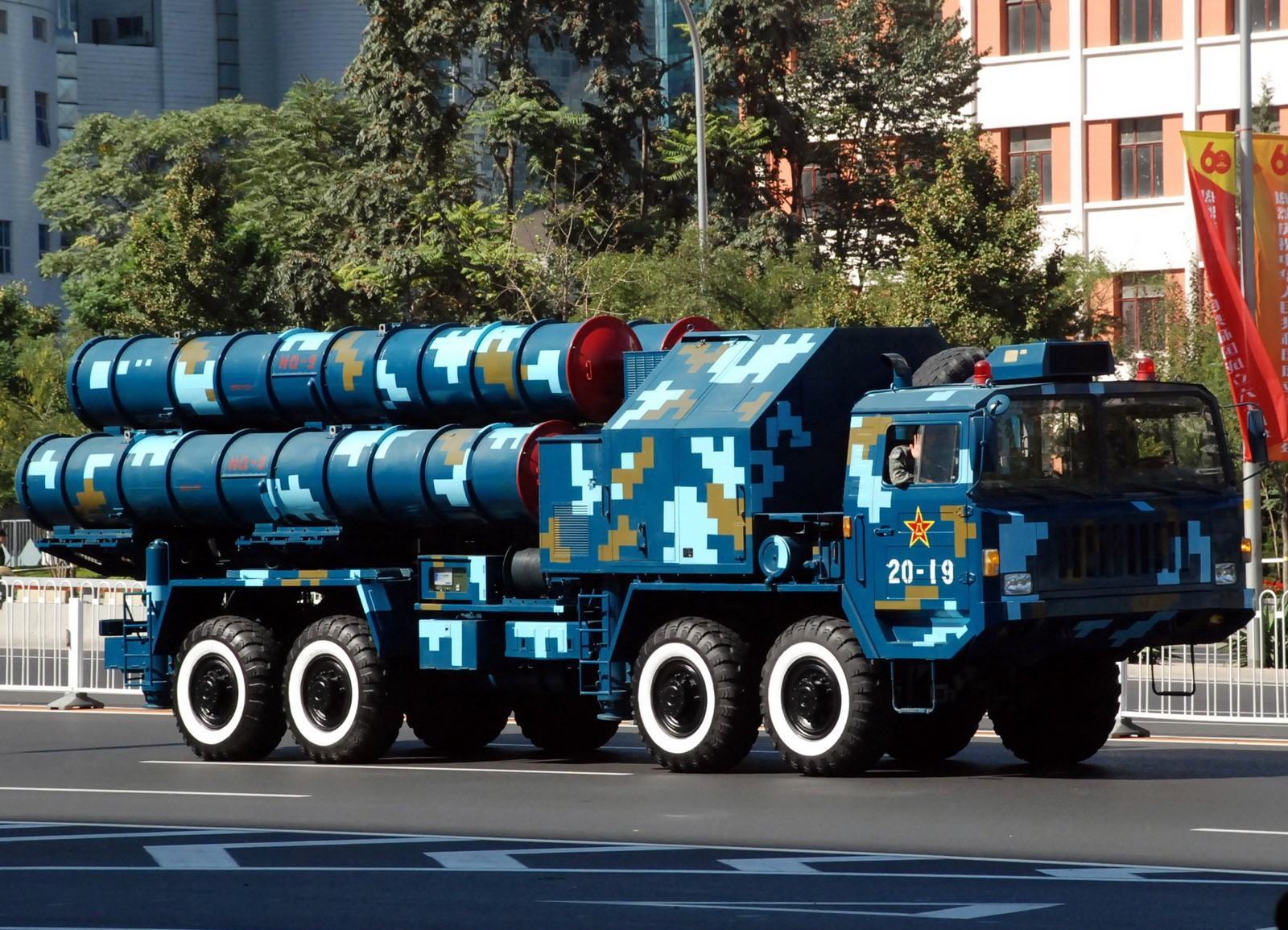
The HQ-9 (simplified Chinese: 红旗-9; traditional Chinese: 紅旗-9; pinyin: Hóng Qí-9; lit. 'Red Banner-9'; NATO reporting name: CH-SA-9.) is a long-range semi-active radar homing (SARH) surface-to-air missile (SAM) developed by the People's Republic of China. The naval variant is the HHQ-9 (simplified Chinese: 海红旗-9; traditional Chinese: 海紅旗-9; pinyin: Hǎi Hóng Qí-9; lit. 'Sea Red Banner-9'). The HQ-9 and its export variants are developed by China Aerospace Science and Industry Corporation (CASIC).
The HQ-9 development program started in the 1970s, with full-scale development beginning in the late-1980s.
According to Western analysts, the HQ-9 is "equivalent" which China imported starting in 1993. or a derivative of the Russian S-300, Justin Bronk of the Royal United Services Institute describes the missile as a "hybrid design based on the Russian SA-20 but with radar, seeker head and C2 elements heavily influenced by American and Israeli technology."
The missile uses track-via-missile (TVM) guidance combining inertial guidance, mid-course uplink, and terminal active radar. The TVM used on earlier missiles may have been developed from a United States MIM-104 Patriot missile purchased from Israel or Germany.
According to a 2001 article from Defence International, the HQ-9 is 6.8 m. long with a mass of nearly two tons. The diameters of the first and second stages are 700 mm and 560 mm, respectively. The warhead mass is 180 kg, and the maximum speed is Mach 4.2. The HQ-9 may use fire-control radars from other Chinese SAM systems.
The HQ-9 was a contender in Turkey's T-LORAMIDS program, and it was reportedly selected as the winner in September 2013. The United States responded by blocking funds to integrate the Chinese system into NATO defenses. However, through 2013 there was no confirmation that the deal had been finalized. In February 2015, the Grand National Assembly of Turkey was informed by the Ministry of National Defence that the evaluation of bids was complete and that the chosen system would be used by Turkey without integration with NATO; the system was not explicitly named. However, other Turkish officials reported that no winner had been selected. Later in the month, Turkish officials revealed that negotiations were ongoing with multiple bidders; the Chinese bid had not yet satisfied requirements concerning technology transfer. In March 2015, a China Daily article reported that it was "well-known that the Chinese FD-2000 system, a HQ-9 model for export, was chosen for the contract with Turkey in 2013" based on comments made by a CPMIEC representative at the 2015 Langkawi International Maritime and Aerospace Exhibition; the article was misleadingly called "Missile sale to Turkey confirmed." In November 2015, Turkey confirmed it would not purchase the HQ-9, opting for an indigenously developed system instead.
China has deployed HQ-9s near or in disputed territory. Missiles were deployed in July 2015 to Hotan in Xinjiang, close to Kashmir across the Line of Actual Control, and in February 2016 to Woody Island in the disputed South China Sea.
The Pakistan Army operates the HQ-9/P variant. Negotiations for the purchase of the HQ-9 and HQ-16 by Pakistan began in early 2015. The system officially entered service on October 14, 2021.
Hub AI
HQ-9 AI simulator
(@HQ-9_simulator)
HQ-9
The HQ-9 (simplified Chinese: 红旗-9; traditional Chinese: 紅旗-9; pinyin: Hóng Qí-9; lit. 'Red Banner-9'; NATO reporting name: CH-SA-9.) is a long-range semi-active radar homing (SARH) surface-to-air missile (SAM) developed by the People's Republic of China. The naval variant is the HHQ-9 (simplified Chinese: 海红旗-9; traditional Chinese: 海紅旗-9; pinyin: Hǎi Hóng Qí-9; lit. 'Sea Red Banner-9'). The HQ-9 and its export variants are developed by China Aerospace Science and Industry Corporation (CASIC).
The HQ-9 development program started in the 1970s, with full-scale development beginning in the late-1980s.
According to Western analysts, the HQ-9 is "equivalent" which China imported starting in 1993. or a derivative of the Russian S-300, Justin Bronk of the Royal United Services Institute describes the missile as a "hybrid design based on the Russian SA-20 but with radar, seeker head and C2 elements heavily influenced by American and Israeli technology."
The missile uses track-via-missile (TVM) guidance combining inertial guidance, mid-course uplink, and terminal active radar. The TVM used on earlier missiles may have been developed from a United States MIM-104 Patriot missile purchased from Israel or Germany.
According to a 2001 article from Defence International, the HQ-9 is 6.8 m. long with a mass of nearly two tons. The diameters of the first and second stages are 700 mm and 560 mm, respectively. The warhead mass is 180 kg, and the maximum speed is Mach 4.2. The HQ-9 may use fire-control radars from other Chinese SAM systems.
The HQ-9 was a contender in Turkey's T-LORAMIDS program, and it was reportedly selected as the winner in September 2013. The United States responded by blocking funds to integrate the Chinese system into NATO defenses. However, through 2013 there was no confirmation that the deal had been finalized. In February 2015, the Grand National Assembly of Turkey was informed by the Ministry of National Defence that the evaluation of bids was complete and that the chosen system would be used by Turkey without integration with NATO; the system was not explicitly named. However, other Turkish officials reported that no winner had been selected. Later in the month, Turkish officials revealed that negotiations were ongoing with multiple bidders; the Chinese bid had not yet satisfied requirements concerning technology transfer. In March 2015, a China Daily article reported that it was "well-known that the Chinese FD-2000 system, a HQ-9 model for export, was chosen for the contract with Turkey in 2013" based on comments made by a CPMIEC representative at the 2015 Langkawi International Maritime and Aerospace Exhibition; the article was misleadingly called "Missile sale to Turkey confirmed." In November 2015, Turkey confirmed it would not purchase the HQ-9, opting for an indigenously developed system instead.
China has deployed HQ-9s near or in disputed territory. Missiles were deployed in July 2015 to Hotan in Xinjiang, close to Kashmir across the Line of Actual Control, and in February 2016 to Woody Island in the disputed South China Sea.
The Pakistan Army operates the HQ-9/P variant. Negotiations for the purchase of the HQ-9 and HQ-16 by Pakistan began in early 2015. The system officially entered service on October 14, 2021.