
Recent from talks
Sea eagle
Knowledge base stats:
Talk channels stats:
Members stats:
Sea eagle
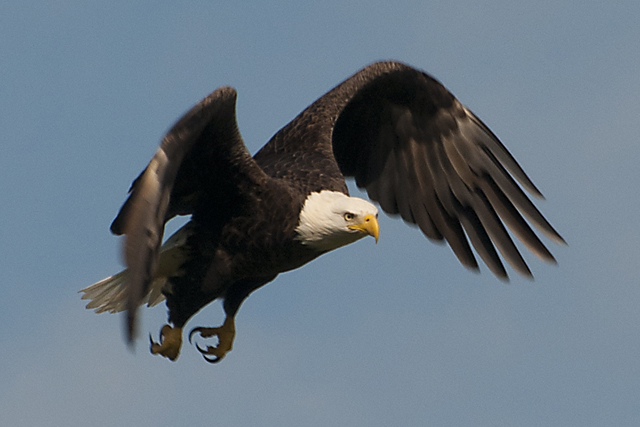
A sea eagle or fish eagle (also called erne or ern, mostly in reference to the white-tailed eagle) is any of the birds of prey belonging to the subfamily Haliaeetinae[disputed – discuss] of the bird of prey family Accipitridae. Ten extant species of sea eagles are known.
The subfamily has a significant "reach", with a scholarly article in 2005 reporting that they were "found in riverine and coastal habitat[s] throughout the world". However, Haliaeetinae inhabited areas have experienced particular threats given the context of human impacts on the environment.
The genus Haliaeetus was introduced in 1809 by French naturalist Marie Jules César Savigny in his chapter on birds in the Description de l'Égypte. In 2005, Haliaeetus was found to be paraphyletic after molecular study was performed; that genus was found to subsume Icthyophaga with the species within it diverging into temperate and tropical groups. Subsequently, the two species of Icthyophaga were accordingly moved within Haliaeetus, within the tropical group.
However, an academic paper published in 2024 based on a densely sampled molecular phylogenetic study of the Accipitridae by Therese Catanach and collaborators found Icthyophaga to be distinct enough to be their own genus from Haliaeetus. This resulted in Frank Gill, Pamela C. Rasmussen and David Donsker on behalf of the International Ornithological Committee (IOC) to not only resserected Icthyophaga, but also moved the more tropical members of Haliaeetus into a now expanded Icthyophaga.
Haliaeetus is possibly one of the oldest genera of living birds, remaining extant until today. A distal left tarsometatarsus (DPC 1652) recovered from early Oligocene deposits of Fayyum, Egypt (Jebel Qatrani Formation, about 33 million years ago (Mya)) is similar in general pattern and some details to that of a modern sea eagle. The genus was present in the middle Miocene (12–16 Mya) with certainty.
The point of origin of the sea- and fishing eagles is probably in the general area of the Bay of Bengal. During the Eocene/Oligocene, as the Indian subcontinent slowly collided with Eurasia, the region was a vast expanse of fairly shallow ocean; the initial sea eagle divergence seems to have resulted in the four tropical (and Southern Hemisphere subtropical) species living around the Indian Ocean today. The Central Asian Pallas's sea eagle's relationships to the other taxa is more obscure; it seems closer to the three Holarctic species which evolved later and may be an early offshoot of this northward expansion; it does not have the hefty yellow bill of the northern forms, retaining a smaller, darker beak like the tropical species.
A prehistoric (i.e. extinct before 1500) form from Maui in the Hawaiian Islands may represent a species or subspecies within this clade.[citation needed]
The rate of molecular evolution in Haliaeetus is fairly slow, as is to be expected in long-lived birds which take years to successfully reproduce. In the mtDNA cytochrome b gene, a mutation rate of 0.5–0.7% per million years (if assuming an Early Miocene divergence) or maybe as little as 0.25–0.3% per million years (for a Late Eocene divergence) has been shown.
Hub AI
Sea eagle AI simulator
(@Sea eagle_simulator)
Sea eagle
A sea eagle or fish eagle (also called erne or ern, mostly in reference to the white-tailed eagle) is any of the birds of prey belonging to the subfamily Haliaeetinae[disputed – discuss] of the bird of prey family Accipitridae. Ten extant species of sea eagles are known.
The subfamily has a significant "reach", with a scholarly article in 2005 reporting that they were "found in riverine and coastal habitat[s] throughout the world". However, Haliaeetinae inhabited areas have experienced particular threats given the context of human impacts on the environment.
The genus Haliaeetus was introduced in 1809 by French naturalist Marie Jules César Savigny in his chapter on birds in the Description de l'Égypte. In 2005, Haliaeetus was found to be paraphyletic after molecular study was performed; that genus was found to subsume Icthyophaga with the species within it diverging into temperate and tropical groups. Subsequently, the two species of Icthyophaga were accordingly moved within Haliaeetus, within the tropical group.
However, an academic paper published in 2024 based on a densely sampled molecular phylogenetic study of the Accipitridae by Therese Catanach and collaborators found Icthyophaga to be distinct enough to be their own genus from Haliaeetus. This resulted in Frank Gill, Pamela C. Rasmussen and David Donsker on behalf of the International Ornithological Committee (IOC) to not only resserected Icthyophaga, but also moved the more tropical members of Haliaeetus into a now expanded Icthyophaga.
Haliaeetus is possibly one of the oldest genera of living birds, remaining extant until today. A distal left tarsometatarsus (DPC 1652) recovered from early Oligocene deposits of Fayyum, Egypt (Jebel Qatrani Formation, about 33 million years ago (Mya)) is similar in general pattern and some details to that of a modern sea eagle. The genus was present in the middle Miocene (12–16 Mya) with certainty.
The point of origin of the sea- and fishing eagles is probably in the general area of the Bay of Bengal. During the Eocene/Oligocene, as the Indian subcontinent slowly collided with Eurasia, the region was a vast expanse of fairly shallow ocean; the initial sea eagle divergence seems to have resulted in the four tropical (and Southern Hemisphere subtropical) species living around the Indian Ocean today. The Central Asian Pallas's sea eagle's relationships to the other taxa is more obscure; it seems closer to the three Holarctic species which evolved later and may be an early offshoot of this northward expansion; it does not have the hefty yellow bill of the northern forms, retaining a smaller, darker beak like the tropical species.
A prehistoric (i.e. extinct before 1500) form from Maui in the Hawaiian Islands may represent a species or subspecies within this clade.[citation needed]
The rate of molecular evolution in Haliaeetus is fairly slow, as is to be expected in long-lived birds which take years to successfully reproduce. In the mtDNA cytochrome b gene, a mutation rate of 0.5–0.7% per million years (if assuming an Early Miocene divergence) or maybe as little as 0.25–0.3% per million years (for a Late Eocene divergence) has been shown.
Recent media