
Sea eagle
View on Wikipedia
| Sea eagle Temporal range: Middle Miocene–Recent
| |
|---|---|

| |
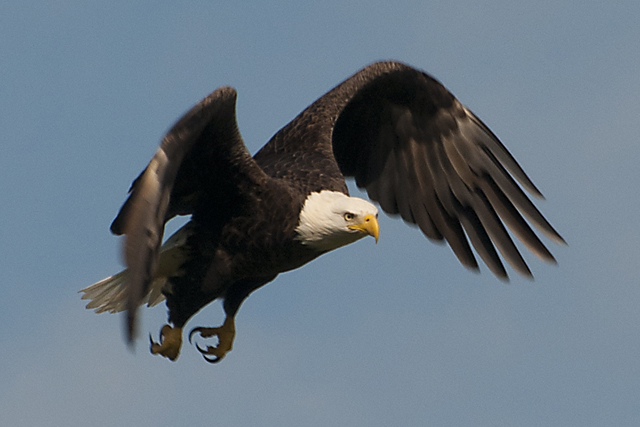
| Bald eagle (Haliaeetus leucocephalus) | |
Scientific classification 
| |
| Kingdom: | Animalia |
| Phylum: | Chordata |
| Class: | Aves |
| Order: | Accipitriformes |
| Family: | Accipitridae |
| Subfamily: | Haliaeetinae Savigny, 1809 |
| Genera | |
|
See text
| |
A sea eagle or fish eagle (also called erne or ern, mostly in reference to the white-tailed eagle) is any of the birds of prey belonging to the subfamily Haliaeetinae[2][disputed – discuss] of the bird of prey family Accipitridae. Ten extant species of sea eagles are known.
The subfamily has a significant "reach", with a scholarly article in 2005 reporting that they were "found in riverine and coastal habitat[s] throughout the world". However, Haliaeetinae inhabited areas have experienced particular threats given the context of human impacts on the environment.[3]
Taxonomy and evolution
[edit]The genus Haliaeetus was introduced in 1809 by French naturalist Marie Jules César Savigny in his chapter on birds in the Description de l'Égypte.[4][5] In 2005, Haliaeetus was found to be paraphyletic after molecular study was performed; that genus was found to subsume Icthyophaga with the species within it diverging into temperate and tropical groups. Subsequently, the two species of Icthyophaga were accordingly moved within Haliaeetus, within the tropical group.[3]
However, an academic paper published in 2024 based on a densely sampled molecular phylogenetic study of the Accipitridae by Therese Catanach and collaborators found Icthyophaga to be distinct enough to be their own genus from Haliaeetus.[6] This resulted in Frank Gill, Pamela C. Rasmussen and David Donsker on behalf of the International Ornithological Committee (IOC) to not only resserected Icthyophaga, but also moved the more tropical members of Haliaeetus into a now expanded Icthyophaga.[7]
Species
[edit]| Image | Genus | Living Species |
|---|---|---|
 |
Haliaeetus Savigny, 1809 |
|
 |
Icthyophaga (Lesson, 1843) |
|
Evolution
[edit]Haliaeetus is possibly one of the oldest genera of living birds, remaining extant until today. A distal left tarsometatarsus (DPC 1652) recovered from early Oligocene deposits of Fayyum, Egypt (Jebel Qatrani Formation, about 33 million years ago (Mya)) is similar in general pattern and some details to that of a modern sea eagle.[8] The genus was present in the middle Miocene (12–16 Mya) with certainty.[9]
The point of origin of the sea- and fishing eagles is probably in the general area of the Bay of Bengal. During the Eocene/Oligocene, as the Indian subcontinent slowly collided with Eurasia, the region was a vast expanse of fairly shallow ocean; the initial sea eagle divergence seems to have resulted in the four tropical (and Southern Hemisphere subtropical) species living around the Indian Ocean today. The Central Asian Pallas's sea eagle's relationships to the other taxa is more obscure; it seems closer to the three Holarctic species which evolved later and may be an early offshoot of this northward expansion; it does not have the hefty yellow bill of the northern forms, retaining a smaller, darker beak like the tropical species.[10]
A prehistoric (i.e. extinct before 1500) form from Maui in the Hawaiian Islands may represent a species or subspecies within this clade.[citation needed]
The rate of molecular evolution in Haliaeetus is fairly slow, as is to be expected in long-lived birds which take years to successfully reproduce. In the mtDNA cytochrome b gene, a mutation rate of 0.5–0.7% per million years (if assuming an Early Miocene divergence) or maybe as little as 0.25–0.3% per million years (for a Late Eocene divergence) has been shown.[10]
The relationships to other genera in the family Accipitridae are less clear; they have long been considered closer to the genus Milvus (kites) than to the true eagles in the genus Aquila on the basis of their morphology and display behaviour;[11][12] more recent genetic evidence agrees with this, but points to their being related to the genus Buteo (buzzards/hawks), as well, a relationship not previously thought close.[10]
Description
[edit]Sea eagles vary in size, from Sanford's sea eagle, averaging 2–2.7 kilograms (4.4–6.0 lb), to Steller's sea eagle, weighing up to 9 kg (20 lb).[11] At up to 6.9 kg (15 lb 3 oz), the white-tailed eagle is the largest eagle in Europe. Bald eagles can weigh up to 6.3 kg (13 lb 14 oz), making them the largest eagle native to North America. There are exceptional records of even heavier individuals in both the white-tailed and bald eagles, although not surpassing the largest Steller's sea eagles. The white-bellied sea eagle can weigh up to 4.5 kg (9 lb 15 oz).[11] They are generally overall brown (from rich brown to dull grey-brown), often with white to the head, tail or underparts. Some of the species have an all-yellow beak as adults, which is unusual among eagles.[11] The tail is entirely white in adult Haliaeetus species except for Sanford's, white-bellied, and Pallas's. Three species pairs exist: white-tailed and bald eagles, Sanford's and white-bellied sea eagles, and the African and Madagascar fish eagles,[10] each of these consists of a white- and a tan-headed species.
Their diets consist mainly of fish, aquatic birds, and small mammals. Nests are typically very large and positioned in a tree, but sometimes on a cliff.[11]
Relation to humans
[edit]
- The bald eagle is the national symbol of the United States.
- The silver eagle on red shield on the arms of Poland has been interpreted as the sea eagle.
- Namibia, Zambia, and Zimbabwe have the African fish eagle as their national bird.
- The white-tailed eagle is the national bird of Poland.
- The Manly Warringah Sea Eagles are an Australian professional rugby league club that competes in the National Rugby League (NRL).
- Nesting pairs of both the bald eagle and white-bellied sea eagle have been subject to live-streaming webcam footage.[13][14]
- In heraldic language, the osprey is termed a "sea-eagle", although ospreys come from the taxonomic family Pandionidae and are not classified as true sea eagles.
- Novelist Kurt Vonnegut invented the extinct "Bermuda ern" as a literary device in his novel Breakfast of Champions.
Conservation
[edit] | This section's tone or style may not reflect the encyclopedic tone used on Wikipedia. (August 2025) |
The Haliaeetinae subfamily is an especially threatened collection of creatures within the broader Accipitridae species, according to the academic journal Molecular Phylogenetics and Evolution, given the "anthropogenic factors" involved. The publication reported in 2005 that prior trends had meant that sea eagles could be "found in riverine and coastal habitat[s] throughout the world". In terms of international scientific campaigns, the Convention on International Trade in Endangered Species (CITES) protects all entities in the broader species, including sea eagles.[3]
See also
[edit]
- Brahminy kite, also called "red-backed sea eagle"
- Osprey, also called "sea hawk"
References
[edit]- ^ "Mindat.org". www.mindat.org. Retrieved 2021-05-28.
- ^ Etymology: Neo-Latin "sea eagle", from Ancient Greek [1] Archived 2021-12-08 at the Wayback Machine ἁλιάετος (haliaetos) or ἁλιαίετος (haliaietos, poetic (e.g. Homeric) variant), "sea eagle, osprey" (hali, "at sea" (dative case), + aetos, "eagle"). The two variant Greek forms lie behind the equally correct latinizations haliaetus (as in Pandion haliaetus) and haliaeetus.
- ^ a b c Lerner, Heather R.L.; Mindell, David P. (2005). "Phylogeny of eagles, Old World vultures, and other Accipitridae based on nuclear and mitochondrial DNA" (PDF). Molecular Phylogenetics and Evolution. 37 (2): 327–46. Bibcode:2005MolPE..37..327L. doi:10.1016/j.ympev.2005.04.010. PMID 15925523.
- ^ Savigny, Marie Jules César (1809). Description de l'Égypte: Histoire naturelle Volume 1 (in French). Paris: Imprimerie impériale. pp. 68, 85.
- ^ Mayr, Ernst; Cottrell, G. William, eds. (1979). Check-list of Birds of the World. Volume 1. Vol. 1 (2nd ed.). Cambridge, Massachusetts: Museum of Comparative Zoology. p. 299.
- ^ Catanach, T.A.; Halley, M.R.; Pirro, S. (2024). "Enigmas no longer: using ultraconserved elements to place several unusual hawk taxa and address the non-monophyly of the genus Accipiter (Accipitriformes: Accipitridae)". Biological Journal of the Linnean Society. 144 (2) blae028. doi:10.1093/biolinnean/blae028.
- ^ Gill, Frank; Donsker, David; Rasmussen, Pamela, eds. (February 2025). "Hoatzin, New World vultures, Secretarybird, raptors". IOC World Bird List Version 15.1. International Ornithologists' Union. Retrieved 21 March 2025.
- ^ Rasmussen, D., Tab, O., Storrs, L., & Simons, E. L. (1987). Fossil Birds from the Oligocene Jebel Qatrani Formation, Fayum Province, Egypt. Smithsonian Contributions to Paleobiology 62: 1–20. PDF Fulltext (file size 8.1 MB)
- ^ Lambrecht, K. (1933). Handbuch der Palaeornithologie. Gebrüder Bornträger, Berlin.
- ^ a b c d Wink, Heidrich & Fentzloff 1996.
- ^ a b c d e del Hoyo, Elliott & Sargatal 1994.
- ^ Brown, L. H, & Amadon, D. (1968). Eagles, Hawks and Falcons of the World. Country Life Books, Feltham.
- ^ AFP (5 April 2011). "Eagle cam becomes net sensation". Sydney Morning Herald. Retrieved 5 April 2011.
- ^ "Sea-Eagle CAM". Sea Eagle Cam, BirdLife Australia. Retrieved 7 September 2020.
General sources
[edit]- del Hoyo, J.; Elliott, A.; Sargatal, J., eds. (1994). Handbook of the Birds of the World. Vol. 2. Barcelona: Lynx Edicions. ISBN 84-87334-15-6.
- Wink, M.; Heidrich, P.; Fentzloff, C. (1996). "A mtDNA phylogeny of sea eagles (genus Haliaeetus) based on nucleotide sequences of the cytochrome b gene" (PDF). Biochemical Systematics and Ecology. 24 (7–8): 783–791. Bibcode:1996BioSE..24..783W. doi:10.1016/S0305-1978(96)00049-X.


Sea eagle
View on GrokipediaTaxonomy and Systematics
Species Composition
The genus Haliaeetus, comprising sea eagles, includes eight extant species within the family Accipitridae, all specialized piscivores with robust bills and partially webbed feet adapted for seizing fish from water surfaces. These species exhibit varying degrees of dependence on coastal, riverine, or lacustrine environments across Eurasia, Africa, North America, and the Indo-Pacific region. Taxonomic recognition follows standard avian checklists, with no recent splits or mergers altering the core composition as of 2023.[8]| Scientific Name | Common Name | Primary Range | IUCN Status (2023) |
|---|---|---|---|
| Haliaeetus albicilla | White-tailed eagle | Europe to East Asia | Least Concern[9] |
| Haliaeetus leucocephalus | Bald eagle | North America | Least Concern[10] |
| Haliaeetus pelagicus | Steller's sea-eagle | Northeast Asia | Vulnerable[11] |
| Haliaeetus leucogaster | White-bellied sea-eagle | Indian Ocean islands to Australasia | Least Concern[12] |
| Haliaeetus vocifer | African fish-eagle | Sub-Saharan Africa | Least Concern[13] |
| Haliaeetus vociferoides | Madagascar fish-eagle | Madagascar | Critically Endangered |
| Haliaeetus sanfordi | Sanford's sea-eagle | Solomon Islands | Near Threatened[14] |
| Haliaeetus leucoryphus | Pallas's fish-eagle | Central Asia to Southeast Asia | Endangered |
Phylogenetic Relationships
The genus Haliaeetus, comprising large sea eagles specialized for piscivory, is positioned within the subfamily Haliaeetinae of the family Accipitridae, with molecular evidence supporting its monophyly relative to other accipitrid genera.[17] Reconstructions using mitochondrial cytochrome b sequences, allozyme data, and morphological traits consistently recover Haliaeetus as a cohesive clade, distinct from booted eagles (Aquila spp.) and other lineages, though early studies noted potential affinities with kite genera like Milvus.[18] Within Accipitridae, Haliaeetinae forms part of a derived clade including Circaetus snake eagles and Aquila eagles, with divergence estimates placing the sea eagle lineage originating around 10-15 million years ago based on calibrated molecular clocks.[19] However, broader analyses incorporating nuclear DNA alongside mitochondrial markers have indicated paraphyly in the traditional circumscription of Haliaeetus, as the smaller fishing eagles of genus Ichthyophaga (e.g., I. ichthyaetus) nest within or as sisters to specific Haliaeetus branches, suggesting a need for taxonomic revision to render Haliaeetus monophyletic by inclusion of Ichthyophaga species.[20] This finding contrasts with mtDNA-only phylogenies but aligns with shared adaptations for coastal foraging, implying convergent or retained ancestral traits across the expanded sea eagle group.[21] Interspecific relationships within core Haliaeetus reveal two primary clades: a Holarctic temperate radiation including the white-tailed eagle (H. albicilla), bald eagle (H. leucocephalus), and Steller's sea eagle (H. pelagicus), which form a tight sister group supported by low genetic divergence (e.g., <2% cytochrome b differences); and a southern hemisphere clade encompassing the white-bellied sea eagle (H. leucogaster), African fish eagle (H. vocifer), and Madagascan fish eagle (H. vociferoides), with H. leucogaster showing closest affinity to H. leucocephalus in barcoding analyses.[17] These patterns reflect vicariant evolution tied to continental isolation, with Palearctic species basal to New World and Australasian divergences around 2-5 million years ago.[18] Recent mitogenome studies reaffirm Haliaeetinae monophyly but highlight ongoing debates over genus boundaries due to incomplete lineage sorting in hybrid zones, such as between H. albicilla and H. pelagicus.[22]Evolutionary History
Fossil Record
The fossil record of the genus Haliaeetus, comprising modern sea eagles, is sparse and primarily consists of Quaternary remains, with earlier assignments to the genus uncertain. Potential Miocene fossils around 10 million years before present (Ma BP) have been tentatively linked to Haliaeetus, but their attribution remains debated due to fragmentary evidence and the need for confirmatory phylogenetic analysis.[23][24] In North America, fossils of the bald eagle (Haliaeetus leucocephalus) are rare and confined to the late Pleistocene, with specimens recovered from Florida sites indicating presence during that epoch but no survival into the early Holocene there. Earlier Pleistocene eagle fossils from the same region belong to extinct taxa not closely allied to Haliaeetus, highlighting a turnover in local accipitrid faunas.[1] Quaternary bones attributable to Haliaeetus have been documented on Hawaiian islands including Maui, Molokai, and Oahu, with a key specimen from a ~3500-year-old skeleton in a Maui lava cave revealing genetic differentiation from continental sea eagles like the white-tailed eagle (Haliaeetus albicilla). Phylogenetic analysis of ancient DNA from these remains suggests an extinct endemic Hawaiian lineage within the genus, adapted to island conditions but vulnerable to subsequent extinction, possibly due to human arrival and habitat alteration around 1000–1200 years ago.[25] No formally named extinct Haliaeetus species beyond these insular forms are widely recognized, reflecting limited preservation of large raptors in coastal and aquatic depositional environments where sea eagles foraged. This paucity underscores reliance on molecular phylogenetics and subfossil bones for reconstructing genus-level evolution rather than abundant skeletal series.[25]Adaptive Radiations
The genus Haliaeetus exemplifies adaptive radiation in raptors, originating from an ancestral piscivore that diversified into species exploiting coastal, estuarine, and lacustrine niches across hemispheres. Phylogenetic analyses of cytochrome b mitochondrial DNA sequences confirm the monophyly of sea eagles, indicating a unified evolutionary origin followed by cladogenesis driven by geographic barriers and ecological opportunities in aquatic habitats.[17] This radiation bifurcates into a boreal/Holarctic clade—encompassing the white-tailed eagle (H. albicilla), bald eagle (H. leucocephalus), Steller's sea eagle (H. pelagicus), and Pallas's fish eagle (H. leucoryphus)—adapted to cooler, fish-abundant northern waters, and a tropical clade—including the African fish eagle (H. vocifer), Madagascan fish eagle (H. vociferoides), white-bellied sea eagle (H. leucogaster), and Sanford's sea eagle (H. sanfordi)—suited to warmer inland and coastal systems of Africa and the Indo-Pacific.[17] The clades reflect vicariant speciation, with boreal species evolving larger body sizes for capturing salmonids and marine mammals, contrasting tropical forms' emphasis on smaller fish and waterbirds.[17] Fossil evidence underscores the radiation's scope, including an extinct Hawaiian Haliaeetus lineage—divergent by over 3% in mtDNA from continental relatives—demonstrating insular colonization and specialization before extirpation, likely due to habitat loss and predation pressures.[25] Overall, the genus's 8–10 extant species arose through allopatric divergence post-Miocene, leveraging shared traits like robust talons and semi-aquatic foraging for niche partitioning amid fluctuating sea levels and prey dynamics.[26]Physical Characteristics
Morphology and Size Variation
Sea eagles, belonging to the genus Haliaeetus, exhibit a robust morphology adapted for piscivory and scavenging, featuring a large, hooked bill with a sharp tomial tooth for dismembering fish, powerful yellow legs terminating in large talons suited for grasping slippery prey, and broad wings relative to body size that facilitate efficient soaring over aquatic habitats.[12] Their body structure emphasizes strength over agility, with a relatively short, rounded tail and a bulky torso supporting enhanced pectoral musculature for sustained flight while carrying heavy loads.[27] Size varies substantially across Haliaeetus species, with body length typically ranging from 70 to 102 cm, wingspans from 1.8 to 2.5 m, and masses from 2.2 to 9 kg in adults.[27] [28] Steller's sea eagle (H. pelagicus) represents the upper extreme, with females averaging 9 kg and males 6 kg, and lengths of 85-94 cm.[28] In contrast, the white-bellied sea eagle (H. leucogaster) is smaller, with adults measuring 75-84 cm in length, wingspans of 1.78-2.2 m, and weights of 2.2-3 kg.[12] Intraspecific variation is pronounced due to reverse sexual dimorphism, a common trait in raptors where females are 15-30% larger than males to support egg production and territory defense, while smaller males optimize agility for hunting.[29] [30] For instance, in the bald eagle (H. leucocephalus), females reach lengths up to 96 cm and weights of 6.3 kg, compared to males at 71 cm and 3 kg, with average wingspans around 2.04 m for both sexes but greater mass in females.[27] Geographic and individual factors, such as latitude and nutrition, further influence size, with northern populations often larger due to Bergmann's rule, though empirical data confirm this pattern most strongly in species like the white-tailed eagle (H. albicilla).[31] Juveniles display additional ontogenetic variation, starting smaller and less robust, with full adult proportions achieved after 4-5 years as plumage and skeletal mass develop.[27] Morphometric traits like tarsus length and bill depth provide reliable indicators of sex in nestlings, enabling up to 98% accurate discrimination via measurements alone in some populations.[32]Plumage and Sexual Dimorphism
Sea eagles of the genus Haliaeetus display plumage characterized by a mix of dark brown to grayish feathers contrasted with white patches, varying by species and age. Adults typically acquire fully contrasting patterns after several years, while juveniles exhibit more uniform mottled brown plumage that gradually lightens and differentiates. For instance, the white-bellied sea eagle (H. leucogaster) features white head, neck, underbody, and tail feathers against dark gray to blackish upperparts and flight feathers.[12] Similarly, the white-tailed eagle (H. albicilla) has a brown body with a pale head and neck, often yellowish-buff, and a distinctive white tail.[5] Steller's sea eagle (H. pelagicus) stands out with predominantly dark brown plumage accented by white shoulders, tail, and thighs, complemented by a massive yellow bill.[6] The bald eagle (H. leucocephalus), a North American species, develops a white head and tail on a dark body in adulthood, with bright yellow legs and bill.[27] These patterns serve adaptive roles in camouflage near water bodies and signaling maturity, with feather wear causing seasonal paling in some species like the white-tailed eagle.[5] Sexual dimorphism in sea eagles is pronounced in body size but absent in adult plumage coloration, rendering males and females visually indistinguishable by feathers alone. Females are consistently larger, often 20-30% heavier and with longer wings, tarsi, and bills, a trait linked to reproductive roles where larger size aids egg production and incubation.[33] [34] In the white-bellied sea eagle, this reverse size dimorphism coexists with plumage monomorphism.[33] For the bald eagle, females weigh 4.1-5.8 kg versus 2.7-4.5 kg for males, yet share identical feather patterns.[35] Juveniles show no reliable plumage differences by sex, though morphometric traits like tarsus thickness can aid identification in nestlings of species such as the white-tailed eagle, achieving 95-98% accuracy.[32] This size disparity, without plumage variance, is typical across Haliaeetus, facilitating mate recognition via behavior and size rather than color.[29][36]Distribution and Habitat
Global Range
The genus Haliaeetus, comprising sea eagles, is distributed across Eurasia, North America, Africa, and parts of Australasia, with species favoring coastal shorelines, large rivers, lakes, and wetlands where fish and waterbirds are abundant. No single species occurs worldwide, but collectively they span from Arctic-temperate zones to tropical latitudes, reflecting adaptations to diverse aquatic ecosystems. Populations are often sedentary near breeding sites but migratory in northern ranges, influenced by seasonal ice cover and prey availability.[9][37] In Eurasia, the white-tailed sea eagle (H. albicilla) holds the broadest range, breeding from western Iceland and northern Scandinavia across Russia to northeastern China and south to Turkey, Greece, and the Caspian Sea basin, with wintering grounds extending to southern Asia and the Middle East; stronghold populations exceed 55% of the European total in Norway and Russia. Steller's sea eagle (H. pelagicus) is confined to northeastern Asia, breeding along Russia's Kamchatka Peninsula, Sea of Okhotsk, and Sakhalin Island, migrating south to winter in Japan, Korea, and coastal China, where approximately 4,000 individuals concentrate on Kamchatka. Pallas's fish eagle (H. leucoryphus) occupies inland wetlands from Kazakhstan and southern Russia through central Asia to northern India, Bangladesh, Myanmar, and Bhutan, with nonbreeding dispersal northward to Mongolia and China. The white-bellied sea eagle (H. leucogaster) ranges through southeastern Asia from India and Sri Lanka eastward to southern China, the Philippines, Indonesia, New Guinea, and Australia (including Tasmania), inhabiting coastal and estuarine zones up to inland river systems.[38][39][40] North America's representation is dominated by the bald eagle (H. leucocephalus), which breeds across Alaska, Canada, the contiguous United States, and into northern Mexico, with highest densities near Pacific Northwest coasts, Great Lakes, and Florida wetlands; winter concentrations occur along unfrozen rivers and reservoirs southward from breeding grounds. In Africa, the African fish eagle (H. vocifer) is widespread in sub-Saharan regions from Senegal and Ethiopia southward to South Africa, tied to freshwater lakes, rivers, and reservoirs like Lake Victoria, where it serves as a national symbol in multiple countries. Limited Pacific distributions include Sanford's sea eagle (I. sanfordi, formerly Haliaeetus), endemic to the Solomon Islands archipelago, including Bougainville, occupying coastal forests and lakes up to 1,500 m elevation.[41][42][43]Ecological Preferences
Sea eagles (Haliaeetus spp.) preferentially inhabit aquatic and coastal ecosystems, including seacoasts, large rivers, lakes, estuaries, and wetlands, where access to fish and waterbirds supports their piscivorous and opportunistic diet. These habitats provide open expanses for soaring and foraging, with species like the white-tailed sea eagle (H. albicilla) favoring boreal, temperate, and tundra zones near undisturbed water bodies for optimal prey availability.[9] [44] Bald eagles (H. leucocephalus), similarly, select wetlands, rivers, and coastal areas with reliable salmon runs or other fish stocks, avoiding arid or densely forested interiors lacking water proximity.[45] [46] Nesting preferences emphasize elevated sites overlooking water, such as mature trees in old-growth forests, gallery woodlands, or sea cliffs, which offer protection from ground predators and visibility for territory defense. White-bellied sea eagles (H. leucogaster) construct nests in large living or dead trees within open mature forests adjacent to coasts or inland waters, prioritizing sites with minimal human disturbance to ensure breeding success.[47] [48] Island habitats can relax some mainland constraints, as observed in Haliaeetus species nesting on undisturbed islands surrounded by shallow waters, where reduced terrestrial competition enhances viability despite limited tree diversity.[49] These raptors exhibit moderate tolerance for human-modified landscapes but thrive in low-fragmentation areas with intact riparian zones and minimal pollution, as degraded water quality reduces fish populations critical to their niche. Foraging radii extend up to 7.5 km from nests, encompassing diverse aquatic prey, underscoring their dependence on expansive, prey-rich territories rather than isolated patches.[50] [51]Ecology and Behavior
Diet and Foraging Strategies
Sea eagles of the genus Haliaeetus are predominantly piscivorous, with fish comprising 60–90% of their diet across species, though this varies by local availability and habitat.[52][53] They opportunistically consume waterbirds (such as ducks and coots), mammals (including rodents and hares), reptiles (like turtles and snakes), amphibians, crustaceans, and carrion, including roadkill or washed-up marine mammals.[54][44] In breeding seasons, diets shift toward higher-energy prey like fish and birds to support nestlings, with white-bellied sea eagles (H. leucogaster) relying on fish for 82% of observed items, supplemented by turtles and waterbirds.[55] White-tailed eagles (H. albicilla) show fish at 69% in northern populations, followed by birds at 20–30%, with carrion increasing in winter when ice limits fishing.[44] Bald eagles (H. leucocephalus) exhibit similar opportunism, with fish at 70–90% near coasts but more mammals inland.[53] Daily intake ranges from 200–600 g per adult, scaling with body size and season, as larger eagles like white-tailed (up to 5 kg) require more to meet energy demands.[56] Foraging strategies emphasize efficiency as energy maximizers rather than time minimizers, prioritizing large, high-return prey to minimize risk and effort.[56] Individuals typically employ a "sit-and-wait" tactic, perching on elevated sites like trees, cliffs, or poles overlooking water bodies or open areas to scan for prey, then launching rapid stoops to capture with powerful talons.[52][57] Bald and white-bellied sea eagles may plunge feet-first into shallow water (up to 1–2 m deep) to snatch fish near the surface, rarely submerging fully, while white-tailed eagles favor coastal shallows or ice edges for similar dives.[54][47] Activity peaks in morning and evening, with within-season shifts to alternative sites as prey migrates or depletes, such as moving from rivers to lakes.[58] Opportunistic behaviors enhance foraging success, including kleptoparasitism—harassing ospreys, gulls, or other raptors to force food release—and scavenging at fisheries, dumps, or whale strandings.[12][59] In human-altered landscapes, eagles exploit fish farms or bait balls, but this can lead to conflicts via bycatch or disease exposure.[50] Territorial pairs defend core foraging radii of 5–20 km, with juveniles dispersing farther to locate patches, adapting diets to seasonal scarcities like frozen waters by targeting waterfowl or carrion.[60][61]Social and Territorial Behavior
Sea eagles of the genus Haliaeetus typically exhibit solitary behavior outside the breeding season, with adults forming long-term monogamous pairs that defend exclusive territories year-round. These pairs engage in territorial displays, including aerial chases and vocalizations, to deter conspecific intruders from nesting sites and foraging areas. In north-east Germany, white-tailed sea eagle (H. albicilla) pairs maintain small home ranges, averaging 10-20 km², through consistent territorial behavior observed throughout the year.[62] Similarly, white-bellied sea eagles (H. leucogaster) defend territories of approximately 3 km² centered on nests, excluding other eagles via aggressive pursuits.[12] During winter, non-breeding aggregations may form at abundant food sources, such as carcasses, but these groups lack a stable dominance hierarchy. Studies of wintering white-tailed sea eagles scavenging in northern Europe found no linear social structure, with agonistic interactions—primarily supplanting and threats—occurring at similar rates among immatures and adults, and no reduction in aggression over time as groups stabilized.[63] Steller's sea eagles (H. pelagicus) are predominantly solitary, congregating only briefly for breeding or at highly productive feeding sites like river mouths, where they perch or soar independently rather than forming cooperative units.[28] Juvenile sea eagles often remain in or near parental territories post-fledging, delaying dispersal to learn foraging skills, which can extend up to several months in white-tailed eagles, potentially influenced by food availability and parental tolerance.[64] Territorial boundaries are enforced rigorously, with pairs capable of patrolling areas exceeding 40 km in linear extent for species like the white-tailed sea eagle, minimizing intraspecific competition in resource-limited coastal habitats.[65] This behavior supports population regulation, as density-dependent factors like territory saturation limit breeding opportunities for subadults.[66]Reproduction and Life History
Sea eagles, genus Haliaeetus, exhibit monogamous breeding systems, with pairs forming long-term bonds that often persist until the death of one partner, and territories defended year-round.[67] Pairs engage in courtship displays including aerial chases, calling, and mutual preening, typically beginning in late winter or early spring depending on latitude.[68] Breeding occurs annually, with nests constructed or refurbished from sticks and lined with softer materials like grass or moss; these structures, often located in tall trees or on coastal cliffs near water bodies, can grow to several meters in diameter and be reused for decades, accumulating layers over successive seasons.[47][69] Egg-laying timing varies geographically: in northern temperate populations such as the white-tailed sea eagle (H. albicilla), it peaks in late March to early April, while in southern regions like Australia for the white-bellied sea eagle (H. leucogaster), it occurs mainly in July.[67][70] Females typically lay 1 to 3 eggs—most commonly 2—at 2- to 3-day intervals; eggs are dull white, measuring approximately 70-75 mm in length for species like the bald eagle (H. leucocephalus).[71][68] Incubation, lasting 34 to 42 days, is shared between parents but predominantly handled by the female, who covers the eggs during absences to maintain temperature; the male supplies food to the incubating female.[72][71] Upon hatching, chicks are semi-altricial, covered in grayish-white down, and weigh about 70-100 grams; asynchronous hatching often results in the firstborn chick outcompeting siblings for food, with facultative siblicide observed in species like the bald eagle, where the younger chick may be killed or starved by the elder.[68] Both parents regurgitate food—primarily fish and carrion—for the brood, with the male initially provisioning more as nestlings grow.[67] Chicks fledge after 70 to 80 days (10 to 12 weeks), though they remain dependent on parents for hunting lessons and supplemental feeding for an additional 2 to 4 months post-fledging.[73][71] Juvenile dispersal follows, with young birds roaming widely—sometimes thousands of kilometers—before establishing breeding territories at 4 to 6 years of age.[67] In the wild, sea eagles have a lifespan of 20 to 25 years on average, though individuals in captivity have exceeded 40 years; mortality is highest in the first year due to starvation, predation, and human-related factors, with annual adult survival rates around 90-95%.[65][69]Conservation Status
Population Trends and Assessments
The white-tailed sea eagle (Haliaeetus albicilla) population has demonstrated strong recovery across much of its Eurasian range following historical declines from persecution and habitat loss, with the Baltic breeding population expanding from 670–680 pairs in 1991 to 2,070–2,200 pairs by 2007 and continuing upward thereafter.[74] In Norway, the species is increasing at both national and European scales, supporting its IUCN Least Concern classification.[75] Regional assessments, such as in Scotland, indicate stable to positive breeding trends from 2009–2018, though productivity varies with local factors like prey availability.[76] The bald eagle (Haliaeetus leucocephalus), often considered a sea eagle in coastal contexts, has exhibited robust growth in North America after near-extirpation due to pesticides like DDT; U.S. Fish and Wildlife Service estimates place the continental population at 316,700 individuals, including 71,400 nesting pairs, as of recent surveys reflecting sustained increases.[77] In California, known nesting pairs rose at an average annual rate of 19% from 4 in 2011 to 31 in 2024, underscoring habitat protection's role in recovery.[78] It holds IUCN Least Concern status globally.[10] Steller's sea eagle (Haliaeetus pelagicus) faces ongoing decline, classified as Vulnerable by IUCN, with global estimates ranging from 4,000–5,000 individuals, including roughly 1,800–1,900 breeding pairs concentrated in Russia and Japan.[39] Assessments attribute the downward trend to habitat degradation and reduced salmonid prey, with no evidence of stabilization in recent counts.[79]| Species | IUCN Status | Population Estimate | Primary Trend |
|---|---|---|---|
| White-tailed sea eagle | Least Concern | Thousands of pairs across Eurasia; Baltic >2,000 pairs | Increasing |
| Bald eagle | Least Concern | 316,700 individuals (North America) | Increasing |
| Steller's sea eagle | Vulnerable | 4,000–5,000 individuals | Decreasing |