
Recent from talks
Hamburg massacre
Knowledge base stats:
Talk channels stats:
Members stats:
Hamburg massacre
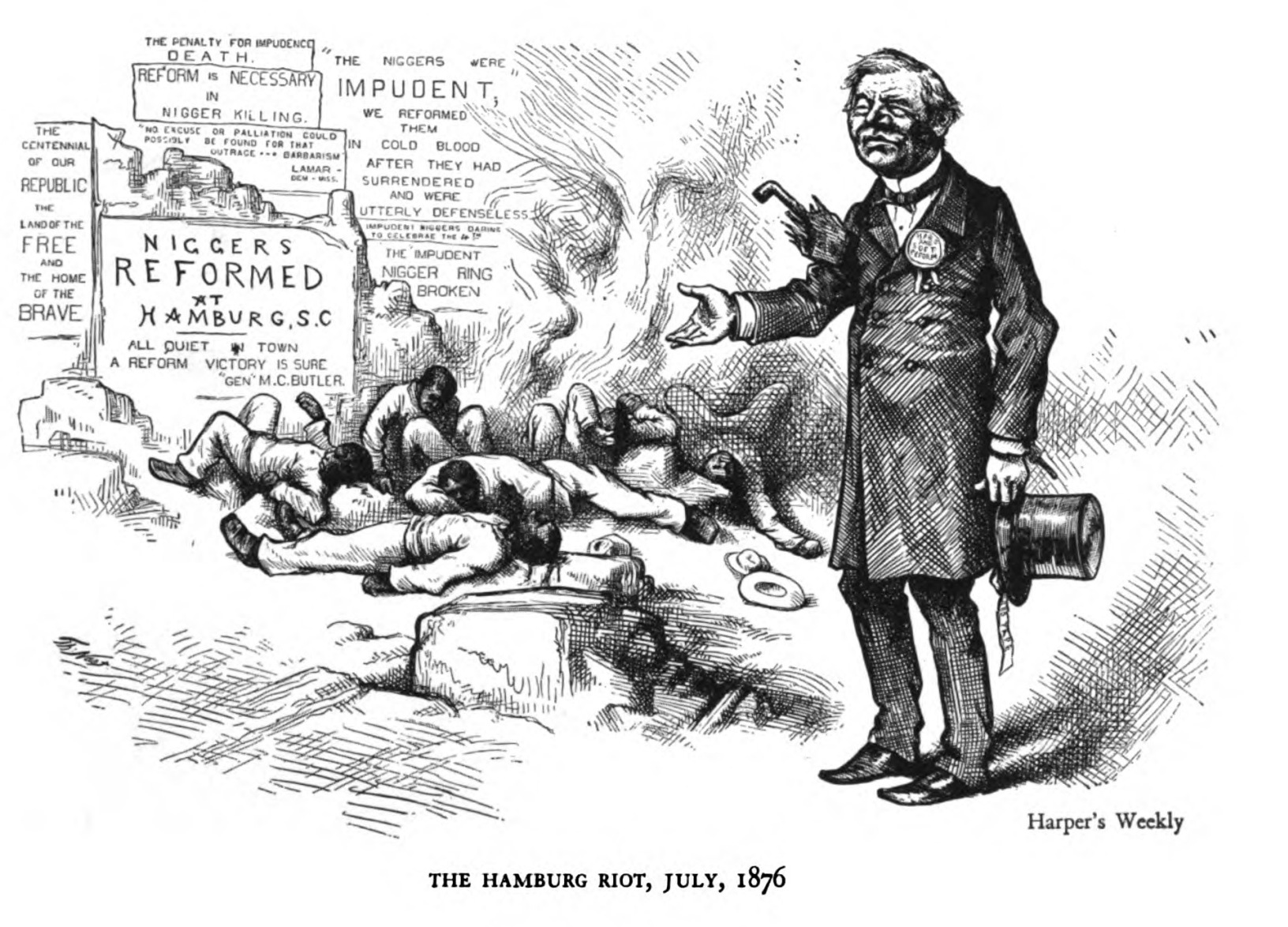
The Hamburg massacre (or Red Shirt massacre or Hamburg riot) was a riot in the United States town of Hamburg, South Carolina, in July 1876, leading up to the last election season of the Reconstruction era. It was the first of a series of civil disturbances planned and carried out by white Democrats in the majority-black Republican Edgefield District, with the goal of suppressing black Americans' civil rights and voting rights and disrupting Republican meetings, through actual and threatened violence.
Beginning with a dispute over free passage on a public road, the massacre was rooted in racial hatred and political motives. A court hearing attracted armed white "rifle clubs," colloquially called the "Red Shirts". Desiring to regain control of state governments and eradicate the civil rights of black Americans, over 100 white men attacked about 30 black servicemen of the National Guard at the armory, killing two as they tried to leave that night. Later that night, the Red Shirts tortured and murdered four of the militia while holding them as prisoners, and wounded several others. In total, the events in Hamburg resulted in the death of one white man and six black men with several more blacks being wounded. Although 94 white men were indicted for murder by a coroner's jury, none were prosecuted.
The events were a catalyst in the overarching violence in the volatile 1876 election campaign. There were other episodes of violence in the months before the election, including an estimated 100 blacks killed during several days in Ellenton, South Carolina, also in Aiken County. The Southern Democrats succeeded in "redeeming" the state government and electing Wade Hampton III as governor. During the remainder of the century, they passed laws to establish single-party white rule, impose legal segregation and "Jim Crow," and disenfranchise blacks with a new state constitution adopted in 1895. This exclusion of blacks from the political system was effectively maintained into the late 1960s.
Hamburg was a market town populated by a majority of freed blacks in Aiken County, across the Savannah River from Augusta, Georgia. Aiken was the only county in the state to have been organized during the Reconstruction era. Following the end of the War, the defunct market town was repopulated by freedmen. (It had been made obsolete by the expansion of the South Carolina Railroad into Augusta.) Many blacks in the postwar period moved from rural areas to cities to escape white violence and gain safety in their own communities.
As Democrats sought to regain control of the state legislature, their leaders planned to disrupt Republican events, as outlined in Confederate veteran General Martin W. Gary's "Plan of the Campaign of 1876" (also known as the Edgefield Plan). On July 4, 1876, Independence Day, two white planters drove in a carriage down Hamburg's wide Market Street, where they encountered a local militia company, which was drilling (or parading) under command of Captain D. L. "Doc" Adams.
The men in the Hamburg Company militia were entirely black and mostly freedmen. A white supremacist group called the Red Shirts, led by Benjamin Tillman, who later went on serve a 24-year career in the United States Senate and whose term was marked by enacting segregationist legislation, instigated confrontations with the black citizens by claiming that said freedmen intentionally blocked passage of public roads and denied passage to any white man. Alternate sources say that a carriage of white men intentionally drove up against the head of the column to cause a civil disturbance. In any case, after an exchange of words, the Red Shirts, also called "white planters", passed through the ranks of the black parade.
The Red Shirts then went to the local court, where, at a hearing on July 6, they accused the militia with obstruction of a public road before Trial Justice Prince Rivers. The case was continued until the afternoon of July 8. More than 100 whites from Edgefield and Aiken counties arrived at court, armed with "shotguns, revolvers, hoes, axes and pitchforks." At that time, Matthew Calbraith Butler, an attorney from Edgefield, appeared as the planters' counsel. (Of the many men surnamed Butler who were involved in the incident, he was referred to as 'General' Butler, based on his service in the Confederate Army.) Despite the lack of any official standing, M. C. Butler demanded for the Hamburg company to disband and turn their guns over to him personally.
As armed white men gathered in the vicinity, the militia company refused to disarm and took refuge in the armory in the Sibley building near the Charlotte, Columbia and Augusta Railroad bridge. The white militia surrounded the building. Perhaps 25 black militia and 15 others were in the building when firing began. In the exchange of gunfire, McKie Meriwether, a local white farmer, was killed.
Hub AI
Hamburg massacre AI simulator
(@Hamburg massacre_simulator)
Hamburg massacre
The Hamburg massacre (or Red Shirt massacre or Hamburg riot) was a riot in the United States town of Hamburg, South Carolina, in July 1876, leading up to the last election season of the Reconstruction era. It was the first of a series of civil disturbances planned and carried out by white Democrats in the majority-black Republican Edgefield District, with the goal of suppressing black Americans' civil rights and voting rights and disrupting Republican meetings, through actual and threatened violence.
Beginning with a dispute over free passage on a public road, the massacre was rooted in racial hatred and political motives. A court hearing attracted armed white "rifle clubs," colloquially called the "Red Shirts". Desiring to regain control of state governments and eradicate the civil rights of black Americans, over 100 white men attacked about 30 black servicemen of the National Guard at the armory, killing two as they tried to leave that night. Later that night, the Red Shirts tortured and murdered four of the militia while holding them as prisoners, and wounded several others. In total, the events in Hamburg resulted in the death of one white man and six black men with several more blacks being wounded. Although 94 white men were indicted for murder by a coroner's jury, none were prosecuted.
The events were a catalyst in the overarching violence in the volatile 1876 election campaign. There were other episodes of violence in the months before the election, including an estimated 100 blacks killed during several days in Ellenton, South Carolina, also in Aiken County. The Southern Democrats succeeded in "redeeming" the state government and electing Wade Hampton III as governor. During the remainder of the century, they passed laws to establish single-party white rule, impose legal segregation and "Jim Crow," and disenfranchise blacks with a new state constitution adopted in 1895. This exclusion of blacks from the political system was effectively maintained into the late 1960s.
Hamburg was a market town populated by a majority of freed blacks in Aiken County, across the Savannah River from Augusta, Georgia. Aiken was the only county in the state to have been organized during the Reconstruction era. Following the end of the War, the defunct market town was repopulated by freedmen. (It had been made obsolete by the expansion of the South Carolina Railroad into Augusta.) Many blacks in the postwar period moved from rural areas to cities to escape white violence and gain safety in their own communities.
As Democrats sought to regain control of the state legislature, their leaders planned to disrupt Republican events, as outlined in Confederate veteran General Martin W. Gary's "Plan of the Campaign of 1876" (also known as the Edgefield Plan). On July 4, 1876, Independence Day, two white planters drove in a carriage down Hamburg's wide Market Street, where they encountered a local militia company, which was drilling (or parading) under command of Captain D. L. "Doc" Adams.
The men in the Hamburg Company militia were entirely black and mostly freedmen. A white supremacist group called the Red Shirts, led by Benjamin Tillman, who later went on serve a 24-year career in the United States Senate and whose term was marked by enacting segregationist legislation, instigated confrontations with the black citizens by claiming that said freedmen intentionally blocked passage of public roads and denied passage to any white man. Alternate sources say that a carriage of white men intentionally drove up against the head of the column to cause a civil disturbance. In any case, after an exchange of words, the Red Shirts, also called "white planters", passed through the ranks of the black parade.
The Red Shirts then went to the local court, where, at a hearing on July 6, they accused the militia with obstruction of a public road before Trial Justice Prince Rivers. The case was continued until the afternoon of July 8. More than 100 whites from Edgefield and Aiken counties arrived at court, armed with "shotguns, revolvers, hoes, axes and pitchforks." At that time, Matthew Calbraith Butler, an attorney from Edgefield, appeared as the planters' counsel. (Of the many men surnamed Butler who were involved in the incident, he was referred to as 'General' Butler, based on his service in the Confederate Army.) Despite the lack of any official standing, M. C. Butler demanded for the Hamburg company to disband and turn their guns over to him personally.
As armed white men gathered in the vicinity, the militia company refused to disarm and took refuge in the armory in the Sibley building near the Charlotte, Columbia and Augusta Railroad bridge. The white militia surrounded the building. Perhaps 25 black militia and 15 others were in the building when firing began. In the exchange of gunfire, McKie Meriwether, a local white farmer, was killed.
Recent media