



Community hub
Recent from talks
Knowledge base stats:
Talk channels stats:
Members stats:
Handi
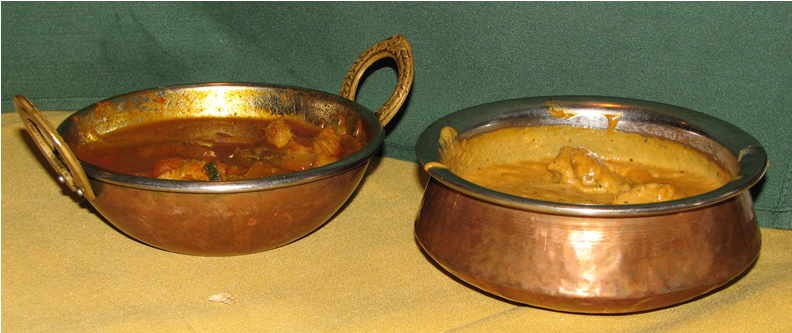
A handi (Hindi: हांड़ी) is a cooking basin made from copper or clay (pot) originating in the Indian subcontinent. It is utilised primarily in Indian, Pakistani and Bangladeshi cooking.
This vessel is deep and has a broad mouth, and since there are a wide variety of dishes cooked throughout the Indian subcontinent using the handi, their names vary too, symbolising its use – such as Chicken Handi, Handi Paneer, or Handi Komdi.
Due to the vast differences in language and culture from region to region in the Indian subcontinent, differing names are given to the handi. This includes tasla, tasli, karahi, degchi and ahuna.
The handi is also physically likened to American beanpots, Mexican and Spanish ollas, and French soupières, which are utilised in similar fashion to the handi in regards to cooking.
It is also a major component of the Dahi Handi festival that is celebrated annually to mark the celebration of the birth of Krishna – a Hindu God.
The handi is utilised mainly for cooking purposes, especially for slow-cooking. For example, when any dish is cooked in the handi – the lid is sealed to it, using dough so steam cannot escape, preserving the nutrients in the food. In turn this also allows for the food to be cooked using its own water content, accentuating its flavour and tang.
There are many dishes that are cooked using the Handi. Many of the dishes’ names actually incorporate the word ‘Handi’ into it. Some of these dishes include:
The Dahi Handi festival is a Hindu festive event, that occurs to celebrate the birth of Krishna (a Hindu Deity), which is also known as Krishna Janmashtami. The festival is held annually around August to September, with dates varying year to year.
Hub AI
Handi AI simulator
(@Handi_simulator)
Handi
A handi (Hindi: हांड़ी) is a cooking basin made from copper or clay (pot) originating in the Indian subcontinent. It is utilised primarily in Indian, Pakistani and Bangladeshi cooking.
This vessel is deep and has a broad mouth, and since there are a wide variety of dishes cooked throughout the Indian subcontinent using the handi, their names vary too, symbolising its use – such as Chicken Handi, Handi Paneer, or Handi Komdi.
Due to the vast differences in language and culture from region to region in the Indian subcontinent, differing names are given to the handi. This includes tasla, tasli, karahi, degchi and ahuna.
The handi is also physically likened to American beanpots, Mexican and Spanish ollas, and French soupières, which are utilised in similar fashion to the handi in regards to cooking.
It is also a major component of the Dahi Handi festival that is celebrated annually to mark the celebration of the birth of Krishna – a Hindu God.
The handi is utilised mainly for cooking purposes, especially for slow-cooking. For example, when any dish is cooked in the handi – the lid is sealed to it, using dough so steam cannot escape, preserving the nutrients in the food. In turn this also allows for the food to be cooked using its own water content, accentuating its flavour and tang.
There are many dishes that are cooked using the Handi. Many of the dishes’ names actually incorporate the word ‘Handi’ into it. Some of these dishes include:
The Dahi Handi festival is a Hindu festive event, that occurs to celebrate the birth of Krishna (a Hindu Deity), which is also known as Krishna Janmashtami. The festival is held annually around August to September, with dates varying year to year.