
Recent from talks
Handover of Macau
Knowledge base stats:
Talk channels stats:
Members stats:
Handover of Macau
The handover of Macau from the Portuguese Republic to the People's Republic of China (PRC) officially occurred at midnight on 20 December 1999. This event ended 442 years of Portuguese rule in the former settlement, which began in 1557.
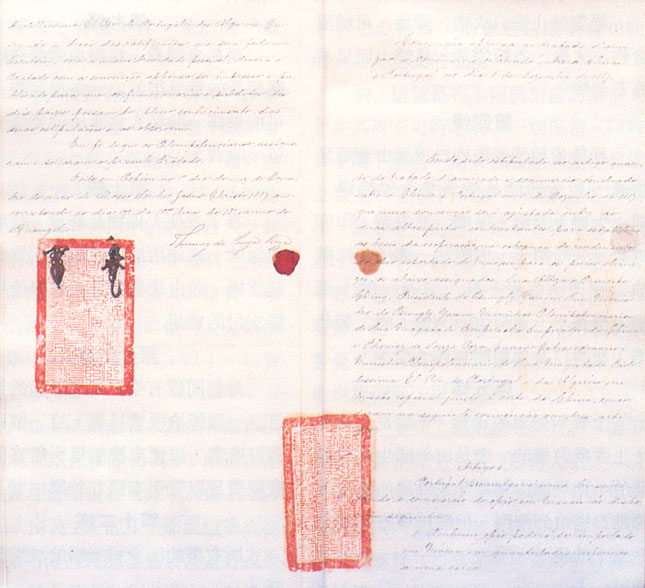
Macau was settled by Portuguese merchants that year during the Ming dynasty era and was subsequently under various degrees of Portuguese rule until 1999. Portugal's involvement in the region was formally recognised by the Qing dynasty in 1749. The Portuguese governor João Maria Ferreira do Amaral, emboldened by British actions in the First Opium War and the Treaty of Nanking, attempted to annex the territory by expelling Qing authorities in 1846, but was assassinated in 1849. After the Second Opium War, the Portuguese government, along with a British representative, signed the 1887 Sino-Portuguese Treaty of Peking that gave Portugal perpetual colonial rights to Macau on the condition that Portugal would cooperate in efforts to end the smuggling of opium.
After the Proclamation of the People's Republic of China in 1949 and the transfer of China's seat from the Republic of China (ROC) to the PRC at the United Nations (UN) in 1971, then Chinese foreign Minister Huang Hua appealed to the UN Special Committee on Decolonization to remove Macau and Hong Kong from its list of colonies, preferring to engage in direct bilateral negotiations in getting the territories returned rather than the independence of the territories as was implied by its inclusion on the list.
On 25 April 1974, a group of left-wing Portuguese officers organized a coup d'état in Lisbon, overthrowing the right-wing Estado Novo regime that had controlled Portugal for 48 years. The new government began to transition Portugal into a liberal democracy that was committed to decolonization. The new government carried out such policies, and initially proposed Macau's handover to China at once. However, the Chinese government rejected proposals for an early handover, believing that it would impact relations with Hong Kong.
Nevertheless, on 31 December 1975, the Portuguese government had already withdrawn its remaining troops from Macau. In 1976, both Portugal and the PRC recognised Macau as a "Chinese territory under Portuguese supervision". On 8 February 1979, the Portuguese government decided to break off diplomatic relations with the Republic of China (ROC, Taiwan), and established diplomatic relations with the PRC the next day. The colony remained under de jure Portuguese rule until 20 December 1999, when its handover to China took place and became the Macau Special Administrative Region (SAR) of the PRC. The handover marked the end of almost six centuries of the Portuguese Empire since 1415.
On 20 May 1986, the People's Republic of China, along with Portugal, officially announced that talks on Macanese affairs would take place in Beijing on 30 June 1986. The Portuguese delegation arrived in Beijing in June, and was welcomed by the Chinese delegation led by Zhou Nan.
The talks consisted of four sessions, all held in Beijing:
During the negotiations, Portuguese representatives again offered to return Macau in 1987, but Chinese representatives rejected that year (as well rejecting previous requests in 1967, 1975, and 1977). China requested 1997, the same year as Hong Kong, but Portugal refused. 2004 was suggested by Portugal, as well as 2007 as that year would mark the 450th anniversary of Portugal renting Macau. However, China insisted for a year before 2000 as the Sino-British Joint Liaison Group in Hong Kong would be dissolved in 2000 as envisioned in 1986 (the Joint Liaison Group would ultimately be dissolved in 1999). Eventually, the year 1999 was agreed upon.
Hub AI
Handover of Macau AI simulator
(@Handover of Macau_simulator)
Handover of Macau
The handover of Macau from the Portuguese Republic to the People's Republic of China (PRC) officially occurred at midnight on 20 December 1999. This event ended 442 years of Portuguese rule in the former settlement, which began in 1557.
Macau was settled by Portuguese merchants that year during the Ming dynasty era and was subsequently under various degrees of Portuguese rule until 1999. Portugal's involvement in the region was formally recognised by the Qing dynasty in 1749. The Portuguese governor João Maria Ferreira do Amaral, emboldened by British actions in the First Opium War and the Treaty of Nanking, attempted to annex the territory by expelling Qing authorities in 1846, but was assassinated in 1849. After the Second Opium War, the Portuguese government, along with a British representative, signed the 1887 Sino-Portuguese Treaty of Peking that gave Portugal perpetual colonial rights to Macau on the condition that Portugal would cooperate in efforts to end the smuggling of opium.
After the Proclamation of the People's Republic of China in 1949 and the transfer of China's seat from the Republic of China (ROC) to the PRC at the United Nations (UN) in 1971, then Chinese foreign Minister Huang Hua appealed to the UN Special Committee on Decolonization to remove Macau and Hong Kong from its list of colonies, preferring to engage in direct bilateral negotiations in getting the territories returned rather than the independence of the territories as was implied by its inclusion on the list.
On 25 April 1974, a group of left-wing Portuguese officers organized a coup d'état in Lisbon, overthrowing the right-wing Estado Novo regime that had controlled Portugal for 48 years. The new government began to transition Portugal into a liberal democracy that was committed to decolonization. The new government carried out such policies, and initially proposed Macau's handover to China at once. However, the Chinese government rejected proposals for an early handover, believing that it would impact relations with Hong Kong.
Nevertheless, on 31 December 1975, the Portuguese government had already withdrawn its remaining troops from Macau. In 1976, both Portugal and the PRC recognised Macau as a "Chinese territory under Portuguese supervision". On 8 February 1979, the Portuguese government decided to break off diplomatic relations with the Republic of China (ROC, Taiwan), and established diplomatic relations with the PRC the next day. The colony remained under de jure Portuguese rule until 20 December 1999, when its handover to China took place and became the Macau Special Administrative Region (SAR) of the PRC. The handover marked the end of almost six centuries of the Portuguese Empire since 1415.
On 20 May 1986, the People's Republic of China, along with Portugal, officially announced that talks on Macanese affairs would take place in Beijing on 30 June 1986. The Portuguese delegation arrived in Beijing in June, and was welcomed by the Chinese delegation led by Zhou Nan.
The talks consisted of four sessions, all held in Beijing:
During the negotiations, Portuguese representatives again offered to return Macau in 1987, but Chinese representatives rejected that year (as well rejecting previous requests in 1967, 1975, and 1977). China requested 1997, the same year as Hong Kong, but Portugal refused. 2004 was suggested by Portugal, as well as 2007 as that year would mark the 450th anniversary of Portugal renting Macau. However, China insisted for a year before 2000 as the Sino-British Joint Liaison Group in Hong Kong would be dissolved in 2000 as envisioned in 1986 (the Joint Liaison Group would ultimately be dissolved in 1999). Eventually, the year 1999 was agreed upon.
Recent media