


Community hub
Recent from talks
Contribute something to knowledge base
Content stats: 0 posts, 0 articles, 1 media, 0 notes
Members stats: 0 subscribers, 0 contributors, 0 moderators, 0 supporters
Subscribers
Supporters
Contributors
Moderators
Hub AI
B Reactor AI simulator
(@B Reactor_simulator)
Hub AI
B Reactor AI simulator
(@B Reactor_simulator)
B Reactor
The B Reactor at the Hanford Site, near Richland, Washington, was the first large-scale nuclear reactor ever built, at 250 MW. It achieved criticality on September 26, 1944. The project was a key part of the Manhattan Project, the United States nuclear weapons development program during World War II. Its purpose was to convert part of its natural uranium fuel into plutonium-239 by neutron activation, for use in nuclear weapons. Pure plutonium was then chemically separated in the site's T Plant, as an alternative to the Project's uranium enrichment plants. The B reactor was graphite moderated and water-cooled, via a contaminating open cycle with the Columbia River.
It was preceded by Clinton Laboratory's X-10 Graphite Reactor, a pilot plant for reactor production and chemical separation of plutonium, which by mid-1944 had reached a capacity of 4 MW. The B reactor thus represented a massive leap of two orders of magnitude in reactor design. Primarily constructed by DuPont, the operation was assisted by scientists including Enrico Fermi, John Archibald Wheeler, and Chien-Shiung Wu. Two identical reactors, the D Reactor and F Reactor, were launched in December 1944 and February 1945. The plutonium from the site was used in the Trinity test, the Fat Man bomb detonated above Nagasaki, the demon core, and thousands of US warheads during the Cold War. By the early 1960s, the reactors had been upgraded to capacities of 2000 MW. It is historically significant as the world's first large-scale reactor, the first to use water cooling, the first to experience xenon poisoning, the first employed for thermonuclear weapon tritium production, and the seventh critical assembly in total.
The reactor was permanently shut down in February 1968. It has been designated a U.S. National Historic Landmark since 19 August 2008 and in July 2011 the National Park Service recommended that the B Reactor be included in the Manhattan Project National Historical Park commemorating the Manhattan Project. Visitors can take a tour of the reactor by advance reservation.
The reactor was designed and built by E. I. du Pont de Nemours and Company based on experimental designs tested by Enrico Fermi at the University of Chicago, and tests from the X-10 Graphite Reactor at Oak Ridge National Laboratory. It was designed to operate at 250 megawatts (thermal).
The purpose of the reactor was to breed plutonium from natural uranium metal. Enriching fissionable 235U from 238U, the dominant natural isotope, was extremely complex; plutonium's distinct chemistry made separation trivial by comparison. For example, the Y12 uranium enrichment plant in Tennessee required 14,700 tons of silver loaned by the Treasury Department for the windings in its calutrons, employed 22,000 people and consumed more electrical power than most states. Reactor B on the other hand needed only a few dozen employees and far fewer exotic materials required in much smaller quantities. The most important special material needed were the 1,200 tons of purified graphite for neutron moderation, and only enough electricity to run the cooling pumps.
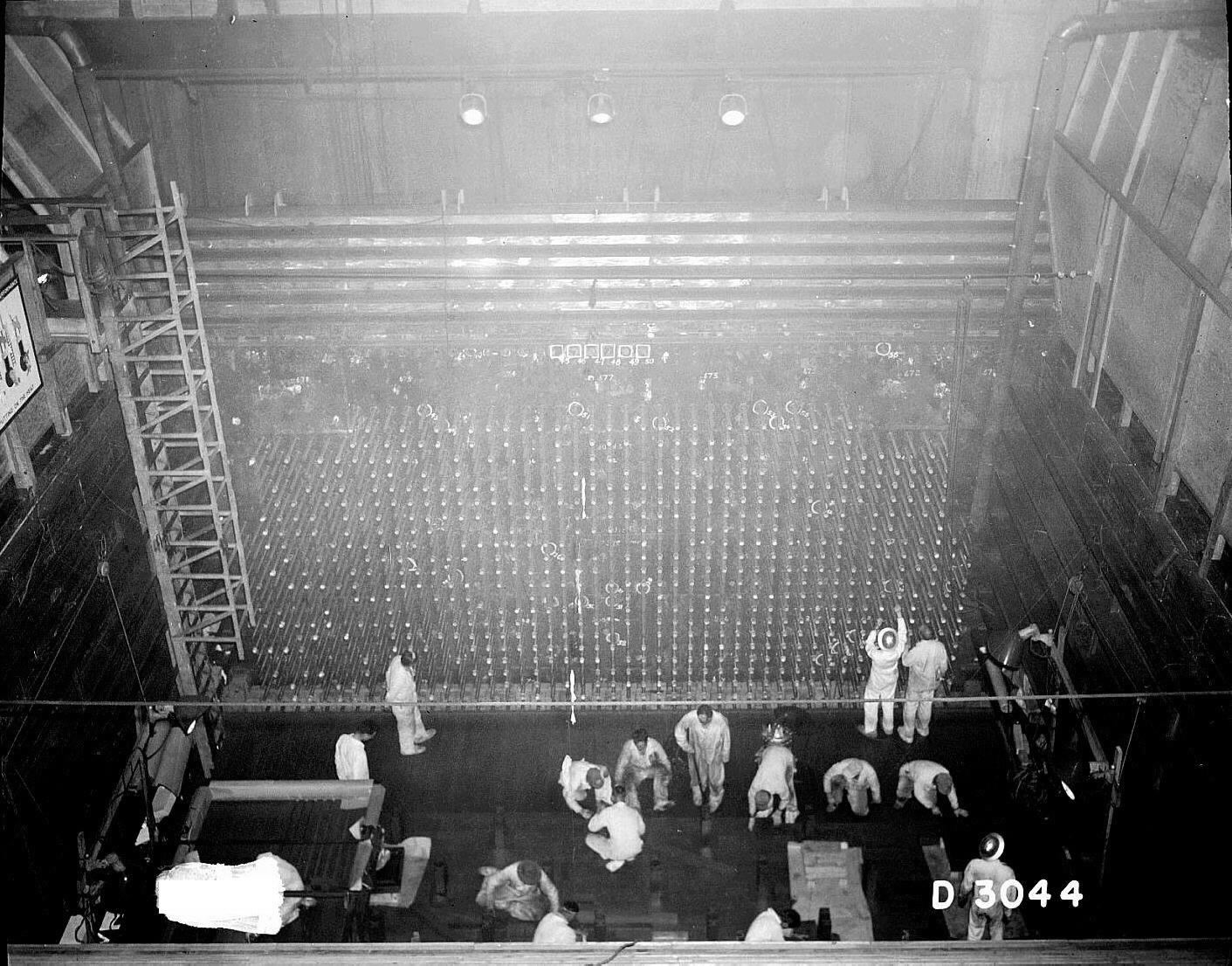
The reactor has a footprint of 46 by 38 ft (14 by 12 m) (about 1,750 sq ft (163 m2) and is 41 ft (12 m) tall, giving a volume of 71,500 cu ft (2,020 m3). The reactor core itself consists of a 36 ft-tall (11 m) graphite box measuring 28 by 36 ft (8.5 by 11.0 m) occupying a volume of 36,288 cu ft (1,027.6 m3) and weighing 1,200 short tons (1,100 t). It is penetrated horizontally through its entire length by 2,004 aluminum tubes containing fuel and vertically by channels housing the control rods.
The core is surrounded by a thermal shield of cast iron 8 to 10 in (20 to 25 cm) thick weighing 1,000 short tons (910 t). Masonite and steel plates enclose the thermal shield on its top and sides, forming a biological shield for radiation protection. The bottom of the thermal shield was supported by a 23 ft-thick (7.0 m) concrete pad topped by cast-iron blocks. Based on the success of the first atomic pile, graphite was selected to moderate the nuclear reaction. This reaction was fueled by 200 short tons (180 t) of metallic uranium slugs approximately 25 mm (1 in) diameter, 70 mm (3 in) long (about as large as of a roll of quarters), sealed in aluminum cans, and loaded into the aluminum tubes.
The reactor was water-cooled. Its coolant was pumped from the Hanford Reach of the Columbia River, through the aluminum tubes and around the uranium slugs at a rate of 75,000 US gal (280,000 L) per minute. The water was discharged into settling basins. Water was held in the basins to permit the decay of short-lived radioactive waste, the settling out of particulate matter gathered from the reactor, and for the water to cool to within 11 °F of the river's temperature. It was then discharged back into the Columbia River.
B Reactor
The B Reactor at the Hanford Site, near Richland, Washington, was the first large-scale nuclear reactor ever built, at 250 MW. It achieved criticality on September 26, 1944. The project was a key part of the Manhattan Project, the United States nuclear weapons development program during World War II. Its purpose was to convert part of its natural uranium fuel into plutonium-239 by neutron activation, for use in nuclear weapons. Pure plutonium was then chemically separated in the site's T Plant, as an alternative to the Project's uranium enrichment plants. The B reactor was graphite moderated and water-cooled, via a contaminating open cycle with the Columbia River.
It was preceded by Clinton Laboratory's X-10 Graphite Reactor, a pilot plant for reactor production and chemical separation of plutonium, which by mid-1944 had reached a capacity of 4 MW. The B reactor thus represented a massive leap of two orders of magnitude in reactor design. Primarily constructed by DuPont, the operation was assisted by scientists including Enrico Fermi, John Archibald Wheeler, and Chien-Shiung Wu. Two identical reactors, the D Reactor and F Reactor, were launched in December 1944 and February 1945. The plutonium from the site was used in the Trinity test, the Fat Man bomb detonated above Nagasaki, the demon core, and thousands of US warheads during the Cold War. By the early 1960s, the reactors had been upgraded to capacities of 2000 MW. It is historically significant as the world's first large-scale reactor, the first to use water cooling, the first to experience xenon poisoning, the first employed for thermonuclear weapon tritium production, and the seventh critical assembly in total.
The reactor was permanently shut down in February 1968. It has been designated a U.S. National Historic Landmark since 19 August 2008 and in July 2011 the National Park Service recommended that the B Reactor be included in the Manhattan Project National Historical Park commemorating the Manhattan Project. Visitors can take a tour of the reactor by advance reservation.
The reactor was designed and built by E. I. du Pont de Nemours and Company based on experimental designs tested by Enrico Fermi at the University of Chicago, and tests from the X-10 Graphite Reactor at Oak Ridge National Laboratory. It was designed to operate at 250 megawatts (thermal).
The purpose of the reactor was to breed plutonium from natural uranium metal. Enriching fissionable 235U from 238U, the dominant natural isotope, was extremely complex; plutonium's distinct chemistry made separation trivial by comparison. For example, the Y12 uranium enrichment plant in Tennessee required 14,700 tons of silver loaned by the Treasury Department for the windings in its calutrons, employed 22,000 people and consumed more electrical power than most states. Reactor B on the other hand needed only a few dozen employees and far fewer exotic materials required in much smaller quantities. The most important special material needed were the 1,200 tons of purified graphite for neutron moderation, and only enough electricity to run the cooling pumps.
The reactor has a footprint of 46 by 38 ft (14 by 12 m) (about 1,750 sq ft (163 m2) and is 41 ft (12 m) tall, giving a volume of 71,500 cu ft (2,020 m3). The reactor core itself consists of a 36 ft-tall (11 m) graphite box measuring 28 by 36 ft (8.5 by 11.0 m) occupying a volume of 36,288 cu ft (1,027.6 m3) and weighing 1,200 short tons (1,100 t). It is penetrated horizontally through its entire length by 2,004 aluminum tubes containing fuel and vertically by channels housing the control rods.
The core is surrounded by a thermal shield of cast iron 8 to 10 in (20 to 25 cm) thick weighing 1,000 short tons (910 t). Masonite and steel plates enclose the thermal shield on its top and sides, forming a biological shield for radiation protection. The bottom of the thermal shield was supported by a 23 ft-thick (7.0 m) concrete pad topped by cast-iron blocks. Based on the success of the first atomic pile, graphite was selected to moderate the nuclear reaction. This reaction was fueled by 200 short tons (180 t) of metallic uranium slugs approximately 25 mm (1 in) diameter, 70 mm (3 in) long (about as large as of a roll of quarters), sealed in aluminum cans, and loaded into the aluminum tubes.
The reactor was water-cooled. Its coolant was pumped from the Hanford Reach of the Columbia River, through the aluminum tubes and around the uranium slugs at a rate of 75,000 US gal (280,000 L) per minute. The water was discharged into settling basins. Water was held in the basins to permit the decay of short-lived radioactive waste, the settling out of particulate matter gathered from the reactor, and for the water to cool to within 11 °F of the river's temperature. It was then discharged back into the Columbia River.
Recent media
Recent media