Hubbry Logo
Demon coreDemon coreMain
Open search
Demon core
Community hub
Demon core
logo
8 pages, 0 posts
0 subscribers
Be the first to start a discussion here.
Demon core
Demon core
from Wikipedia

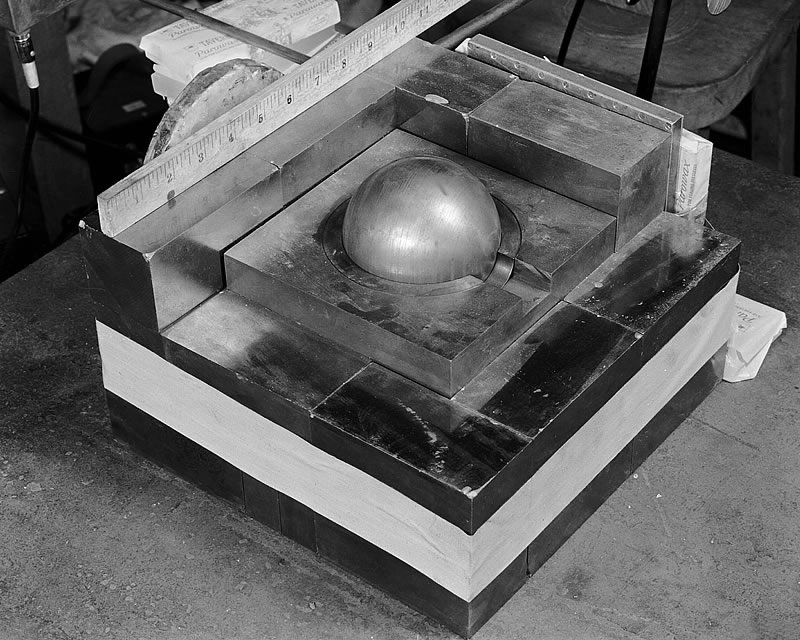
A square base of metal blocks, with a smaller square of metal on the top in the center, a Cooper block (the "core") contained in its center. A ruler along one side of the base shows roughly 10.5 inches (270 mm) square.
A re-creation of the experiment involved in the 1945 incident. The sphere of plutonium is surrounded by tungsten carbide blocks acting as neutron reflectors.

The demon core was a sphere of plutonium that was involved in two fatal radiation accidents when scientists tested it as a fissile core of an early atomic bomb. It was manufactured in 1945 by the Manhattan Project, the U.S. nuclear weapon development effort during World War II. It was a subcritical mass that weighed 6.2 kilograms (14 lb) and was 8.9 centimeters (3.5 in) in diameter. The core was prepared for shipment to the Pacific Theater as part of the third nuclear weapon to be dropped on Japan, but when Japan surrendered, the core was retained for testing and potential later use in the case of another conflict.

The two criticality accidents occurred at the Los Alamos Laboratory in New Mexico on August 21, 1945, and May 21, 1946. In both cases, an experiment was intended to demonstrate how close the core was to criticality, using a neutron-reflective tamper (layer of dense material surrounding the fissile material). In both accidents, the core was accidentally put into a critical configuration. Physicists Harry Daghlian (in the first accident) and Louis Slotin (in the second accident) both suffered acute radiation syndrome and died shortly afterward. At the same time, others present in the laboratory were also exposed. The core was melted down during the summer of 1946, and the material was recycled for use in other cores.

Manufacturing and early history

[edit]

The demon core (like the core used in the bombing of Nagasaki) was, when assembled, a solid 6.2-kilogram (14 lb) softball-sized sphere measuring 8.9 centimeters (3.5 in) in diameter. It consisted of three parts made of plutonium-gallium: two hemispheres and an anti-jet ring, designed to keep neutron flux from "jetting" out of the joined surface between the hemispheres during implosion. The core of the device used in the Trinity Test at the Alamogordo Bombing and Gunnery Range in July did not have such a ring.[1][2]

The two physicists Harry Daghlian (center left) and Louis Slotin (center right) during the Trinity Test. Both died following supercritical accidents involving the "demon core."

The refined plutonium was shipped from the Hanford Site in Washington to the Los Alamos Laboratory; an inventory document dated August 30 shows Los Alamos had expended "HS-1, 2, 3, 4; R-1" (the components of the Trinity and Nagasaki bombs) and had in its possession "HS-5, 6; R-2", finished and in the hands of quality control. Material for "HS-7, R-3" was in the Los Alamos metallurgy section and would also be ready by September 5 (it is not certain whether this date allowed for the unmentioned "HS-8"'s fabrication to complete the fourth core).[3] The metallurgists used a plutonium-gallium alloy, which stabilized the delta (δ) phase allotrope of plutonium so it could be hot pressed into the desired spherical shape. As plutonium was found to corrode readily, the sphere was then coated with nickel.[4]

On August 10, Major General Leslie R. Groves Jr., wrote to General of the Army George C. Marshall, the Chief of Staff of the United States Army, to inform him that:

The next bomb of the implosion type had been scheduled to be ready for delivery on the target on the first good weather after August 24th, 1945. We have gained 4 days in manufacture and expect to ship the final components from New Mexico on August 12th or 13th. Providing there are no unforeseen difficulties in manufacture, in transportation to the theatre or after arrival in the theatre, the bomb should be ready for delivery on the first suitable weather after August 17th or 18th.[3]

Marshall added an annotation, "It is not to be released on Japan without express authority from the President", on President Harry S. Truman's orders.[3] On August 13, the third bomb was scheduled. It was anticipated that it would be ready by August 16 to be dropped on August 19.[3] This was pre-empted by Japan's surrender on August 15, 1945, while preparations were still being made for it to be couriered to Kirtland Field. The third core remained at Los Alamos.[5]

First incident

[edit]

The core, once assembled, was designed to be at "−5 cents".[6] In this state, there is only a small safety margin against extraneous factors that might increase reactivity, causing the core to become supercritical, and then prompt critical, a brief state of rapid energy increase.[7] These factors are not common in the environment; they are only likely to occur under conditions such as the compression of the solid metallic core (which would eventually be the method used to explode the bomb), the addition of more nuclear material, or provision of an external reflector which would reflect outbound neutrons back into the core. The experiments conducted at Los Alamos leading to the two fatal accidents were designed to guarantee that the core was indeed close to the critical point by arranging such reflectors and seeing how much neutron reflection was required to approach supercriticality.[6]

On August 21, 1945, the plutonium core produced a burst of neutron radiation that resulted in physicist Harry Daghlian's death. Daghlian made a mistake while performing neutron reflector experiments on the core. He was working alone; a security guard, Private Robert J. Hemmerly, was seated at a desk 10 to 12 feet (3 to 4 m) away.[8] The core was placed within a stack of neutron-reflective tungsten carbide bricks, and the addition of each brick made the assembly closer to criticality. While attempting to stack another brick around the assembly, Daghlian accidentally dropped it onto the core and thereby caused the core to go well into supercriticality, a self-sustaining critical chain reaction. He quickly moved the brick off the assembly, but he received a fatal dose of radiation. He died 25 days later from acute radiation poisoning.[9]

Name Age at accident Profession Dose[8]: 20  Aftermath
Haroutune "Harry" Krikor Daghlian Jr. 24 Physicist 200 rad (2.0 Gy) neutron
110 rad (1.1 Gy) gamma
Died 25 days after the accident of acute radiation syndrome, hematopoietic focus[8]: 22 
Private Robert J. Hemmerly 29 Special Engineer Detachment guard 8 rad (0.080 Gy) neutron
0.1 rad (0.0010 Gy) gamma
Died in 1978 (33 years after accident) of acute myelogenous leukemia at age 62[8]: 9–11, 22 

Second incident

[edit]
A re-creation of the 1946 experiment. The half-sphere is seen, but the core inside is not. The beryllium hemisphere is held up with a screwdriver.
A sketch used by doctors to determine the amount of radiation to which each person in the room had been exposed during the excursion
A drawing based on the above sketch

On May 21, 1946,[10] physicist Louis Slotin and seven other personnel were in a Los Alamos laboratory conducting another experiment to verify the closeness of the core to criticality by the positioning of neutron reflectors. Slotin, who was leaving Los Alamos, was showing the technique to Alvin C. Graves, who would use it in a final test before the Operation Crossroads nuclear tests scheduled a month later at Bikini Atoll. It required the operator to place two half-spheres of beryllium (a neutron reflector) around the core to be tested and manually lower the top reflector over the core using a thumb hole at the polar point. As the reflectors were manually moved closer and farther away from each other, neutron detectors indicated the core's neutron multiplication rate. The experimenter needed to maintain a slight separation between the reflector halves to allow enough neutrons to escape from the core in order to stay below criticality. The standard protocol was to use shims between the halves, as allowing them to close completely could result in the instantaneous formation of a critical mass and a lethal power excursion.[10]

By Slotin's own unapproved protocol, the shims were not used. The top half of the reflector was resting directly on the bottom half at one point, while 180 degrees from this point a gap was maintained by the blade of a flat-tipped screwdriver in Slotin's hand. The size of the gap between the reflectors was changed by twisting the screwdriver. Slotin, who was given to bravado,[11] became the local expert, performing the test on almost a dozen occasions, often in his trademark blue jeans and cowboy boots in front of a roomful of observers. Enrico Fermi reportedly told Slotin and others they would be "dead within a year" if they continued performing the test in that manner.[12] Scientists referred to this flirtation with a nuclear chain reaction as "tickling the dragon's tail", based on a remark by physicist Richard Feynman.[13][14]

On the day of the accident, Slotin's screwdriver slipped outward a fraction of an inch while he was lowering the top reflector, allowing the reflector to fall into place around the core. Instantly, there was a flash of light; the core had become supercritical, releasing an intense burst of neutron radiation. Slotin quickly twisted his wrist, flipping the top shell to the floor.[15] There was an estimated half-second between when the sphere closed to when Slotin removed the top reflector.[6] Slotin received a lethal dose of 1,000 rad (10 Gy) neutron and 114 rad (1.14 Gy) gamma radiation in less than a second, while the position of Slotin's body over the apparatus shielded the others from much of the neutron radiation. Slotin died nine days later from acute radiation poisoning.

Graves, the next nearest person to the core, was watching over Slotin's shoulder and was thus partially shielded by him. He received a high but non-lethal radiation dose. Graves was hospitalized for several weeks with severe radiation poisoning.[8] He died 19 years later, at age 55, of heart failure. While this may have been caused by Graves' exposure to radiation, the condition may have been hereditary, as his father also died of heart failure.[16][17]

The second accident was reported by the Associated Press on May 26, 1946: "Four men injured through accidental exposure to radiation in the government's atomic laboratory here [Los Alamos] have been discharged from the hospital and 'immediate condition' of four others is satisfactory, the Army reported today. Dr. Norris E. Bradbury, project director, said the men were injured last Tuesday in what he described as an experiment with fissionable material."[18]

Medical studies

[edit]

Later research was performed concerning the health of the men. An early report was published in 1951. A later report was compiled for the U.S. government and submitted in 1979.[8] A summary of its findings:

Name Origin Age at accident Profession Dose[8] Aftermath
Louis Alexander Slotin Winnipeg, Manitoba, Canada 35 Physicist 1,000 rad (10 Gy) neutron
114 rad (1.14 Gy) gamma
Died 9 days after the accident of acute radiation syndrome, gastrointestinal focus.[10]
Alvin C. Graves Austin, Texas 36 Physicist 166 rad (1.66 Gy) neutron
26 rad (0.26 Gy) gamma
Died in 1965 (19 years after the accident) of myocardial infarction, with aggravating "compensated myxedema and cataracts", while skiing.[8]
Samuel Allan Kline Chicago, Illinois 26 Physics student, later patent attorney Died in 2001 (55 years after the accident) at age 81; refused to participate with studies and was prevented from obtaining his own medical records from the incident.[8]
Marion Edward Cieslicki Mt. Lebanon, Pennsylvania 23 Physicist 12 rad (0.12 Gy) neutron
4 rad (0.040 Gy) gamma
Died of acute myelocytic leukemia in 1965 (19 years after the accident).[8]
Dwight Smith Young Chicago, Illinois 54 Photographer 51 rad (0.51 Gy) neutron
11 rad (0.11 Gy) gamma
Died of aplastic anemia and bacterial endocarditis in 1975 (29 years after the accident) at age 83.[8]
Raemer Edgar Schreiber McMinnville, Oregon 36 Physicist 9 rad (0.090 Gy) neutron
3 rad (0.030 Gy) gamma
Died of natural causes in 1998 (52 years after the accident), at age 88.[8][15]
Theodore Perlman New Orleans, Louisiana[19] 23 Engineer 7 rad (0.070 Gy) neutron
2 rad (0.020 Gy) gamma
"Alive and in good health and spirits" as of 1978; most likely died in June 1988 (42 years after the accident), in Livermore, California.[8]
Private Patrick Joseph Cleary New York City, New York 21 Security guard 33 rad (0.33 Gy) neutron
9 rad (0.090 Gy) gamma
Sergeant 1st Class Cleary was killed in action on 3 September 1950 (4 years after the accident) while serving with the 8th Cavalry Regiment, US Army in the Korean War.[8][20]

Two machinists, Paul Long and another, unidentified, in another part of the building, 20–25 ft (6–7.5 m) away, were not treated.[21]

After these incidents, the core, originally known as "Rufus", was referred to as the "demon core".[3][22] Hands-on criticality experiments were stopped, and remote-control machines and TV cameras were designed by Schreiber, one of the survivors, to perform such experiments with all personnel at a quarter-mile distance.[15]

Planned uses and fate of the core

[edit]

The demon core was intended for use in the Operation Crossroads nuclear tests, but after the second criticality accident, time was needed for its radioactivity to decrease and for it to be re-evaluated for the effects of the fission products it held, some of which were very neutron poisonous to the desired level of fission. The next two cores were shipped for use in Able and Baker, and the demon core was scheduled to be shipped later for the third test of the series, provisionally named Charlie, but that test was canceled because of the unexpected level of radioactivity resulting from the underwater Baker test and the inability to decontaminate the target warships. The core was melted down during the summer of 1946, and the material was recycled for use in other cores.[22]

See also

[edit]

References

[edit]
[edit]
Revisions and contributorsEdit on WikipediaRead on Wikipedia
from Grokipedia
![Partially-reflected-plutonium-sphere.jpeg][float-right] The demon core was a 6.2-kilogram subcritical sphere of -gallium alloy, measuring 8.9 centimeters in , manufactured at Los Alamos Laboratory as the fissile component for a planned third plutonium implosion-type atomic bomb during but repurposed for criticality experiments after Japan's surrender. It became infamous following two supercriticality accidents during manual "tickling the dragon's tail" tests to determine its : on August 21, 1945, Harry K. Daghlian Jr. accidentally dropped a 4.4-kilogram brick reflector onto the core while working alone at night, prompting a brief that exposed him to a fatal dose, leading to his death from 25 days later. Less than a year later, on May 21, 1946, Louis Slotin demonstrated a similar experiment to colleagues by precariously separating beryllium hemisphere reflectors with a , which slipped and allowed the assembly to go supercritical for nearly a minute; Slotin displaced the upper hemisphere with his body to shield others but absorbed a himself, succumbing to poisoning nine days afterward. These incidents, the first documented criticality accidents resulting in fatalities, underscored the perils of hands-on nuclear experimentation without remote handling, prompting Los Alamos to ban such manual procedures and eventually leading to the core's meltdown for reuse in other . The core's nickname, "demon core," emerged posthumously, reflecting its deadly reputation among laboratory personnel.

Production and Initial Purpose

Manufacturing and Composition

The demon core was composed of a , primarily with approximately 1% added to stabilize the delta phase of , which facilitated and machining while preventing phase transitions that could alter its and criticality . The finished core formed a subcritical spherical mass weighing 6.2 kilograms and measuring 8.9 centimeters in diameter. production for the core occurred at the , where was irradiated in graphite-moderated reactors to produce via and subsequent . Chemical separation processes extracted the from the spent fuel, requiring roughly 4,000 pounds of uranium to yield 1 pound of . The purified was then transported to Los Alamos Laboratory for alloying and fabrication. At Los Alamos, the underwent followed by hot-pressing into the spherical form, after which a thin coating was applied to inhibit oxidation and contain emitted alpha particles. This yielded a core intended as the fissile component for a third atomic bomb but repurposed for postwar criticality experiments.

Role in Manhattan Project and WWII

The demon core, a 6.2-kilogram sphere of -gallium alloy, was produced at Los Alamos Laboratory as the for the third atomic bomb in the U.S. arsenal during . This implosion-type device, akin to the bomb detonated over on August 9, 1945, was prepared amid plans for additional strikes on to hasten its surrender. By mid-August 1945, the core had been machined to specifications optimizing multiplication for supercriticality when compressed by conventional explosives in a bomb assembly. Initially slated for shipment to Tinian Island for integration into a weapon potentially targeting Japanese cities such as or Niigata, the core's deployment was halted by Japan's unconditional surrender on August 15, 1945, following the and bombings. The Manhattan Project's production at supplied the fissile cores for both and this reserve unit, underscoring the program's rapid scaling to support multiple operations under , the planned invasion of . With the war's end, the core was retained at Los Alamos rather than disassembled or repurposed for immediate postwar use, allowing its subsequent role in criticality research to extend the project's legacy in .

Criticality Experiments and Accidents

Methods of Criticality Testing

Criticality experiments with the demon core, a 6.2-kilogram of -gallium approximately 89 millimeters in , aimed to measure multiplication factors and approach supercriticality without initiating a sustained . These tests involved surrounding the subcritical core with neutron-reflecting materials to enhance fission efficiency, using a polonium-beryllium to initiate chains, and monitoring via detectors connected to oscilloscopes. Researchers manually adjusted reflector positions to incrementally increase reactivity, observing exponential rises in counts to determine the effective multiplication constant k and parameters for plutonium assemblies. The phrase "tickling the dragon's tail," attributed to physicist , described this precarious balancing act near the prompt-critical threshold, where delays in neutron emission could still allow brief supercritical excursions. One primary technique employed as reflectors, stacked around the core's sides and top on a platform to simulate tamper effects in designs. On August 21, 1945, added layer by layer, withdrawing one when detectors indicated excessive reactivity, but accidentally dropped a 4.4-kilogram onto , reducing separation and prompting a 0.9-second supercritical burst yielding about 10^{15} fissions. This method tested geometric configurations' impact on criticality, with chosen for their high density and moderation properties akin to tampers. Another approach utilized hemispheres, valued for their low neutron absorption and high scattering cross-section, to enclose the core hemispherically. On May 21, 1946, physicist demonstrated this to observers by lowering the upper hemisphere over the core, maintaining a gap with a while a operated nearby; slippage caused the halves to close fully, inducing a 700-millisecond of 3 × 10^{16} fissions. Beryllium's reflective qualities allowed precise control of k-effective, enabling measurements of assembly behavior under varying separations, though manual handling introduced human-error risks absent in later remote manipulators. These experiments, conducted at Los Alamos Laboratory's Omega Site, prioritized rapid data collection post-World War II over formalized safety protocols, reflecting the era's emphasis on empirical validation of theoretical criticality models.

Harry Daghlian Incident (August 1945)

On August 21, 1945, at the Omega Site laboratory in , physicist conducted a manual criticality experiment using the 6.2-kilogram plutonium-gallium core. He worked alone late in the evening, stacking bricks—each weighing approximately 4.4 kilograms—as neutron reflectors around the core to determine the precise configuration needed for criticality. This hands-on approach violated standard safety protocols, which discouraged solitary operations and favored remote handling to minimize exposure risks. As Daghlian positioned the final atop the assembly, which was already near the critical point, he misjudged its stability and accidentally dropped it directly onto . The impact initiated a supercritical , producing an intense burst of and gamma , accompanied by a glow from ionized air and a wave of . Recognizing the danger, Daghlian immediately used his hands to remove the offending and then manually disassembled the surrounding stack, halting the reaction after about 20 seconds but prolonging his exposure to the decaying field. Daghlian received an estimated whole-body dose of around 404 rem (approximately 4 Gy), with his hands and arms absorbing far higher localized doses due to their proximity—up to 200 Gy on the right hand. Initial symptoms included a tingling sensation and subsequent painful blisters and burns on his hands. Within days, he developed , manifesting as , high fever, significant , severe gastrointestinal distress, and eventual despite intensive medical intervention at the U.S. Engineers Hospital in Los Alamos. Daghlian died on September 15, 1945, 25 days after the accident, marking the first documented fatality from . The cause was , resulting from the destruction of and gastrointestinal tissues by the , which overwhelmed the body's regenerative capacity. This incident underscored the hazards of manual criticality testing and contributed to subsequent reforms, including stricter rules against solo experiments and the development of remote-handling equipment.

Louis Slotin Incident (May 1946)

On May 21, 1946, physicist Louis Slotin conducted an informal demonstration of criticality using the plutonium core at Los Alamos Laboratory's technical area, with several observers present including Alvin C. Graves. The setup involved two beryllium hemispheres positioned around the 6.2-kilogram spherical plutonium-gallium core, with neutron-reflecting beryllium tamper pieces, to approach supercriticality in a procedure colloquially known as "tickling the dragon's tail." Slotin manually held the upper hemisphere in place using a flathead screwdriver inserted between the halves to prevent full closure, monitoring neutron output with detectors while gradually lowering the reflector to edge closer to the critical point. At approximately 3:20 p.m., the screwdriver slipped from Slotin's hand, allowing the upper hemisphere to drop fully onto the core assembly, initiating a supercritical . Observers reported a brilliant blue flash of illuminating the room, accompanied by a wave of heat, as the excursion released a burst of neutrons and gamma rays lasting less than one second. Reacting instinctively, Slotin flipped the hemisphere away with his and body, halting the reaction after an estimated 1000-2000 fissions had occurred, though his positioning between the core and others resulted in him receiving the majority of the . Slotin absorbed a of approximately 1000 rad (10 Gy) of mixed and gamma , far exceeding the acute fatal threshold, while nearby individuals like Graves received doses around 200-400 rad but survived with varying symptoms. Immediately following the incident, Slotin remarked, "I'm okay," and assisted in dismantling the assembly, but within 30 minutes he vomited, signaling the onset of . He was transported to Los Alamos Hospital, where over the next nine days his condition deteriorated rapidly: initial remission gave way to severe gastrointestinal damage, internal hemorrhaging, and third-degree burns resembling a "three-dimensional sunburn," culminating in a and death on May 30, 1946, at age 35 from radiation-induced poisoning. The accident highlighted procedural risks in manual criticality experiments, as Slotin's demonstration bypassed safer mechanical methods advocated by some colleagues, relying instead on his expertise for precise control. Post-incident dosimetry and modeling confirmed the excursion's intensity, with neutron flux peaks estimated at levels sufficient for prompt criticality, though insufficient for a runaway explosion due to the core's subcritical mass in air. This event, the second fatal mishap involving the core, prompted immediate restrictions on such "tickling" techniques at Los Alamos.

Health Consequences and Medical Insights

Acute Radiation Effects on Victims

Harry Daghlian Jr. received a lethal dose during the August 21, 1945, criticality accident, estimated at 5.1 Sv to the whole body, with extreme localized exposure to his right hand (approximately 200 Gy) and left hand (30 Gy) from direct contact with the brick. Initial symptoms included severe burns and blistering on his hands, followed by the prodromal phase of (ARS) manifesting as , , and within hours. By the end of the first week, symptoms intensified into high fever, persistent , , and , reflecting gastrointestinal and early hematopoietic damage from the neutron-heavy exposure. Daghlian endured agonizing physical deterioration, including widespread tissue breakdown, before succumbing on September 15, 1945, 25 days post-accident. Louis Slotin absorbed an estimated 10–20 Gy total-body in the May 21, 1946, incident, primarily neutrons and gamma rays, with his right hand closest to the core receiving the highest localized flux. Acute effects began shortly after the excursion ended, with Slotin reporting and that evening, escalating to and the following day. His right hand blistered rapidly, fingernails turned blue, and skin reddened and swelled across hands and abdomen, indicative of cutaneous injury superimposed on systemic ARS. Within days, redness spread, skin sloughed in sheets, fever rose, and he experienced severe and organ swelling, culminating in multi-system failure; Slotin died on May 30, 1946, nine days later. Both cases demonstrated the rapid progression of ARS from high-dose irradiation, where caused widespread cellular beyond gamma effects alone, leading to refractory , epithelial sloughing, and immune suppression without immediate criticality burns from heat. Observers like Alvin Graves received sublethal doses (e.g., 182 rem for Graves in Slotin's accident) and exhibited milder transient symptoms such as but recovered, underscoring dose-dependency in ARS onset and severity. These incidents provided early empirical data on human tolerance, revealing thresholds around 2–6 Gy for survivable ARS versus fatal outcomes above 10 Gy.

Treatment Efforts and Autopsies

Following Harry Daghlian's on August 21, 1945, he received an estimated whole-body dose of 5.1 Sv from neutrons and gamma rays, with his hands absorbing significantly higher localized doses up to 200 Gy on the right hand. Medical response was limited to supportive care, including antibiotics, fluids, and a that briefly stabilized his blood counts before they plummeted. His sister and mother were flown to Los Alamos to provide bedside care amid his deteriorating condition. Symptoms unfolded over days: nausea and vomiting within hours, by day 3, fever and cramps by day 5, by day 12, and epilation by day 17, progressing to near-zero counts and severe gastrointestinal failure by day 24. Daghlian died on September 15, 1945, from hematopoietic syndrome, the bone marrow suppression phase of (). details remain sparse in declassified records, but tissue analysis confirmed profound radiation-induced cellular destruction without complicating , attributing death solely to ARS-mediated organ failure. Louis Slotin's accident on May 21, 1946, delivered a of 11-20 Gy, predominantly to his body shielding the assembly, equivalent to about 800-1000 rem biologically weighted. Treatment efforts mirrored Daghlian's, focusing on palliation: penicillin and strict to avert secondary , a nasal gastric tube to drain accumulating fluids and ease paralytic , and an for respiratory distress in his final hours. Initial symptoms included hand burns and , escalating by day 4 to , gas pains, and fever over 103°F (39.4°C); by day 7, , bloody , and ensued, culminating in circulatory collapse on day 9. Slotin died on May 30, 1946, at age 35, his case exemplifying combined gastrointestinal and hematopoietic ARS phases. Autopsy by Chicago pathologist Louis Hempelmann revealed aspiration of gastric contents into the lungs as the , triggered by reflex and debility. effects dominated: abdominal viscera showed massive , , and sloughing of the jejunum and mucosa with villous ; widespread congestion and hemorrhage reflected platelet counts below 10,000 per microliter; and a overlaid nascent petechiae from vascular fragility. No infection marred the findings, leading physicist to conclude: "It was a pure and simple case of death from ." These autopsies underscored ARS's mechanistic progression—initial cellular yielding unchecked , arrest, and systemic —informing early understandings of neutron-heavy exposures absent targeted therapies like transplant, unavailable until decades later.

Long-Term Follow-Up Studies

A retrospective health physics study, conducted approximately 30 years after the 1945 Daghlian and 1946 Slotin accidents and documented in Los Alamos National Laboratory report LA-UR-79-2802 (October 1979), reconstructed radiation doses and examined long-term outcomes for survivors present during the incidents who lived beyond one year post-exposure. Eight such individuals were identified across both events, with estimated whole-body doses ranging from 11 rem to 136 rem, derived from contemporaneous measurements including blood serum sodium-24 activity (1.1 to 13.3 Bq per mg) and later neutron activation analysis of personal effects. Among these survivors, four deaths occurred from conditions potentially linked to : two cases of cancer, one instance of chronic resulting in fatal , and one heart attack. The remaining four individuals were alive at the time of the study or succumbed to unrelated causes, such as combat-related injuries. Dose reconstructions relied on empirical data from film badges, ionization chambers, and biological indicators, but the small cohort size precluded statistical confirmation of , with confounding factors like age, lifestyle, and baseline health unaccounted for in the limited follow-up. No systematic long-term monitoring programs were established immediately after the accidents, reflecting the era's nascent understanding of stochastic radiation effects; the 1979 analysis served primarily as a dosimetry validation exercise rather than a prospective epidemiological survey. Subsequent reviews of criticality incidents, such as those compiled by the U.S. , have referenced the acute exposures but noted the absence of comprehensive longitudinal data on sublethal doses in these cases, underscoring gaps in early protocols.

Aftermath and Broader Impact

Fate of the Core in Postwar Tests

Following the Louis Slotin criticality accident on May 21, 1946, the demon core—already contaminated from the prior Harry Daghlian incident in August 1945—was slated for incorporation into a plutonium device for Operation Crossroads, the U.S. military's series of postwar nuclear tests at Bikini Atoll in the Marshall Islands. Specifically, it was considered for the planned third detonation, codenamed "Charlie," an underwater test intended to follow the Able and Baker shots conducted in July 1946. However, the core's elevated radioactivity, resulting from neutron activation during the two supercritical excursions, rendered it unsuitable for safe transport and assembly, as the added fission products and induced isotopes increased handling risks and potential predetonation hazards. The "Charlie" shot itself was ultimately canceled in late 1946 due to concerns over radioactive fallout and logistical challenges, further obviating the core's direct use. Instead, during the summer of 1946, the approximately 6.2 kilograms of -gallium alloy was melted down at and recast, with its material blended into the stockpile for fabricating pits in subsequent nuclear weapons. This process removed short-lived contaminants while preserving the fissile Pu-239 content, allowing the plutonium to contribute to postwar test devices in the late and beyond, though no records specify exact detonations attributable to its atoms. The core's disassembly marked the end of its individual history as a distinct object, underscoring the pragmatic of scarce resources in the early atomic era, where material conservation outweighed sentimental or symbolic retention. No further criticality experiments were conducted with it, reflecting heightened caution post-accidents, and its fate exemplified the transition from wartime improvisation to structured postwar weapons development under the Atomic Energy Commission.

Contributions to Nuclear Safety Protocols

The criticality accidents involving the demon core at catalyzed immediate and enduring changes to nuclear safety practices. Following Louis Slotin's fatal supercritical excursion on May 21, 1946, which exposed him to approximately 1,000 rads of neutron and gamma radiation, all hands-on critical assembly experiments were prohibited. This ban explicitly ended manual techniques, such as using screwdrivers to precariously position reflectors around cores to approach criticality, as these methods had repeatedly demonstrated vulnerability to and unintended prompt critical reactions. In place of direct manipulation, subsequent criticality testing shifted to remote-controlled mechanisms, positioning operators roughly 0.25 miles from the experimental apparatus to eliminate personal exposure to potential radiation bursts. These procedural reforms, implemented shortly after Slotin's death on May 30, 1946, addressed the causal chain of events in both the August 21, 1945, incident—where a dropped brick triggered supercriticality—and Slotin's accident, where mechanical slippage amplified neutron multiplication exponentially. The demon core incidents highlighted the inherent of subcritical assemblies near the critical point, where small perturbations could yield lethal doses in seconds, prompting the institutionalization of remote handling as a core principle in experiments. This transition not only averted further manual mishaps but also laid foundational precedents for modern standards, including geometric spacing requirements, mass limits, and engineered barriers to prevent accidental assembly of supercritical configurations. By privileging mechanical reliability over operator dexterity, these protocols reduced reliance on individual vigilance, recognizing that human factors alone could not mitigate the rapid kinetics of fission reactions.

Historical Lessons on Risk in Scientific Advancement

The Demon core incidents revealed the acute dangers of manual criticality experiments in early nuclear research, where human precision was tasked with maintaining subcritical configurations amid pressures for rapid advancement. On August 21, 1945, physicist Jr. accidentally dropped a brick onto the assembly, inducing supercriticality and exposing him to a lethal burst estimated at 510 rem; similarly, on May 21, 1946, ’s slipped while separating hemispheres, causing a prompt critical excursion that delivered approximately 1,000 rem to Slotin. These events, both at , demonstrated how minor mechanical failures could escalate into exponential fission chain reactions, with outputs far exceeding safe thresholds due to delayed disassembly times of seconds to minutes. The accidents catalyzed a shift from ad hoc, hands-on "tickling the dragon's tail" procedures—informal demonstrations prioritizing data over safeguards—to formalized remote operations using mechanical manipulators and automated controls. Pre-incident practices reflected wartime exigencies, where scientists like Slotin conducted low-budget assemblies without redundant interlocks, relying on visual and auditory cues for criticality onset; post-incident reviews at Los Alamos banned such direct interventions, recognizing that human reflexes could not reliably counter the millisecond-scale dynamics of . This pivot emphasized engineered geometry controls, such as fixed mass limits and poisons, to enforce subcriticality margins independently of operator skill. Broader implications extended to institutional protocols, influencing the development of criticality safety handbooks and international standards that prioritize double contingencies—multiple independent failures required for an —over single procedural barriers. The core's subsequent meltdown for postwar testing cores underscored the non-reusability of near-critical assemblies without redesign, while long-term from bystander exposures informed dose reconstruction models, revealing underestimations in early calculations. These lessons affirmed that scientific progress in hazardous domains demands causal prioritization of designs over expediency, as empirical validation through risky trials yielded data at the cost of irreplaceable lives and eroded trust in unchecked ambition.

References

Add your contribution
Related Hubs
User Avatar
No comments yet.