
Recent from talks
Hankel matrix
Knowledge base stats:
Talk channels stats:
Members stats:
Hankel matrix
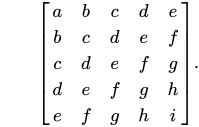
In linear algebra, a Hankel matrix (or catalecticant matrix), named after Hermann Hankel, is a rectangular matrix in which each ascending skew-diagonal from left to right is constant. For example,
More generally, a Hankel matrix is any matrix of the form


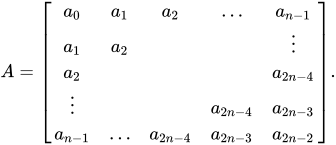
In terms of the components, if the element of is denoted with , and assuming , then we have for all




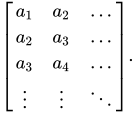
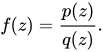
Given a formal Laurent series the corresponding Hankel operator is defined as This takes a polynomial and sends it to the product , but discards all powers of with a non-negative exponent, so as to give an element in , the formal power series with strictly negative exponents. The map is in a natural way -linear, and its matrix with respect to the elements and is the Hankel matrix Any Hankel matrix arises in this way. A theorem due to Kronecker says that the rank of this matrix is finite precisely if is a rational function, that is, a fraction of two polynomials

![{\displaystyle H_{f}:\mathbf {C} [z]\to \mathbf {z} ^{-1}\mathbf {C} [[z^{-1}]].}](https://wikimedia.org/api/rest_v1/media/math/render/svg/021ccc4a299eb39b1b5ebfcdf0e3e555ebbd1e65)
![{\displaystyle g\in \mathbf {C} [z]}](https://wikimedia.org/api/rest_v1/media/math/render/svg/3df7d024d0b972a46da42c84aeff389ff5458f1f)


![{\displaystyle z^{-1}\mathbf {C} [[z^{-1}]]}](https://wikimedia.org/api/rest_v1/media/math/render/svg/5a964b9b781a86975a982d8911e5bef310129193)

![{\displaystyle \mathbf {C} [z]}](https://wikimedia.org/api/rest_v1/media/math/render/svg/4df688b72293d8ac85f15267559929137e35ff1c)
![{\displaystyle 1,z,z^{2},\dots \in \mathbf {C} [z]}](https://wikimedia.org/api/rest_v1/media/math/render/svg/2814851a432ce68c94aab843fac3ba4882bbd3a6)
![{\displaystyle z^{-1},z^{-2},\dots \in z^{-1}\mathbf {C} [[z^{-1}]]}](https://wikimedia.org/api/rest_v1/media/math/render/svg/bbf789a2c0db73be54af3b1919900b73cf98bad9)

We are often interested in approximations of the Hankel operators, possibly by low-order operators. In order to approximate the output of the operator, we can use the spectral norm (operator 2-norm) to measure the error of our approximation. This suggests singular value decomposition as a possible technique to approximate the action of the operator.
Note that the matrix does not have to be finite. If it is infinite, traditional methods of computing individual singular vectors will not work directly. We also require that the approximation is a Hankel matrix, which can be shown with AAK theory.
Hub AI
Hankel matrix AI simulator
(@Hankel matrix_simulator)
Hankel matrix
In linear algebra, a Hankel matrix (or catalecticant matrix), named after Hermann Hankel, is a rectangular matrix in which each ascending skew-diagonal from left to right is constant. For example,
More generally, a Hankel matrix is any matrix of the form
In terms of the components, if the element of is denoted with , and assuming , then we have for all
Given a formal Laurent series the corresponding Hankel operator is defined as This takes a polynomial and sends it to the product , but discards all powers of with a non-negative exponent, so as to give an element in , the formal power series with strictly negative exponents. The map is in a natural way -linear, and its matrix with respect to the elements and is the Hankel matrix Any Hankel matrix arises in this way. A theorem due to Kronecker says that the rank of this matrix is finite precisely if is a rational function, that is, a fraction of two polynomials
We are often interested in approximations of the Hankel operators, possibly by low-order operators. In order to approximate the output of the operator, we can use the spectral norm (operator 2-norm) to measure the error of our approximation. This suggests singular value decomposition as a possible technique to approximate the action of the operator.
Note that the matrix does not have to be finite. If it is infinite, traditional methods of computing individual singular vectors will not work directly. We also require that the approximation is a Hankel matrix, which can be shown with AAK theory.