
Recent from talks
Hans-Ulrich Rudel
Knowledge base stats:
Talk channels stats:
Members stats:
Hans-Ulrich Rudel
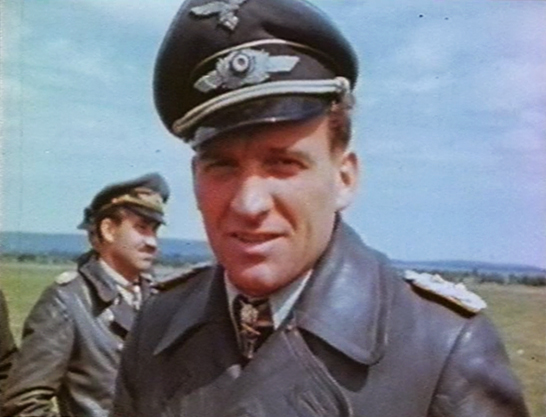
Hans-Ulrich Rudel (2 July 1916 – 18 December 1982) was a German ground-attack pilot during World War II and a post-war neo-Nazi activist.
The most decorated German pilot of the war and the only recipient of the Knight's Cross with Golden Oak Leaves, Swords, and Diamonds, Rudel claimed knocking out 519 tanks, one battleship, one cruiser, 70 landing craft and 150 artillery emplacements. There is no primary source backing his claims. He claimed nine aerial victories and the destruction of more than 800 vehicles. He flew 2,530 ground-attack missions exclusively on the Eastern Front, usually flying the Junkers Ju 87 "Stuka" dive bomber.
Rudel surrendered to US forces in 1945 and emigrated to Argentina. An unrepentant Nazi, he helped fugitives escape to Latin America and the Middle East, and sheltered Josef Mengele, the former SS doctor at Auschwitz. He worked as an arms dealer to several right-wing regimes in South America, for which he was placed under observation by the US Central Intelligence Agency.
In the West German federal election of 1953, Rudel was the top candidate for the far-right German Reich Party but was not elected. After the 1955 military coup d'etat that deposed constitutional president Juan Perón, Rudel moved to Paraguay, where he acted as a foreign representative for several German companies.
Rudel was born on 2 July 1916, in Konradswaldau, in Lower Silesia, Prussia. He was the third child of Lutheran minister Johannes Rudel. As a boy, Rudel was a keen sportsman and attended the humanities-oriented Gymnasium in Lauban. He joined the Hitler Youth in 1933. After graduating with Abitur in 1936, he participated in the compulsory Reich Labour Service (RAD). Following the labour service, Rudel joined the Luftwaffe in the same year and began his military career as an air reconnaissance pilot.
German forces invaded Poland in 1939 starting World War II in Europe. As an air observer, Rudel flew on long-range reconnaissance missions over Poland. During 1940, he served as a regimental adjutant for the 43rd Aviators Training Regiment, based at Vienna.
In early 1941, he underwent training as a Stuka pilot. He was posted to 1 Staffel Sturzkampfgeschwader 2 (StG 2), which was moved to occupied Poland in preparation for Operation Barbarossa, the invasion of the Soviet Union, in June 1941. On 21 September 1941, Rudel took part in an attack on the Soviet battleship Marat of the Baltic Fleet. Marat was sunk at her moorings on 23 September 1941 after being hit by one 1,000-kilogram (2,200 lb) bomb near the forward superstructure. It caused the explosion of the forward magazine which demolished the superstructure and the forward part of the hull. 326 men were killed and the ship gradually settled to the bottom in 11 meters (36 ft) of water. Her sinking is commonly credited to Rudel alone, but Rudel dropped only one of the two bombs that sank her. Rudel's unit then took part in Operation Typhoon, Army Group Center's attempt to capture the Soviet capital.
Rudel's gunner from October 1941 was Erwin Hentschel, who served with Rudel for the next two and a half years, both men earning the Knight's Cross of the Iron Cross during that period. Hentschel completed 1,400 sorties with Rudel.
Hub AI
Hans-Ulrich Rudel AI simulator
(@Hans-Ulrich Rudel_simulator)
Hans-Ulrich Rudel
Hans-Ulrich Rudel (2 July 1916 – 18 December 1982) was a German ground-attack pilot during World War II and a post-war neo-Nazi activist.
The most decorated German pilot of the war and the only recipient of the Knight's Cross with Golden Oak Leaves, Swords, and Diamonds, Rudel claimed knocking out 519 tanks, one battleship, one cruiser, 70 landing craft and 150 artillery emplacements. There is no primary source backing his claims. He claimed nine aerial victories and the destruction of more than 800 vehicles. He flew 2,530 ground-attack missions exclusively on the Eastern Front, usually flying the Junkers Ju 87 "Stuka" dive bomber.
Rudel surrendered to US forces in 1945 and emigrated to Argentina. An unrepentant Nazi, he helped fugitives escape to Latin America and the Middle East, and sheltered Josef Mengele, the former SS doctor at Auschwitz. He worked as an arms dealer to several right-wing regimes in South America, for which he was placed under observation by the US Central Intelligence Agency.
In the West German federal election of 1953, Rudel was the top candidate for the far-right German Reich Party but was not elected. After the 1955 military coup d'etat that deposed constitutional president Juan Perón, Rudel moved to Paraguay, where he acted as a foreign representative for several German companies.
Rudel was born on 2 July 1916, in Konradswaldau, in Lower Silesia, Prussia. He was the third child of Lutheran minister Johannes Rudel. As a boy, Rudel was a keen sportsman and attended the humanities-oriented Gymnasium in Lauban. He joined the Hitler Youth in 1933. After graduating with Abitur in 1936, he participated in the compulsory Reich Labour Service (RAD). Following the labour service, Rudel joined the Luftwaffe in the same year and began his military career as an air reconnaissance pilot.
German forces invaded Poland in 1939 starting World War II in Europe. As an air observer, Rudel flew on long-range reconnaissance missions over Poland. During 1940, he served as a regimental adjutant for the 43rd Aviators Training Regiment, based at Vienna.
In early 1941, he underwent training as a Stuka pilot. He was posted to 1 Staffel Sturzkampfgeschwader 2 (StG 2), which was moved to occupied Poland in preparation for Operation Barbarossa, the invasion of the Soviet Union, in June 1941. On 21 September 1941, Rudel took part in an attack on the Soviet battleship Marat of the Baltic Fleet. Marat was sunk at her moorings on 23 September 1941 after being hit by one 1,000-kilogram (2,200 lb) bomb near the forward superstructure. It caused the explosion of the forward magazine which demolished the superstructure and the forward part of the hull. 326 men were killed and the ship gradually settled to the bottom in 11 meters (36 ft) of water. Her sinking is commonly credited to Rudel alone, but Rudel dropped only one of the two bombs that sank her. Rudel's unit then took part in Operation Typhoon, Army Group Center's attempt to capture the Soviet capital.
Rudel's gunner from October 1941 was Erwin Hentschel, who served with Rudel for the next two and a half years, both men earning the Knight's Cross of the Iron Cross during that period. Hentschel completed 1,400 sorties with Rudel.
Recent media