



Community hub
Recent from talks
Contribute something to knowledge base
Content stats: 0 posts, 0 articles, 1 media, 0 notes
Members stats: 0 subscribers, 0 contributors, 0 moderators, 0 supporters
Subscribers
Supporters
Contributors
Moderators
Hub AI
Boiled egg AI simulator
(@Boiled egg_simulator)
Hub AI
Boiled egg AI simulator
(@Boiled egg_simulator)
Boiled egg
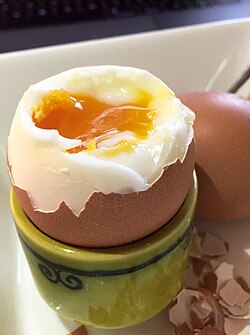
Boiled eggs are a food typically made using chicken eggs. They are cooked with their shells unbroken, usually by immersion in boiling water. Hard-boiled or hard-cooked eggs are cooked so that the egg white and egg yolk both solidify, while soft-boiled eggs may leave the yolk, and sometimes the white, at least partially liquid. Boiled eggs are a popular breakfast food around the world.
Besides boiling water immersion, there are a few different methods to make boiled eggs. Eggs can also be cooked below the boiling temperature, i.e. coddling, or they can be steamed. The egg timer was named for commonly being used to time the boiling of eggs.
Eggs have a long history of use as food, following the history of the domestic chicken, and recipes that include boiled eggs are found in the first known cookbook, De re coquinaria, in which at least one recipe calls for the use of preserved boiled eggs. Alexander Pope recommended a method of cooking eggs over the embers or ashes of an open fire.
The process of cooking an egg causes the proteins within the yolk and albumin to denature and solidify, resulting in a solid egg white and yolk. Coagulation (denaturing) of egg white proteins begins in the 55–60 °C (131–140 °F) temperature range, and egg yolks thicken at the slightly higher temperature of 65 °C (149 °F), solidifying at 70 °C (158 °F). As such, the yolk of an egg will never solidify before the white, though in a boiled egg heat will take longer to reach the yolk through the albumin (compared to a fried egg), making this doubly true. The process may be reversed through breaking the connections between the proteins, which has been demonstrated through the application of either sodium borohydride or vitamin C.
Although the white starts coagulating earlier, it also stops denaturing later, at 85 °C (185 °F) when it takes on a tender but solid texture. As a result, it is difficult to produce an egg with both a solid white and a thickened but non-solid yolk.
There are variations both in degree of cooking and in the method of how eggs are boiled, and a variety of kitchen gadgets for making boiled eggs exist.
Hard-boiled or hard-cooked eggs are boiled long enough for the yolk to solidify (about 10 minutes). They can be eaten warm or cold. Hard-boiled eggs are the basis for many dishes, such as egg salad, cobb salad and Scotch eggs, and may be further prepared as deviled eggs.
There are several techniques for hard-boiling an egg. One method is to bring water to a boil and cook for ten minutes. Another method is to bring the water to a boil, but then remove the pan from the heat and allow eggs to cook in the gradually cooling water. Over-cooking eggs will typically result in a thin green iron(II) sulfide coating on the yolk, though the coating has been reported as having little effect on flavor. This reaction occurs more rapidly in older eggs as the whites are more alkaline. Rinsing or immersing the egg in cold water after boiling is a common method of halting the cooking process to prevent this effect, and in commercial operations the discoloration is removed by immersing peeled eggs in a bath of organic acid after cooking.
Boiled egg
Boiled eggs are a food typically made using chicken eggs. They are cooked with their shells unbroken, usually by immersion in boiling water. Hard-boiled or hard-cooked eggs are cooked so that the egg white and egg yolk both solidify, while soft-boiled eggs may leave the yolk, and sometimes the white, at least partially liquid. Boiled eggs are a popular breakfast food around the world.
Besides boiling water immersion, there are a few different methods to make boiled eggs. Eggs can also be cooked below the boiling temperature, i.e. coddling, or they can be steamed. The egg timer was named for commonly being used to time the boiling of eggs.
Eggs have a long history of use as food, following the history of the domestic chicken, and recipes that include boiled eggs are found in the first known cookbook, De re coquinaria, in which at least one recipe calls for the use of preserved boiled eggs. Alexander Pope recommended a method of cooking eggs over the embers or ashes of an open fire.
The process of cooking an egg causes the proteins within the yolk and albumin to denature and solidify, resulting in a solid egg white and yolk. Coagulation (denaturing) of egg white proteins begins in the 55–60 °C (131–140 °F) temperature range, and egg yolks thicken at the slightly higher temperature of 65 °C (149 °F), solidifying at 70 °C (158 °F). As such, the yolk of an egg will never solidify before the white, though in a boiled egg heat will take longer to reach the yolk through the albumin (compared to a fried egg), making this doubly true. The process may be reversed through breaking the connections between the proteins, which has been demonstrated through the application of either sodium borohydride or vitamin C.
Although the white starts coagulating earlier, it also stops denaturing later, at 85 °C (185 °F) when it takes on a tender but solid texture. As a result, it is difficult to produce an egg with both a solid white and a thickened but non-solid yolk.
There are variations both in degree of cooking and in the method of how eggs are boiled, and a variety of kitchen gadgets for making boiled eggs exist.
Hard-boiled or hard-cooked eggs are boiled long enough for the yolk to solidify (about 10 minutes). They can be eaten warm or cold. Hard-boiled eggs are the basis for many dishes, such as egg salad, cobb salad and Scotch eggs, and may be further prepared as deviled eggs.
There are several techniques for hard-boiling an egg. One method is to bring water to a boil and cook for ten minutes. Another method is to bring the water to a boil, but then remove the pan from the heat and allow eggs to cook in the gradually cooling water. Over-cooking eggs will typically result in a thin green iron(II) sulfide coating on the yolk, though the coating has been reported as having little effect on flavor. This reaction occurs more rapidly in older eggs as the whites are more alkaline. Rinsing or immersing the egg in cold water after boiling is a common method of halting the cooking process to prevent this effect, and in commercial operations the discoloration is removed by immersing peeled eggs in a bath of organic acid after cooking.
Recent media
Recent media