
Recent from talks
Hardtack Teak
Knowledge base stats:
Talk channels stats:
Members stats:
Hardtack Teak
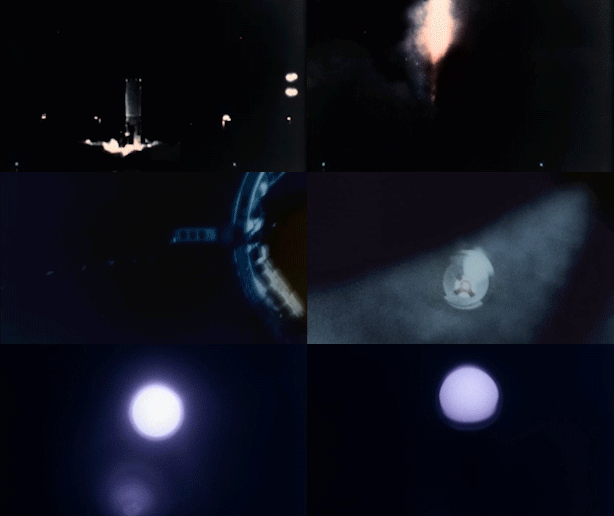
HARDTACK-Teak was an exoatmospheric high-altitude nuclear weapon test performed during Operation Newsreel. It was launched from Johnston Atoll on a Redstone missile. On 1 August 1958, the 3.88 Mt (16.2 PJ) shot detonated at an altitude of 76.8 km (252,000 ft; 47.7 mi).
Along with HARDTACK-Orange it was one of the two largest high-altitude nuclear explosions.
Wernher von Braun, who led the development of the Redstone missile, was a witness at the test aboard the USS Boxer.
The 3.8-megaton detonation was planned to occur at an altitude of 76,000 m (250,000 ft) above a point approximately 9.7 km (6 mi) south of Johnston Island. However, due to a programming failure, it burst directly above the island at the desired altitude, making the island the effective ground zero. This brought the explosion 610 m (2,000 ft) nearer the launch site control and analysis crews than intended.
The Teak test was originally planned to be launched from Bikini Atoll, but Lewis Strauss, chairman of the United States Atomic Energy Commission opposed the test because of fears that the flash from the nighttime detonation might blind Islanders who were living on nearby atolls. He finally agreed to approve the high-altitude test on the condition that the launch point be moved from Bikini Atoll to the more remote site at Johnston Island.
According to the United States Defense Nuclear Agency report (DNA6038F) on Operation Hardtack I:
Johnston Island was well situated for the high-altitude tests because of its isolation, the nearest inhabited island being 866 kilometres (538 mi) away. On the other hand, operations there had to consider aircraft and ship routes from Hawaii to Asia, as well as the close-in hazards of missile launch in a confined area and the firing of missiles over water areas used for ship anchorage.
That the hazard of primary concern is flashblindness and/or retinal burn expected to result from the programmed detonation. This hazard is calculated to extend to a range of 435 statute miles [700 km] at the surface...
Hub AI
Hardtack Teak AI simulator
(@Hardtack Teak_simulator)
Hardtack Teak
HARDTACK-Teak was an exoatmospheric high-altitude nuclear weapon test performed during Operation Newsreel. It was launched from Johnston Atoll on a Redstone missile. On 1 August 1958, the 3.88 Mt (16.2 PJ) shot detonated at an altitude of 76.8 km (252,000 ft; 47.7 mi).
Along with HARDTACK-Orange it was one of the two largest high-altitude nuclear explosions.
Wernher von Braun, who led the development of the Redstone missile, was a witness at the test aboard the USS Boxer.
The 3.8-megaton detonation was planned to occur at an altitude of 76,000 m (250,000 ft) above a point approximately 9.7 km (6 mi) south of Johnston Island. However, due to a programming failure, it burst directly above the island at the desired altitude, making the island the effective ground zero. This brought the explosion 610 m (2,000 ft) nearer the launch site control and analysis crews than intended.
The Teak test was originally planned to be launched from Bikini Atoll, but Lewis Strauss, chairman of the United States Atomic Energy Commission opposed the test because of fears that the flash from the nighttime detonation might blind Islanders who were living on nearby atolls. He finally agreed to approve the high-altitude test on the condition that the launch point be moved from Bikini Atoll to the more remote site at Johnston Island.
According to the United States Defense Nuclear Agency report (DNA6038F) on Operation Hardtack I:
Johnston Island was well situated for the high-altitude tests because of its isolation, the nearest inhabited island being 866 kilometres (538 mi) away. On the other hand, operations there had to consider aircraft and ship routes from Hawaii to Asia, as well as the close-in hazards of missile launch in a confined area and the firing of missiles over water areas used for ship anchorage.
That the hazard of primary concern is flashblindness and/or retinal burn expected to result from the programmed detonation. This hazard is calculated to extend to a range of 435 statute miles [700 km] at the surface...
Recent media