Hubbry Logo
Wernher von BraunWernher von BraunMain
Open search
Wernher von Braun
Community hub
Wernher von Braun
logo
39 pages, 0 posts
0 subscribers
Be the first to start a discussion here.
Wernher von Braun
Wernher von Braun
from Wikipedia

Wernher Magnus Maximilian Freiherr von Braun[1] (US: /ˈvɜːrnər vɒn ˈbrn/ VUR-nər von BROWN;[4] German: [ˈvɛʁnheːɐ̯ fɔn ˈbʁaʊn]; 23 March 1912 – 16 June 1977) was a German-American aerospace engineer[1] and space architect. He was a member of the Nazi Party and later the Allgemeine SS which supported his rocket work. He became the leading figure in the development of rocket technology in Nazi Germany, and later a pioneer of rocket and space technology in the US.[5]

Key Information

As a young man, von Braun worked in Nazi Germany's rocket development program. He helped design and co-developed the V-2 rocket at Peenemünde Army Research Center during World War II. The V-2 became the first object to travel rapidly from ground level to the higher atmosphere on 20 June 1944.

Following the war, he was moved to the United States, along with about 1,600 other German scientists, engineers, and technicians, as part of Operation Paperclip.[6] He worked for the United States Army on an intermediate-range ballistic missile program, and he developed the rockets that launched the United States' first space satellite Explorer 1 in 1958. He worked with Walt Disney on a series of films, which popularized the idea of human space travel in the US and beyond from 1955 to 1957.[7]

In 1960, his group was assimilated into NASA, where he served as director of the newly formed Marshall Space Flight Center and as the chief architect of the Saturn V super heavy-lift launch vehicle that propelled the Apollo spacecraft to the Moon.[8][9] In 1967, von Braun was inducted into the National Academy of Engineering, and in 1975, he received the National Medal of Science.

Von Braun is seen by some as escaping justice for his awareness of Nazi war crimes due to the Americans' desire to beat the Soviets in the Cold War.[10][11][5] He is also sometimes described by others as the "father of space travel",[12] the "father of rocket science",[13] or the "father of the American lunar program".[10] Towards the end of his career, he also advocated a human mission to Mars.

Early life

[edit]

Wernher von Braun was born on 23 March 1912, in the small town of Wirsitz in the Province of Posen, Kingdom of Prussia (then part of the German Empire, now part of Poland).[14]

His father, Magnus Freiherr von Braun (1878–1972), was a civil servant and conservative politician; he served as Minister of Agriculture in the federal government during the Weimar Republic. His mother, Emmy von Quistorp (1886–1959), traced her ancestry through both parents to medieval European royalty and was a descendant of Philip III of France, Valdemar I of Denmark, Robert III of Scotland, and Edward III of England.[15][16] He had an older brother, the West German diplomat Sigismund von Braun, who served as Secretary of State in the Foreign Office in the 1970s, and a younger brother, Magnus von Braun, who was a rocket scientist and later a senior executive with Chrysler.[17]

The family moved to Berlin, Brandenburg, in 1915, where his father worked at the Ministry of the Interior. After his Confirmation, his mother gave him a telescope, and he developed a passion for astronomy.[18] Von Braun learned to play both the cello and the piano at an early age and at one time wanted to become a composer. He took lessons from the composer Paul Hindemith. The few pieces of von Braun's youthful compositions that exist are reminiscent of Hindemith's style.[19]: 11  He could play piano pieces of Beethoven and Bach from memory. Beginning in 1925, he attended a boarding school at Ettersburg Castle near Weimar, Free State of Thuringia, where he did not do well in physics and mathematics. There he acquired a copy of Die Rakete zu den Planetenräumen (1923, By Rocket into Planetary Space)[20] by rocket pioneer Hermann Oberth. In 1928, his parents moved him to the Hermann-Lietz-Internat (also a residential school) on the East Frisian North Sea island of Spiekeroog. Space travel had always fascinated him, and from then on he applied himself to physics and mathematics to pursue his interest in rocket engineering.[21][22]

In 1928 the Raketenrummel or "Rocket Rumble" fad initiated by Fritz von Opel and Max Valier was highly influential on von Braun as a teenage space enthusiast. He was so enthusiastic after seeing one of the public Opel-RAK rocket car demonstrations, that he constructed his own homemade toy rocket car and caused a disruption in a crowded sidewalk by launching the toy wagon, to which he had attached the largest firework rockets he could purchase. He was later taken in for questioning by the local police, until released to his father for disciplinary action. The incident highlighted the young von Braun's determination to "dedicate his life to space travel".[1]: 62-64 

In 1930, von Braun attended the Technische Hochschule Berlin, where he joined the Spaceflight Society (Verein für Raumschiffahrt or VfR), co-founded by Valier, and worked with Willy Ley in his liquid-fueled rocket motor tests in conjunction with others such as Rolf Engel, Rudolf Nebel, Hermann Oberth or Paul Ehmayr.[23] In spring 1932, he graduated with a diploma in mechanical engineering.[24] His early exposure to rocketry convinced him that the exploration of space would require far more than applications of the current engineering technology. Wanting to learn more about physics, chemistry, and astronomy, von Braun entered the Friedrich-Wilhelm University of Berlin for doctoral studies and graduated with a doctorate in physics in 1934.[25] He also studied at ETH Zürich for a term from June to October 1931.[25]

German career

[edit]

In 1930, von Braun attended a presentation given by Auguste Piccard. After the talk, the young student approached the famous pioneer of high-altitude balloon flight, and stated to him: "You know, I plan on traveling to the Moon at some time." Piccard is said to have responded with encouraging words.[26]

Von Braun was greatly influenced by Oberth, of whom he said:

Hermann Oberth was the first who, when thinking about the possibility of spaceships, grabbed a slide-rule and presented mathematically analyzed concepts and designs... I, myself, owe to him not only the guiding-star of my life, but also my first contact with the theoretical and practical aspects of rocketry and space travel. A place of honor should be reserved in the history of science and technology for his ground-breaking contributions in the field of astronautics.[27]

According to historian Norman Davies, von Braun was able to pursue a career as a rocket scientist in Germany due to a "curious oversight" in the Treaty of Versailles which did not include rocketry in its list of weapons forbidden to Germany.[28]

Involvement with the Nazi regime

[edit]
Von Braun with Fritz Todt, who utilized forced labor for major works across occupied Europe. Von Braun is wearing the Nazi party badge on his suit lapel.

Nazi Party membership

[edit]

Von Braun was an opportunist who joined the Nazi Party to continue his work on rockets for Nazi Germany.[6] He applied for membership in the Party on 12 November 1937, and was issued membership number 5,738,692.[29]: 96 

Michael J. Neufeld, an author of aerospace history and chief of the Space History Division at the Smithsonian's National Air and Space Museum, wrote that ten years after von Braun obtained his Nazi Party membership, he signed an affidavit for the U.S. Army, though he stated the incorrect year:[29]: 96 

In 1939, I was officially demanded to join the National Socialist Party. At this time I was already Technical Director at the Army Rocket Center at Peenemünde (Baltic Sea). The technical work carried out there had, in the meantime, attracted more and more attention in higher levels. Thus, my refusal to join the party would have meant that I would have to abandon the work of my life. Therefore, I decided to join. My membership in the party did not involve any political activity.[29]: 96 

It has not been ascertained whether von Braun's error with regard to the year was deliberate.[29]: 96  Neufeld wrote:

Von Braun, like other Peenemünders, was assigned to the local group in Karlshagen; there is no evidence that he did more than send in his monthly dues. But he is seen in some photographs with the party's swastika pin in his lapel – it was politically useful to demonstrate his membership.[29]: 96 

Von Braun's later attitude toward the Nazi regime of the late 1930s and early 1940s was complex. He said that he had been so influenced by the early Nazi promise of release from the post–World War I economic effects, that his patriotic feelings had increased.[30] In a 1952 memoir article he admitted that, at that time, he "fared relatively rather well under totalitarianism".[29]: 96–97  Yet, he also wrote that "to us, Hitler was still only a pompous fool with a Charlie Chaplin moustache"[31] and that he perceived him as "another Napoleon" who was "wholly without scruples, a godless man who thought himself the only god".[32]

Later examination of von Braun's background, conducted by the United States Federal Bureau of Investigation, suggests that his background check file contained no derogatory information pertaining to his involvement in the party, but it was found that he had numerous letters of commendation for outstanding performance of duties during his time working under the Nazi party.[33] Overall FBI conclusions point to von Braun's involvement in the Nazi Party to be purely for the advancement of his academic career, or out of fear of imprisonment or execution.[33]

Membership in the Allgemeine-SS

[edit]

Von Braun joined the SS horseback riding school on 1 November 1933 as an SS-Anwärter. He left the following year.[34]: 63  In 1940, von Braun joined the SS[35]: 47 [36] and was given the rank of Untersturmführer in the Allgemeine-SS and issued membership number 185,068.: 121  In 1947, he gave the U.S. War Department this explanation:

In spring 1940, one SS-Standartenführer (SS-Colonel) Müller from Greifswald, a bigger town in the vicinity of Peenemünde, looked me up in my office...and told me that Reichsführer-SS Himmler had sent him with the order to urge me to join the SS. I told him I was so busy with my rocket work that I had no time to spare for any political activity. He then told me, that...the SS would cost me no time at all. I would be awarded the rank of a[n] "Untersturmfuehrer" (lieutenant) and it were [sic] a very definite desire of Himmler that I attend his invitation to join.

I asked Müller to give me some time for reflection. He agreed.

Realizing that the matter was of highly political significance for the relation between the SS and the Army, I called immediately on my military superior, Dr. Dornberger. He informed me that the SS had for a long time been trying to get their "finger in the pie" of the rocket work. I asked him what to do. He replied on the spot that if I wanted to continue our mutual work, I had no alternative but to join.[37]

When shown a picture of himself standing behind Himmler, von Braun said that he had only worn the SS uniform that one time,[38] but in 2002 a former SS officer at Peenemünde told the BBC that von Braun had regularly worn the SS uniform to official meetings. He began as an Untersturmführer (Second lieutenant) and was promoted three times by Himmler, the last time in June 1943 to SS-Sturmbannführer (Major). Von Braun later stated that these were simply technical promotions received each year regularly by mail.[38][39]

Work under Nazi regime

[edit]

In 1932, von Braun received a Bachelor of Science Degree in Mechanical Engineering from Technische Hochschule Berlin (now Technische Universität Berlin), Germany. During a period in 1931, von Braun attended the ETH Zürich in Switzerland. During this time in Switzerland, von Braun assisted Professor Hermann Oberth in writing a book concerning the possibilities of creating and manufacturing liquid-propellant rockets. Shortly after this, von Braun founded his own private rocket development business in Berlin, and through which he made the first rocket fired by gasoline and liquid oxygen.[33]

In 1932, having caught wind of von Braun's rocket business, the German Army connected with von Braun to pursue basic missile research and weather data experimentation.[33] Von Braun said that the German government financed the development of test stands and facilities for experimentation in Darmstadt, Germany. In 1939, von Braun was appointed a technical advisor at Peenemünde Army Research Center on the Baltic Sea.[33]

First rank, from left to right, General Walter Dornberger (partially hidden), General Friedrich Olbricht (with Knight's Cross), Major Heinz Brandt, and Wernher von Braun (in civilian dress) at Peenemünde, Province of Pomerania, in March 1941

In 1933, von Braun was working on his creative doctorate when the Nazi Party came to power in a coalition government in Germany; rocketry was almost immediately moved onto the national agenda. An artillery captain, Walter Dornberger, arranged an Ordnance Department research grant for von Braun, who then worked next to Dornberger's existing solid-fuel rocket test site at Kummersdorf.[40]

Von Braun received his doctorate in physics (aerospace engineering) on 27 July 1934, from the University of Berlin for a thesis titled "About Combustion Tests." His doctoral supervisor was Erich Schumann.[29]: 61  However, this thesis represented only the public aspect of von Braun's work. His actual thesis, entitled "Construction, Theoretical, and Experimental Solution to the Problem of the Liquid Propellant Rocket" (dated 16 April 1934), detailed the construction and design of the A2 rocket. It remained classified by the German army until its publication in 1960.[41][42] By the end of 1934, his group had successfully launched two liquid fuel A2 rockets that rose to heights of 2.2 and 3.5 km (2 mi).[43]

Von Braun continued his guided missile work throughout World War Two, and met with Adolf Hitler on several occasions, being formally decorated by Hitler twice, including being awarded the Iron Cross.[44]

At the time, Germany was highly interested in American physicist Robert H. Goddard's research. Before 1939, German scientists occasionally contacted Goddard directly with technical questions. Von Braun used Goddard's plans from various journals and incorporated them into the building of the Aggregat (A) series of rockets. The first successful launch of an A-4 took place on 3 October 1942.[45] The A-4 rocket became well known as the V-2.[46] In 1963, von Braun reflected on the history of rocketry, and said of Goddard's work: "His rockets ... may have been rather crude by present-day standards, but they blazed the trail and incorporated many features used in our most modern rockets and space vehicles."[25]

Goddard confirmed his work was used by von Braun in 1944, shortly before the Nazis began firing V-2s at England. A V-2 crashed in Sweden and some parts were sent to an Annapolis lab where Goddard was doing research for the Navy. If this was the so-called Bäckebo Bomb, it had been procured by the British in exchange for Spitfires; Annapolis would have received some parts from them. Goddard is reported to have recognized components he had invented and inferred that his brainchild had been turned into a weapon.[47] Later, von Braun said: "I have very deep and sincere regret for the victims of the V-2 rockets, but there were victims on both sides...A war is a war, and when my country is at war, my duty is to help win that war."[1]: 351 

The engineer who designed the V2, Wernher von Braun, came to be feted as a hero of the space age. The Allies realised that the V-2 was a machine, unlike anything they had developed themselves.

V-2: The Nazi rocket that launched the space age, BBC, September 2014.[48]

In response to Goddard's statements, von Braun said "at no time in Germany did I or any of my associates ever see a Goddard patent". This was independently confirmed. He wrote that statements that he had lifted Goddard's work were the furthest from the truth, noting that Goddard's paper "A Method of Reaching Extreme Altitudes", which was studied by von Braun and Oberth, lacked the specificity of liquid-fuel experimentation with rockets. It was also confirmed that he was responsible for an estimated 20 patentable innovations related to rocketry, as well as receiving U.S. patents after the war concerning the advancement of rocketry. Documented accounts also stated he provided solutions to a host of aerospace engineering problems in the 1950s and 1960s.[49]

Schematic of the A4/V2

On 22 December 1942, Adolf Hitler ordered the production of the A-4 as a "vengeance weapon", and the Peenemünde group developed it to target London. Following von Braun's 7 July 1943 presentation of a color movie showing an A-4 taking off, Hitler was so enthusiastic that he personally made von Braun a professor shortly thereafter.[50]

By that time, the British and Soviet intelligence agencies were aware of the rocket program and von Braun's team at Peenemünde, based on the intelligence provided by the Polish underground Home Army. Over the nights of 17–18 August 1943, RAF Bomber Command's Operation Hydra dispatched raids on the Peenemünde camp consisting of 596 aircraft, and dropped 1,800 tons of explosives.[51] The facility was salvaged and most of the engineering team remained unharmed; however, the raids killed von Braun's engine designer Walter Thiel and Chief Engineer Walther, and the rocket program was delayed.[52][53]

The V-2 became the first artificial object to travel into space by crossing the Kármán line with the vertical launch of MW 18014 on 20 June 1944.[54]

The first combat A-4, renamed the V-2 (Vergeltungswaffe 2 "Retaliation/Vengeance Weapon 2") for propaganda purposes, was launched toward England on 7 September 1944, only 21 months after the project had been officially commissioned.[1]: 184  Doug Millard of the Science Museum, London states:

The V-2 was a quantum leap of technological change. We got to the Moon using V-2 technology but this was technology that was developed with massive resources, including some particularly grim ones. The V-2 programme was hugely expensive in terms of lives, with the Nazis using slave labour to manufacture these rockets.[48]

Experiments with rocket aircraft

[edit]

In 1936, von Braun's rocketry team working at Kummersdorf investigated installing liquid-fuelled rockets in aircraft. Ernst Heinkel enthusiastically supported their efforts, supplying a He-72 and later two He-112s for the experiments. Later in 1936, Erich Warsitz was seconded by the RLM to von Braun and Heinkel, because he had been recognized as one of the most experienced test pilots of the time, and because he also had an extraordinary fund of technical knowledge.[55]: 30  After he familiarized Warsitz with a test-stand run, showing him the corresponding apparatus in the aircraft, he asked: "Are you with us and will you test the rocket in the air? Then, Warsitz, you will be a famous man. And later we will fly to the Moon – with you at the helm!"[55]: 35 

A regular He 112

In June 1937, at Neuhardenberg (a large field about 70 km (43 mi) east of Berlin, listed as a reserve airfield in the event of war), one of these latter aircraft was flown with its piston engine shut down during flight by Warsitz, at which time it was propelled by von Braun's rocket power alone. Despite a wheels-up landing and the fuselage having been on fire, it proved to official circles that an aircraft could be flown satisfactorily with a back-thrust system through the rear.[55]: 51 

At the same time, Hellmuth Walter's experiments into hydrogen peroxide based rockets were leading toward light and simple rockets that appeared well-suited for aircraft installation. Also, the firm of Hellmuth Walter at Kiel had been commissioned by the RLM to build a rocket engine for the He-112, so there were two different new rocket motor designs at Neuhardenberg: whereas von Braun's engines were powered by alcohol and liquid oxygen, Walter engines had hydrogen peroxide and calcium permanganate as a catalyst. Von Braun's engines used direct combustion and created fire, while the Walter devices used hot vapors from a chemical reaction, but both created thrust and provided high speed.[55]: 41  The subsequent flights with the He-112 used the Walter-rocket instead of von Braun's; it was more reliable, simpler to operate, and safer for the test pilot, Warsitz.[55]: 55 

Slave labor

[edit]

SS General Hans Kammler, who as an engineer had constructed several concentration camps, including Auschwitz, had a reputation for brutality and had conceived the idea of using concentration camp prisoners as slave laborers in the rocket program. Arthur Rudolph, chief engineer of the V-2 rocket factory at Peenemünde, endorsed this idea in April 1943 when a labor shortage developed. More people died building the V-2 rockets than were killed by it as a weapon.[56] Von Braun admitted visiting the plant at Mittelwerk on many occasions,[6] and called conditions at the plant "repulsive", but stated that he had never personally witnessed any deaths or beatings, although it had become clear to him by 1944 that deaths had occurred.[57] He denied ever having visited the Mittelbau-Dora concentration camp, where 20,000 died from illness, beatings, hangings, and intolerable working conditions.[58]

Some prisoners state that von Braun engaged in brutal treatment or approved of it. Guy Morand, a French resistance fighter who was a prisoner in Dora, testified in 1995 that, after an apparent sabotage attempt, von Braun ordered a prisoner to be flogged,[59] while Robert Cazabonne, another French prisoner, stated that von Braun stood by as prisoners were hanged by chains suspended by cranes.[59]: 123–124  However, these accounts may have been a case of mistaken identity.[60] Former Buchenwald inmate Adam Cabala stated that von Braun went to the concentration camp to pick slave laborers:

... also the German scientists led by Prof. Wernher von Braun were aware of everything daily. As they went along the corridors, they saw the exhaustion of the inmates, their arduous work and their pain. Not one single time did Prof. Wernher von Braun protest against this cruelty during his frequent stays at Dora. Even the aspect of corpses did not touch him: On a small area near the ambulance shed, inmates tortured to death by slave labor and the terror of the overseers were piling up daily. But, Prof. Wernher von Braun passed them so close that he was almost touching the corpses.[61]

Von Braun later stated that he was aware of the treatment of prisoners, but felt helpless to change the situation.[62] When asked if von Braun could have protested against the brutal treatment of the slave laborers, von Braun team member Konrad Dannenberg (a member of the Nazi party since 1932) told The Huntsville Times: "If he had done it, in my opinion, he would have been shot on the spot."[63]

Arrest and release by the Nazi regime

[edit]

According to André Sellier, a French historian and survivor of the Mittelbau-Dora concentration camp, Heinrich Himmler had von Braun come to his Feldkommandostelle Hochwald HQ in East Prussia in February 1944.[64] To increase his power-base within the Nazi regime, Himmler was conspiring to use Kammler to gain control of all German armament programs, including the V-2 program at Peenemünde.[19]: 38–40  He therefore recommended that von Braun work more closely with Kammler to solve the problems of the V-2. Von Braun stated that he replied that the problems were merely technical and he was confident that they would be solved with Dornberger's assistance.[65]

Von Braun had been under SD surveillance since October 1943. A secret report stated that he and his colleagues Klaus Riedel and Helmut Gröttrup were said to have expressed regret at an engineer's house one evening in early March 1944 that they were not working on a spaceship[6] and that they felt the war was not going well; this was considered a "defeatist" attitude. A young female dentist who was an SS spy reported their comments. Himmler's unfounded allegations branding von Braun and his colleagues as communist sympathizers and accusing them of sabotaging the V-2 program, coupled with von Braun's regular piloting of a government-provided airplane that could facilitate an escape to Britain, led to their arrest by the Gestapo.[19]: 38–40 

The unsuspecting von Braun was detained on 14 March (or 15 March),[66] 1944, and was taken to a Gestapo cell in Stettin (now Szczecin, Poland).[19]: 38–40  where he was held for two weeks without knowing the charges against him.[67]

Through Major Hans Georg Klamroth, in charge of the Abwehr for Peenemünde, Dornberger obtained von Braun's conditional release and Albert Speer, Reichsminister for Munitions and War Production, persuaded Hitler to reinstate von Braun so that the V-2 program could continue[6][19]: 38–40 [68] or turn into a "V-4 program" (the Rheinbote as a short-range ballistic rocket) which in their view would be impossible without von Braun's leadership.[32] In his memoirs, Speer states Hitler had finally conceded that von Braun was to be "protected from all prosecution as long as he is indispensable, difficult though the general consequences arising from the situation."[69]

An investigation by the United States Federal Bureau of Investigation on 1 May 1961 advised that "there was no record of an arrest in their respective files"[70] suggesting that von Braun's imprisonment was wiped from German prison records at a point after his conditional release or after the Nazi regime had fallen.

Surrender to the Americans

[edit]
Von Braun, with his arm in a cast, Walter Dornberger (on the left) and Bernhard Tessmann (on the right) surrendered to the Americans just before this 3 May 1945 photo.

The Soviet Army was about 160 km (100 mi) from Peenemünde in early 1945 when von Braun assembled his planning staff and asked them to decide how and to whom they should surrender. Unwilling to go to the Soviets, von Braun and his staff decided to try to surrender to the Americans. Kammler had ordered the relocation of his team to central Germany; however, a conflicting order from an army chief ordered them to join the army and fight. Deciding that Kammler's order was their best bet to defect to the Americans, von Braun fabricated documents and transported 500 of his affiliates to the area around Mittelwerk, where they resumed their work in Bleicherode and surrounding towns after the middle of February 1945. For fear of their documents being destroyed by the SS, von Braun ordered the blueprints to be hidden in an abandoned iron mine in the Harz mountain range near Goslar.[71] The U.S. Army Counter Intelligence Corps managed to unveil the location after lengthy interrogations of von Braun, Walter Dornberger, Bernhard Tessmann and Dieter Huzel and recovered 14 tons of V-2 documents by 15 May 1945, from the British Occupation Zone.[29][72]

While on an official trip in March, von Braun suffered a complicated fracture of his left arm and shoulder in a car accident after his driver fell asleep at the wheel. His injuries were serious, but he insisted that his arm be set in a cast so that he could leave the hospital. Due to this neglect of the injury, he had to be hospitalized again a month later when his bones had to be rebroken and realigned.[71]

In early April, as the Allied forces advanced deeper into Germany, Kammler ordered the engineering team, around 450 specialists, to be moved by train into the town of Oberammergau in the Bavarian Alps, where they were closely guarded by the SS with orders to execute the team if they were about to fall into enemy hands. However, von Braun managed to convince SS Major Kummer to order the dispersal of the group into nearby villages so that they would not be an easy target for U.S. bombers.[71] On 29 April 1945, Oberammergau was captured by the Allied forces who seized the majority of the engineering team.[73]

Nearing the end of the war, Hitler instructed SS troops to gas all technical men concerned with rocket development.[70] Upon hearing this, von Braun commandeered a train and fled with other "technical men" to a location in the mountains of South Germany. After some time, von Braun and many of the others who made it to the mountains left their location to flee to advancing American lines in Austria.[33]

Von Braun and several members of the engineering team, including Dornberger, made it to Austria.[74] On 2 May 1945, upon finding an American private from the U.S. 44th Infantry Division, von Braun's brother and fellow rocket engineer, Magnus, approached the soldier on a bicycle, calling out in broken English: "My name is Magnus von Braun. My brother invented the V-2. We want to surrender."[17][75] After the surrender, Wernher von Braun spoke to the press:

I myself and everybody you see here decided to go west. And I think our decision was not one of expediency, but a moral decision. We knew that we had created a new means of warfare, and the question as to what nation, to what victorious nation we were willing to entrust this brainchild of ours was a moral decision more than anything else. We wanted to see the world spared another conflict such as Germany had just been through, and we felt that only by surrendering such a weapon to people who are guided by the Bible could such an assurance to the world be best secured.[76]

The American high command was well aware of how important their catch was: von Braun had been at the top of the Black List, the code name for the list of German scientists and engineers targeted for immediate interrogation by U.S. military experts. On 9 June 1945, two days before the originally scheduled handover of the Nordhausen and Bleicherode area in Thuringia to the Soviets, U.S. Army Major Robert B. Staver, Chief of the Jet Propulsion Section of the Research and Intelligence Branch of the U.S. Army Ordnance Corps in London, and Lieutenant Colonel R. L. Williams took von Braun and his department chiefs by Jeep from Garmisch to Munich, from where they were flown to Nordhausen. In the following days, a larger group of rocket engineers, among them Helmut Gröttrup, was evacuated from Bleicherode 40 miles (64 km) southwest to Witzenhausen, a small town in the American Zone.[77]

According to Dornberger, there the Soviets tried to kidnap von Braun at night using English uniforms: Americans recognized this and did not let them in.[78]

Von Braun was briefly detained at the "Dustbin" interrogation center at Kransberg Castle, where the elite of Nazi Germany's economic, scientific, and technological sectors were debriefed by U.S. and British intelligence officials.[79] Initially, he was recruited to the U.S. under a program called Operation Overcast, subsequently known as Operation Paperclip. There is evidence, however, that British intelligence and scientists were the first to interview him in depth, eager to gain information that they knew U.S. officials would deny them.[80][81] The team included the young L.S. Snell, then the leading British rocket engineer, later chief designer of Rolls-Royce Limited and inventor of the Concorde's engines. The specific information the British gleaned remained top secret, both from the Americans and from the other allies.[82]

American career

[edit]

U.S. Army career

[edit]
Wernher von Braun at a meeting of NACA's Special Committee on Space Technology, 1958.

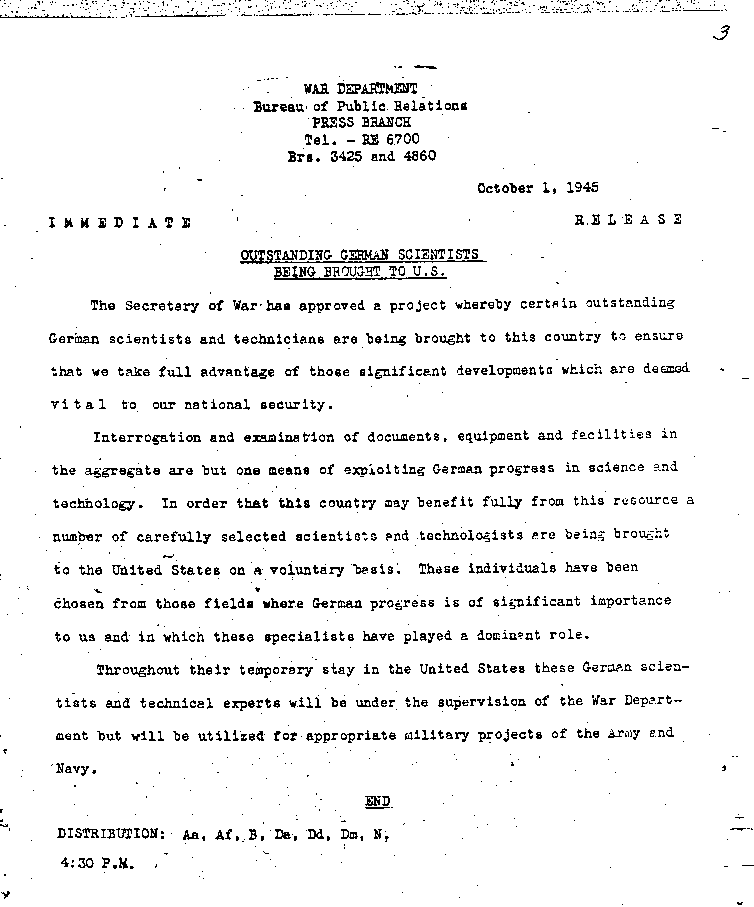
On 20 June 1945, U.S. Secretary of State Edward Stettinius Jr. approved the transfer of von Braun and his specialists to the United States as one of his last acts in office. This was announced to the public on 1 October 1945.[83]

In September 1945, von Braun and other members of the Peenemünde team signed a work contract with the United States Army Ordnance Corps.[84] On 20 September 1945, the first seven technicians arrived in the United States at New Castle Army Air Field, just south of Wilmington, Delaware. They were then flown to Boston, Massachusetts, and taken by boat to the Army Intelligence Service post at Fort Strong in Boston Harbor. Later, with the exception of von Braun, the men were transferred to Aberdeen Proving Ground in Maryland to sort out the Peenemünde documents, enabling the scientists to continue their rocketry experiments.[85]

Von Braun's badge at ABMA (1957).

Finally, von Braun and his remaining Peenemünde staff (see List of German rocket scientists in the United States) were transferred to their new home at Fort Bliss, a large Army installation just north of El Paso, Texas. Von Braun later wrote that he found it hard to develop a "genuine emotional attachment" to his new surroundings.[86] His chief design engineer Walther Reidel became the subject of a December 1946 article, "German Scientist Says American Cooking Tasteless; Dislikes Rubberized Chicken", exposing the presence of von Braun's team in the country and drawing criticism from Albert Einstein and John Dingell.[86] Requests to improve their living conditions such as laying linoleum over their cracked wood flooring were rejected.[86] Von Braun was hypercritical of the slowness of the United States' development of guided missiles. His lab was never able to get sufficient funds to go on with their programs.[33] Von Braun remarked "at Peenemünde we had been coddled, here you were counting pennies".[86] Whereas von Braun had thousands of engineers who answered to him at Peenemünde, he was now subordinate to "pimply" 26-year-old Jim Hamill, an Army major who possessed only an undergraduate degree in engineering.[86] His loyal Germans still addressed him as "Herr Professor", but Hamill addressed him as "Wernher" and never responded to von Braun's request for more materials. Every proposal for new rocket ideas was dismissed.[86]

While at Fort Bliss, they trained military, industrial, and university personnel in the intricacies of rockets and guided missiles. As part of the Hermes project, they helped refurbish, assemble, and launch a number of V-2s that had been shipped from Allied-occupied Germany to the White Sands Proving Ground in New Mexico. They also continued to study the future potential of rockets for military and research applications. Since they were not permitted to leave Fort Bliss without military escort, von Braun and his colleagues began to refer to themselves only half-jokingly as "PoPs" – "Prisoners of Peace".[1]: 218 

"V-2 Rocket Assembling and Launching" (1947) de-classified official United States War Department information film reel.

In 1950, at the start of the Korean War, von Braun and his team were transferred to Huntsville, Alabama, his home for the next 20 years. From 1952 to 1956,[87] von Braun led the Army's rocket development team at Redstone Arsenal, resulting in the Redstone rocket, which was used for the first live nuclear ballistic missile tests conducted by the United States. He personally witnessed this historic launch and detonation.[88] Work on the Redstone led to the development of the first high-precision inertial guidance system on the Redstone rocket.[89] By 1953 von Braun's title was, "Chief, Guided Missiles Development Division, Redstone Arsenal."[90]

As director of the Development Operations Division of the Army Ballistic Missile Agency, von Braun, with his team, then developed the Jupiter-C, a modified Redstone rocket.[91] The Jupiter-C was the basis for the Juno I rocket that successfully launched the West's first satellite, Explorer 1, on 31 January 1958. This event signaled the birth of America's space program.[92]

[edit]

Repeating the pattern he had established during his earlier career in Germany, von Braun – while directing military rocket development in the real world – continued to entertain his engineer-scientist's dream of a future in which rockets would be used for space exploration. However, he was no longer at risk of being fired. As American public opinion of Germans began to recover, von Braun found himself increasingly in a position to popularize his ideas. The 14 May 1950 headline of The Huntsville Times ("Dr. von Braun Says Rocket Flights Possible to Moon") might have marked the beginning of these efforts. Von Braun's ideas rode a publicity wave that was created by science fiction movies and stories.[7]

Von Braun with President Dwight D. Eisenhower, 1960; following the Sputnik crisis in 1957, the American leadership agreed to von Braun's main role in the design of space rockets.

In 1952, von Braun first published his concept of a crewed space station in a Collier's Weekly magazine series of articles titled "Man Will Conquer Space Soon!". These articles were illustrated by the space artist Chesley Bonestell and were influential in spreading his ideas. Frequently, von Braun worked with fellow German-born space advocate and science writer Willy Ley to publish his concepts, which, unsurprisingly, were heavy on the engineering side and anticipated many technical aspects of space flight that later became reality.[93]

The space station (to be constructed using rockets with recoverable and reusable ascent stages) was a toroid structure, with a diameter of 250 feet (76 m); this built on the concept of a rotating wheel-shaped station introduced in 1929 by Herman Potočnik in his book The Problem of Space Travel – The Rocket Motor. The space station spun around a central docking nave to provide artificial gravity, and was assembled in a 1,075-mile (1,730 km) two-hour, high-inclination Earth orbit allowing observation of essentially every point on Earth on at least a daily basis. The ultimate purpose of the space station was to provide an assembly platform for crewed lunar expeditions. More than a decade later, the movie version of 2001: A Space Odyssey drew heavily on the design concept in its visualization of an orbital space station.[94]

Von Braun envisioned these expeditions as very large-scale undertakings, with a total of 50 astronauts traveling in three huge spacecraft (two for crew, one primarily for cargo), each 49 m (160.76 ft) long and 33 m (108.27 ft) in diameter and driven by a rectangular array of 30 rocket propulsion engines.[95] Upon arrival, astronauts would establish a permanent lunar base in the Sinus Roris region by using the emptied cargo holds of their craft as shelters, and would explore their surroundings for eight weeks. This would include a 400 km (249 mi) expedition in pressurized rovers to the crater Harpalus and the Mare Imbrium foothills.[96]

Walt Disney and von Braun, seen in 1954 holding a model of his passenger ship, collaborated on a series of three educational films; among other things, this suggests that von Braun had enough free time to popularize astronautics due to the fact that priority in the design of a space rocket was given to other people.[7]

At this time, von Braun also worked out preliminary concepts for a human mission to Mars that used the space station as a staging point. His initial plans, published in The Mars Project (1952), had envisaged a fleet of 10 spacecraft (each with a mass of 3,720 metric tonnes), three of them uncrewed and each carrying one 200-tonne winged lander[95] in addition to cargo, and nine crew vehicles transporting a total of 70 astronauts. The engineering and astronautical parameters of this gigantic mission were thoroughly calculated. A later project was much more modest, using only one purely orbital cargo ship and one crewed craft. In each case, the expedition used minimum-energy Hohmann transfer orbits for its trips to Mars and back to Earth.[97]

Before technically formalizing his thoughts on human spaceflight to Mars, von Braun had written a science fiction novel on the subject, set in the year 1980. However, 18 publishers rejected the manuscript.[98] Von Braun later published small portions of this opus in magazines, to illustrate selected aspects of his Mars project popularizations. The complete manuscript, titled Project Mars: A Technical Tale, did not appear as a printed book until December 2006.[99]

In the hope that its involvement would bring about greater public interest in the future of the space program, von Braun also began working with Walt Disney and the Disney studios as a technical director, initially for three television films about space exploration. The initial broadcast devoted to space exploration was Man in Space, which first went on air on 9 March 1955, drawing 40 million viewers.[86][100][101]

Later (in 1959) von Braun published a short booklet, condensed from episodes that had appeared in This Week Magazine before – describing his updated concept of the first crewed lunar landing.[102] The scenario included only a single and relatively small spacecraft – a winged lander with a crew of only two experienced pilots who had already circumnavigated the Moon on an earlier mission. The brute-force direct ascent flight schedule used a rocket design with five sequential stages, loosely based on the Nova designs that were under discussion at this time. After a night launch from a Pacific island, the first three stages brought the spacecraft (with the two remaining upper stages attached) to terrestrial escape velocity, with each burn creating an acceleration of 8–9 times standard gravity. The residual propellant in the third stage was used for the deceleration intended to commence only a few hundred kilometers above the landing site in a crater near the lunar north pole. The fourth stage provided acceleration to lunar escape velocity, and the fifth stage was responsible for a deceleration during return to the Earth to a residual speed that allows aerocapture of the spacecraft ending in a runway landing, much in the way of the Space Shuttle. One remarkable feature of this technical tale is that the engineer von Braun anticipated a medical phenomenon that became apparent only years later: being a veteran astronaut with no history of serious adverse reactions to weightlessness offers no protection against becoming unexpectedly and violently spacesick.[check quotation syntax][citation needed]

Religious conversion

[edit]

In the first half of his life, von Braun was a nonpracticing, perfunctory Lutheran.[1]: 4 : 230  As described by Ernst Stuhlinger and Frederick I. Ordway III: "Throughout his younger years, von Braun did not show signs of religious devotion, or even an interest in things related to the church or to biblical teachings. In fact, he was known to his friends as a 'merry heathen' (fröhlicher Heide)."[103] Nevertheless, in 1945 he explained his decision to surrender to the Western Allies, rather than Russians, as being influenced by a desire to share rocket technology with people whom he felt followed the Bible. In 1946,[1]: 469  he attended church in El Paso, El Paso County, Texas, and underwent a religious conversion to Evangelical Christianity.[104] In an unnamed religious magazine he stated:

One day in Fort Bliss, a neighbor called and asked if I would like to go to church with him. I accepted, because I wanted to see if the American church was just a country club as I'd been led to expect. Instead, I found a small, white frame building... in the hot Texas sun on a browned-grass lot... Together, these people make a live, vibrant community. This was the first time I really understood that religion was not a cathedral inherited from the past, or a quick prayer at the last minute. To be effective, a religion has to be backed up by discipline and effort.[1]: 229–230 

On the motives behind this conversion, Michael J. Neufeld is of the opinion that he turned to religion "to pacify his own conscience",[105] and University of Southampton scholar Kendrick Oliver said that von Braun was presumably moved "by a desire to find a new direction for his life after the moral chaos of his service for the Third Reich".[106] Having "concluded one bad bargain with the Devil, perhaps now he felt a need to have God securely at his side".[107]

At a Gideons conference in 2004, W. Albert Wilson, a former pilot and NASA employee, stated that he had talked with von Braun about the Christian faith while von Braun was working for NASA, and believed that conversation had been instrumental in von Braun's conversion.[108]

Later in life, he joined an Episcopal congregation,[104] and became increasingly religious.[109] He publicly spoke and wrote about the complementarity of science and religion, the afterlife of the soul, and his belief in God.[110][111] He stated, "Through science man strives to learn more of the mysteries of creation. Through religion he seeks to know the Creator."[112] He was interviewed by the Assemblies of God pastor C. M. Ward and stated that "The farther we probe into space, the greater my faith."[113] In addition, he met privately with evangelist Billy Graham and with the civil rights leader Martin Luther King Jr.[114]

Concepts for orbital warfare

[edit]

Von Braun developed and published his space station concept during the time of the Cold War when the U.S. government put the containment of the Soviet Union above everything else. The fact that his space station – if armed with missiles that could be easily adapted from those already available at this time – would give the United States space superiority in both orbital and orbit-to-ground warfare did not escape him. In his popular writings, von Braun elaborated on them in several of his books and articles, but he took care to qualify such military applications as "particularly dreadful". This much-less-peaceful aspect of von Braun's "drive for space" has been reviewed by Michael J. Neufeld from the Space History Division of the National Air and Space Museum in Washington.[115]

NASA career

[edit]
Von Braun in his office at Marshall Space Flight Center, 1959

The U.S. Navy had been tasked with building a rocket to lift satellites into orbit, but the resulting Vanguard rocket launch system was unreliable. In 1957, with the launch of Sputnik 1, a belief grew within the United States that it lagged behind the Soviet Union in the emerging Space Race. American authorities then chose to use von Braun and his German team's experience with missiles to create an orbital launch vehicle. Von Braun had originally proposed such an idea in 1954, but it was denied at the time.[86]

NASA was established by law on 29 July 1958. One day later, the 50th Redstone rocket was successfully launched from Johnston Atoll in the south Pacific as part of Operation Hardtack I. Two years later, NASA opened the Marshall Space Flight Center at Redstone Arsenal in Huntsville, and the Army Ballistic Missile Agency (ABMA) development team led by von Braun was transferred to NASA. In a face-to-face meeting with Herb York at the Pentagon, von Braun made it clear he would go to NASA only if development of the Saturn were allowed to continue.[116] Von Braun became the center's first director on 1 July 1960 and held the position until 27 January 1970.[117]

Von Braun in front of the five F-1 Saturn V test engines.
Von Braun in front of the five F-1 Saturn V test engines, 1969. The engines were 19 feet tall, 12 feet wide at the exhaust, and burned 15 tons of liquid oxygen and kerosene per second.

Von Braun's early years at NASA included a failed "4 inch mission." On 21 November 1960 during which the first uncrewed Mercury-Redstone rocket, the rocket only rose up a mere 4 inches before settling back down onto the launch pad. The unfortunate and untimely failure of the rocket launch created a "nadir of morale in Project Mercury." The launch failure was later determined to be the result of a "power plug with one prong shorter than the other because a worker failed it to make it fit."[citation needed] Because of the difference in the length of one prong, the launch system detected the difference in the power disconnection as a "cut-off signal to the engine." The safety system in fact stopped the launch.[118]

After the success of the Mercury-Redstone 2 mission in January 1961, a mere 2 months after the failed "4 inch mission," NASA morale was improved. Still, a new string of problems emerged. Von Braun insisted on one more test before the Redstone could be deemed man-rated. His overly cautious nature brought about clashes with other people involved in the program, who argued that MR-2's technical issues were simple and had been resolved shortly after the flight. He overruled them, so a test mission involving a Redstone on a boilerplate capsule was flown successfully in March. Von Braun's stubbornness was blamed for the inability of the U.S. to launch a crewed space mission before the Soviet Union, which ended up putting the first man in space the following month.[119] Three weeks later on 5 May, von Braun's team successfully launched Alan Shepard into space. He named his Mercury-Redstone 3 Freedom 7.[120]

The Marshall Center's first major program was the development of Saturn rockets to carry heavy payloads into and beyond Earth orbit. From this, the Apollo program for crewed Moon flights was developed. Von Braun initially pushed for a flight engineering concept that called for an Earth orbit rendezvous technique (the approach he had argued for building his space station), but in 1962, he converted to the lunar orbit rendezvous concept that was subsequently realized.[121][122] During Apollo, he worked closely with former Peenemünde teammate, Kurt H. Debus, the first director of the Kennedy Space Center. His dream to help mankind set foot on the Moon became a reality on 16 July 1969, when a Marshall-developed Saturn V rocket launched the crew of Apollo 11 on its historic eight-day mission. Over the course of the program, Saturn V rockets enabled six teams of astronauts to reach the surface of the Moon.[123]

During the late 1960s, von Braun was instrumental in the development of the U.S. Space and Rocket Center in Huntsville. The desk from which he guided America's entry into the Space Race remains on display there. He also was instrumental in the launching of the experimental Applications Technology Satellite. He traveled to India and hoped that the program would be helpful in bringing a massive educational television project to help the poorest people in that country.[124]

Von Braun with President Kennedy at Redstone Arsenal in 1963; President Kennedy was the initiator of the American lunar program in 1961, and von Braun was appointed its technical director.

During the local summer of 1966–67, von Braun participated in a field trip to Antarctica, organized for him and several other members of top NASA management.[125] The goal of the field trip was to determine whether the experience gained by the U.S. scientific and technological community during the exploration of Antarctic wastelands would be useful for the crewed exploration of space. Von Braun was mainly interested in the management of the scientific effort on Antarctic research stations, logistics, habitation, and life support, and in using the barren Antarctic terrain like the glacial dry valleys to test the equipment that one day was used to look for signs of life on Mars and other worlds.[126]

In an internal memo dated 16 January 1969,[127] von Braun had confirmed to his staff that he would stay on as a center director at Huntsville to head the Apollo Applications Program. He referred to this time as a moment in his life when he felt the strong need to pray, stating "I certainly prayed a lot before and during the crucial Apollo flights".[128] A few months later, on the occasion of the first Moon landing, he publicly expressed his optimism that the Saturn V carrier system would continue to be developed, advocating human missions to Mars in the 1980s.[129]

Nonetheless, on 1 March 1970, von Braun and his family relocated to Washington, D.C., when he was assigned the post of NASA's Deputy Associate Administrator for Planning at NASA Headquarters. After a series of conflicts associated with the truncation of the Apollo program, and facing severe budget constraints, von Braun retired from NASA on 26 May 1972. Not only had it become evident by this time that NASA and his visions for future U.S. space flight projects were incompatible, but also it was perhaps even more frustrating for him to see popular support for a continued presence of man in space wane dramatically once the goal to reach the Moon had been accomplished.[130]

Von Braun also developed the idea of a Space Camp that would train children in fields of science and space technologies, as well as help their mental development much the same way sports camps aim at improving physical development.[29]: 354–355 [131]

Career after NASA

[edit]
"Civil Defense Emergency Preparedness at Marshall Space Flight Center" information film reel, foreword by Wernher von Braun.

After leaving NASA, von Braun moved to the Washington, D.C. area and became vice president for Engineering and Development at the aerospace company Fairchild Industries in Germantown, Maryland on 1 July 1972.[131]

In 1973, during a routine physical examination, von Braun was diagnosed with kidney cancer, which could not be controlled with the medical techniques available at the time.[132]

Von Braun helped establish and promote the National Space Institute, a precursor of the present-day National Space Society, in 1975, and became its first president and chairman. In 1976, he became a scientific consultant to Lutz Kayser, the CEO of OTRAG, and a member of the Daimler-Benz board of directors. However, his deteriorating health forced him to retire from Fairchild on 31 December 1976. When the 1975 National Medal of Science was awarded to him in early 1977, he had been hospitalized, and was unable to attend the White House ceremony.[133]

Engineering philosophy

[edit]

Von Braun's insistence on more tests after Mercury-Redstone 2 flew higher than planned has been identified as contributing to the Soviet Union's success in launching the first human in space.[134] The successful Mercury-Redstone BD flight took the launch slot that might have put Alan Shepard into space, three weeks ahead of Yuri Gagarin. His Soviet counterpart Sergei Korolev insisted on two successful flights with dogs before risking Gagarin's life on a crewed attempt. The second test flight took place one day after the Mercury-Redstone BD mission.[29]

Von Braun took a conservative approach to engineering, designing with ample safety factors and redundant structure. This became a point of contention with other engineers, who struggled to keep vehicle weight down so that payload could be maximized. As noted above, his caution likely led to the U.S. losing the race to put a man into space before the Soviets. Krafft Ehricke likened von Braun's approach to building the Brooklyn Bridge.[135]: 208  Many at NASA headquarters jokingly referred to Marshall as the "Chicago Bridge and Iron Works", but acknowledged that the designs worked.[136] The conservative approach paid off when a fifth engine was added to the Saturn C-4, producing the Saturn V. The C-4 design had a large crossbeam that could easily absorb the thrust of an additional engine.[29]: 371 

Von Braun did not indicate interest in politics or political philosophy during his onboarding working for the U.S. Army. He was primarily focused on his work in guided missiles for the purpose of advancing science and technology. According to FBI background checks, "any political activity he may have engaged in was a means to an end to provide him with the necessary freedom to conduct his experiments."[33] This included time spent in the Nazi party during World War 2.

During his time in NASA, he opposed racial segregation which brought him into conflict with George Wallace, who advocated racial discrimination in Alabama and wanted to continue segregation.[137] Von Braun accused segregationist policies of obstructing the development of Alabama. His statements were considered "unusual for a space scientist, particularly in the south, but well within agency and national policy.[138]

Personal life

[edit]
Maria von Braun, c. 1963

Von Braun had a charismatic personality and was known as a ladies' man. As a student in Berlin, he often was seen in the evenings in the company of two girlfriends at once.[29]: 63  He later had a succession of affairs within the secretarial and computer pool at Peenemünde.[29]: 92–94 

In January 1943, von Braun became engaged to Dorothee Brill, a physical education teacher in Berlin, and he sought permission to marry from the SS Race and Settlement Main Office. However, the engagement was broken due to his mother's opposition.[29]: 146–147  Later in 1943, he had an affair with a French woman while in Paris preparing V-2 launch sites in northeastern France. She was imprisoned for collaboration after the war and became destitute.[29]: 147–148 

During his stay at Fort Bliss, von Braun proposed marriage to Maria Luise von Quistorp (10 June 1928 – 20 January 2025),[139] his maternal first cousin, in a letter to his father. He married her in a Lutheran church in Landshut, Bavaria, on 1 March 1947, having received permission to go back to Germany and return with his wife. He was 35, and his new bride was 18.[140] Shortly after, he converted to Evangelicalism.[141] He returned to Manhattan on 26 March 1947, with his wife, father, and mother. On 8 December 1948, the von Brauns' first daughter together, Iris Careen, was born at Fort Bliss Army Hospital.[45] The couple had two more children: Margrit Cécile, born in 1952,[142] and Peter Constantine, born in 1960.[142]

On 15 April 1955, von Braun became a naturalized citizen of the United States.[143]

Death

[edit]
Grave of Wernher von Braun in Ivy Hill Cemetery (Alexandria, Virginia), 2008

In 1973, von Braun was diagnosed with kidney cancer during a routine medical examination. However, he continued to work for a couple of years. In 1975, President Gerald R. Ford awarded him the country's highest science honor, the National Medal of Science in Engineering. He was too ill to attend the White House ceremony.[144] In January 1977, then very ill, he resigned from Fairchild Industries.

Von Braun died on 16 June 1977 of pancreatic cancer in Alexandria, Virginia, at age 65.[145][146] He is buried on Valley Road at the Ivy Hill Cemetery in Alexandria. His gravestone cites Psalm 19:1: "The heavens declare the glory of God; and the firmament sheweth his handywork" (KJV).[147]

Recognition and critique

[edit]
In 1970, Huntsville, Alabama, honored von Braun's years of service with a series of events including the unveiling of a plaque in his honor. Pictured (l–r), his daughter Iris, wife Maria, U.S. Sen. John Sparkman, Alabama Gov. Albert Brewer, von Braun, son Peter, and daughter Margrit.
  • Apollo program director Sam Phillips was quoted as saying he did not think that the United States would have reached the Moon as quickly as it did without von Braun's help. Later, after discussing it with colleagues, he amended this to say he did not believe the United States would have reached the Moon at all.[19]: 167 
  • In a TV interview on the occasion of the U.S. Moon landing in July 1969, Helmut Gröttrup, a staff member in Peenemünde and later head of the German collective in the Soviet rocketry program, set up the thesis that automatic space probes can get the same amount of scientific data with an effort of only 10 or 20 percent of the costs, and that the money should be better spent on other purposes. Von Braun justified the expenses for crewed operations with the following argument: "I think somehow space flights for the first time give mankind a chance to become immortal. Once this earth will no longer be able to support life we can emigrate to other places which are better suited for our life."[148]
  • Scrutiny of von Braun's use of forced labor at Mittelwerk intensified again in 1984 when Arthur Rudolph, one of his top affiliates from the A-4/V2 through the Apollo projects, agreed to renounce his U.S. citizenship and emigrate in exchange for not being tried for war crimes.[6][149]
  • A science- and engineering-oriented gymnasium in Friedberg, Bavaria was named after von Braun in 1979. In response to rising criticism, a school committee decided in 1995, after lengthy deliberations, to keep the name but "to address von Braun's ambiguity in the advanced history classes". In 2012, Nazi concentration camp survivor David Salz gave a speech in Friedberg, calling out to the public to "Do everything to make this name disappear from this school!".[150][151] The gymnasium was renamed "Staatliches Gymnasium Friedberg" in February 2014.[152]
  • An arena and entertainment complex in Huntsville, Alabama, is named the Von Braun Center in his honor. The complex opened in 1975.[153]

Summary of SS career

[edit]
  • SS number: 185,068
  • Nazi Party number: 5,738,692[29]: 96 

Dates of rank

[edit]
  • SS-Anwärter: 1 November 1933 (Candidate; received rank upon joining SS Riding School)
  • SS-Mann: July 1934 (Private)

(left SS after graduation from the school; commissioned in 1940 with date of entry backdated to 1934)

Honors

[edit]
[edit]

Von Braun has been featured in a number of films and television shows or series:

Several fictional characters have been modeled on von Braun:

Other appearances

[edit]

Print media:

  • In Warren Ellis's graphic novel Ministry of Space, von Braun is a supporting character, settling in Britain after World War II, and being essential for the realization of the British space program.
  • In Jonathan Hickman's comic book series The Manhattan Projects, von Braun is a major character.
  • Satirist Mort Sahl has been credited with mocking von Braun by suggesting Braun's book "I aim at the stars", needed a subtitle: "But sometimes I hit London."[174]

Literature:

  • The Good German by Joseph Kanon. Von Braun and other scientists are said to have been implicated in the use of slave labor at Peenemünde; their transfer to the U.S. forms part of the narrative.
  • Space by James Michener. Von Braun and other German scientists are brought to the U.S. and form a vital part of the U.S. efforts to reach space.[175]
  • Gravity's Rainbow by Thomas Pynchon. The novel involves British intelligence attempting to predict and avert V-2 rocket attacks. The work even includes a gyroscopic equation for the V2. The first portion of the novel, "Beyond The Zero", begins with a quotation from von Braun: "Nature does not know extinction; all it knows is transformation. Everything science has taught me, and continues to teach me, strengthens my belief in the continuity of our spiritual existence after death."
  • V-S Day by Allen Steele is a 2014 alternate history novel in which the Space Race occurs during World War II between teams led by Robert H. Goddard and von Braun.
  • Moonglow by Michael Chabon (2016) includes a fictionalized description of the search for and capture of von Braun by the U.S. Army, and his role in the Nazi V-2 program and subsequently in the U.S. space program.
  • V2 by Robert Harris (2019) covers 5 days of von Braun's group in Peenemünde in November 1944.[176]

Theatre:

  • Rocket City, Alabam', a stage play by Mark Saltzman, weaves von Braun's real life with a fictional plot in which a young Jewish woman in Huntsville, Alabama becomes aware of his Nazi past and tries to inspire awareness and outrage. Von Braun is a character in the play.[177]

Music:

  • Infinite Journey (1962), Johann Sebastian Bach and Apollo program rocket sounds album by various artists including Henry Mazer, which features von Braun as a narrator.[178]
  • "Wernher von Braun" (1965):[179] A song written and performed by Tom Lehrer for an episode of NBC's American version of the BBC TV show That Was The Week That Was; the song was later included in Lehrer's albums That Was The Year That Was and The Remains of Tom Lehrer. It was a satire on what Lehrer saw as von Braun's cavalier attitude toward the consequences of his work in Nazi Germany.[180] For example, one line in the song states: "A man whose allegiance/ Is ruled by expedience/ Call him a Nazi, he won't even frown/ 'Nazi, Schmazi!' says Wernher von Braun."[181] There was a widespread rumour that von Braun had sued Lehrer for the song, but this is untrue.[180][182]
  • The Last Days of Pompeii (1991): A rock opera by Grant Hart's post-Hüsker Dü alternative rock group Nova Mob, in which von Braun features as a character. The album includes a song called "Wernher von Braun".
  • Von Braun at Nuremberg (for Mort Sahl) (2009 - from the album “20009”): A song by the indie-folk duo Drakkar Sauna, which features a paraphrasing of von Braun’s book title “I aim at the stars” and Mort Sahl’s satirical elaboration “but sometimes I hit London.”

Video games:

Published works

[edit]
  • Constructive, theoretical and experimental contributions to the problem of liquid rockets, July 27, 1934. PhD Thesis at the University of Berlin. Title in German is Konstruktive, theoretische und experimentelle Beiträge zu dem Problem der Flüssigkeitsrakete[184]: 161 
  • Proposal for a Workable Fighter with Rocket Drive. 6 July 1939.
  • 'Survey' of Previous Liquid Rocket Development in Germany and Future Prospects. May 1945.[186]
  • Wernher von Braun, Willey Ley, Fred Whipple, Joseph Kaplan, Heinz Haber, Oscar Schachter. Edited by Cornelius Ryan, Across the Space Frontier, Viking Press, 1952.[187]
  • A Minimum Satellite Vehicle Based on Components Available from Developments of the Army Ordnance Corps. 15 September 1954. It would be a blow to U.S. prestige if we did not [launch a satellite] first.[186]
  • The Mars Project, Urbana, University of Illinois Press, (1953). With Henry J. White, translator.
  • Willy Ley; Wernher Von Braun; Chesley Bonestell (1956). The Exploration of Mars. Viking.
  • Saturn Rockets for Space Exploration, New Mexico 1963
  • Arthur C. Clarke, ed. (1967). German Rocketry, The Coming of the Space Age. New York: Meredith Press.
  • First Men to the Moon, Holt, Rinehart and Winston, New York (1960). Portions of work first appeared in This Week Magazine.
  • Daily Journals of Wernher von Braun, May 1958 – March 1970. March 1970.[186]
  • History of Rocketry & Space Travel, New York, Crowell (1975). With Frederick I. Ordway III.
  • The Rocket's Red Glare, Garden City, New York: Anchor Press, (1976). With Frederick I. Ordway III.
  • New Worlds, Discoveries From Our Solar System, Garden City, New York: Anchor Press/Doubleday, (1979). With Frederick I. Ordway III. Von Braun's final work, completed posthumously.
  • Project Mars: A Technical Tale, Apogee Books, Toronto (2006). A previously unpublished science fiction story by von Braun. Accompanied by paintings from Chesley Bonestell and von Braun's own technical papers on the proposed project.[188]
  • Willhite, Irene E. (2007). The Voice of Dr. Wernher von Braun: An Anthology. Apogee Books Space Series. Collector's Guide Publishing. ISBN 978-1894959643. A collection of speeches delivered by von Braun over the course of his career.[189]

See also

[edit]

References

[edit]

Additional reading

[edit]
[edit]
Revisions and contributorsEdit on WikipediaRead on Wikipedia
from Grokipedia
Wernher von Braun (23 March 1912 – 16 June 1977) was a German-American aerospace engineer who spearheaded the development of liquid-fueled rocketry, first as technical director of Nazi Germany's program and later as a key architect of the ' rocket for the Apollo lunar missions. Born in Wirsitz, , von Braun joined the in 1937 and became an SS officer in 1940, leading a team at that produced the V-2, the world's first long-range guided , which was manufactured using forced labor from the , where prisoners endured brutal conditions under his program's demands; he visited the underground factory approximately 15 times between 1943 and 1945 and was involved in decisions regarding labor allocation. After surrendering to American forces in May 1945, von Braun was relocated to the with over 100 colleagues through , a program that prioritized technical expertise over scrutiny of Nazi pasts, enabling him to contribute to U.S. Army missile development at and . As director of 's from 1960 to 1970, he oversaw the engineering of the , whose first stage generated 7.5 million pounds of thrust and powered Apollo 11's historic crewed in , marking humanity's first steps on another celestial body. Von Braun's career exemplifies the dual-edged nature of scientific ambition harnessed by state power, yielding breakthroughs in propulsion technology amid profound moral compromises tied to wartime exploitation and ideological allegiance.

Early Life and Education

Childhood and Influences

Wernher Magnus Maximilian Freiherr von Braun was born on March 23, 1912, in Wirsitz, Province of Posen, Kingdom of Prussia, German Empire (now Wyrzysk, Poland), into a Prussian noble family with the baronial title Freiherr. He was the second of three sons; his elder brother Magnus later became a chemist, and his younger brother Sigismund pursued a diplomatic career. His father, Magnus Alexander Maximilian von Braun, served as a conservative politician and held positions including Minister of Agriculture in the Weimar Republic, emphasizing traditional values and economic policy rooted in agrarian interests. His mother, Emmy von Quistorp, descended from Baltic German nobility and maintained an avid interest in astronomy, which she cultivated through personal study and observation. The family's wealth and status afforded von Braun a privileged upbringing, including relocation to Berlin soon after his birth, where he attended elite schools and received supplementary private tutoring in , physics, and classical languages to supplement formal . Emmy von Braun nurtured her son's innate curiosity by presenting him with a in his early years, sparking a fascination with celestial observation and the mechanics of the that contrasted with his father's focus on terrestrial . This domestic environment, blending aristocratic discipline with intellectual encouragement, laid the groundwork for von Braun's technical inclinations, though his initial academic performance in quantitative subjects lagged due to disinterest in rote schooling. A pivotal influence emerged around age 13 when von Braun encountered Hermann Oberth's 1923 treatise Die Rakete zu den Planetenräumen, the first systematic mathematical analysis of rocket for interplanetary travel, which redirected his astronomical enthusiasms toward practical rocketry engineering. Oberth's empirical approach—grounding speculative in Newtonian physics and thermodynamics—provided a causal framework that resonated with von Braun's emerging problem-solving mindset, prompting rudimentary experiments with gunpowder-driven models and launchers in his teens, despite early failures attributed to insufficient mastery. These youthful endeavors, conducted amid the post-World War I economic constraints of , underscored his self-directed pursuit of principles over prevailing trends.

Academic Training and Early Experiments

Von Braun completed his secondary education at the Französisches Gymnasium in Berlin, graduating in 1930 with a focus on mathematics and physics that aligned with his growing interest in rocketry. That year, he enrolled at the Technische Hochschule Berlin (now Technische Universität Berlin) to study mechanical engineering, supplementing his coursework with studies in physics and astronomy at the Friedrich-Wilhelms-Universität Berlin. These academic pursuits were informal and self-directed in part, reflecting the German higher education system's flexibility for promising students, though von Braun prioritized practical rocketry over traditional degree milestones. Prior to formal university enrollment, von Braun joined the Verein für Raumschiffahrt (VfR, or Society for Space Travel) in September 1929 at age 17, inspired by Hermann Oberth's 1923 book Die Rakete zu den Planetenräumen. As a junior member of the group, he contributed to early experiments with liquid-propellant engines, using readily available fuels like and or alcohol. The VfR established test sites in Berlin suburbs such as and Bernau, where von Braun helped construct rudimentary engine test stands and conducted static firings of small-scale motors, achieving initial successes in controlled despite frequent failures due to material limitations and imprecise fueling. These efforts marked a shift from theoretical speculation to empirical testing, validating liquid propulsion's potential over solid fuels through iterative design refinements. In 1932, with financial support from the Ordnance, von Braun initiated his doctoral research at the University of , focusing on combustion dynamics in liquid-fueled chambers to address instability and efficiency issues observed in VfR tests. His thesis, titled Theoretical and Experimental Contributions to the Problem of the , analyzed propellant mixing, burn rates, and chamber pressures through both modeling and ground tests of prototype engines. He defended and received his PhD in physics on July 27, 1934, with the work remaining classified due to its military implications. This academic culmination integrated first-hand experimental data from over a dozen engine firings, establishing foundational principles for scalable that von Braun later applied in professional contexts.

Pre-War Rocketry in Germany

Entry into Rocketeering

Von Braun's fascination with rocketry originated in his teenage years, inspired by Hermann Oberth's 1923 publication Die Rakete zu den Planetenräumen (The Rocket into Interplanetary Space), which outlined theoretical foundations for space travel using liquid-propellant rockets and prompted him to self-study and to grasp its physics. This intellectual pursuit shifted his focus from astronomy to practical rocketry, viewing multi-stage liquid-fueled vehicles as essential for overcoming Earth's gravity through sustained thrust from high-energy propellants like and . In September 1929, at age 17, von Braun joined the Verein für Raumschiffahrt (VfR), Germany's primary amateur rocketry organization founded in to advance Oberth's concepts through experimentation. The VfR emphasized liquid propellants over solid fuels for controllability and efficiency, conducting tests on a rented field near Berlin-Reinickendorf despite financial constraints and safety risks. Von Braun contributed to group efforts, including assembly and static firing of small engines, though early VfR launches in 1929–1930 often failed due to combustion instability and material limitations. Enrolling at the Technische Hochschule in 1930 to study and physics, von Braun integrated rocketry into his coursework, constructing rudimentary liquid-fueled engines with ethanol or gasoline oxidizers. His initial devices produced brief thrusts of several kilograms but frequently detonated from inadequate cooling or feed systems, highlighting the hurdles of cryogenic handling and absent in prior black-powder traditions. These independent trials, funded personally and via VfR dues, demonstrated von Braun's empirical approach: iterating based on failure analysis rather than untested theory, achieving short powered flights by late 1930 despite no telemetry or precise measurements. By 1931, amid VfR's resource shortages—exacerbated by the —von Braun's work underscored liquid rocketry's viability for ascent trajectories, though scalability remained unproven without institutional support.

Association with the German Army Ordnance

In late 1932, Wernher von Braun, then a 20-year-old engineering student and member of the amateur Verein für Raumschiffahrt rocket society, was approached by the German Army Ordnance Department seeking to develop liquid-fueled rockets as a means to bypass the restrictions on long-range artillery. Captain , tasked with propulsion research, recruited von Braun as a civilian technical assistant at the West army proving grounds near , where initial static tests and launches of small liquid-propellant engines began. Von Braun's team, funded by Ordnance contracts totaling around 10,000 Reichsmarks initially, developed early prototypes including the Repulsor engine and missile concepts, though these faced reliability issues with ethanol and propellants. By November 1, 1932, von Braun was formally assigned to Dornberger's group, marking the start of his full-time employment with the Ordnance Department, which lasted until 1937. Progress accelerated with the A-1 and A-2 rockets; on February 14, 1934, an A-2 variant achieved a vertical flight of 1.6 kilometers, followed by more stable tests reaching 2.2 kilometers later that year, demonstrating controlled ascent for the first time. This collaboration positioned von Braun as the technical leader of the army's rocketry efforts, with Dornberger providing military oversight and resources, though von Braun retained focus on ambitions amid Ordnance priorities for potential weaponry. By 1936, Dornberger's promotion to major underscored the program's growing importance, leading to expanded facilities and von Braun's elevation to head the development team, setting the stage for larger-scale projects.

World War II and the V-2 Program

Development of the A-4/V-2 Rocket

The A-4 rocket, later designated V-2, represented the culmination of Wernher von Braun's early work on liquid-propellant rocketry under the German Army's Ordnance Office. Development of the A-4 began in 1938 as the fourth iteration in the Aggregat series, building on the subscale A-1 through A-3 test vehicles that validated basic propulsion and stability concepts from 1932 to 1937. Von Braun, as technical director at the Peenemünde Army Research Center established in 1937, led a team of engineers focused on creating a supersonic, long-range ballistic missile capable of delivering a one-ton warhead over 300 kilometers. The A-4's design featured a 14.03-meter-long cylindrical body with a maximum of 1.68 meters and a launch of approximately 12,870 kilograms, powered by a single liquid-propellant engine using a 74% ethanol-water mixture as fuel and liquid oxygen as oxidizer. The engine, developed under Walter Thiel, produced about 25 tons of thrust through a turbopump-fed system with a graphite-lined combustion chamber and nozzle, enabling a burn time of 65 seconds to accelerate the rocket to a maximum speed of 5,760 km/h. Guidance relied on gyroscopic stabilization and an autopilot for pitch control during ascent, with no mid-flight corrections after engine cutoff, following a predetermined ballistic trajectory. Testing progressed through static firings and vertical launches at , overcoming challenges like engine instability and structural failures in prototypes. Early A-4 flights in 1942 suffered explosions and control issues, but iterative refinements culminated in the first successful full-duration launch on October 3, 1942, when the reached an altitude of about 96 kilometers, demonstrating supersonic performance and breaking . This milestone validated the design's feasibility for weaponization, prompting to rename it Vergeltungswaffe 2 (V-2) and authorize deployment against Allied targets. Von Braun's emphasis on scalable liquid-fuel technology laid the groundwork for post-war rocketry, though wartime pressures accelerated development at the expense of reliability, with subsequent tests refining range and accuracy up to 320 kilometers.

Production Challenges and Labor Utilization

Following the RAF's Operation Hydra bombing of on the night of 17–18 , which killed approximately 735 people—mostly forced laborers—and severely damaged surface facilities, V-2 production faced acute disruptions, including halted assembly lines and the need for rapid dispersal of operations. Wernher von Braun, as technical director, chaired a staff meeting on 25 that recommended relocating manufacturing to underground tunnels to evade further Allied air attacks, leading to the establishment of the facility beneath Kohnstein Mountain near Nordhausen. This shift imposed engineering challenges, such as adapting the design for mass assembly by unskilled workers in confined, poorly ventilated spaces prone to flooding and structural instability, while logistical issues like transporting heavy components via rail into the tunnels delayed initial output. To address chronic labor shortages—exacerbated by the bombing and the project's scale—production increasingly relied on forced labor from the SS-administered , established in late summer 1943 as a of Buchenwald, with prisoners initially tunneling out the 25-mile network of galleries before shifting to assembly. Approximately 60,000 prisoners, including , political dissidents, and Soviet POWs, passed through the Mittelbau system from August 1943 to March 1945, with over 60,000 employed at Dora by 1944 under conditions of 12–14-hour shifts, minimal rations, and routine abuse by guards and overseers. Von Braun visited the site about 15 times between late 1943 and February 1945 and, on 15 August 1944, personally selected skilled prisoners at Buchenwald for transfer to Dora, demonstrating direct involvement in labor procurement decisions amid awareness of the site's brutal mortality rates from exhaustion, disease, and executions. The labor system's inefficiencies compounded production hurdles: high prisoner death rates—estimated at least 10,000–12,000 directly tied to V-2 manufacturing from malnutrition, tunnel collapses, and sabotage accusations leading to SS reprisals—created constant workforce turnover, necessitating frequent transports from other camps like Auschwitz and Ravensbrück. Mittelwerk engineers, including some under von Braun's team, adapted workflows for semi-automated assembly to mitigate sabotage and quality defects, enabling output to rise from prototypes in early 1944 to roughly 5,797 V-2s completed by war's end, with peaks of 20–30 missiles per day in late 1944 despite ongoing Allied bombings of supply lines. This reliance on expendable labor prioritized quantity over worker welfare, reflecting Nazi directives for "total war" production but yielding rockets with frequent guidance and propulsion failures in combat.

Encounters with Nazi Authorities

Von Braun formally affiliated with Nazi authorities by joining the National Socialist German Workers' Party (NSDAP) on May 1, 1937, receiving membership number 5,738,692, a step necessitated by career advancement within the German military rocket program. He had earlier participated in an SS riding group as a university student in 1933–1934 and, under pressure around 1940, accepted a commission as an SS-Sturmbannführer (major), attaining the rank of SS officer to secure resources and autonomy for his projects amid competition from Heinrich Himmler's SS organization. A pivotal encounter occurred on , 1944, when the arrested von Braun in Stettin on charges of "" after he reportedly remarked that his rockets would enable peacetime travel to the Moon, implying skepticism about Germany's war prospects. Imprisoned for approximately ten days, his detention stemmed from internal rivalries, including resistance to Himmler's attempts to subsume the army's rocket efforts under SS control, though no formal charges addressed worker mistreatment or sabotage. Release was secured through interventions by Army General , Armaments Minister , and ultimately , who prioritized V-2 production continuity over prolonged detention. This episode marked von Braun's growing disillusionment with the regime, as evidenced by his later rebuff of Himmler's overtures and his focus on technical imperatives over ideological loyalty, though his SS status persisted until war's end.

Surrender and Operation Paperclip

As Allied forces closed in during the final weeks of World War II, Wernher von Braun anticipated Germany's defeat and orchestrated the evacuation of his V-2 team from the Mittelwerk facility near Nordhausen, directing them southward through the Harz Mountains toward the Bavarian Alps to avoid capture by Soviet troops. On May 2, 1945, von Braun—suffering a broken arm from a motorcycle accident during the flight—surrendered with approximately 500 team members, including General Walter Dornberger, to elements of the U.S. 44th Infantry Division in Reutte, Austria, presenting documents outlining German rocket technology and expressing willingness to work for the Americans. Initial U.S. interrogations at dustbin camps in revealed the value of von Braun's expertise, prompting his inclusion in , a classified program initiated in 1945 to recruit over 1,600 German scientists, engineers, and technicians—many with Nazi affiliations, including SS membership—to bolster American technological capabilities against potential Soviet advances in rocketry and aviation. Despite awareness of the V-2 program's reliance on forced labor from concentration camps like Dora-Mittelbau, where an estimated 20,000 prisoners died under brutal conditions, U.S. authorities expedited von Braun's clearance by sanitizing records and granting temporary visas, prioritizing strategic utility over war crimes accountability. Von Braun and an initial cadre of seven key specialists arrived in the United States on September 20, 1945, via troopship at Fort Strong in , before being relocated to , , under U.S. Army Ordnance Corps contracts; by late 1945, around 125 team members had joined them at White Sands Proving Ground, , where they reconstructed V-2 missiles from salvaged components shipped from to demonstrate the technology and initiate American guided-missile development. This transfer, codenamed Project Overcast initially and expanded under Paperclip, enabled von Braun to lead replication efforts, launching the first U.S.-assembled V-2 on April 16, 1946, which reached an altitude of 8 miles and provided data critical to post-war rocketry.

American Military Career

Integration into U.S. Army Rocket Program

Under (initially Overcast), von Braun and select personnel were vetted and relocated, with records of Nazi affiliations often expunged to expedite transfer amid geopolitical urgency. Von Braun, accompanied by seven key engineers, arrived by C-54 aircraft at , , on September 18, 1945, marking the start of U.S. Army integration; subsequent shipments brought the core team to approximately 118 by February 1946, totaling around 127 specialists. At , under the U.S. Army Ordnance Corps, von Braun entered a one-year technical service contract effective September 1945, housed initially in converted barracks with restricted movements due to security protocols. The group, supervised by Ordnance Technical Intelligence units, focused on reconstructing V-2 components from salvaged parts shipped from Europe, enabling the first U.S. V-2 launch on April 16, 1946, from White Sands Proving Ground, , reaching 3.3 miles altitude. Over 60 V-2 firings followed through 1952, yielding data on and while training American engineers in liquid-fuel rocketry. constrained operations until a December 1946 press release disclosed the team's presence, amid challenges like inadequate funding—initial annual budget under $1 million—and primitive testing facilities. Von Braun directed early indigenous developments, including the Hermes program initiated in 1946, which adapted V-2 technology for U.S. tactical missiles; Hermes II, a ramjet-assisted test vehicle, achieved powered flights by 1949. A milestone came with Project Bumper, combining a V-2 lower stage with a upper stage for multi-staging; Bumper 5, launched February 24, 1949, reached 244 miles altitude, the highest then achieved by a U.S. and validating separation techniques. These efforts, prioritizing empirical replication over theoretical redesign due to resource limits, positioned the Army's Ordnance Rocket Center at as the nucleus of American guided missile research, with von Braun's leadership bridging German wartime innovations to U.S. requirements. By 1950, team expansion to over 200 and escalating demands prompted relocation to .

Redstone Arsenal and Missile Developments

Following approval by the Secretary of the Army on October 28, 1949, Wernher von Braun and his team of German rocket scientists transferred from Fort Bliss, Texas, to Redstone Arsenal in Huntsville, Alabama, with von Braun arriving in April 1950. There, he was appointed Director of Development Operations, overseeing the Army Ordnance Guided Missile Development Group, which leveraged V-2-derived technology to advance U.S. ballistic missile capabilities. This relocation centralized rocket research at Redstone, utilizing existing facilities for testing and production to accelerate missile programs amid Cold War pressures. The primary initial project was the Redstone missile, a liquid-fueled, surface-to-surface with a range of up to 200 miles, capable of delivering nuclear or conventional warheads. Development formally began on July 10, 1951, building directly on von Braun's prior work; the missile was named Redstone on April 8, 1952, and achieved its first flight test on August 20, 1953, from , though the engine failed after 80 seconds. Under von Braun's technical direction, iterative testing refined accuracy and reliability, leading to deployment with U.S. forces in by June 1958 as part of NATO's shield. The Redstone marked the U.S. Army's first operational , demonstrating precision guidance and storable propellants adapted from German designs. In 1956, the (ABMA) was established on February 1 at , with John B. Medaris as commander and von Braun as technical director, expanding efforts to intermediate-range systems. Von Braun advocated for the missile as a logical extension of Redstone, proposing a 1,500-mile range (IRBM) in mid-1955; the Department of Defense approved development on November 8, 1955. utilized Redstone's and propulsion components, with enhancements for greater range and , achieving its first flight in May 1957. Despite Army successes in prototyping, inter-service rivalry led to transfer of the operational program to the U.S. in November 1956, with deployments to sites in and by 1960-1962. Additional projects under von Braun at ABMA included early Pershing missile concepts, initiated in the late as a solid-fueled successor to Redstone for tactical nuclear delivery, though full development extended beyond his primary tenure. These efforts at solidified U.S. leadership in liquid-propellant rocketry, prioritizing empirical testing and scalable designs to meet strategic deterrence needs.

Jupiter and Explorer Launch

Following the successful deployment of the Redstone missile, Wernher von Braun's team at the (ABMA) in , initiated development of the intermediate-range ballistic missile (IRBM) in 1955, extending Redstone's design for a target range of 1,500 nautical miles using a and kerosene-fueled engine cluster producing 83,000 pounds of . The program emphasized aerodynamic stability, inertial guidance, and reentry vehicle testing, with von Braun overseeing technical direction amid inter-service competition for IRBM primacy. Initial static firings occurred in 1956, followed by the first full flight test of Jupiter AM-1A on March 1, 1957, from Cape Canaveral's Launch Complex 5, which reached 5,000 miles downrange despite propulsion anomalies, validating core airframe and control systems. Parallel to military Jupiter tests, ABMA conducted Jupiter-C flights—Redstone derivatives with added solid-propellant upper stages—to simulate ICBM reentry conditions, achieving a milestone on September 20, 1956, when the configuration lofted a test payload to 3,500 miles altitude and , though without orbital intent. The Soviet launch on October 4, 1957, prompted von Braun to advocate repurposing this hardware for satellite insertion under Project Orbiter, a proposal initially deferred in favor of the Navy's but revived after 's explosive failure on December 6, 1957. On December 8, 1957, ABMA received authorization, modifying into the by activating a fourth upper stage, while the integrated the 30.8-pound payload featuring a detector designed by . Von Braun's team executed integration, testing, and shipment in 84 days, demonstrating rapid engineering under John B. Medaris's command. Juno I lifted off from Launch Complex 26A at on January 31, 1958, at 10:48 p.m. EST (Vehicle UE, based on Redstone Arsenal serial 29), attaining orbital insertion after a 95-minute ascent confirmed by two hours post-launch. operated for 111 days, transmitting data that revealed unexpectedly high radiation levels in the Van Allen belts, contradicting pre-launch assumptions of minimal flux and spurring geophysical research. This success, attributable to ABMA's reusable hardware from prior tests, established U.S. space access independent of or programs and propelled von Braun toward leadership, though Jupiter's military role persisted until 1961 deployment in and under auspices.

NASA Era and Lunar Achievement

Role in Mercury-Redstone and Apollo Programs

Von Braun's team at the developed the , a modified Redstone adapted with an uprated engine producing 78,000 pounds of thrust and enhanced guidance systems for suborbital . This vehicle enabled the first U.S. manned space missions: on May 5, 1961, which carried to a maximum altitude of 116.5 statute miles and a downrange distance of 303 statute miles in a 15-minute flight, and on July 21, 1961, with Grissom reaching 118 statute miles altitude over a 16-minute trajectory. Prior unmanned tests, including Mercury-Redstone Booster Development in March 1961, validated the configuration despite initial failures in earlier Redstone-derived flights like and 2. These launches from , marked the Redstone's transition from military missile to crewed booster under von Braun's technical direction, achieving velocities up to 5,134 mph and proving the design's structural integrity for human-rated operations. ![President Kennedy meets with Wernher von Braun at Marshall Space Flight Center, May 19, 1963][float-right] On July 1, 1960, following NASA's absorption of ABMA personnel, von Braun became the first director of the Marshall Space Flight Center, tasked with delivering launch vehicles for the Apollo lunar program under President Kennedy's May 25, 1961, directive to land humans on the Moon by decade's end. At Marshall, his organization managed Saturn vehicle development, integrating upper stages from other contractors while overseeing propulsion and structural testing; this included Saturn I's multi-engine clustering approach, first flown unmanned on October 27, 1961, with eight engines totaling over 1.3 million pounds of thrust. Von Braun advocated for scalable, clustered rocket architectures to meet Apollo's mass-to-orbit requirements exceeding 100 tons, influencing program decisions on booster sizing amid debates over mission modes like Earth Orbit Rendezvous. His leadership ensured Marshall's contributions to Apollo's unmanned and manned qualification flights, culminating in hardware that supported the program's 1968-1972 operational phase, though execution details fell to subsequent sections on specific designs.

Design of the Saturn V Rocket

Under Wernher von Braun's direction as the first director of NASA's Marshall Space Flight Center, the Saturn V was conceived as a three-stage super heavy-lift launch vehicle to enable crewed lunar missions as part of the Apollo program. Development accelerated following President John F. Kennedy's 1961 commitment to land humans on the Moon, with von Braun's team scaling up principles from earlier rockets like the V-2 and Redstone, emphasizing clustered high-thrust engines and efficient staging to achieve the required payload capacity of approximately 140 metric tons to low Earth orbit. The first stage, designated and built by , measured 138 feet in length and 33 feet in diameter, powered by five engines burning kerosene and () to produce a combined sea-level of about 7.5 million pounds. Each F-1 generated over 1.5 million pounds of , representing the largest single-chamber liquid-fueled engine ever flown, with von Braun advocating for its reliability through extensive ground testing despite combustion instability challenges addressed via redesigns. The stage incorporated four outboard engines gimbaled for steering and featured a structure of aluminum alloy skin over stringers, with propellants stored in separate tanks connected by common bulkheads to minimize weight. The second stage, , manufactured by , utilized five J-2 engines fueled by (LH2) and , delivering a vacuum of roughly 1 million pounds per for high specific impulse efficiency in the upper atmosphere. This stage, also 33 feet in but shorter at about 81 feet, employed lightweight aluminum-lithium and hydrogen-cooled to handle the cryogenic propellants' thermal stresses. The third stage, , produced by Douglas Aircraft, relied on a single J-2 with 200,000 pounds of vacuum , using the same LH2/ propellants and designed for both orbital insertion and burns, with a restart capability enabled by auxiliary systems. Overall, the Saturn V stood 363 feet tall with a maximum of 33 feet, incorporating 41 engines in total including vernier and motors for attitude control and propellant settling. Von Braun's oversight emphasized and rigorous testing, drawing from his experience with large-scale rocketry to ensure structural integrity under dynamic loads exceeding 7 g's during ascent, culminating in 13 successful launches without structural failure.

Contributions to Human Spaceflight Milestones

Under Wernher von Braun's leadership at the Army Ballistic Missile Agency and later NASA's Marshall Space Flight Center, his team adapted the Redstone missile into the Mercury-Redstone Launch Vehicle (MRLV), specifically engineered for manned suborbital flights by incorporating modifications for human-rating, including enhanced reliability and safety features. The MRLV powered Mercury-Redstone 3 on May 5, 1961, launching astronaut Alan B. Shepard Jr. on a 15-minute suborbital trajectory reaching an altitude of 116.5 statute miles and a speed of 5,134 mph, marking the first American crewed spaceflight. This success, followed by Mercury-Redstone 4 on July 21, 1961, with Virgil I. Grissom, validated the Redstone derivative as a foundational step in U.S. human spaceflight, demonstrating reliable crewed launch capabilities ahead of orbital missions. As director of NASA's from July 1960 to January 1970, von Braun directed the development of the , a three-stage super heavy-lift rocket with a maximum of 7.5 million pounds from its five F-1 engines in the first stage, designed to propel Apollo command, service, and lunar modules toward the . The enabled Apollo 8's crewed lunar orbit mission from December 21–27, 1968, the first human voyage beyond , with astronauts , James Lovell, and traveling 240,000 miles to circle the 10 times. This milestone proved the rocket's capacity for deep space human missions, paving the way for Apollo 11's July 16–24, 1969, flight, where lofted , , and Michael Collins, culminating in the first lunar landing on July 20 with Armstrong and Aldrin spending 21 hours 36 minutes on the surface and collecting 47.5 pounds of samples. Von Braun's oversight extended to subsequent Apollo successes, with Saturn V launching Apollo 12 through 17, achieving five more lunar landings between November 1969 and December 1972, during which 12 astronauts walked on the and returned with 842 pounds of lunar material, fulfilling President Kennedy's 1961 goal of landing humans on the before decade's end. These missions collectively demonstrated sustained endurance, with Apollo 11's ascent stage reaching velocity of 24,240 mph, and highlighted von Braun's emphasis on scalable rocketry for interplanetary travel, though grounded in iterative testing that resolved early developmental challenges like pogo oscillations in the first stage.

Post-NASA Activities and Visions

Advocacy for Space Exploration

Von Braun co-founded the National Space Institute (NSI) in 1974, serving as its first president to sustain public and political support for following the Apollo program's conclusion. The NSI focused on educating the public about the strategic, scientific, and economic benefits of space activities, including advocacy for increased funding to amid budget cuts. Through the NSI, von Braun promoted , permanent space stations, and international cooperation for peaceful space utilization, stating that the organization was "dedicated to advancing the exploration and utilization of for the benefit of all mankind." He delivered speeches and testified before congressional committees, arguing that halting momentum in would cede technological leadership to competitors like the and hinder long-term human advancement. Earlier in his career, von Braun had popularized space travel via , collaborating with on the 1955 television episode "," which explained rocketry principles and reached millions, influencing public opinion and even President Dwight D. Eisenhower's interest in satellite programs. These efforts laid groundwork for his later advocacy, consistently emphasizing space exploration's role in expanding human frontiers based on engineering feasibility and empirical rocket development successes.

Concepts for Mars Missions and Orbital Systems

Von Braun's concepts for Mars missions emphasized large-scale expeditions assembled in Earth orbit, requiring robust orbital to overcome propulsion and logistical challenges of interplanetary travel. In a 1969 presentation to NASA's , he proposed a manned architecture utilizing launches to place planetary vehicle components into , followed by Space Shuttle-assisted assembly of nuclear thermal propulsion stages based on technology. This plan envisioned two six-crew spacecraft departing on a conjunction-class , with modular landers for surface operations, targeting initial landings in the early to establish a scientific outpost. The design prioritized redundancy through dual vehicles and in-orbit refueling, reflecting von Braun's engineering focus on scalable, stepwise expansion from lunar capabilities. Complementing these mission profiles, von Braun advocated for permanent orbital systems as manufacturing and staging hubs, including rotating wheel-shaped space stations to simulate via . His 1950s conceptualization featured a 250-foot-diameter toroidal station, constructed from modular segments launched by heavy-lift boosters, serving as a zero-gravity for fabricating Mars-bound hulls, habitats, and propulsion modules. Such facilities would enable assembly of multi-ship fleets—echoing his earlier outline of ten 165-foot vessels carrying 70 personnel—while providing crew acclimation to long-duration and shielding through mass equivalence. Post-NASA, von Braun reiterated these ideas in public advocacy and industry roles, stressing reusable orbital transports for cost-effective logistics. In a 1972 analysis, he described fully reusable launch vehicles capable of routine Earth-to-orbit operations, integral to sustaining stations as waystations for Mars campaigns by minimizing expendable hardware and enabling depots. These systems aligned with his causal view that orbital infrastructure must precede deep-space ventures, drawing on empirical lessons from V-2 scaling and Apollo to argue for nuclear augmentation and closed-loop to achieve self-sufficiency. His proposals influenced later frameworks, though fiscal constraints deferred beyond conceptual studies.

Involvement in Private and Defense Sectors

In July 1972, von Braun resigned from to join Fairchild Industries as for engineering and development, marking his transition to the private sector. Fairchild, headquartered in , specialized in aircraft manufacturing, space systems, and technologies with applications in both commercial and government contracts, including defense-related projects. In this capacity, von Braun oversaw engineering efforts, including contributions to pioneering satellite communication systems. Fairchild's portfolio encompassed dual-use technologies, such as and , which aligned with von Braun's expertise in large-scale rocketry and orbital systems developed during his tenure. His role emphasized applying rocketry principles to private-sector innovations, though specific project outputs during his approximately five-year stint remain less documented amid the company's broader operations in defense components. Additionally, von Braun served as a director of Flight Safety International, a private firm dedicated to training and safety systems, further extending his influence in commercial safety and operations. His private-sector engagements reflected a shift toward industry-led advancements, though his activities were curtailed by a 1976 diagnosis of , leading to his death on June 16, 1977.

Technical Philosophy and Innovations

Engineering Principles and Risk Management

Von Braun's engineering philosophy emphasized iterative prototyping and empirical validation through extensive testing, drawing from the V-2 program's sequence of over 60 launches between 1942 and 1945, many of which failed but yielded data to refine guidance systems, stability, and structural . This approach prioritized component-level verification before full assembly, minimizing cascading failures by isolating variables such as engine and fuel mixture ratios, which had caused early A-4 (V-2) prototypes to explode on the pad. He viewed failure not as defeat but as diagnostic feedback, as illustrated by his response to a 1958 Redstone missile anomaly where a technician's admitted error in creating a spark during pre-launch checks led to immediate procedural reforms rather than . In managing large-scale projects at the , von Braun instituted the "Monday Notes" system starting in the early 1960s, mandating one-page weekly summaries from senior engineers detailing accomplishments, setbacks, and unresolved risks, which enabled rapid escalation of issues like anomalies or delays without bureaucratic filtering. This practice, cascading down to mid-level staff via preparatory "Friday notes," promoted transparency and collective problem-solving, reducing the likelihood of overlooked systemic risks in complex integrations such as the Saturn I's clustered engines. Complementing this were organizational tools like "Automatic Responsibility," which predefined for specific subsystems to avoid diffusion of blame during anomalies, and the " System," an informal protocol for preempting disruptions through vigilant monitoring of team morale and resource strains. Risk assessment under von Braun balanced conservatism—such as initial reluctance to adopt volatile due to its handling hazards—with pragmatic adaptations to constraints; for the , he endorsed "all-up" testing in 1963–1967, deploying fully fueled, multi-stage vehicles on inaugural flights ( on November 9, 1967) to simulate operational stresses and detect integration flaws unattainable in piecemeal tests, despite critics' warnings of total loss potential. This method succeeded empirically, with on April 4, 1968, revealing pogo oscillations and second-stage glitches that informed fixes without derailing the timeline, underscoring von Braun's causal view that real-world data from controlled high-stakes tests outweighed simulated safety margins in accelerating reliable performance. His framework thus integrated first-principles analysis of failure modes with structured oversight, yielding a 100% success rate for 's nine launches from 1967 to 1973.

Approaches to Large-Scale Rocketry

Von Braun's approaches to large-scale rocketry centered on multi-stage configurations to optimize efficiency by sequentially discarding expended stages, thereby reducing overall vehicle mass and enabling greater capacities to or beyond. This principle, applied from early German designs like the proposed A9/A10 combination for transatlantic range, scaled up in American projects such as the Saturn series, where three stages propelled Apollo missions to the Moon. To generate the immense thrust required for heavy-lift vehicles without relying on unproven single massive engines, von Braun favored clustering multiple proven smaller engines, which allowed for modular development, simplified manufacturing, easier static testing on existing stands, and inherent redundancy against individual failures. In the 1940s A-10 concept, this involved bundling six A-4 (V-2) combustion chambers into a single expansion nozzle for enhanced thrust; by the 1960s, the first stage employed five F-1 engines, each delivering approximately 1.5 million pounds-force, collectively providing 7.5 million pounds-force at liftoff on November 9, 1967, during Apollo 4. He integrated advanced liquid-propellant systems, prioritizing / for dense, high-thrust first stages and /oxygen for efficient upper stages, supported by high-pressure turbopumps and to manage thermal stresses in combustion chambers. Early innovations included fuel-cooled chambers in the Aggregate-II (1934) and evolved thicker-walled designs with stronger alloys for the V-2, ensuring scalability to larger volumes. Rigorous full-scale testing underpinned his methodology, with static firings of complete assemblies to validate models of combustion dynamics, nozzle expansion, and structural integrity, minimizing flight risks through empirical rather than theoretical alone. This included custom instrumentation for thrust, temperature, and flow measurements, as demonstrated in tests that refined V-2 performance to a 198-second .

Influence on Modern Aerospace

Von Braun's development of the V-2 rocket during World War II introduced key technical advancements, including liquid-propellant engines, gyroscopic guidance systems, and supersonic flight capabilities, which laid the groundwork for modern ballistic missiles and space launch vehicles. The V-2, first launched successfully on October 3, 1942, was the initial human-made object to reach space, achieving altitudes exceeding 80 kilometers and demonstrating the feasibility of guided rocketry on a large scale. These elements directly influenced post-war intercontinental ballistic missile (ICBM) programs, such as the U.S. Redstone missile derived from V-2 technology, and extended to orbital insertion techniques used in contemporary satellite deployments. In the United States, von Braun's leadership at NASA's from 1960 onward refined multi-stage rocket architecture, emphasizing and oxygen propellants for upper stages to maximize efficiency through high —typically over 400 seconds for such engines. This approach, implemented in the rocket that debuted on , 1967, with its first stage generating 7.5 million pounds of thrust via five F-1 engines, established benchmarks for heavy-lift capabilities that persist in designs like the (SLS), which reuses Saturn-derived components and clustering principles for missions beyond . Von Braun's insistence on staged separation and payload optimization addressed fundamental challenges, enabling the of approximately 11.2 km/s required for lunar trajectories. Von Braun's methodologies, including rigorous ground testing and validation, shaped modern and in rocketry. His team's work on clustered engine configurations and structural integrity under extreme dynamic loads informed innovations, contributing to the reliability of expendable and emerging reusable launch systems. By 2023, these principles underpinned the global launch manifest, with over 200 orbital missions annually, many traceable to and guidance legacies from von Braun's programs. Furthermore, his early for space infrastructure, as outlined in technical papers from the , influenced orbital assembly concepts now pursued in architectures like NASA's .

Personal Life and Worldview

Family and Relationships

Wernher von Braun was born on March 23, 1912, into a conservative aristocratic Prussian family in Wirsitz, , . His father, Magnus von Braun, descended from a noble East Prussian lineage traceable to the 13th century and served as a , including as Minister of Agriculture under the . His mother, Emmy von Quistorp, hailed from a similarly aristocratic background and stimulated his early fascination with astronomy by presenting him with a on his third birthday. Von Braun had two brothers: , the eldest, who pursued a diplomatic career and held the position of West German in the Foreign Office during the 1970s; and Magnus Jr., the youngest, who studied chemistry, contributed to rocket propulsion research, and briefly worked alongside Wernher at the facility starting in 1943. On March 1, 1947, von Braun married Maria Luise von Quistorp, his first cousin through his mother's side, in a ceremony at , , under U.S. military supervision due to his status as a recent recruit. Born June 10, 1928, Maria joined von Braun in the United States later that year, initially residing with him and extended family members at , , amid the relocation of his rocket team. The couple had three children: daughter Iris Careen, born December 9, 1948, at Fort Bliss Army Hospital; daughter Margrit Cécile, born June 8, 1952; and son Peter Constantin, born June 2, 1960, both in the United States after the family's move to , in 1950. Maria provided steadfast support throughout von Braun's career, managing demands while he directed major rocketry programs, and the family integrated into the Huntsville community centered on space endeavors.

Religious Conversion and Philosophical Beliefs

Von Braun was raised in a nominally Lutheran household in Germany but exhibited little personal interest in religion during his early years, effectively functioning as an agnostic with no engagement in spiritual matters. In 1946, shortly after arriving in the United States at , , von Braun experienced a during a visit to a small evangelical church in El Paso, prompted by an invitation from a neighbor. Expecting a mere social gathering akin to a , he instead encountered a vibrant congregation that prompted self-reflection on his moral direction, leading him to surrender to Christ in what he described as a transformative spiritual awakening. This shift marked a departure from his prior disinterest, with observers noting changes in his behavior and priorities. Following his conversion, von Braun actively participated in American churches, initially drawn to the dynamic, growing evangelical congregations in , which he contrasted favorably with the "large empty cathedrals" of , praising their "spiritual life" over institutional formality. He became outspoken about his evangelical , publishing a 15-page booklet titled The Farther We Probe into , the Greater My Faith in 1966, which sold nearly 500,000 copies, and contributing to outlets like the Pentecostal Evangel. Later affiliations included Lutheran circles, as evidenced by his 1976 invitation to address the Lutheran Church of America's , though his public expressions aligned more closely with evangelical emphases on personal faith. Philosophically, von Braun advocated for the harmony between scientific inquiry and religious , viewing the as evidence of divine design rather than random chance. He argued that "the revealed through scientific inquiry is the living witness that has indeed been at work," and that manned flight would "only confirm our in the certainty of its Creator." In a article titled "My Faith: A Space-Age Tells Why He Must Believe in ," published in the American Weekly, he contended that the orderliness of natural laws pointed to a "superior " behind , rejecting atheistic interpretations as incompatible with objective science. Von Braun maintained that science and offered complementary perspectives—"two windows" on the Creator's —insisting that probing deepened rather than diminished his conviction in as the intentional architect of creation.

Controversies Surrounding Nazi Era Involvement

Factual Extent of Party and SS Membership

Wernher von Braun joined the National Socialist German Workers' Party (NSDAP) on May 1, , receiving membership number 5,738,692, as recorded in official party files. This enrollment occurred after initial party membership drives had closed to the general public in 1933, with subsequent admissions limited to those in positions of influence or authority, such as von Braun's role in the German army's rocket program. Archival evidence from the NSDAP master file card confirms his status as a dues-paying member through the end of , though von Braun later described the affiliation as a pragmatic necessity for career advancement rather than ideological conviction. No records indicate von Braun held elected or administrative positions within the , nor participated in political rallies, efforts, or ideological training beyond nominal compliance. His focus remained on technical rocketry development under the Army Ordnance Office, with membership serving primarily to facilitate and avoid professional obstacles in the Nazi-controlled . Regarding the Schutzstaffel (SS), von Braun's early association dates to 1933–1934, when he briefly participated in an SS-sponsored equestrian unit as a university student, but he was discharged without formal membership. In April or May 1940, an SS officer approached him at , leading to his enrollment in the as an ( equivalent), with membership number 185,068. He received subsequent promotions, attaining the rank of (major equivalent) by November 1943. This SS affiliation was presented postwar as honorary and coerced, tied to Heinrich Himmler's oversight of the V-2 program, but contemporary photos show von Braun wearing the SS uniform and insignia on occasions, including interactions with high-ranking Nazi officials. The extent of active SS involvement appears limited to ceremonial duties and program-related coordination, with no documented participation in SS combat units, security operations, or internal policing; his role aligned with technical leadership rather than functions. Von Braun's 1947 affidavit to U.S. authorities emphasized the SS rank as a formality to secure and for rocket research, corroborated by the absence of disciplinary actions against him for inactivity within SS structures prior to his 1944 arrest on unrelated charges.

Awareness and Role in Mittelbau-Dora Labor Conditions

The Mittelbau-Dora complex, established in late summer 1943 as a of Buchenwald, supplied forced labor for the underground factory near Nordhausen, where V-2 rocket assembly occurred to evade Allied bombing; conditions were lethal, with prisoners enduring 12-hour shifts in dust-choked tunnels, rampant disease like typhoid and , starvation rations, and SS beatings, resulting in approximately 20,000 deaths by war's end, including peaks of 669 fatalities in alone. Production at , peaking at 600-700 V-2s monthly by September 1944, relied on 5,000-6,000 assembly-line prisoners, whose sabotage and high mortality—estimated at 10,000 directly tied to the V-2 program—exceeded the rockets' combat toll. As technical director of the V-2 project under Walter Dornberger, von Braun oversaw design adaptations for underground mass production using concentration camp labor, chairing a key August 25, 1943, staff meeting that recommended shifting operations to tunnels with prisoner workers; he co-authored memos requesting additional skilled inmates and personally visited Buchenwald before August 15, 1944, to select prisoners for transfer to Dora, as detailed in his subsequent memo arranging the allocation. He inspected the Mittelwerk facility at least 12 times to monitor quality and output, directly engaging with production processes dependent on this labor system. In correspondence with Dornberger, von Braun noted the "catastrophic conditions" of tunnel work and sleeping arrangements, highlighting high death rates that necessitated constant recruitment to sustain productivity, framing the issue in terms of engineering efficiency rather than humanitarian concern. Von Braun's postwar accounts minimized his exposure, claiming in a 1969 West German court testimony to have witnessed "terrible conditions" underground but denying sight of executions or corpses, while portraying himself as an apolitical engineer uninvolved in administration; historians like Michael J. Neufeld assess this as evasion, given his leadership role in decisions with Albert Speer's armaments ministry to employ slave labor, with no documented efforts to alleviate abuses despite awareness of the system's brutality. While von Braun occasionally intervened for individual prisoners, such as aiding a French physicist in summer 1944, these acts coexisted with advocacy for transferring skilled inmates to bolster Dora's workforce, underscoring prioritization of project imperatives over systemic reform.

Arrest by Gestapo and Alleged Disloyalty

In March 1944, Wernher von Braun was arrested by the along with his brother and colleague Klaus Riedel, on suspicions of disloyalty and potential sabotage of the V-2 program. The arrests stemmed from overheard conversations and remarks attributed to von Braun, including statements during a social gathering where he allegedly expressed pessimism about Germany's prospects in the war, suggesting defeat was inevitable and that his primary interest lay in space exploration rather than weaponry. These comments were interpreted as defeatist, with von Braun reportedly indicating that post-war rocket development might continue under American auspices, fueling accusations of or intent to defect given his piloting abilities. The incident occurred amid escalating tensions between the Army's rocket team, led by von Braun and General , and SS Reichsführer , who sought greater control over V-2 production and had previously pressured von Braun to align more closely with the , including offers of membership that were rebuffed. Himmler's surveillance of the team since late likely contributed to the timing, as the aimed to undermine Army oversight amid production setbacks following Allied bombings. Von Braun was detained in Stettin (now , ) for approximately ten days, during which no formal charges of protesting the regime were pursued by the or (SD). Von Braun's release was secured through interventions by Dornberger and Armaments Minister , who appealed directly to , emphasizing von Braun's in V-2 deployment essential to the . Speer testified to von Braun's indispensability, overriding Himmler's influence despite the latter's push to portray the rocket engineers as unreliable or ideologically suspect. This event highlighted von Braun's pragmatic detachment from ideological fervor, as his candid assessments of military realities—while risking severe repercussions under Nazi law against —did not halt his subsequent contributions to the V-2 program upon reinstatement. In postwar accounts, von Braun referenced the arrest to underscore his victimization by the regime, though contemporaries noted it reflected late-war disillusionment rather than principled opposition.

Assessments of Legacy

Achievements in Advancing Human Knowledge

Von Braun's early work advanced liquid-propellant rocketry through experimental designs and theoretical analysis, culminating in his 1934 doctoral thesis on combustion processes in liquid-fueled engines, which informed scalable systems. His leadership in the development of the , the first long-range guided capable of reaching the edge of , demonstrated practical multi-stage liquid-fueled rocketry, achieving suborbital flight on June 20, 1944, and providing foundational data on high-altitude and guidance. These innovations established key engineering principles for overcoming atmospheric drag and achieving supersonic velocities, influencing subsequent missile and space vehicle designs worldwide. In the United States, von Braun directed the adaptation of V-2 technology into the Redstone missile, America's first operational , which launched on August 20, 1953, and served as the basis for early space missions. A modified Redstone variant, the , successfully orbited , the first U.S. satellite, on January 31, 1958, yielding critical measurements of Earth's radiation belts and validating theories. His oversight of the and Juno programs further refined intermediate-range capabilities and applications, contributing empirical data on reentry physics and payload deployment. As director of NASA's from 1960, von Braun spearheaded the program's design, a three-stage super heavy-lift vehicle with over 7.5 million pounds of thrust, which powered the mission to the Moon on July 16, 1969, enabling the first human lunar landing and advancing knowledge of extraterrestrial propulsion, structural integrity under extreme loads, and interplanetary trajectory computation. The 's F-1 engines, each generating 1.5 million pounds of thrust using and , represented a breakthrough in clustered high-thrust liquid propulsion, tested extensively to ensure reliability for crewed . Beyond hardware, von Braun authored books and articles from the onward, including conceptual designs for orbital stations and Mars expeditions, promoting systematic research and inspiring interdisciplinary studies in human space habitation.

Criticisms of Moral Compromises

Critics have argued that Wernher von Braun's career advancement under the Nazi regime required profound moral compromises, as he aligned himself with the party's apparatus despite awareness of its atrocities. Von Braun joined the Nazi Party on November 1, 1937, and the SS on November 11, 1940, attaining the rank of Sturmbannführer (major) by 1944, when he received the Knight's Cross of the War Service Cross for his contributions to the V-2 program. Historians such as Michael J. Neufeld contend that these affiliations were not merely nominal but opportunistic, enabling access to resources and protection within the regime while prioritizing rocketry over ethical concerns about the regime's use of forced labor. The V-2 rocket program's relocation to the underground Mittelbau-Dora complex in 1943 exemplified these compromises, as production relied on approximately 60,000 prisoners from concentration camps, including Buchenwald, with an estimated 20,000 deaths from exhaustion, , , and executions between 1943 and 1945. Von Braun visited the Dora site at least six times, inspected tunnels where prisoners toiled under SS oversight, and in a 1944 memo to SS General , complained about worker inefficiencies without addressing the brutal conditions or high mortality rates that hindered output. Critics, including Neufeld, highlight that von Braun's engineering team benefited directly from this slave labor system, which the Nazi increasingly depended upon, yet he later claimed of the full extent of the horrors, a seen as implausible given his documented interactions with SS . Postwar, von Braun's integration into the U.S. via involved sanitizing his Nazi record, with U.S. authorities upgrading dossiers to minimize his SS role and party loyalty, allowing him to lead NASA's development despite evidence of complicity. In memoirs and interviews, he portrayed his Nazi involvement as coerced for scientific progress, stating in 1958 that the V-2's civilian applications justified wartime exigencies, a stance ethicists critique as subordinating human costs—thousands of Allied civilian deaths from V-2 strikes and prisoner fatalities—to technological ambition. This pattern of rationalization has led scholars to depict von Braun as a Faustian figure, whose space achievements were inextricably linked to unrepented ethical lapses in enabling a regime's genocidal infrastructure.

Balanced Evaluations in Historical Context

Historians evaluating Wernher von Braun's legacy often situate his actions within the dynamics of , where ambitious engineers faced limited options for large-scale projects without regime alignment. Von Braun's membership in 1937 and SS officer commission in 1940 are documented as pragmatic steps to secure funding and autonomy for rocketry, rather than ideological commitment, a pattern observed among many technical elites skeptical of Hitler's yet accommodating to advance their work. His 1944 arrest for allegedly stating the war was lost—followed by release under Himmler's protection—further indicates detachment from full regime loyalty, prioritizing technical pursuits amid escalating desperation. The V-2 program's reliance on approximately 20,000 forced laborers at Mittelbau-Dora, where up to 20,000 deaths occurred from brutal conditions, represents a profound ethical failing, with von Braun's visits to the site confirming awareness of harsh treatment, though he compartmentalized it to focus on engineering milestones like the first launches in 1942–1944. In the context of Allied bombing campaigns and mutual escalations—such as the V-2's indiscriminate strikes killing around 9,000 civilians in and —von Braun's role mirrored broader wartime moral trade-offs, where technological imperatives overrode humanitarian concerns on all sides, yet his post-war rationalizations downplayed personal responsibility. Critics like historian Michael J. Neufeld highlight these compromises as repugnant, arguing von Braun profited from atrocities without sufficient remorse, while defenders note that refusing cooperation might have yielded no alternative leadership for the program, potentially stalling rocketry's foundational advances. Operation Paperclip's recruitment of von Braun and over 1,600 German specialists in 1945–1946, despite sanitized dossiers omitting full Nazi ties, reflected : U.S. officials prioritized capturing expertise to counter Soviet gains, as evidenced by the rapid transfer of V-2 components and personnel yielding early American missile tests by 1946. This decision enabled von Braun's leadership in developing the rocket, which propelled Apollo 11's lunar landing on July 20, 1969, catalyzing global scientific progress in , guidance, and materials—technologies with enduring civilian and defensive applications. Balanced assessments weigh the V-2's human cost against these outcomes, recognizing that von Braun's causal role in bridging wartime rocketry to peaceful accelerated human capabilities, even as ethical lapses underscore the perils of state-driven science untethered from accountability. Recent scholarship, including Neufeld's , critiques von Braun's American reinvention as overly sanitized, attributing hagiographic portrayals to space program's needs, yet acknowledges his irreplaceable expertise in averting Soviet dominance. In a broader historical lens, von Braun exemplifies how wartime exigencies forged technical giants through morally fraught paths, with his legacy enduring not despite but because of the unyielding pursuit of amid ideological storms—prompting ongoing over whether individual genius excuses systemic complicity or if aggregated advancements justify selective absolution.

Recent Scholarly and Cultural Perspectives

In the past decade, scholarly assessments of von Braun have increasingly scrutinized his complicity in the V-2 program's reliance on forced labor at Mittelbau-Dora, where approximately 20,000 prisoners worked under brutal conditions, resulting in thousands of deaths, with evidence indicating von Braun's awareness through multiple site visits and a 1944 request for additional prisoners. Historians such as Michael J. Neufeld, in post-2010 analyses and interviews, argue that while von Braun was not ideologically driven by , his opportunistic alignment enabled atrocities, challenging earlier narratives that downplayed his role beyond technical leadership. This reflects a broader trend toward contextualizing his actions within wartime exigencies—such as the for defeatist remarks—yet concludes he could have faced charges for slave labor exploitation under Article 6(b), though lack of direct atrocity proof and U.S. via precluded prosecution. Cultural depictions have paralleled this shift, moving from mid-20th-century portrayals as an untainted —exemplified by his 1950s collaborations—to more critical examinations in 21st-century media that integrate his membership and V-2 legacy. Documentaries like PBS's Chasing the Moon (2019) explicitly link his Nazi-era to Apollo successes, exposing U.S. sanitization of his record for gains, while 50th-anniversary Apollo retrospectives in outlets like TIME (2019) question whether technological inheritance from V-2 production justifies overlooking the human cost. Nuanced voices, such as space historian in 2025, advocate viewing his legacy as "hugely complicated," weighing empirical contributions to rocketry against moral failings without excusing the former for the latter, amid debates on whether societal of such figures hinges on outcomes like Huntsville's enduring economy. These perspectives underscore causal realism: von Braun's advancements accelerated , but derived from systems predicated on exploitation, prompting ongoing contention over hero versus enabler framings in popular narratives.

References

Add your contribution
Related Hubs
User Avatar
No comments yet.