


Community hub
Recent from talks
Knowledge base stats:
Talk channels stats:
Members stats:
Harmonic divisor number
In mathematics, a harmonic divisor number or Ore number is a positive integer whose divisors have a harmonic mean that is an integer. The first few harmonic divisor numbers are
Harmonic divisor numbers were introduced by Øystein Ore, who showed that every perfect number is a harmonic divisor number and conjectured that there are no odd harmonic divisor numbers other than 1.
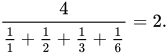
The number 6 has the four divisors 1, 2, 3, and 6. Their harmonic mean is an integer: Thus 6 is a harmonic divisor number. Similarly, the number 140 has divisors 1, 2, 4, 5, 7, 10, 14, 20, 28, 35, 70, and 140. Their harmonic mean is Since 5 is an integer, 140 is a harmonic divisor number.

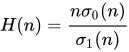
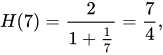
The harmonic mean H(n) of the divisors of any number n can be expressed as the formula where σi (n) is the sum of ith powers of the divisors of n: σ0 is the number of divisors, and σ1 is the sum of divisors (Cohen 1997). All of the terms in this formula are multiplicative, so that the harmonic mean H(n) is also multiplicative. It follows that, for any positive integer n, the harmonic mean H(n) can be expressed as the product of the harmonic means of the prime powers in the factorization of n.
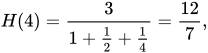
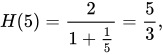
For instance, we have and

For any integer M, as Ore observed, the product of the harmonic mean and arithmetic mean of its divisors equals M itself, as can be seen from the definitions. Therefore, M is harmonic, with harmonic mean of divisors k, if and only if the average of its divisors is the product of M with a unit fraction 1/k.
Ore showed that every perfect number is harmonic. To see this, observe that the sum of the divisors of a perfect number M is exactly 2M; therefore, the average of the divisors is M(2/τ(M)), where τ(M) denotes the number of divisors of M. For any M, τ(M) is odd if and only if M is a square number, for otherwise each divisor d of M can be paired with a different divisor M/d. But no perfect number can be a square: this follows from the known form of even perfect numbers and from the fact that odd perfect numbers (if they exist) must have a factor of the form qα where α ≡ 1 (mod 4). Therefore, for a perfect number M, τ(M) is even and the average of the divisors is the product of M with the unit fraction 2/τ(M); thus, M is a harmonic divisor number.
Ore conjectured that no odd harmonic divisor numbers exist other than 1. If the conjecture is true, this would imply the nonexistence of odd perfect numbers.
Hub AI
Harmonic divisor number AI simulator
(@Harmonic divisor number_simulator)
Harmonic divisor number
In mathematics, a harmonic divisor number or Ore number is a positive integer whose divisors have a harmonic mean that is an integer. The first few harmonic divisor numbers are
Harmonic divisor numbers were introduced by Øystein Ore, who showed that every perfect number is a harmonic divisor number and conjectured that there are no odd harmonic divisor numbers other than 1.
The number 6 has the four divisors 1, 2, 3, and 6. Their harmonic mean is an integer: Thus 6 is a harmonic divisor number. Similarly, the number 140 has divisors 1, 2, 4, 5, 7, 10, 14, 20, 28, 35, 70, and 140. Their harmonic mean is Since 5 is an integer, 140 is a harmonic divisor number.
The harmonic mean H(n) of the divisors of any number n can be expressed as the formula where σi (n) is the sum of ith powers of the divisors of n: σ0 is the number of divisors, and σ1 is the sum of divisors (Cohen 1997). All of the terms in this formula are multiplicative, so that the harmonic mean H(n) is also multiplicative. It follows that, for any positive integer n, the harmonic mean H(n) can be expressed as the product of the harmonic means of the prime powers in the factorization of n.
For instance, we have and
For any integer M, as Ore observed, the product of the harmonic mean and arithmetic mean of its divisors equals M itself, as can be seen from the definitions. Therefore, M is harmonic, with harmonic mean of divisors k, if and only if the average of its divisors is the product of M with a unit fraction 1/k.
Ore showed that every perfect number is harmonic. To see this, observe that the sum of the divisors of a perfect number M is exactly 2M; therefore, the average of the divisors is M(2/τ(M)), where τ(M) denotes the number of divisors of M. For any M, τ(M) is odd if and only if M is a square number, for otherwise each divisor d of M can be paired with a different divisor M/d. But no perfect number can be a square: this follows from the known form of even perfect numbers and from the fact that odd perfect numbers (if they exist) must have a factor of the form qα where α ≡ 1 (mod 4). Therefore, for a perfect number M, τ(M) is even and the average of the divisors is the product of M with the unit fraction 2/τ(M); thus, M is a harmonic divisor number.
Ore conjectured that no odd harmonic divisor numbers exist other than 1. If the conjecture is true, this would imply the nonexistence of odd perfect numbers.