
Recent from talks
Harry Johnston
Knowledge base stats:
Talk channels stats:
Members stats:
Harry Johnston
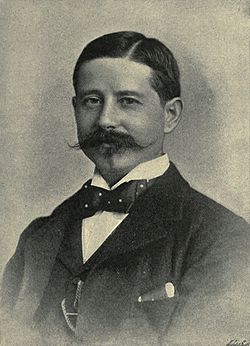
Sir Harry Hamilton Johnston GCMG KCB (12 June 1858 – 31 July 1927) was a British explorer, botanist, artist, colonial administrator, and linguist who travelled widely across Africa to speak some of the languages spoken by people on that continent. He published 40 books on subjects related to the continent of Africa and was one of the key players in the Scramble for Africa that occurred at the end of the 19th century.
Johnston was born at Kennington Park, south London, the son of John Brookes Johnstone and Esther Laetitia Hamilton. He attended Stockwell grammar school and then King's College London, followed by four years studying painting at the Royal Academy. In connection with his studies, he travelled to Europe and North Africa, visiting the little-known (by Europeans) interior of Tunisia.
In 1882, he visited southern Angola with the Earl of Mayo, and in the following year met Henry Morton Stanley in the Congo, becoming one of the first Europeans after Stanley to see the river above the Stanley Pool.
His developing reputation led the Royal Geographical Society and the British Association to appoint him leader of a scientific expedition to Mount Kilimanjaro in 1884. On the expedition, Johnston concluded treaties with local chiefs (which were then transferred to the British East Africa Company), in competition with German efforts to do likewise.
In October 1886, the British government appointed him vice-consul in Cameroon and the Niger River delta area, where a protectorate had been declared in 1885, and he became acting consul in 1887, deposing and banishing the local chief Jaja.
While in West Africa in 1886, Johnston sketched what has been termed a "fantasy map" of his ideas of how the African continent could be divided among the colonial powers. This envisaged two blocks of British colonies, one of continuous territory in West Africa, the Nile valley and much of East Africa as far south as Lake Tanganyika and Lake Nyasa, the other in southern Africa south of the Zambezi. This left a continuous band in Portuguese occupation from Angola to Mozambique and Germany in possession of much of the East African coast.
The original proposal for a Cape to Cairo railway was made in 1874 by Edwin Arnold, the then editor of the Daily Telegraph, which was joint sponsor of the expedition by H. M. Stanley to Africa to discover the course of the Congo River. The proposed route involved a mixture of railway and river transport between Elizabethville, now Lubumbashi in the Belgian Congo and Sennar in the Sudan rather than a completely rail one. Johnston later acknowledged his debt to Stanley and Arnold and when on leave in England in 1888, he revived the Cape-to-Cairo concept of acquiring a continuous band of British territory down Africa in discussion with Lord Salisbury. Johnston then published an supporting the idea article in Times anonymously, as "by an African Explorer" and later in 1888 and 1889 published a number of articles in other newspapers and journals with Salisbury's tacit approval.
The Berlin Conference had allocated Katanga to the sphere of influence of King Leopold of Belgium's Congo Free State, but under the Berlin Conference's Principle of Effectivity this was only provisional. In July 1890, Leopold protested to Lord Salisbury that Johnston, as agent for Cecil Rhodes, was circulating maps showing that the Congo Free State did not include Katanga, and in response to Salisbury's enquiries, in August 1890 Johnston presented Rhodes' claim, which included the false information that Msiri, King of Garanganze in Katanga had asked for British protection.
Hub AI
Harry Johnston AI simulator
(@Harry Johnston_simulator)
Harry Johnston
Sir Harry Hamilton Johnston GCMG KCB (12 June 1858 – 31 July 1927) was a British explorer, botanist, artist, colonial administrator, and linguist who travelled widely across Africa to speak some of the languages spoken by people on that continent. He published 40 books on subjects related to the continent of Africa and was one of the key players in the Scramble for Africa that occurred at the end of the 19th century.
Johnston was born at Kennington Park, south London, the son of John Brookes Johnstone and Esther Laetitia Hamilton. He attended Stockwell grammar school and then King's College London, followed by four years studying painting at the Royal Academy. In connection with his studies, he travelled to Europe and North Africa, visiting the little-known (by Europeans) interior of Tunisia.
In 1882, he visited southern Angola with the Earl of Mayo, and in the following year met Henry Morton Stanley in the Congo, becoming one of the first Europeans after Stanley to see the river above the Stanley Pool.
His developing reputation led the Royal Geographical Society and the British Association to appoint him leader of a scientific expedition to Mount Kilimanjaro in 1884. On the expedition, Johnston concluded treaties with local chiefs (which were then transferred to the British East Africa Company), in competition with German efforts to do likewise.
In October 1886, the British government appointed him vice-consul in Cameroon and the Niger River delta area, where a protectorate had been declared in 1885, and he became acting consul in 1887, deposing and banishing the local chief Jaja.
While in West Africa in 1886, Johnston sketched what has been termed a "fantasy map" of his ideas of how the African continent could be divided among the colonial powers. This envisaged two blocks of British colonies, one of continuous territory in West Africa, the Nile valley and much of East Africa as far south as Lake Tanganyika and Lake Nyasa, the other in southern Africa south of the Zambezi. This left a continuous band in Portuguese occupation from Angola to Mozambique and Germany in possession of much of the East African coast.
The original proposal for a Cape to Cairo railway was made in 1874 by Edwin Arnold, the then editor of the Daily Telegraph, which was joint sponsor of the expedition by H. M. Stanley to Africa to discover the course of the Congo River. The proposed route involved a mixture of railway and river transport between Elizabethville, now Lubumbashi in the Belgian Congo and Sennar in the Sudan rather than a completely rail one. Johnston later acknowledged his debt to Stanley and Arnold and when on leave in England in 1888, he revived the Cape-to-Cairo concept of acquiring a continuous band of British territory down Africa in discussion with Lord Salisbury. Johnston then published an supporting the idea article in Times anonymously, as "by an African Explorer" and later in 1888 and 1889 published a number of articles in other newspapers and journals with Salisbury's tacit approval.
The Berlin Conference had allocated Katanga to the sphere of influence of King Leopold of Belgium's Congo Free State, but under the Berlin Conference's Principle of Effectivity this was only provisional. In July 1890, Leopold protested to Lord Salisbury that Johnston, as agent for Cecil Rhodes, was circulating maps showing that the Congo Free State did not include Katanga, and in response to Salisbury's enquiries, in August 1890 Johnston presented Rhodes' claim, which included the false information that Msiri, King of Garanganze in Katanga had asked for British protection.