


Community hub
Recent from talks
Contribute something to knowledge base
Content stats: 0 posts, 0 articles, 1 media, 0 notes
Members stats: 0 subscribers, 0 contributors, 0 moderators, 0 supporters
Subscribers
Supporters
Contributors
Moderators
Hub AI
Harry Quelch AI simulator
(@Harry Quelch_simulator)
Hub AI
Harry Quelch AI simulator
(@Harry Quelch_simulator)
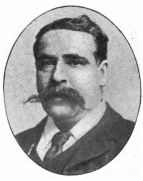
Harry Quelch
Henry Quelch (30 January, 1858 – 17 September, 1913) was one of the first Marxists and founders of the social democratic movement in Great Britain. He was a socialist activist, journalist and trade unionist. His brother, Lorenzo "Len" Quelch, was also a socialist activist, while his son, Tom Quelch, achieved note as a prominent communist activist.
Harry Quelch was born 30 January 1858 in the small town of Hungerford, Berkshire, England. He was the son and grandson of a village blacksmith; his maternal grandfather had been an agricultural labourer.
Circumstances forced the eldest child, Harry, into the world to contribute to the family's maintenance from a very young age, with Harry taking his first job at the age of 10. He worked variously in an upholsterer's shop and later for a local dairyman and cattle dealer. At the age of 14 he left Berkshire for good to make his way in the big city of London.
In London the boy worked a succession of jobs in a biscuit factory, in a tannery, and in an iron foundry before landing a better job as a packer in a paper warehouse. This last job allowed the boy sufficient free time to teach himself French. It was in this language that he first read the writing of Karl Marx as part of the process of his self-education. It was in this way that he was converted to the ideas of Social-Democracy. He also later taught himself German, the de facto official language of international socialism.
Quelch married in 1879 and soon fathered a family of his own. His son, Tom, followed in his father's footsteps as a radical political activist, becoming a founding member of the Communist Party of Great Britain.
Harry Quelch joined the Democratic Federation (forerunner of the Social Democratic Federation, SDF) in 1881 at the age of 23. Just two years later the young man was elected to its executive. In April 1884 Quelch became an international delegate of the British socialist movement for the first time when he and Hyndman were sent to Paris to attend a congress of the French Workers' Party.
When a large section of the party's active membership, led by William Morris, departed the SDF in 1884 to form the Socialist League, Quelch stayed behind, redoubling his efforts on behalf of the organisation. it was around this time that Quelch's abilities as a speaker and journalist began to fully develop.
Quelch became the full-time editor of the SDF's newspaper, Justice. He also represented the SDF on bodies including various strike committees and the Trades Union Congress, and at socialist conferences across Europe. He was heavily involved in the London dock strike of 1889, and was the main organiser and first general secretary of the South Side Labour Protection League, a union for dock workers founded after the strike. He was elected several times as the chair of the London Trades Council, and was one of the founders of the Labour Representation Committee. From 1892 until the end of 1908, he was also the business manager for the 20th Century Press, a radical publisher.
Harry Quelch
Henry Quelch (30 January, 1858 – 17 September, 1913) was one of the first Marxists and founders of the social democratic movement in Great Britain. He was a socialist activist, journalist and trade unionist. His brother, Lorenzo "Len" Quelch, was also a socialist activist, while his son, Tom Quelch, achieved note as a prominent communist activist.
Harry Quelch was born 30 January 1858 in the small town of Hungerford, Berkshire, England. He was the son and grandson of a village blacksmith; his maternal grandfather had been an agricultural labourer.
Circumstances forced the eldest child, Harry, into the world to contribute to the family's maintenance from a very young age, with Harry taking his first job at the age of 10. He worked variously in an upholsterer's shop and later for a local dairyman and cattle dealer. At the age of 14 he left Berkshire for good to make his way in the big city of London.
In London the boy worked a succession of jobs in a biscuit factory, in a tannery, and in an iron foundry before landing a better job as a packer in a paper warehouse. This last job allowed the boy sufficient free time to teach himself French. It was in this language that he first read the writing of Karl Marx as part of the process of his self-education. It was in this way that he was converted to the ideas of Social-Democracy. He also later taught himself German, the de facto official language of international socialism.
Quelch married in 1879 and soon fathered a family of his own. His son, Tom, followed in his father's footsteps as a radical political activist, becoming a founding member of the Communist Party of Great Britain.
Harry Quelch joined the Democratic Federation (forerunner of the Social Democratic Federation, SDF) in 1881 at the age of 23. Just two years later the young man was elected to its executive. In April 1884 Quelch became an international delegate of the British socialist movement for the first time when he and Hyndman were sent to Paris to attend a congress of the French Workers' Party.
When a large section of the party's active membership, led by William Morris, departed the SDF in 1884 to form the Socialist League, Quelch stayed behind, redoubling his efforts on behalf of the organisation. it was around this time that Quelch's abilities as a speaker and journalist began to fully develop.
Quelch became the full-time editor of the SDF's newspaper, Justice. He also represented the SDF on bodies including various strike committees and the Trades Union Congress, and at socialist conferences across Europe. He was heavily involved in the London dock strike of 1889, and was the main organiser and first general secretary of the South Side Labour Protection League, a union for dock workers founded after the strike. He was elected several times as the chair of the London Trades Council, and was one of the founders of the Labour Representation Committee. From 1892 until the end of 1908, he was also the business manager for the 20th Century Press, a radical publisher.
Recent media
Recent media