
Recent from talks
Harry Watrous
Knowledge base stats:
Talk channels stats:
Members stats:
Harry Watrous
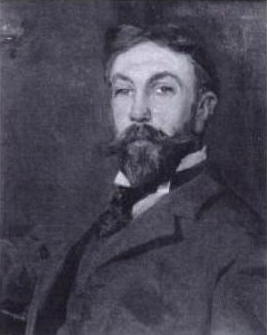
Harry Willson Watrous (17 September 1857 – 10 May 1940) was an American visual artist who received an academic education in France. His paintings included genre scenes, stylized figural works, landscapes, nocturnes, portraits, religious subjects, and still lifes. His 1913 painting The Drop Sinister, What Shall We Do with It? has been called the first known portrait of an American interracial family. He is perhaps best known for his enigmatic paintings of sophisticated women, often darkly dressed and seen in profile.
Harry Watrous was born in San Francisco in 1857, the son of Charles and Ruth Willson Watrous. He had two brothers, Charles (1854–56) and Walter (1860–1903). Harry's father had been a whaler in his youth and made his fortune during the California Gold Rush. The family moved to New York City in 1864, where his father's wealth allowed the young Watrous to be educated in private schools and to pursue an artistic career at his own pace, without having to worry about making a living.
He traveled to Spain with the deaf American artist Henry Humphrey Moore in 1881, and then to Paris, where he studied under Gustave Boulanger and Jules Lefebvre at the Académie Julian, and in Léon Bonnat's atelier. He had paintings accepted at the Paris Salons of 1884 and 1885. He was strongly influenced first by Marià Fortuny and then by Jean Louis Meissonier, who predicted that "someday this young man will be the American Meissonier." Watrous would later contribute a chapter about Meissonier to the book Modern French Masters. He returned to the United States in 1886.
Beginning in 1883, Watrous painted small genre pictures, "amazing in their almost microscopic detail." These works "of cabinet size…descended directly from such seventeenth-century masters as Metsu, Terborch, and Vermeer," and later, Vibert and Meissonier.
It is not a simple matter to reproduce with oil paint the sheen of satins and silks, the softness of furs and the richness of velvets, especially when it comes to doing it on a small canvas with the minute precision required in a picture that is intended to be seen at close range.…The strain upon an artist's eyes in doing such miniature-like work is very great and in the case of Mr. Watrous effectually prevented his continuing it, having seriously affected his sight.
This impairment of his vision began in 1905 and was temporary, but did prompt Watrous to stop painting tiny, minutely detailed genre scenes, and to work on a larger scale and in a broader manner, producing from 1905 to 1918 the idealized female figures for which he is best known. "Perhaps the most original of all his works, these paintings are very enigmatic, suggesting a symbolic intent or at least a psychological strangeness." The paintings often convey a sense of whimsy or quiet melancholy.
When the Metropolitan Museum acquired this painting [The Passing of Summer] just after it was completed, the artist explained that in the autumn of 1911 he had observed a woman seated alone at a table in a French restaurant. Watrous asked her, "Well, has Prince Charming appeared?" Her melancholy answer was "No, and this is the passing of summer." This work thus alludes to the fleeting nature of youth and beauty and the loss of opportunity.
A profile of Watrous from 1923 noted that in these paintings
Hub AI
Harry Watrous AI simulator
(@Harry Watrous_simulator)
Harry Watrous
Harry Willson Watrous (17 September 1857 – 10 May 1940) was an American visual artist who received an academic education in France. His paintings included genre scenes, stylized figural works, landscapes, nocturnes, portraits, religious subjects, and still lifes. His 1913 painting The Drop Sinister, What Shall We Do with It? has been called the first known portrait of an American interracial family. He is perhaps best known for his enigmatic paintings of sophisticated women, often darkly dressed and seen in profile.
Harry Watrous was born in San Francisco in 1857, the son of Charles and Ruth Willson Watrous. He had two brothers, Charles (1854–56) and Walter (1860–1903). Harry's father had been a whaler in his youth and made his fortune during the California Gold Rush. The family moved to New York City in 1864, where his father's wealth allowed the young Watrous to be educated in private schools and to pursue an artistic career at his own pace, without having to worry about making a living.
He traveled to Spain with the deaf American artist Henry Humphrey Moore in 1881, and then to Paris, where he studied under Gustave Boulanger and Jules Lefebvre at the Académie Julian, and in Léon Bonnat's atelier. He had paintings accepted at the Paris Salons of 1884 and 1885. He was strongly influenced first by Marià Fortuny and then by Jean Louis Meissonier, who predicted that "someday this young man will be the American Meissonier." Watrous would later contribute a chapter about Meissonier to the book Modern French Masters. He returned to the United States in 1886.
Beginning in 1883, Watrous painted small genre pictures, "amazing in their almost microscopic detail." These works "of cabinet size…descended directly from such seventeenth-century masters as Metsu, Terborch, and Vermeer," and later, Vibert and Meissonier.
It is not a simple matter to reproduce with oil paint the sheen of satins and silks, the softness of furs and the richness of velvets, especially when it comes to doing it on a small canvas with the minute precision required in a picture that is intended to be seen at close range.…The strain upon an artist's eyes in doing such miniature-like work is very great and in the case of Mr. Watrous effectually prevented his continuing it, having seriously affected his sight.
This impairment of his vision began in 1905 and was temporary, but did prompt Watrous to stop painting tiny, minutely detailed genre scenes, and to work on a larger scale and in a broader manner, producing from 1905 to 1918 the idealized female figures for which he is best known. "Perhaps the most original of all his works, these paintings are very enigmatic, suggesting a symbolic intent or at least a psychological strangeness." The paintings often convey a sense of whimsy or quiet melancholy.
When the Metropolitan Museum acquired this painting [The Passing of Summer] just after it was completed, the artist explained that in the autumn of 1911 he had observed a woman seated alone at a table in a French restaurant. Watrous asked her, "Well, has Prince Charming appeared?" Her melancholy answer was "No, and this is the passing of summer." This work thus alludes to the fleeting nature of youth and beauty and the loss of opportunity.
A profile of Watrous from 1923 noted that in these paintings
Recent media