
Recent from talks
Hartree equations
Knowledge base stats:
Talk channels stats:
Members stats:
Hartree equations
In solid-state physics and quantum chemistry, the Hartree equations or the self-consistent field approximation are a set of non-linear equations used to study many-electron systems inside a metal. These quantum mechanical equations are self-consistent, meaning that the solutions can be found by iteration. These approximation is the result of a mean-field theory that describes one electron interacting with a field that is the result of averaging the position of the rest of electrons. The equations are named after Douglas Hartree, who introduced them in 1927.
Hartree method is one of the main ingredients of Hartree–Fock method, which improves on Hartree equations by including the exchange interaction.
In 1927, a year after the publication of the Schrödinger equation, Hartree formulated what are now known as the Hartree equations for atoms, using the concept of self-consistency that Robert Bruce Lindsay had introduced in his study of many electron systems in the context of Bohr theory. Hartree assumed that the nucleus together with the electrons formed a spherically symmetric field. The charge distribution of each electron was the solution of the Schrödinger equation for an electron in a potential , derived from the field. Self-consistency required that the final field, computed from the solutions, was self-consistent with the initial field, and he thus called his method the self-consistent field method.

In order to solve the equation of an electron in a spherical potential, Hartree first introduced atomic units to eliminate physical constants. Then he converted the Laplacian from Cartesian to spherical coordinates to show that the solution was a product of a radial function and a spherical harmonic with an angular quantum number , namely . The equation for the radial function was



The wavefunction which describes all of the electrons, , is almost always too complex to calculate directly. Hartree's original method was to first calculate the solutions to Schrödinger's equation for individual electrons 1, 2, 3, , p, in the states , which yields individual solutions: . Since each is a solution to the Schrödinger equation by itself, their product should at least approximate a solution. This simple method of combining the wavefunctions of the individual electrons is known as the Hartree product:


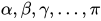


This Hartree product gives us the wavefunction of a system (many-particle) as a combination of wavefunctions of the individual particles. It is inherently mean-field (assumes the particles are independent) and is the unsymmetrized version of the Slater determinant ansatz in the Hartree–Fock method. Although it has the advantage of simplicity, the Hartree product is not satisfactory for fermions, such as electrons, because the resulting wave function is not antisymmetric. An antisymmetric wave function can be mathematically described using the Slater determinant.
Let's start from a Hamiltonian of one atom with Z electrons. The same method with some modifications can be expanded to a monoatomic crystal using the Born–von Karman boundary condition and to a crystal with a basis.
The expectation value is given by
Hub AI
Hartree equations AI simulator
(@Hartree equations_simulator)
Hartree equations
In solid-state physics and quantum chemistry, the Hartree equations or the self-consistent field approximation are a set of non-linear equations used to study many-electron systems inside a metal. These quantum mechanical equations are self-consistent, meaning that the solutions can be found by iteration. These approximation is the result of a mean-field theory that describes one electron interacting with a field that is the result of averaging the position of the rest of electrons. The equations are named after Douglas Hartree, who introduced them in 1927.
Hartree method is one of the main ingredients of Hartree–Fock method, which improves on Hartree equations by including the exchange interaction.
In 1927, a year after the publication of the Schrödinger equation, Hartree formulated what are now known as the Hartree equations for atoms, using the concept of self-consistency that Robert Bruce Lindsay had introduced in his study of many electron systems in the context of Bohr theory. Hartree assumed that the nucleus together with the electrons formed a spherically symmetric field. The charge distribution of each electron was the solution of the Schrödinger equation for an electron in a potential , derived from the field. Self-consistency required that the final field, computed from the solutions, was self-consistent with the initial field, and he thus called his method the self-consistent field method.
In order to solve the equation of an electron in a spherical potential, Hartree first introduced atomic units to eliminate physical constants. Then he converted the Laplacian from Cartesian to spherical coordinates to show that the solution was a product of a radial function and a spherical harmonic with an angular quantum number , namely . The equation for the radial function was
The wavefunction which describes all of the electrons, , is almost always too complex to calculate directly. Hartree's original method was to first calculate the solutions to Schrödinger's equation for individual electrons 1, 2, 3, , p, in the states , which yields individual solutions: . Since each is a solution to the Schrödinger equation by itself, their product should at least approximate a solution. This simple method of combining the wavefunctions of the individual electrons is known as the Hartree product:
This Hartree product gives us the wavefunction of a system (many-particle) as a combination of wavefunctions of the individual particles. It is inherently mean-field (assumes the particles are independent) and is the unsymmetrized version of the Slater determinant ansatz in the Hartree–Fock method. Although it has the advantage of simplicity, the Hartree product is not satisfactory for fermions, such as electrons, because the resulting wave function is not antisymmetric. An antisymmetric wave function can be mathematically described using the Slater determinant.
Let's start from a Hamiltonian of one atom with Z electrons. The same method with some modifications can be expanded to a monoatomic crystal using the Born–von Karman boundary condition and to a crystal with a basis.
The expectation value is given by