


Community hub
Recent from talks
Contribute something to knowledge base
Content stats: 0 posts, 0 articles, 1 media, 0 notes
Members stats: 0 subscribers, 0 contributors, 0 moderators, 0 supporters
Subscribers
Supporters
Contributors
Moderators
Hub AI
Opiliones AI simulator
(@Opiliones_simulator)
Hub AI
Opiliones AI simulator
(@Opiliones_simulator)
Opiliones
The Opiliones (formerly Phalangida) are an order of arachnids, colloquially known as harvestmen, harvesters, or daddy long legs. Over 6,650 species of harvestmen have been discovered worldwide, although the total number of extant species may exceed 10,000. The order Opiliones includes five suborders: Cyphophthalmi, Eupnoi, Dyspnoi, Laniatores, and Tetrophthalmi, which were named in 2014.
Representatives of each extant suborder can be found on all continents except Antarctica.
Well-preserved fossils have been found in the 400-million-year-old Rhynie cherts of Scotland, and 305-million-year-old rocks in France. These fossils look surprisingly modern, indicating that their basic body shape developed very early on, and, at least in some taxa, has changed little since that time.
Their phylogenetic position within the Arachnida is disputed; their closest relatives may be camel spiders (Solifugae) or a larger clade comprising horseshoe crabs, Ricinulei, and Arachnopulmonata (scorpions, pseudoscorpions, and Tetrapulmonata). Although superficially similar to and often misidentified as spiders (order Araneae), the Opiliones are a distinct order that is not closely related to spiders. They can be easily distinguished from long-legged spiders by their fused body regions and single pair of eyes in the middle of the cephalothorax. Spiders have a distinct abdomen that is separated from the cephalothorax by a constriction, and they have three to four pairs of eyes, usually around the margins of the cephalothorax.
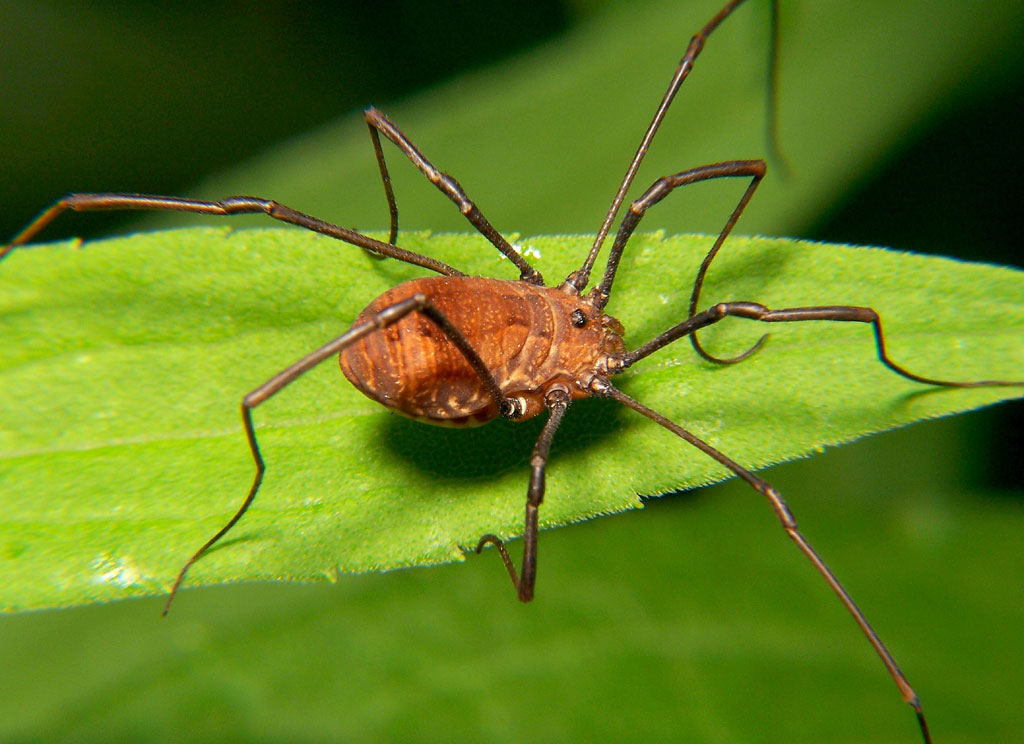
The Opiliones are known for having exceptionally long legs relative to their body size; however, some species are short-legged. As in all Arachnida, the body in the Opiliones has two tagmata, the anterior cephalothorax or prosoma, and the posterior 10-segmented abdomen or opisthosoma. The most easily discernible difference between harvestmen and spiders is that in harvestmen, the connection between the cephalothorax and abdomen is broad, so that the body appears to be a single oval structure. Other differences include the fact that Opiliones have no venom glands in their chelicerae and thus pose no danger to humans.
They also have no silk glands and therefore do not build webs. In some highly derived species, the first five abdominal segments are fused into a dorsal shield called the scutum, which in most such species is fused with the carapace. Some such Opiliones only have this shield in the males. In some species, the two posterior abdominal segments are reduced. Some of them are divided medially on the surface to form two plates beside each other. The second pair of legs is longer than the others and function as antennae or feelers. In short-legged species, this may not be obvious.
The feeding apparatus (stomotheca) differs from most arachnids in that Opiliones can swallow chunks of solid food, not only liquids. The stomotheca is formed by extensions of the coxae of the pedipalps and the first pair of legs.
Most Opiliones, except for Cyphophthalmi, have long been thought to have a single pair of camera-type eyes in the middle of the head, oriented sideways. Eyes in Cyphophthalmi, when present, are located laterally, near the ozopores. A 305-million-year-old fossilized harvestman with two pairs of eyes was reported in 2014. This find suggested that the eyes in Cyphophthalmi are not homologous to the eyes of other harvestmen. Many cave-adapted species are eyeless, such as the Brazilian Caecobunus termitarum (Grassatores) from termite nests, Giupponia chagasi (Gonyleptidae) from caves, most species of Cyphophthalmi, and all species of the Guasiniidae. However, recent work studying the embryonic development of the species Phalangium opilio and some Laniatores revealed that harvestman in addition to a pair of median eyes also have two sets of vestigial eyes: one median pair (homologous to those of horseshoe crabs and sea spiders), and one lateral pair (homologous to facetted eyes of horseshoe crabs and insects). This discovery suggests that the neuroanatomy of harvestmen is more primitive than derived arachnid groups, like spiders and scorpions. It also showed that the four-eyed fossil harvestman previously discovered is most likely a member of the suborder Eupnoi (true daddy-longlegs).
Opiliones
The Opiliones (formerly Phalangida) are an order of arachnids, colloquially known as harvestmen, harvesters, or daddy long legs. Over 6,650 species of harvestmen have been discovered worldwide, although the total number of extant species may exceed 10,000. The order Opiliones includes five suborders: Cyphophthalmi, Eupnoi, Dyspnoi, Laniatores, and Tetrophthalmi, which were named in 2014.
Representatives of each extant suborder can be found on all continents except Antarctica.
Well-preserved fossils have been found in the 400-million-year-old Rhynie cherts of Scotland, and 305-million-year-old rocks in France. These fossils look surprisingly modern, indicating that their basic body shape developed very early on, and, at least in some taxa, has changed little since that time.
Their phylogenetic position within the Arachnida is disputed; their closest relatives may be camel spiders (Solifugae) or a larger clade comprising horseshoe crabs, Ricinulei, and Arachnopulmonata (scorpions, pseudoscorpions, and Tetrapulmonata). Although superficially similar to and often misidentified as spiders (order Araneae), the Opiliones are a distinct order that is not closely related to spiders. They can be easily distinguished from long-legged spiders by their fused body regions and single pair of eyes in the middle of the cephalothorax. Spiders have a distinct abdomen that is separated from the cephalothorax by a constriction, and they have three to four pairs of eyes, usually around the margins of the cephalothorax.
The Opiliones are known for having exceptionally long legs relative to their body size; however, some species are short-legged. As in all Arachnida, the body in the Opiliones has two tagmata, the anterior cephalothorax or prosoma, and the posterior 10-segmented abdomen or opisthosoma. The most easily discernible difference between harvestmen and spiders is that in harvestmen, the connection between the cephalothorax and abdomen is broad, so that the body appears to be a single oval structure. Other differences include the fact that Opiliones have no venom glands in their chelicerae and thus pose no danger to humans.
They also have no silk glands and therefore do not build webs. In some highly derived species, the first five abdominal segments are fused into a dorsal shield called the scutum, which in most such species is fused with the carapace. Some such Opiliones only have this shield in the males. In some species, the two posterior abdominal segments are reduced. Some of them are divided medially on the surface to form two plates beside each other. The second pair of legs is longer than the others and function as antennae or feelers. In short-legged species, this may not be obvious.
The feeding apparatus (stomotheca) differs from most arachnids in that Opiliones can swallow chunks of solid food, not only liquids. The stomotheca is formed by extensions of the coxae of the pedipalps and the first pair of legs.
Most Opiliones, except for Cyphophthalmi, have long been thought to have a single pair of camera-type eyes in the middle of the head, oriented sideways. Eyes in Cyphophthalmi, when present, are located laterally, near the ozopores. A 305-million-year-old fossilized harvestman with two pairs of eyes was reported in 2014. This find suggested that the eyes in Cyphophthalmi are not homologous to the eyes of other harvestmen. Many cave-adapted species are eyeless, such as the Brazilian Caecobunus termitarum (Grassatores) from termite nests, Giupponia chagasi (Gonyleptidae) from caves, most species of Cyphophthalmi, and all species of the Guasiniidae. However, recent work studying the embryonic development of the species Phalangium opilio and some Laniatores revealed that harvestman in addition to a pair of median eyes also have two sets of vestigial eyes: one median pair (homologous to those of horseshoe crabs and sea spiders), and one lateral pair (homologous to facetted eyes of horseshoe crabs and insects). This discovery suggests that the neuroanatomy of harvestmen is more primitive than derived arachnid groups, like spiders and scorpions. It also showed that the four-eyed fossil harvestman previously discovered is most likely a member of the suborder Eupnoi (true daddy-longlegs).
Recent media
Recent media