Hubbry Logo
CheliceraeCheliceraeMain
Open search
Chelicerae
Community hub
Chelicerae
logo
8 pages, 0 posts
0 subscribers
Be the first to start a discussion here.
Chelicerae
Chelicerae
from Wikipedia
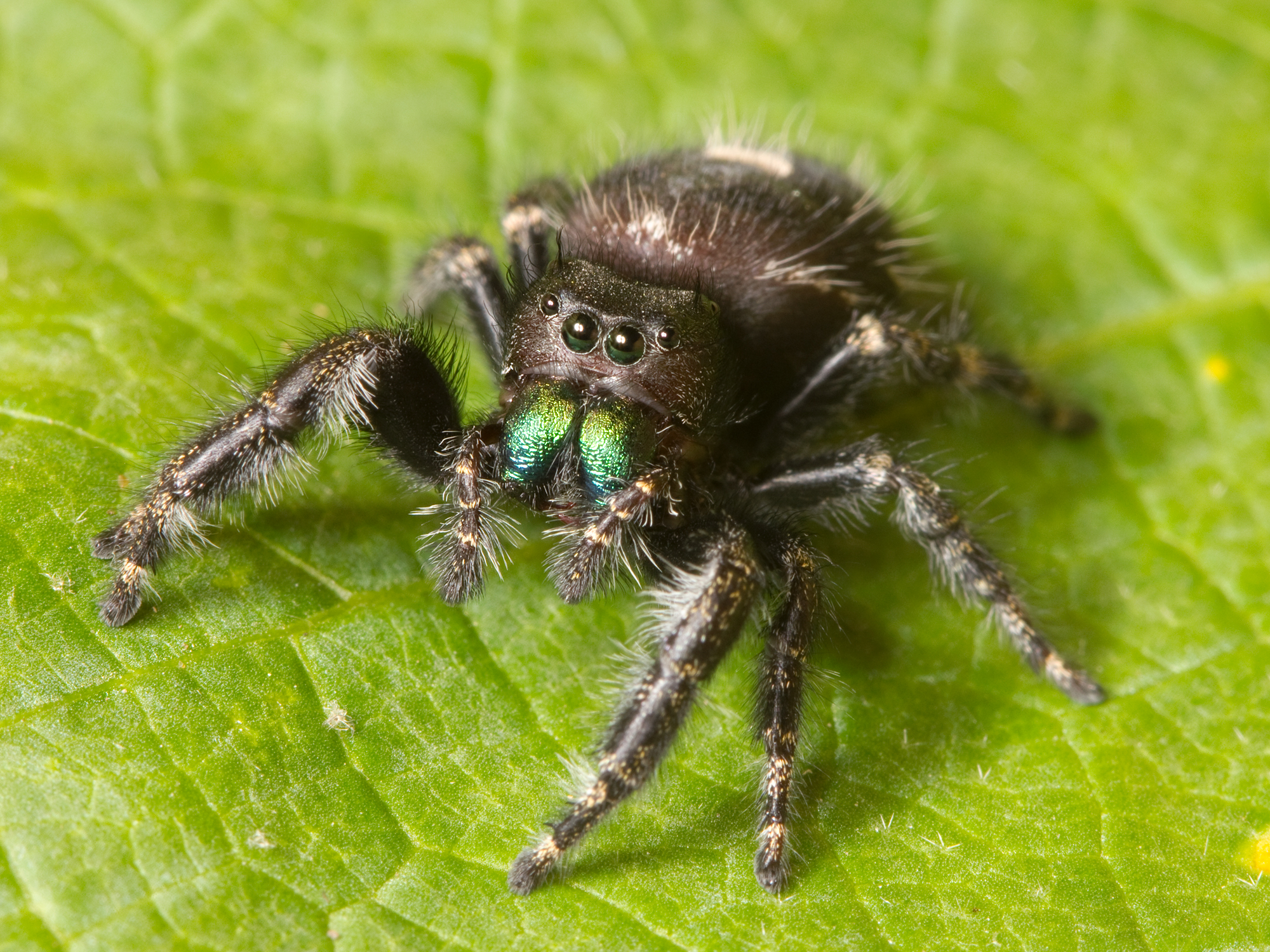
The jumping spider Phidippus audax. The basal parts of the chelicerae are the two iridescent green mouthparts.

The chelicerae (/kəˈlɪsər/) are the mouthparts of the subphylum Chelicerata, an arthropod group that includes arachnids, horseshoe crabs, and sea spiders. Commonly referred to as "jaws", chelicerae may be shaped as either articulated fangs, or as a type of pincers. Some chelicerae, such as those found on nearly all spiders, are hollow and contain (or are connected to) venom glands, used to inject venom into prey or a perceived threat. Both pseudoscorpions and harvestmen — neither of which have that venom channel — have additional structures on their chelicerae that are used for grooming (papillae in pseudoscorpions, cheliceral teeth in Opiliones).[1] In many spider species, males and females have sexually dimorphic chelicerae.

Types

[edit]
Types of chelicerae: (A) jackknife, (B) scissor, and (C) 3-segmented chelate
3D view of the chelicerae of a jumping spider. The pedipalps were removed to see the chelicerae.

Chelicerae can be divided into three kinds: jackknife chelicerae, scissor chelicerae, and three-segmented chelate chelicerae.[2]

Jackknife chelicerae

[edit]

The jackknife chelicera is subchelate (with fixed finger much reduced or absent) and is composed of two segments. This type of chelicera occurs exclusively in the Tetrapulmonata.

Jackknife chelicera are described in two different forms: orthognathous and labidognathous. Orthognathous chelicerae are articulated in a manner that enables movements of the appendages parallel to the body axis. This kind of chelicera occurs in the Liphistiomorphae and Mygalomorphae spiders and in the related orders Amblypygi, Schizomida and Uropygi. Labidognathous chelicerae move at right angles to the body axis. This kind of chelicera is rotated and occurs exclusively in the Araneomorphae spiders.[3]

Spider chelicerae

[edit]
Spider chelicerae. The chelicerae are shown in black, the surface of the cephalothorax in brown, the legs in reddish brown, and the venom glands and surrounding muscle tissue in green. The fang portion of the right chelicera can be seen projecting into the space between the two chelicerae.

The chelicerae consist of a base segment, sometimes called the "paturon", that articulates with the cephalothorax (or prosoma) and a fang portion that articulates with the base segment.[2] Almost all spiders have venom glands and can inject the venom through openings near the tips of their fangs when biting prey. The glands that produce this venom are located in the two segments of the chelicerae, and, in most spiders, extend beyond the chelicerae and into the cephalothorax.[2] The fang, the organic functional equivalent to a hypodermic needle, is what penetrates the skin, fur, or exoskeleton of the spider's target. In most species spider mouthparts are primarily intended for envenoming a spider's prey, typically insects and other small arthropods.[2] The basal portion includes all or part of the spider's venom glands, which can be squeezed to control the amount of venom forced out of the glands.[2] Such control permits a spider to administer either a dry bite, a dose appropriate to the nature of the prey or enemy, or a maximal dose.[2] The control is also necessary for actions such as the spitting of venomous silk by members of the family Scytodidae; they depend on that mechanism both in hunting and defence.

The fang is about 2mm long. The spider itself is about 25mm long.
Microphotograph of the same chelicera and the tip of a 22–gauge (0.64 mm (0.025 in)) hypodermic needle

When a spider bites, the two parts of the chelicerae come together like a folding knife, and when making a threat display or actually preparing to bite, the spider will open the angle of the fangs with the basal portion of the chelicerae and also open the angle of the basal portion with the cephalothorax.[2] In the tarantulas and other Mygalomorphae, the horizontal separation of the tips of the fangs does not change much, but in the other spiders the tips of the fangs move apart from each other as well as elevating.[2] Even the tips of the fangs of the rather large spider shown above are quite sharp, and the spider's body is well adapted to driving the fangs into flesh. Some spider bites, such as those of the Sydney funnel-web spider, are reported to have penetrated toenails and soft leather shoes.

Uncate chelicerae

[edit]

The uncate chelicera is chelate and composed of two segments and occurs in the orders Pseudoscorpiones, Solifugae, Ricinulei, and Araneae[4] (e.g., brown recluse, cellar spider, and crevice weaving spider).

Three-segmented chelate chelicerae

[edit]

Having three-segmented chelate chelicerae is the primitive condition and occurs in arachnids such as the Scorpiones and the Opiliones, as well as in non-arachnid Chelicerata such as the Xiphosura and Eurypterida.[5] The chelifores of the Pycnogonida may be homologous to chelicerae.[6]

References

[edit]
[edit]
Revisions and contributorsEdit on WikipediaRead on Wikipedia
from Grokipedia
Chelicerae are the paired, claw-like appendages that form the anterior-most pair of head structures in arthropods of the , which encompasses arachnids and several other groups, and they primarily function in feeding by grasping, piercing, or manipulating prey. These appendages typically consist of two or three segments, with the distal segment often acting against a penultimate one in a pincer-like or fang-like manner, and they are located on the prosoma, the anterior body region fused with the head in arachnids. While their basic form is conserved across chelicerates, chelicerae exhibit significant variation adapted to diverse lifestyles, such as injection in spiders or mechanical shredding in scorpions. In spiders (order Araneae), chelicerae are specialized as muscular, fang-tipped jaws that move in a scissor-like or vertical fashion to hold prey and deliver through a subterminal duct, facilitating immobilization and of tissues for consumption, though a few families like lack venom glands. Scorpions (order Scorpiones) possess smaller, chelate chelicerae resembling pincers, which grasp and tear prey during preoral digestion, and also play a role in by gripping the female's chelicerae with their own. Among mites and ticks (subclass Acari), chelicerae often form piercing stylets or barbed structures for cutting into host tissues to extract fluids, while in , they include a galea for production used in nest-building. In other arachnids like solifuges (camel spiders), the chelicerae are massively enlarged and serrated for powerful prey capture and burrowing, highlighting their multifunctional adaptations beyond feeding, including defense and mating. Beyond arachnids, chelicerae in non-arachnid chelicerates like horseshoe crabs (class Merostomata) are small and pincer-like for mechanical food manipulation without , whereas in (class Pycnogonida), they are slender probes for piercing soft-bodied prey. This diversity underscores the chelicerae's evolutionary significance as a defining trait of , enabling a wide array of ecological roles from predation to across terrestrial, marine, and freshwater habitats.

Overview

Definition and Characteristics

Chelicerae are paired, claw-like appendages located anterior to the mouth in members of the subphylum , which includes arachnids, horseshoe crabs, and . The term derives from the Greek words chele (claw) and keras (horn), reflecting their horn-like, grasping structure. These appendages are a defining synapomorphy of chelicerates, setting them apart from other by serving as the foremost mouthparts rather than antennae or mandibles. Key characteristics of chelicerae include their typical segmentation into a basal portion (in spiders, termed the paturon) and a distal movable or pincer that articulates via a . This structure enables mobility through associated muscles, allowing for grasping, piercing, or manipulation, though exact forms vary across chelicerate taxa—such as jackknife types in spiders or chelate pincers in scorpions. In many , the chelicerae are equipped with fangs connected to glands, enhancing their functional versatility. Embryologically, chelicerae originate from the deutocerebral segment of the head, as evidenced by conserved expression patterns that confirm the retention of this segment in chelicerates. This deutocerebral identity is specified by genetic mechanisms, such as the activity of the homothorax gene, which differentiates these appendages from posterior ones across arthropods. As the primary feeding apparatus, chelicerae underscore the chelicerate body's tagmosis into a prosoma bearing these appendages and the opisthosoma.

Occurrence in Chelicerates

Chelicerae are the preoral appendages that define the monophyletic subphylum , serving as a key synapomorphy that unites all members of this lineage. This subphylum encompasses over 100,000 described extant species, making it the second most diverse group after . Chelicerae are universally present across the major chelicerate classes, including the highly diverse Arachnida (spiders, scorpions, mites, ticks, and relatives), the marine (horseshoe crabs), (sea spiders), and the extinct Eurypterida (sea scorpions). These appendages, typically deutocerebral in origin and chelate or pincer-like in form, distinguish phylogenetically from other subphyla. The exclusivity of chelicerae to Chelicerata underscores their role as a shared derived trait, absent in the mandibulate arthropods such as (millipedes and centipedes), Crustacea (crabs, , and lobsters), and (insects and their allies). In these groups, head appendages evolved convergently toward mandibles for biting and grasping, paired with antennae derived from a different segmental origin, reflecting distinct evolutionary pathways in head tagmosis. This morphological divergence supports the deep phylogenetic split between Chelicerata and , with chelicerae emerging as a hallmark of chelicerate in both molecular and fossil evidence. Within non-arachnid chelicerates, chelicerae display morphological variation adapted to diverse habitats, though retaining their core pincer-like structure. In , such as the horseshoe crab Limulus polyphemus, chelicerae are reduced in size relative to body proportions, consisting of small, chelate appendages with a pincer at the distal end. In Pycnogonida, the chelicerae—often termed chelifores—are typically more elongated and clawed, projecting forward from the prosoma to facilitate interaction with marine environments. These forms highlight the chelicerae's evolutionary plasticity while affirming their presence across Chelicerata's ~120,000 extant species.

Structure

General Anatomy

Chelicerae are paired, appendage-like mouthparts characteristic of chelicerates, primarily composed of two main segments: a proximal paturon, which serves as the basal portion for articulation and movement, and a distal , a sharp, pointed structure adapted for piercing prey or substrates. The paturon forms the robust base, often housing part of the apparatus in certain arachnids, while the fang articulates directly with it via a bicondylar , enabling precise extension and retraction. This two-part configuration allows for efficient prey manipulation and across diverse chelicerate taxa. The external structure of chelicerae consists of a cuticular primarily made of reinforced with proteins and sclerotization agents, providing durability and flexibility while minimizing weight. Sclerotization, a process involving cross-linking of cuticular proteins, hardens the paturon and , enhancing resistance to mechanical stress during feeding activities. Articulations between the paturon and , often featuring a fang groove for retraction, permit folding mechanisms that vary by group, such as vertical motion in some basal forms or perpendicular pinching in derived arachnids. Chelicerae attach anteriorly to the prosoma, the fused head-thorax region in arachnids known as the , positioning them ventral to the for direct access to sources. Internal musculature supports their operation, with adductor muscles contracting to close the against the paturon and abductor muscles facilitating opening, for enhanced force generation. These muscles originate within the prosoma and insert via tendons onto the cheliceral segments, enabling rapid strikes. Variations in cheliceral size and shape reflect ecological adaptations, ranging from minute dimensions in small mites like immature mesostigmatids (body lengths under 0.3 mm) to several centimeters in large such as species. Orientation typically faces medially toward the midline for grasping, though some forms exhibit lateral projections adapted for specific predatory behaviors.

Segmental Composition

Chelicerae in most exhibit a two-segmented structure, consisting of a proximal basal segment known as the paturon and a distal movable . This configuration is characteristic of derived lineages, where the paturon provides structural support and musculature, while the fang enables precise manipulation. In contrast, more basal chelicerate groups, such as certain extinct eurypterids and chasmataspidids, retain a primitive three-segmented form, with an additional proximal segment articulating basally to the paturon, allowing greater flexibility in early evolutionary contexts. The segmentation is articulated primarily through hinge joints, which facilitate folding motions essential to cheliceral operation. In jackknife-type chelicerae, a bicondylar connects the paturon and , enabling the fang to fold compactly against the paturon when at rest. Chelates, or pincer-like structures, arise from the opposition of a movable distal (the ) against a fixed proximal finger on the paturon, forming a grasping mechanism without requiring additional segments. These joint types reflect adaptations derived from the limb's serial homology, emphasizing mobility over rigidity. Internally, the of venomous arachnids, such as spiders, are hollow and serve as conduits for delivery, connected via a duct that extends from the fang tip to paired glands housed within or adjacent to the chelicerae. These glands, often cylindrical and muscular, allow controlled injection through contraction. Sensory setae, or mechanoreceptive hairs, are distributed across the cheliceral surfaces, providing tactile feedback by detecting mechanical stimuli such as or contact during manipulation. Comparatively, chelicerae are homologous to the antennules of crustaceans, representing the deutocerebral appendages in the arthropod ground plan, but have been profoundly modified from primarily sensory functions to manipulative and predatory roles. Unlike mandibulate arthropods, chelicerates lack true mandibles, necessitating extraoral where enzymes are applied externally to liquefy prey prior to ingestion.

Functions

Predatory and Feeding Roles

In chelicerates, chelicerae serve as primary appendages for prey capture, enabling the piercing of exoskeletons or to immobilize victims through injection or mechanical grasping. In spiders, the chelicerae feature hollow fangs that deliver neurotoxins, such as those targeting channels to induce in and other small arthropods. These fangs penetrate the prey's , allowing rapid that subdues larger or more mobile targets efficiently. For food processing, chelicerae facilitate extraoral digestion, a process characteristic of chelicerates where enzymes are introduced externally to liquefy internal tissues before ingestion. In spiders, the fangs inject digestive fluids alongside venom, breaking down proteins and other macromolecules into a fluid form that is then sucked up through the pharynx. This method maximizes nutrient extraction while minimizing the ingestion of indigestible solids. In harvestmen (), chelicerae grasp and tear prey into smaller pieces for primarily piecemeal feeding, though extra-oral digestion involving liquefaction also occurs. Adaptations in chelicerae enhance their predatory efficiency across taxa; for instance, serrated edges on the cheliceral digits in certain mites, such as , aid in cutting through host tissues during blood meals. Chelate forms, common in scorpions, function as pincers to pinch and hold prey securely after immobilization by the tail sting. These structures often incorporate reinforced cuticles for durability during repeated use. Representative examples illustrate these roles: scorpions use their chelate chelicerae to crush and shred or small vertebrates post-envenomation, after which are applied to liquefy the remains into ingestible fluids, as they cannot consume solids whole. In predatory mites like those in the , chelicerae seize and pierce enchytraeid worms or other microarthropods, with specialized designs optimizing penetration and fluid extraction.

Sensory and Defensive Functions

Chelicerae in chelicerates often feature chemoreceptors and mechanoreceptors that facilitate the detection of chemical signals from prey or the surrounding environment, as well as tactile sensing for navigating substrates. In ricinuleids, such as Pseudocellus pearsei, the cheliceral digits contain ensheathed gustatory sensilla with terminal pores on the teeth, enabling the perception of chemical cues during prey manipulation, while slit-like mechanoreceptors near the digit articulation detect touch and vibrations for environmental exploration. Similarly, in spiders like Cupiennius salei, tactile hairs on the chelicerae serve as mechanoreceptors, projecting sensory information centrally to aid in substrate probing and spatial awareness. In ticks, cheliceral sensilla play a key role in chemosensation beyond initial attachment, housing pore structures that function as chemoreceptors for tasting meals and differentiating host suitability prior to feeding. For instance, in Rhipicephalus sanguineus, these inner-digit sensilla allow gustatory assessment, contributing to host location by evaluating chemical profiles encountered during questing behavior. Tactile setae distributed on chelicerae across arachnids further support mechanosensory functions, such as detecting surface textures during exploration, enhancing overall environmental interaction without reliance on visual cues. Defensive applications of chelicerae appear in select groups, where they assist in protective behaviors like grooming to dislodge irritants or potential threats. In , such as Maxchernes iporangae, the chelicerae are employed to maintain cleanliness by removing debris or parasites from the body, indirectly bolstering defense against infections or environmental hazards while the pedipalps adopt a vigilant posture. Scorpions similarly utilize their chelicerae for grooming exoskeletal irritants, a function that prevents vulnerability to pathogens and supports overall defensive readiness, though primary protection relies on other appendages. Specialized sensory roles are evident in pycnogonids, or , where chelicerae (chelifores) probe substrates tactilely to locate food sources, integrating mechanoreceptive feedback for precise environmental sampling. Chelicerae often coordinate with pedipalps during non-feeding tasks, enabling refined manipulation and sensing. In , this synergy allows chelicerae to handle silk production or debris while pedipalps provide tactile guidance, as seen in grooming or nest maintenance activities that enhance hygiene and protection. Such integration underscores the chelicerae's versatility in sensory-defensive contexts, complementing the segmental placement of receptors for efficient appendage interplay.

Morphological Types

Jackknife Chelicerae

Jackknife chelicerae are a type of two-segmented appendage characterized by a folding mechanism where the basal segment, known as the paturon, articulates with the prosoma and folds upward, while the apical segment, or fang, moves vertically in a downward striking motion reminiscent of a jackknife blade. This configuration allows for precise penetration and is devoid of chelae, relying solely on the fang for grasping and injection. These chelicerae predominate in the order Araneae (spiders), where they are the standard form, and occur in other members of the clade, such as (whip spiders) and (vinegaroons), but are absent in scorpions (Scorpiones), which possess three-segmented chelate chelicerae. In (harvestmen), chelicerae are typically three-segmented and non-jackknife, though some species exhibit elongated forms adapted for specific behaviors. Functionally, the jackknife design facilitates from an overhead position, enabling spiders to subdue prey larger than themselves by injecting through the hollow . In spiders, the connects directly to expansive glands housed in the prosoma, which produce potent cocktails of neurotoxins and enzymes tailored for immobilizing and liquefying diverse prey. Variations in jackknife chelicerae include differences in paturon size and orientation; for instance, in araneomorph spiders like (Salticidae), the paturon is often elongated and robust, enhancing precision in prey capture and mate interactions. Orthognathous forms, seen in mygalomorph spiders, feature parallel-facing chelicerae, while labidognathous types in araneomorphs converge medially for more versatile striking.

Uncate Chelicerae

Uncate chelicerae represent a morphological variant characterized by a two-segmented structure consisting of a fixed paturon and a curved, hook-like , derived from the Latin "uncus" meaning hook. Unlike folding types, these chelicerae lack a for vertical closure and instead operate through horizontal or lateral movements facilitated by a , enabling scissor-like action for prey manipulation. The is typically sickle-shaped, with on both fixed and movable segments, including primary teeth and secondary denticles that enhance cutting efficiency. This type is distributed among certain orders, notably select families of (camel spiders), such as Solpugidae and Eremobatidae, which exhibit robust, chelate forms. They also appear in basal arachnids, including some and ricinuleids, reflecting an ancestral configuration in chelicerate evolution. In , they can exceed prosoma length, underscoring size-related adaptations. Functionally, uncate chelicerae excel in slashing and tearing soft-bodied prey, such as and small arthropods, through mechanical shear rather than venom injection, as these structures lack associated venom glands. employ a similar "cheliceral mill" mechanism, where overlapping teeth grind tissues, with females showing more robust forms for predation and males featuring slender, hooked modifications for mating behaviors like transfer. This emphasis on physical damage suits nocturnal, opportunistic in leaf litter or habitats. Variations in uncate chelicerae primarily involve fang curvature, tailored to prey size and ; for instance, broader curves in like Eremobates facilitate larger carrion. is pronounced in , with male flagella—modified setae on the fixed finger—ranging from setiform to composite structures aiding copulation. These adaptations highlight the versatility of uncate forms without compromising their core slashing role.

Three-Segmented Chelate Chelicerae

Three-segmented chelate chelicerae consist of a proximal basal segment, a medial segment bearing a fixed finger, and a distal movable finger that opposes the fixed one to form a pincer-like chela capable of clamping and grasping. This structure allows for precise manipulation, with the opposed digits enabling the chelicerae to hold objects securely through a shearing or pinching motion. This cheliceral type is distributed among several orders, including Scorpiones (scorpions), (harvestmen), and certain subgroups of Acari (mites), as well as in extinct eurypterids (sea scorpions). In scorpions, the chelicerae are positioned anteriorly on the prosoma and articulate with the body via a basal . Within Acari, chelate forms predominate in mesostigmatid mites, where the three segments support diverse feeding adaptations, and in , the chelicerae consist of three segments with the distal two forming a toothed pincer. Functionally, these chelicerae serve primarily in predatory and feeding roles by grasping small prey or particles, facilitating their to the mouthparts. In scorpions, following by the , the chelicerae manipulate and tear the immobilized prey, aiding in dissection and ingestion while also assisting in grooming. In , the chelicerae grasp and tear prey without venom. In mites, the chelae grasp minute prey or pierce host tissues to extract fluids, with the pincer action porting material toward the for sucking. Variations in this cheliceral form include significant size differences, ranging from microscopic pincers in mites (under 0.1 mm) to robust, macro-scale structures in s (up to several centimeters). occurs in some species, where males possess enlarged chelicerae relative to females, potentially enhancing their role in mate grasping during . Such dimorphism underscores adaptive modifications for reproductive behaviors without altering the fundamental three-segmented chelate design.

Evolution

Origins in Arthropods

The origins of chelicerae trace back to the early evolutionary history of arthropods, with the fossil record providing key insights into their emergence. Chelicerae-like structures, interpreted as grasping appendages homologous to modern chelicerae, first appear in middle trilobitomorph arthropods from deposits such as the , dating to approximately 508 million years ago. These structures, seen in taxa like Sanctacaris uncata, suggest an early specialization of frontal appendages for manipulation, though their exact chelicerate affinity remains debated. Definitive chelicerae, more clearly resembling those of extant chelicerates, are documented in synziphosurines, such as Setapedites abundantis from deposits around 478 million years ago, marking a consolidation of the chelicera as a diagnostic feature of the group. Developmentally, chelicerae arise from the deutocerebral segment of the head during embryogenesis, originating as limb buds innervated by the deutocerebrum. This positioning reflects a conserved pattern across arthropods, where the deutocerebral appendages differentiate from more posterior locomotory limbs through genetic mechanisms involving regulation and distal-less expression. In chelicerates, this co-option transformed ancestral walking appendages into specialized feeding tools, enabling precise grasping and piercing, as evidenced by comparative studies of embryonic development in spiders and horseshoe crabs. Such modifications highlight how segmental identity shifts underpinned the functional evolution of chelicerae from generalist to specialized roles. Evolutionary hypotheses propose that chelicerae derived from biramous appendages typical of basal arthropods, through the reduction or loss of the exopod (outer branch) and associated flagella, resulting in a compact, uniramous form suited for predation. This transformation is linked to ecological shifts in marine ancestors, where early arthropods transitioned from passive filter-feeding—relying on biramous limbs for suspension capture—to active predation, with chelicerae providing a for seizing prey. Fossil evidence from great-appendage arthropods, such as Haikoucaris, supports this, showing intermediate forms with short, spiny frontal appendages akin to proto-chelicerae. A pivotal event in chelicerae evolution was their establishment in stem-group chelicerates during the (GOBE), spanning roughly 485 to 443 million years ago, when marine ecosystems underwent rapid faunal expansion. This period saw the proliferation of synziphosurine-like stem chelicerates, such as Setapedites abundantis, featuring chelicerae adapted to diverse benthic habitats, coinciding with increased oxygen levels and blooms that favored predatory innovations. The GOBE thus provided the environmental context for chelicerae to become entrenched as a hallmark of chelicerate radiation, setting the stage for subsequent diversification.

Diversification Across Groups

The diversification of chelicerae within arachnids accelerated after the period, approximately 420 million years ago, aligning with the transition to terrestrial habitats and the radiation of major lineages such as spiders and scorpions. In spiders (Araneae), the two-segmented jackknife form emerged as a derived for efficient prey manipulation on land, facilitated by the loss of the proximal segment through genetic mechanisms involving the domain. Similarly, scorpions (Scorpiones) retained three-segmented chelate chelicerae suited to burrowing and soil-based predation, reflecting their early divergence and to terrestrial microhabitats. Outside arachnids, non-arachnid chelicerates exhibit retention or modification of ancestral forms. Horseshoe crabs () preserve the primitive three-segmented chelicerae, consisting of a proximal paturon and distal claw-like segments, which serve basic feeding functions in marine environments and highlight the plesiomorphic condition across . In sea spiders (Pycnogonida), chelicerae manifest as elongated chelifores, particularly in deep-sea species like , enabling probing and capture in low-visibility aquatic habitats. Key drivers of this diversification include habitat adaptations and co-evolutionary innovations. Terrestrialization prompted morphological shifts, such as the of venom delivery systems in chelicerae around 300 million years ago, originating from ancestral duplications in early araneomorphs to enhance predation efficiency. In web-building s, the development of glands paralleled cheliceral evolution, potentially reducing reliance on chelicerae for direct prey handling by enabling passive capture strategies. In modern lineages, cheliceral diversification includes reductions or losses, particularly in parasitic forms. Parasitic mites, such as those in the genus , display extreme reduction of chelicerae into piercing stylets for host tissue penetration, an adaptation tied to their endoparasitic lifestyle within mammalian follicles. This spectrum of forms underscores ongoing evolutionary plasticity, with fossil records suggesting untapped potential for discovering intermediate morphologies in undescribed deposits.

References

Add your contribution
Related Hubs
User Avatar
No comments yet.