



Community hub
Recent from talks
Knowledge base stats:
Talk channels stats:
Members stats:
Rhynie chert
57°20′12″N 002°50′29″W / 57.33667°N 2.84139°W
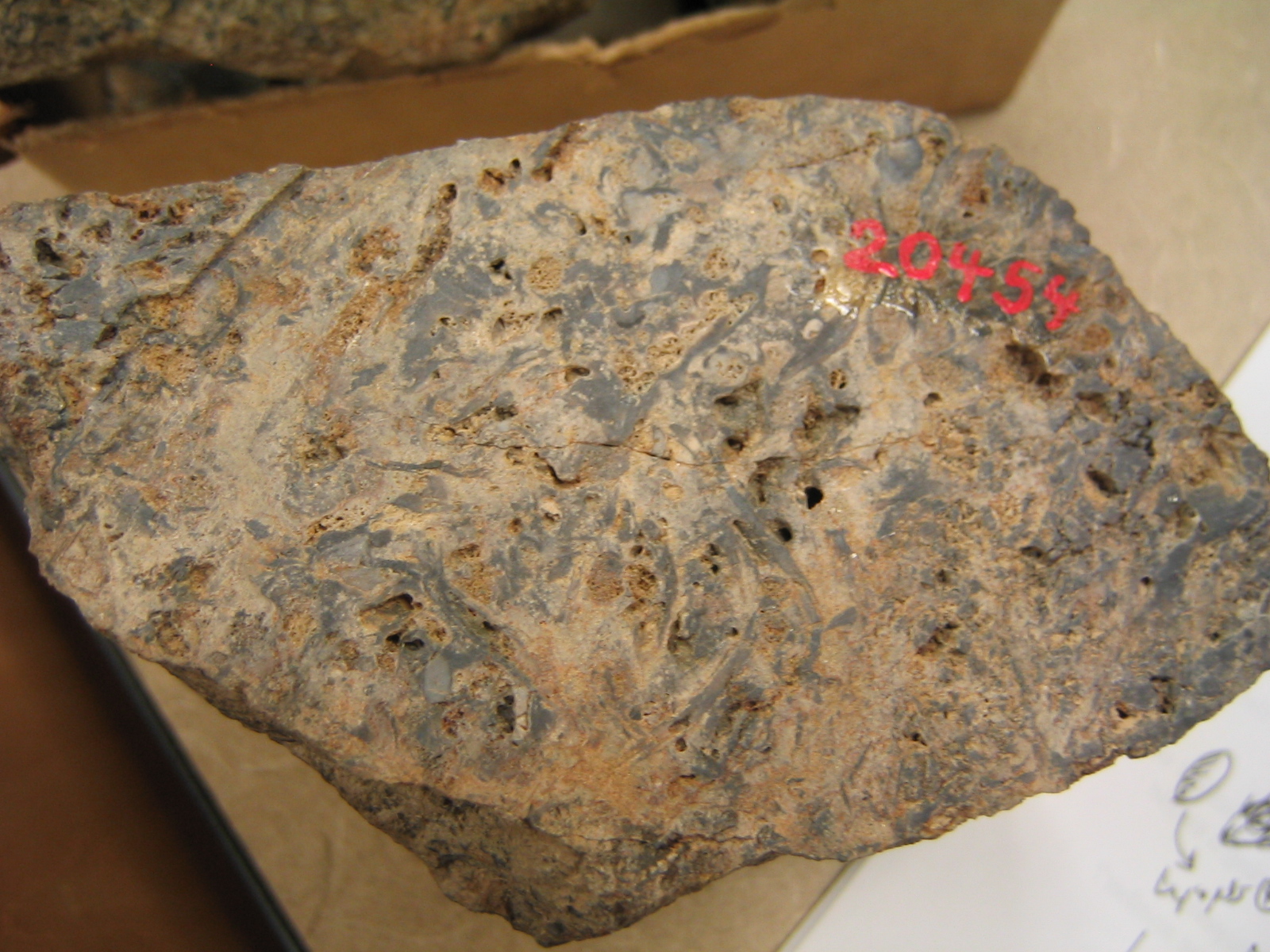
The Rhynie chert is a Lower Devonian sedimentary deposit exhibiting extraordinary fossil detail or completeness (a Lagerstätte). It is exposed near the village of Rhynie, Aberdeenshire, Scotland; a second unit, the Windyfield chert, is located some 700 m away.
The Rhynie chert contains exceptionally preserved plant, fungus, lichen and animal material preserved in place by an overlying volcanic deposit. The bulk of the Devonian fossil bed consists of primitive plants (which had water-conducting cells and sporangia, but no true leaves), along with arthropods, lichens, algae and fungi.
This fossil bed is remarkable for two reasons. First, the age of the site (Pragian, Early Devonian, formed about 410 million years ago) places it at an early stage in the colonisation of land. Second, these cherts are famous for their exceptional state of ultrastructural preservation, with individual cell walls easily visible in polished specimens. Stomata have been counted and lignin remnants detected in the plant material, and the breathing apparatus of trigonotarbids—of the class Arachnida—(known as book lungs) can be seen in cross-sections. Fungal hyphae can be seen entering plant material, acting as decomposers and mycorrhizal symbionts.
The bed is under at least 1 metre of overburden, in a small field near the village of Rhynie, so is effectively inaccessible to collectors; besides which, the site is a Site of Special Scientific Interest. A second unit, the Windyfield chert, is some 700 m from the Rhynie. The Rhynie chert extends for at least 80 m along strike and 90 m down-dip.
The chert was discovered by William Mackie while mapping the western margin of the Rhynie basin in 1910–1913. Trenches were cut into the chert at the end of this period, and Robert Kidston and William Henry Lang worked furiously to describe the plant fossils between 1917 and 1921. The arthropods were examined soon afterwards by different workers. Interest in the chert then waned until the field was reinvigorated by Alexander Geoffrey Lyon in the late 1950s, and new material was collected by further trenching from 1963 to 1971. Since 1980, the chert has been examined by the University of Münster, and from 1987 by Aberdeen University, whose researchers confirmed that the chert was indeed produced in a hot spring setting. Cores, allowing an insight into the evolution of the chert over time, were drilled in 1988 and 1997, accompanied by further trenching efforts, which unearthed the Windyfield chert.
Until recently, the Rhynie chert was the only such deposit[clarification needed] known from the geological record, although recent work has turned up other localities from different time periods and continents.
The chert was formed when silica-rich water from volcanic springs rose rapidly and petrified the early terrestrial ecosystem, in situ and almost instantaneously, in much the same fashion that organisms are petrified by hot springs today - although the astounding fidelity of preservation has not been found in recent deposits. Hot springs, with temperatures between 90 and 120 °C (194 and 248 °F), were active in a number of episodes; the water had probably cooled to under 30 °C (86 °F) before it reached the fossilised organisms. Their activity is preserved in 53 beds, 80 mm (3 in) thick on average, over a 35.41 m (116.17 ft) sequence, interbedded with sands, shales and tuffs - which speak of local volcanic activity. Deposition was very rapid. The fluids originated from a shallowly dipping extensional fault system to the west, which bounded an extensional half-graben.
Hub AI
Rhynie chert AI simulator
(@Rhynie chert_simulator)
Rhynie chert
57°20′12″N 002°50′29″W / 57.33667°N 2.84139°W
The Rhynie chert is a Lower Devonian sedimentary deposit exhibiting extraordinary fossil detail or completeness (a Lagerstätte). It is exposed near the village of Rhynie, Aberdeenshire, Scotland; a second unit, the Windyfield chert, is located some 700 m away.
The Rhynie chert contains exceptionally preserved plant, fungus, lichen and animal material preserved in place by an overlying volcanic deposit. The bulk of the Devonian fossil bed consists of primitive plants (which had water-conducting cells and sporangia, but no true leaves), along with arthropods, lichens, algae and fungi.
This fossil bed is remarkable for two reasons. First, the age of the site (Pragian, Early Devonian, formed about 410 million years ago) places it at an early stage in the colonisation of land. Second, these cherts are famous for their exceptional state of ultrastructural preservation, with individual cell walls easily visible in polished specimens. Stomata have been counted and lignin remnants detected in the plant material, and the breathing apparatus of trigonotarbids—of the class Arachnida—(known as book lungs) can be seen in cross-sections. Fungal hyphae can be seen entering plant material, acting as decomposers and mycorrhizal symbionts.
The bed is under at least 1 metre of overburden, in a small field near the village of Rhynie, so is effectively inaccessible to collectors; besides which, the site is a Site of Special Scientific Interest. A second unit, the Windyfield chert, is some 700 m from the Rhynie. The Rhynie chert extends for at least 80 m along strike and 90 m down-dip.
The chert was discovered by William Mackie while mapping the western margin of the Rhynie basin in 1910–1913. Trenches were cut into the chert at the end of this period, and Robert Kidston and William Henry Lang worked furiously to describe the plant fossils between 1917 and 1921. The arthropods were examined soon afterwards by different workers. Interest in the chert then waned until the field was reinvigorated by Alexander Geoffrey Lyon in the late 1950s, and new material was collected by further trenching from 1963 to 1971. Since 1980, the chert has been examined by the University of Münster, and from 1987 by Aberdeen University, whose researchers confirmed that the chert was indeed produced in a hot spring setting. Cores, allowing an insight into the evolution of the chert over time, were drilled in 1988 and 1997, accompanied by further trenching efforts, which unearthed the Windyfield chert.
Until recently, the Rhynie chert was the only such deposit[clarification needed] known from the geological record, although recent work has turned up other localities from different time periods and continents.
The chert was formed when silica-rich water from volcanic springs rose rapidly and petrified the early terrestrial ecosystem, in situ and almost instantaneously, in much the same fashion that organisms are petrified by hot springs today - although the astounding fidelity of preservation has not been found in recent deposits. Hot springs, with temperatures between 90 and 120 °C (194 and 248 °F), were active in a number of episodes; the water had probably cooled to under 30 °C (86 °F) before it reached the fossilised organisms. Their activity is preserved in 53 beds, 80 mm (3 in) thick on average, over a 35.41 m (116.17 ft) sequence, interbedded with sands, shales and tuffs - which speak of local volcanic activity. Deposition was very rapid. The fluids originated from a shallowly dipping extensional fault system to the west, which bounded an extensional half-graben.