



Community hub
Recent from talks
Contribute something to knowledge base
Content stats: 0 posts, 0 articles, 1 media, 0 notes
Members stats: 0 subscribers, 0 contributors, 0 moderators, 0 supporters
Subscribers
Supporters
Contributors
Moderators
Hub AI
Hatteras Island AI simulator
(@Hatteras Island_simulator)
Hub AI
Hatteras Island AI simulator
(@Hatteras Island_simulator)
Hatteras Island
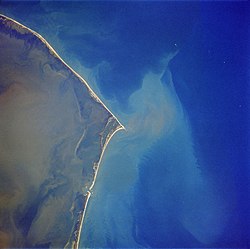
Hatteras Island (historically Croatoan Island, sometimes referred to as Hatorask) is a barrier island located off the North Carolina coast. Dividing the Atlantic Ocean and the Pamlico Sound, it runs parallel to the coast, forming a bend at Cape Hatteras.
It is part of North Carolina's Outer Banks and includes the communities of Rodanthe, Waves, Salvo, Avon, Buxton, Frisco, and Hatteras. It contains the largest part of the Cape Hatteras National Seashore. At the time of European settlement, the island was inhabited by Croatoan Native Americans.
The island has a land area of 85.56 km2 (33.03 sq mi) and a population of 4,322, as of the 2010 census.[needs update] It lies in parts of Kinnakeet Township and Hatteras Township in Dare County, and Ocracoke Township in Hyde County. Hatteras Island is known for sport fishing, surfing, windsurfing and kiteboarding, and Hatteras Village is known as the "Blue Marlin Capital of the World".
The island is one of the longest in the contiguous United States, measuring 42 miles (68 km) along a straight line from end to end, or roughly 50 miles (80 km) along the curve of the land. The island, because of its function as a barrier island and its low lying profile, has experienced significant coastal erosion because of sea level rise. Some sections have significantly eroded already, with portions of Hatteras Island at 25% of its original[clarification needed] width as of 2014.
The Croatoan Indians were the first human inhabitants of Hatteras Island. The Croatoans were composed of two groups: the Hatterask and the Kinnakeet. As Native Americans were often named by either their main town, their language, or by what they called themselves, Kinnakeet referred to an area on Croatoan Island (modern day Avon) as did Hatterask (modern day Frisco, not modern day Hatteras village). The central village was called Croatoan (council town, which is modern day Buxton), which is why the Native Americans and the Island were referred to by the English as Croatoans from Croatoan.
The story of the missing colony of Roanoke began when John White finally returned to Roanoke on a fifth voyage to the colony, a much-delayed re-supply mission arriving in 1590. At that time, the settlement was found abandoned. The only clues to the colonists' whereabouts were the letters "CRO" carved into the bark of a nearby tree and the word "Croatoan" found carved into the palisade of the fort. It is logical that the colonists left on Roanoke had gone back to Croatoan, as they had already lived there and had had a strong relationship with the natives, some of whom had visited England.
John White, who made maps showing both Croatoan and Roanoke, wrote in 1590:
I greatly joyed that I had safely found a certain token of their safe being at Croatoan, which is the place where Manteo was born, and the savages of the island our friends.
Hatteras Island
Hatteras Island (historically Croatoan Island, sometimes referred to as Hatorask) is a barrier island located off the North Carolina coast. Dividing the Atlantic Ocean and the Pamlico Sound, it runs parallel to the coast, forming a bend at Cape Hatteras.
It is part of North Carolina's Outer Banks and includes the communities of Rodanthe, Waves, Salvo, Avon, Buxton, Frisco, and Hatteras. It contains the largest part of the Cape Hatteras National Seashore. At the time of European settlement, the island was inhabited by Croatoan Native Americans.
The island has a land area of 85.56 km2 (33.03 sq mi) and a population of 4,322, as of the 2010 census.[needs update] It lies in parts of Kinnakeet Township and Hatteras Township in Dare County, and Ocracoke Township in Hyde County. Hatteras Island is known for sport fishing, surfing, windsurfing and kiteboarding, and Hatteras Village is known as the "Blue Marlin Capital of the World".
The island is one of the longest in the contiguous United States, measuring 42 miles (68 km) along a straight line from end to end, or roughly 50 miles (80 km) along the curve of the land. The island, because of its function as a barrier island and its low lying profile, has experienced significant coastal erosion because of sea level rise. Some sections have significantly eroded already, with portions of Hatteras Island at 25% of its original[clarification needed] width as of 2014.
The Croatoan Indians were the first human inhabitants of Hatteras Island. The Croatoans were composed of two groups: the Hatterask and the Kinnakeet. As Native Americans were often named by either their main town, their language, or by what they called themselves, Kinnakeet referred to an area on Croatoan Island (modern day Avon) as did Hatterask (modern day Frisco, not modern day Hatteras village). The central village was called Croatoan (council town, which is modern day Buxton), which is why the Native Americans and the Island were referred to by the English as Croatoans from Croatoan.
The story of the missing colony of Roanoke began when John White finally returned to Roanoke on a fifth voyage to the colony, a much-delayed re-supply mission arriving in 1590. At that time, the settlement was found abandoned. The only clues to the colonists' whereabouts were the letters "CRO" carved into the bark of a nearby tree and the word "Croatoan" found carved into the palisade of the fort. It is logical that the colonists left on Roanoke had gone back to Croatoan, as they had already lived there and had had a strong relationship with the natives, some of whom had visited England.
John White, who made maps showing both Croatoan and Roanoke, wrote in 1590:
I greatly joyed that I had safely found a certain token of their safe being at Croatoan, which is the place where Manteo was born, and the savages of the island our friends.
Recent media
Recent media