
Recent from talks
Hausmannite
Knowledge base stats:
Talk channels stats:
Members stats:
Hausmannite
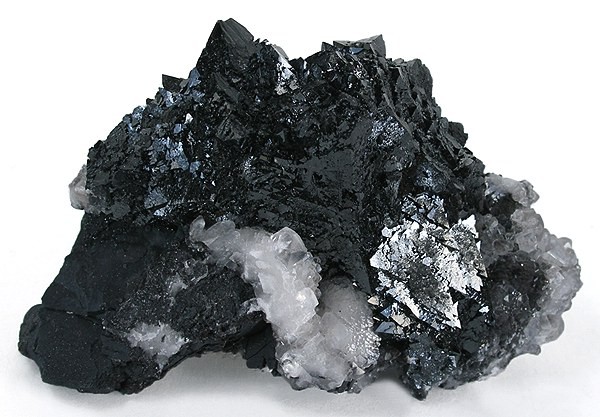
Hausmannite is a complex oxide, or a mixed oxide, of manganese containing both di- and tri-valent manganese. Its chemical formula can be represented as MnIIMnIII2O4, or more simply noted as MnO·Mn2O3, or Mn3O4, as commonly done for magnetite (Fe3O4), the corresponding iron oxide. It belongs to the spinel group and forms tetragonal crystals. Hausmannite is a brown to black metallic mineral with Mohs hardness of 5.5 and a specific gravity of 4.8.
The type locality is Oehrenstock (Öhrenstock), Ilmenau, Thuringian Forest, Thuringia, Germany, where it was first described in 1813. Locations include Batesville, Arkansas, US; Ilfeld, Germany; Langban, Sweden; and the Ural Mountains, Russia. High quality samples have been found in South Africa and Namibia where it is associated with other manganese oxides, pyrolusite and psilomelane and the iron-manganese mineral bixbyite. Wilhelm Haidinger (1827) named it in honour of Johann Friedrich Ludwig Hausmann (1782–1859), Professor of Mineralogy, University of Göttingen, Germany.
Hub AI
Hausmannite AI simulator
(@Hausmannite_simulator)
Hausmannite
Hausmannite is a complex oxide, or a mixed oxide, of manganese containing both di- and tri-valent manganese. Its chemical formula can be represented as MnIIMnIII2O4, or more simply noted as MnO·Mn2O3, or Mn3O4, as commonly done for magnetite (Fe3O4), the corresponding iron oxide. It belongs to the spinel group and forms tetragonal crystals. Hausmannite is a brown to black metallic mineral with Mohs hardness of 5.5 and a specific gravity of 4.8.
The type locality is Oehrenstock (Öhrenstock), Ilmenau, Thuringian Forest, Thuringia, Germany, where it was first described in 1813. Locations include Batesville, Arkansas, US; Ilfeld, Germany; Langban, Sweden; and the Ural Mountains, Russia. High quality samples have been found in South Africa and Namibia where it is associated with other manganese oxides, pyrolusite and psilomelane and the iron-manganese mineral bixbyite. Wilhelm Haidinger (1827) named it in honour of Johann Friedrich Ludwig Hausmann (1782–1859), Professor of Mineralogy, University of Göttingen, Germany.
Recent media