Hubbry Logo
BixbyiteBixbyiteMain
Open search
Bixbyite
Community hub
Bixbyite
logo
8 pages, 0 posts
0 subscribers
Be the first to start a discussion here.
Bixbyite
Bixbyite
from Wikipedia
Bixbyite
General
CategoryOxide minerals
Formula(Mn,Fe)2O3
IMA symbolBxb[1]
Strunz classification4.CB.10
Dana classification4.3.7.2
Crystal systemCubic
Crystal classDiploidal (m3)
H-M symbol: (2/m 3)
Space groupIa3
Unit cella = 9.411 Å; Z = 16
Identification
Formula mass158.33 g/mol
ColorBlack
Crystal habitMassive to crystalline
TwinningOn {111}, as penetration twins
CleavageImperfect on {111}, in traces
FractureIrregular to uneven
Mohs scale hardness6 – 6+12
LusterMetallic
StreakBlack
DiaphaneityOpaque
Specific gravity5.12
Density4.95
Optical propertiesIsotropic
Refractive index2.51 – 2.56
Common impuritiesAl, Mg, Si, Ti
References[2][3][4][5]

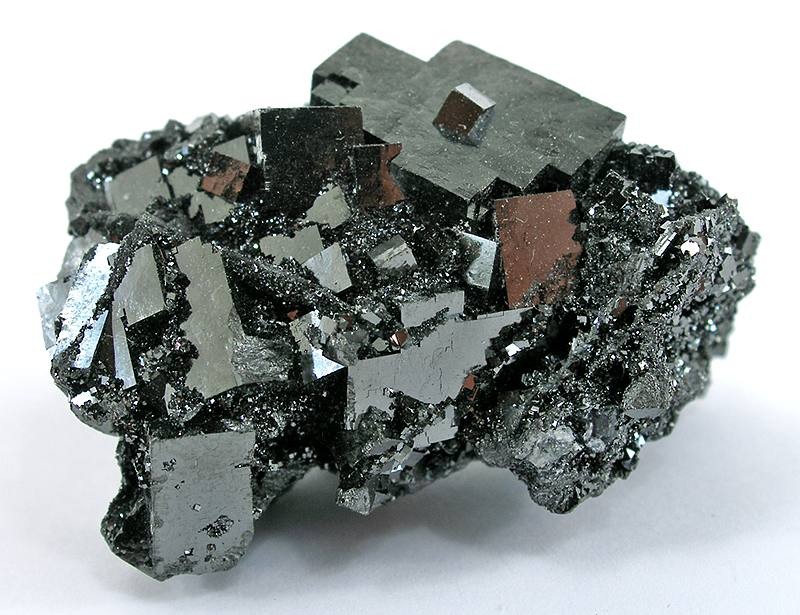
Bixbyite is a manganese iron oxide mineral with chemical formula: (Mn,Fe)2O3. The iron/manganese ratio is quite variable and many specimens have almost no iron. It is a metallic dark black with a Mohs hardness of 6.0 – 6.5.[3] It is a somewhat rare mineral sought after by collectors as it typically forms euhedral isometric crystals exhibiting various cubes, octahedra, and dodecahedra.

It is commonly associated with beryl, quartz, spessartine, hematite, pseudobrookite, hausmannite, braunite and topaz in pneumatolytic or hydrothermal veins and cavities and in metamorphic rocks. It can also be found in lithophysal cavities in rhyolite.[3] Typical localities are Jhabua and Chhindwara districts, India and the Thomas Range in Juab County, Utah. It is also reported from San Luis Potosi, Mexico; northern Patagonia, Argentina; Girona, Catalonia, Spain; Sweden, Germany, Namibia, Zimbabwe, and South Africa.[3][6]

Bixbyite was named for the American mineralogist Maynard Bixby (1853–1935), responsible for its discovery in 1897.[3] It should not be confused with bixbite, a red form of beryl; to avoid confusion, this name has been deprecated from the CIBJO and the IMA.

See also

[edit]

References

[edit]
[edit]
Revisions and contributorsEdit on WikipediaRead on Wikipedia
from Grokipedia
Bixbyite is a rare manganese-iron oxide mineral with the chemical formula (Mn³⁺, Fe³⁺)₂O₃, crystallizing in the cubic system and typically forming metallic black, isometric crystals or masses. It exhibits a Mohs hardness of 6–6.5, a black streak, and a specific gravity of approximately 4.95, with a metallic luster that makes it opaque and isotropic. Named after American mineralogist and prospector Maynard Bixby (1853–1935), who first collected specimens from the Thomas Range in Juab County, Utah, in 1897, the mineral was formally described that same year by Samuel L. Penfield and Harry W. Foote in the American Journal of Science. Bixbyite should not be confused with bixbite, an unrelated gem variety of red beryl also named after Bixby but discovered later in 1904. The occurs primarily in lithophysal cavities within rhyolitic volcanic rocks or in metamorphosed manganese ore deposits, often associated with , , pseudobrookite, , and in rhyolite environments, or braunite in ore settings. Notable localities include the type locality at Thomas Range, , —where euhedral crystals up to 1 cm can form—as well as in and Långban in . Due to its scarcity and attractive crystal habits, bixbyite is prized by mineral collectors, though it has no significant industrial uses. Its structure, featuring a defect corundum-type lattice, contributes to its stability in high-temperature volcanic settings.

Etymology and history

Naming

Bixbyite is named after Maynard Bixby (1853–1935), a Utah-based mineral collector, prospector, and dealer who provided the initial specimens of the mineral to scientists for examination. The mineral received its formal description and naming in 1897 by American mineralogists Samuel Lewis Penfield and Harry Ward Foote, published in the American Journal of Science. Originally described as a single species analogous to (Fe,Mn)2O3, bixbyite was later redefined by the International Mineralogical Association (IMA) to distinguish its end-members: bixbyite-(Mn) as the primary manganese-dominant variety (ideal formula Mn2O3) and bixbyite-(Fe) as the iron-dominant variety (ideal formula Fe2O3), with both receiving IMA approval in 2021.

Discovery

Bixbyite was first identified as a distinct species in 1897 through the chemical analysis of specimens collected from the Thomas Range in . The samples, found in association with in rhyolitic cavities, were submitted by mineral collector Maynard Bixby to researchers at . Samuel L. Penfield and Harry W. Foote performed detailed wet chemical analyses, including dissolution in and volumetric determinations, which revealed a composition dominated by and iron oxides with minor impurities of silica, alumina, magnesia, and titania. This analysis confirmed bixbyite's oxide formula as (Mn,Fe)₂O₃, distinguishing it from similar minerals such as the rhombohedral (Fe₂O₃) and (MnO(OH)) through its higher content and isometric crystal symmetry, evidenced by cubic and trapezohedral forms with specific interplanar angles. The mineral's black metallic luster, of 6 to 6.5, and specific of approximately 4.95 further supported its novelty. Penfield and Foote's findings were published in the August 1897 issue of the American Journal of Science, formally establishing bixbyite as a new in the isometric system. The mineral was named in honor of Maynard Bixby for his contributions to its discovery and provision of specimens. Initial descriptions faced some ambiguity regarding its relation to other manganese oxides due to limited structural data available at the time, but this was resolved in the early 20th century through diffraction studies. In 1930, and M. D. Shappell provided the first detailed determination using methods, confirming the bixbyite-type arrangement as a defective fluorite-related with Ia3̄, thus solidifying its classification.

Chemical and physical properties

Chemical composition

Bixbyite is an oxide mineral with the ideal chemical formula (\ceMn3+,Fe3+)2\ceO3(\ce{Mn^{3+}, Fe^{3+}})_2\ce{O3}, where the cations occupy octahedral coordination sites predominantly in the trivalent state. This formula encompasses a complete solid solution series between the manganese-dominant end-member bixbyite-(Mn), \ceMn2O3\ce{Mn2O3}, and the iron-dominant end-member bixbyite-(Fe), \ceFe2O3\ce{Fe2O3}, with bixbyite-(Fe) having been approved as a distinct mineral species by the IMA in December 2021. In natural specimens, the composition varies depending on the locality, with bixbyite-(Mn) typically containing 60-80 wt% \ceMn2O3\ce{Mn2O3} and 10-30 wt% \ceFe2O3\ce{Fe2O3}, reflecting the Mn:Fe ratio often exceeding 1:1 in type material. Minor impurities such as \ceSiO2\ce{SiO2}, \ceAl2O3\ce{Al2O3}, \ceTiO2\ce{TiO2}, \ceMgO\ce{MgO}, and \ceCaO\ce{CaO} are present at levels up to 5 wt% collectively, but no significant cation substitutions occur beyond the Mn-Fe . The valence states of Mn and Fe as +3 have been confirmed through structural refinements and spectroscopic analyses, ensuring charge balance within the framework. Compositional data are primarily obtained via electron microprobe analysis for precise weight percentages and wet chemical methods for bulk verification, revealing consistent trivalent cation dominance without anomalous substitutions.

Physical characteristics

Bixbyite is typically black in color and opaque, forming distinctive crystals that are highly prized by collectors. It exhibits a metallic to submetallic luster, contributing to its striking appearance in hand specimens. The mineral produces a black streak when rubbed on an unglazed plate. Bixbyite has a Mohs of 6 to 6.5, making it moderately resistant to scratching and suitable for identification through standard field tests. Its fracture is uneven to irregular, with imperfect cleavage on {111} in traces. In terms of , bixbyite has a specific ranging from 4.93 to 5.00, with values tending higher in iron-rich varieties due to the greater of Fe³⁺ compared to Mn³⁺. The is predominantly euhedral and isometric, forming well-developed cubes, octahedra, and dodecahedra up to several centimeters in size, though massive aggregates also occur.

Crystal structure and optical properties

Crystal structure

Bixbyite exhibits a cubic crystal structure in the isometric system, characterized by space group Ia3 (No. 206). This structure type, known as the bixbyite or C-type sesquioxide arrangement, was first elucidated through X-ray diffraction studies on natural samples from Utah. The unit cell is cubic with a lattice parameter a ≈ 9.41 Å and contains Z = 16 formula units, though slight variations occur with composition; manganese-rich bixbyite-(Mn) typically has a ≈ 9.39 Å, while iron-enriched variants show a marginally larger value of ≈ 9.42 Å due to differences in cation ionic radii. The atomic arrangement in bixbyite consists of oxygen atoms in a cubic close-packing, forming a framework derived from the with ordered anion positions. Cations, primarily Mn³⁺ and Fe³⁺, occupy two distinct sets of octahedral sites (8a and 24d in Wyckoff notation) with approximately 50% occupancy, resulting in a cation-deficient configuration. This partial occupancy creates systematic vacancies that are ordered within the lattice, leading to distorted octahedral coordination around the cations—sixfold with varying Mn-O and Fe-O bond lengths ranging from 1.92 to 2.25 . The overall topology resembles a defect , but with cations exclusively in octahedral interstices and no tetrahedral occupancy, distinguishing it from standard spinel polymorphs like MgAl₂O₄. A defining feature of the bixbyite is the precise ordering of these vacancies, which stabilizes the cubic symmetry and differentiates it from related polymorphs such as (α-Al₂O₃), a hexagonal with fully occupied octahedral sites and no vacancies. This ordered defect arrangement contributes to the mineral's stability in metamorphic environments and its unique physical properties, with the superstructure doubling the unit cell to accommodate the 3:4 metal-to-oxygen ratio.

Optical properties

Bixbyite displays isotropic optical properties owing to its cubic crystal symmetry, resulting in no in homogeneous samples. However, natural specimens may exhibit weak due to or local structural deviations, as evidenced by diffuse scattering patterns that break the ideal cubic symmetry. The calculated , derived from the Gladstone-Dale relationship, is approximately 2.56, though direct measurement is challenging given the mineral's opacity; variations in composition, such as higher iron content, may influence this value. Pleochroism is absent in pure bixbyite crystals, consistent with , though subtle effects could arise in impure or zoned samples from compositional heterogeneity, though no direct observations are documented. In transmitted microscopy of thin sections, bixbyite appears opaque or dark brown due to its metallic luster and absorption, precluding standard analysis; it instead requires reflected techniques for study. High is noted in immersion mounts where edges are visible, aiding preliminary identification. Under reflected light microscopy, bixbyite shows moderate to high reflectivity, typically 22–25% across visible wavelengths, with a peak of 24.7% at 400 nm and decreasing to 22.1% at 700 nm; these values, higher than the 15–20% range sometimes cited, facilitate its distinction as a ore in polished sections. This reflectivity profile is influenced by the mineral's cubic but can vary slightly with Fe/Mn ratios.

Geological occurrence

Formation environment

Bixbyite primarily forms in lithophysal and miarolitic cavities within volcanic rhyolites during late-stage magmatic differentiation, where it crystallizes from volatile-rich phases in subsolidus environments. These cavities develop in peraluminous rhyolitic flows, allowing for the deposition of minerals as the magma cools and degasses. The typically develops at temperatures between 500 and 640°C under low pressures near 1 , consistent with shallow crustal or subvolcanic conditions. Formation often involves pneumatolytic processes driven by fluorine-rich volatile fluids that facilitate the oxidation of primary manganese-iron phases to produce the (Mn,Fe)₂O₃ structure. These oxidizing conditions promote the breakdown of precursor phases and the precipitation of bixbyite in open spaces, with stability enhanced by the presence of and pseudobrookite in the paragenesis. Synthetic analogs of bixbyite can be produced through methods under mild conditions followed by at approximately 600°C, mirroring natural subsolidus conditions and confirming the role of aqueous fluids in stabilizing the bixbyite structure.

Associated minerals

Bixbyite commonly forms paragenetic associations with a variety of minerals in rhyolitic and metamorphic environments, reflecting its occurrence in cavity fillings and oxidized manganese-rich deposits. In rhyolitic settings, it is frequently found alongside , pseudobrookite, , , and (bixbite), where these minerals crystallize together in lithophysal cavities or vugs within volcanic rocks. At the Thomas Range in , bixbyite often appears intergrown with sanidine and within crystal pockets, contributing to the diverse mineral assemblages in these pneumatolytic environments. In metamorphic contexts, such as deposits in (e.g., Långban), bixbyite associates with hausmannite and jacobsite, forming part of high-temperature suites in altered carbonate rocks. Rare associations occur in high-temperature assemblages, where bixbyite may appear with or , typically alongside pseudobrookite and in oxidized igneous or metamorphic settings.

Distribution and localities

Type locality

The type locality of bixbyite is the Thomas Range (also known as the Drum Mountains), , , where the mineral was first discovered in 1897 by mineralogist Maynard Bixby. This site is renowned for its occurrences within peralkaline rhyolite domes and flows of age (approximately 6–22 million years old), which form a light-colored, vuggy volcanic terrain. Bixbyite crystals form primarily in lithophysal cavities within these rhyolites, with cavity sizes reaching up to 1 meter in diameter, providing space for well-developed growth. The crystals themselves typically measure 0.5–2 cm, though exceptional specimens can reach 2–3 cm, exhibiting cubic to modified isometric habits that are often striated, twinned, or pitted. This locality yields some of the finest euhedral bixbyite crystals known worldwide, prized for their metallic luster and complex morphology. Specimens up to 5 cm have also been reported from pockets in the Thomas Range. The Thomas Range lies on public lands administered by the U.S. (BLM), where recreational collecting of minerals like bixbyite is allowed without a permit for personal use, subject to restrictions including a daily limit of 25 pounds plus one piece and an annual limit of 250 pounds. Commercial collection requires a separate permit, and all activities must adhere to guidelines protecting the site's geological and ecological integrity.

Other localities

Bixbyite occurs in the Dugway Range of , , where smaller crystals form in rhyolite formations similar to those at the type locality. Minor occurrences have also been reported in and , often in association with deposits. The mineral is found in Sweden's Långban -iron deposits, embedded within metamorphic manganosilicate assemblages. Additional occurrences include the Black Range in , ; Saddle Mountain in , ; the Kajlidongri mine in , ; and the Kuruman district in .

Significance

Collecting and specimens

Bixbyite holds significant appeal among mineral collectors due to its striking, sharp cubic crystals exhibiting a metallic black luster, often perched on rhyolite matrix or associated with from the Thomas Range in . These specimens are valued for their well-defined octahedral modifications and rarity, with high-quality examples featuring crystals around 1 cm in size typically commanding prices of $100 to $500 in the collector market. Notable specimens include the holotype material, conserved at Yale University's Peabody Museum of Natural History under catalog number 1.6369, which originates from the type locality in the Thomas Range. Larger exceptional finds, such as cubic crystals up to 5 cm on edge from recent explorations in the Thomas Range, have been documented and are displayed in collections like the Smithsonian National Museum of Natural History, including accession NMNH M2549-00. The market for bixbyite revolves around hobbyist trading through mineral shows, dealers, and auctions, with no established commercial due to its occurrence in small rhyolite-hosted pockets. Ethical concerns arise from illegal collecting in environmentally sensitive or protected areas, though recreational gathering is permitted on lands in the Thomas Range under guidelines limiting quantities to personal use. Collectors can identify genuine bixbyite by testing its Mohs hardness of 6 to 6.5, confirming its non-magnetic nature to differentiate from similar-looking , and observing its with a specific around 4.95.

Research applications

Bixbyite serves as a structural for C-type bixbyite oxides, which are extensively studied in due to their defect arrangements and stability under high-pressure conditions. These oxides feature ordered oxygen vacancies and cation distributions that influence local bonding and lattice parameters, as demonstrated in analyses of thorium-neodymium-cerium variants. Such studies highlight the role of rare-earth ions in inducing bond contractions and defect chemistry, making bixbyite-type structures relevant for understanding anion-deficient derivatives. In geochemical research, natural bixbyite occurrences in miarolitic rhyolites provide key insights into volcanic oxidation processes and the mobility of and iron. The crystallizes from a high-temperature gas phase under strongly oxidizing conditions, with formation temperatures exceeding 500°C and minimum estimates around 640°C based on phase equilibria. Oscillatory and sector in bixbyite crystals, with Fe₂O₃ varying from 35.0 to 48.9 wt% and Mn₂O₃ from 45.6 to 61.7 wt%, reflects elemental and partitioning during late-stage rhyolite cooling, linking bixbyite to associated tin mineralization like . Synthetic bixbyite analogs are employed in ceramics for magnetic and magneto-optical materials, where their structure enables tailored properties such as room-temperature in strained thin films of ScFeO₃, achieved via epitaxial growth on substrates. These materials exhibit saturation of 5.1 /cc at 5 K and low , attributed to interface effects. In the , bixbyite-structured s have been investigated for battery cathodes, with microdice morphologies synthesized via ultrasonic-aided reverse methods delivering stable performance in aqueous zinc-ion batteries due to their robust framework. High-entropy bixbyite s further extend these applications, showing potential in catalytic desulfurization with 100% efficiency under high temperatures while retaining magnetic properties. Recent advances include 2023 investigations into the polymorphism and thermophysical properties of bixbyite-structured high-entropy oxides under extreme conditions, revealing enhanced capabilities with low thermal conductivity suitable for high-temperature environments. These studies link bixbyite-type phases to deep-Earth by exploring their stability and phase transitions at pressures up to 40 GPa, as seen in Raman spectroscopic analyses of Mn₂O₃, which undergo reconstructive transitions relevant to mantle oxidation states.

References

Add your contribution
Related Hubs
User Avatar
No comments yet.