Hubbry Logo
Hawksbill MountainHawksbill MountainMain
Open search
Hawksbill Mountain
Community hub
Hawksbill Mountain
logo
8 pages, 0 posts
0 subscribers
Be the first to start a discussion here.
Hawksbill Mountain
Hawksbill Mountain
from Wikipedia

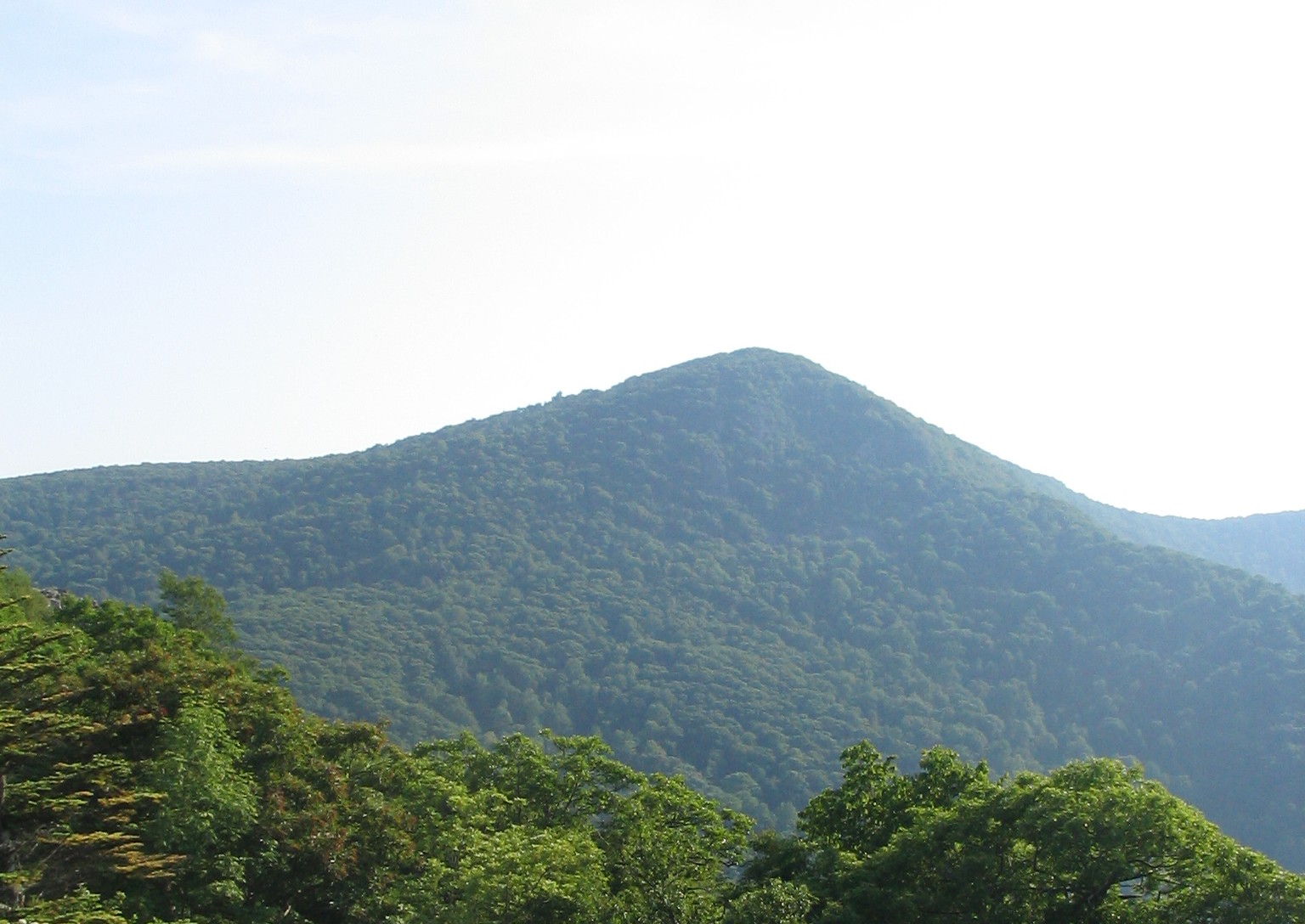
Hawksbill Mountain is a mountain with an elevation of 4,050 feet (1,234 m).[1] Marking the border between Madison County and Page County in Virginia, the summit of Hawksbill Mountain is the highest point in Shenandoah National Park as well as the highest point in both Madison and Page Counties.

Key Information

The north face of Hawksbill Peak is a 2,500-foot (760 m) drop into Timber Hollow, which is the largest elevation change in the park. The summit is one of the few places in Shenandoah National Park where one can find balsam fir, a tree more typical of northern New England and southeast Canada.

The National Park Service has constructed a stone observation platform at the summit. Byrd's Nest No. 2, one of a series of shelters built in the park by Senator Harry Byrd, is nearby. Hawksbill peak is also the site of a peregrine falcon restoration project. The summit of Hawksbill Mountain can be reached by a short hike from a trailhead located at the Upper Hawksbill parking area, just off of Skyline Drive in Shenandoah National Park. A number of other hiking trails lead to the summit of Hawksbill, while the Appalachian Trail goes around and about 500 ft (150 m) in elevation below the summit.[3]

Hawksbill Mountain view
360-degree panorama from the top of Hawksbill Mountain
[edit]

See also

[edit]

References

[edit]
[edit]
Revisions and contributorsEdit on WikipediaRead on Wikipedia
from Grokipedia
Hawksbill Mountain is the highest peak in , located in the of , , with an elevation of 4,050 feet (1,234 m). Straddling the border between Madison and Page counties, it serves as a prominent landmark within the park, accessible via at milepost 45.5. The mountain's summit features a stone observation platform offering expansive 360-degree panoramic views of the to the west, the Virginia Piedmont to the east, and the surrounding Blue Ridge peaks. Renowned for its opportunities, Hawksbill Mountain can be reached by several trails, including the popular 1.7-mile round-trip Hawksbill Summit Trail, a moderate route with approximately 690 feet of elevation gain that starts from the Hawksbill Gap parking area. Longer options, such as the 2.9-mile loop via the , provide varied terrain through forested areas and rocky outcrops, typically taking 1 to 2 hours to complete depending on the chosen path. These trails highlight the mountain's geological features, part of the ancient Appalachian range, and are not ADA accessible, with pets prohibited except for service animals. Ecologically, Hawksbill Mountain supports unique high-elevation habitats that host rare species, including the endangered Shenandoah salamander, found exclusively on the park's highest peaks. The cliffs also provide nesting sites for peregrine falcons, with restoration efforts aiding the re-establishment of this species in the region; a reproductive pair successfully fledged young in 2014. The summit platform, originally donated in 1963 by U.S. Senator Sr. and restored in 2016 as part of the centennial celebrations, underscores the mountain's role in conservation, protecting biodiversity amid challenges like .

Geography

Location and Boundaries

Hawksbill Mountain is situated at 38°33′19″N 78°23′42″W in Virginia, United States. The peak straddles the border between Madison County to the west and Page County to the east. As part of the Blue Ridge Mountains within the broader Appalachian Mountain range, it forms a prominent feature in the central section of Shenandoah National Park, where it stands as the park's highest point. The mountain is fully encompassed within the boundaries, extending along from milepost 45.5 at Hawksbill Gap to milepost 46.5 at the Upper Hawksbill parking area. It lies approximately 10 miles from the town of Luray to the east and near Stanley to the west. Access to the mountain is primarily via , which requires a entrance fee; the nearest major highways are to the east near Luray and State Route 55 to the west near Stanley.

Topography and Elevation

Hawksbill Mountain reaches a elevation of 4,050 feet (1,234 m) above , establishing it as the in . This prominence also makes it the tallest peak in both Madison County and , where the summit marks the boundary between the two. The mountain's structure features a broad, rounded that provides expansive panoramic views, supported by steep eastern and western slopes that contribute to its ridge-like formation within the . The north face of Hawksbill Mountain presents a dramatic topographic feature, dropping approximately 2,500 feet (760 m) into the Timber Hollow Overlook area, which represents the greatest vertical relief in the park. This steep descent underscores the mountain's rugged profile and enhances its visibility from surrounding vantage points along . Hawksbill forms part of a larger in the park's central section, incorporating elements such as Hawksbill Gap—a notable at around milepost 45.6 on —and subsidiary features like the Lower Hawksbill area, which reaches about 4,007 feet (1,221 m). In comparison to nearby summits, Hawksbill exceeds the elevation of Stony Man at 4,010 feet (1,222 m), the park's second-highest peak, and at 3,282 feet (1,000 m), highlighting its dominance in the regional landscape. These elevations emphasize Hawksbill's role as a key topographic high point, with its ridge extending influences over local drainage patterns and vistas across the and Piedmont regions.

Geology

Formation History

Hawksbill Mountain is composed primarily of rocks from the Catoctin Formation, a metavolcanic sequence that originated during the late period, approximately 570 to 550 million years ago. This formation developed amid the breakup of the supercontinent , which initiated continental rifting along the ancestral margin of and led to extensive volcanic activity. The initial phases involved the extrusion of rhyolitic lava flows and tuffs at the base, followed by thicker sequences of basaltic flows derived from mantle-derived tholeiitic magmas, covering over 4,000 square miles (10,000 km²) with accumulations up to approximately 550 meters (1,800 feet) thick. These subaerial eruptions occurred along long fissures without central volcanoes, marking the early stages of formation. The broader geological context of the region traces back further to the around 1.1 billion years ago, which assembled through continental collisions and formed the crystalline basement rocks upon which the Catoctin Formation was later deposited. Following a prolonged period of erosion that leveled the Grenville highlands, the late rifting event reactivated faults and produced the volcanic pile of the Catoctin. Subsequent tectonic events during the Appalachian Orogenies—particularly the in the Ordovician-Silurian period around 440 million years ago—imposed greenschist-facies metamorphism, folding, and uplift on these rocks as collided with other landmasses. Later phases, including the Acadian and Alleghanian orogenies, further deformed and elevated the strata into the Blue Ridge anticlinorium. Over the ensuing 200 million years, since the breakup of the around 200 million years ago, differential has sculpted the modern landscape of the Blue Ridge Province, exposing the resistant Catoctin greenstones as prominent ridges like Hawksbill Mountain. This prolonged , influenced by , fluvial incision, and climatic variations, has reduced the once-vast while preserving the remnants in elevated crests within . The Catoctin Formation thus represents a key vestige of ancient rifting and orogenic cycles, integral to the tectonic evolution of the central Appalachians.

Rock Composition and Features

Hawksbill Mountain's summit and upper slopes are primarily composed of metamorphic from the Catoctin Formation, altered into greenstone through regional during the era. This greenstone originated as subaerial and submarine lava flows during the late , approximately 570 to 550 million years ago, associated with the rifting of the . The rock's characteristic dark green hue results from the presence of and minerals formed during greenschist-facies . Distinctive structural features of the greenstone include columnar jointing, visible in exposed faces where cooling lava contracted to form hexagonal basalt columns, often wavy or irregular in shape. These columns are particularly evident near Hawksbill Gap and contribute to the mountain's rugged profile. The Catoctin Formation is interbedded with thinner layers of quartzite, meta-arkose, and schist, representing minor sedimentary intercalations within the volcanic sequence. Occasional Mesoproterozoic granitic intrusions associated with the Grenville Orogeny appear as dikes or sills cutting through the greenstone, adding textural contrast. Notable outcrops on Hawksbill include sheer cliffs along the eastern slopes, formed by differential erosion of the resistant greenstone, creating jagged escarpments up to several hundred feet high. At the summit, large greenstone boulders, products of and , accumulate as talus and have been utilized in the construction of the stone observation platform. Geologically, these features exemplify preserved volcanic activity in the Blue Ridge province and provide key insights into ancient continental rifting processes.

Ecology

Flora

The flora of Hawksbill Mountain, the highest peak in at 4,051 feet (1,235 m), reflects a transition from temperate forests at lower elevations to subalpine coniferous communities at the summit, influenced by its granitic and greenstone geology and cool, moist . At mid to lower elevations along the mountain's slopes, the dominant vegetation consists of mixed oak-hickory forests, featuring such as red oak (), white oak (), chestnut oak (), (Carya spp.), and red maple (). These forests form the primary canopy, providing structure and supporting a diverse adapted to the park's acidic, nutrient-poor soils. As elevation increases toward the summit, the vegetation shifts to a transitional zone with northern hardwood species, including yellow birch (), sugar maple (), and basswood (), interspersed among the oaks. At the highest elevations, particularly on the upper slopes and exposed ridges, rare coniferous groves of balsam fir () and red spruce () persist, representing the southernmost extent of these boreal species south of the Mason-Dixon line. These fir and spruce stands, remnants of post-glacial climatic islands, thrive in the cool, foggy conditions but face stress from invasive pests like the balsam woolly adelgid, which causes tree deformation and mortality. The understory throughout Hawksbill Mountain is rich in shrubs and herbaceous plants, including mountain laurel (Kalmia latifolia), which blooms profusely in June, and rhododendron (Rhododendron spp.), adding evergreen structure to the forest floor. Ferns such as Christmas fern (Polystichum acrostichoides) and hay-scented fern (Dennstaedtia punctilobula) carpet shaded areas, while spring ephemeral wildflowers like trillium (Trillium spp.) and hepatica (Hepatica nobilis) emerge in April and May, signaling the onset of the growing season in moist coves and trailsides. Ecological zones on the mountain include montane elements on exposed ridges, where open greenstone outcrops host the rare High-Elevation Greenstone Barren community, characterized by low-growing herbs and shrubs adapted to thin, rocky soils. Fragments of , protected since the park's establishment, persist in sheltered areas, contributing to . The mountain's greenstone-derived soils, though extremely acidic with high organic content, foster specialized plant associations, including mycorrhizal fungi that aid nutrient uptake in these nutrient-limited environments. Fire-adapted , such as table mountain pine (Pinus pungens) in adjacent areas, highlight historical disturbance regimes that shaped the , though suppression has led to declines in some serotinous cone producers.

Fauna

Hawksbill Mountain, as part of , supports a diverse array of adapted to its Appalachian ridge , including , birds, , , and that thrive in the varied habitats from forested slopes to rocky outcrops. The mountain's elevation and proximity to migration corridors contribute to seasonal movements, with over 50 species, more than 200 bird species, 51 and species, and numerous documented across the park. Among the mammals, black bears (Ursus americanus) roam the wooded areas and ridges, often foraging for berries and nuts in summer while denning in winter; their populations are estimated at around 300-500 in the broader park based on annual surveys. (Odocoileus virginianus) are abundant and commonly sighted, with seasonal migrations along the mountain ridges in fall to lower elevations for foraging, supporting herd sizes exceeding 1,000 individuals park-wide according to monitoring. Bobcats (Lynx rufus) inhabit the as elusive predators, preying on small mammals and birds, while eastern chipmunks (Tamias striatus) scurry through leaf litter and rocky crevices, caching seeds and contributing to . Birds are particularly prominent, with the (Falco peregrinus) serving as a conservation success story; the species was reintroduced to the park through hacking programs from the late 1970s to the early 1990s, including 36 young falcons released specifically at Hawksbill Mountain between 1989 and 1993, leading to successful nesting on the summit cliffs. Turkey vultures (Cathartes aura) soar over the ridges scavenging carrion, and various warblers such as the (Setophaga virens) migrate through in spring and fall, adding to the over 200 bird species recorded in park-wide inventories. Reptiles and amphibians find suitable microhabitats in the mountain's moist hollows and talus slopes. Timber rattlesnakes (Crotalus horridus) bask on south-facing rocks and hunt , with populations monitored as a species of concern in the park. Eastern box turtles (Terrapene carolina) traverse the forest floor, often retreating into their hinged shells when threatened, while diverse salamanders, including the Shenandoah salamander (Plethodon shenandoah), inhabit damp crevices and streamsides in the hollows. Insects play key ecological roles, with monarch butterflies (Danaus plexippus) passing through during their annual migration, nectaring on milkweed along the trails in late summer; park events highlight their conservation needs amid declining populations. Fireflies (Photinus spp.) illuminate the summer valleys with bioluminescent displays, peaking in June and July as males signal mates in the . Conservation efforts on Hawksbill Mountain emphasize the restoration, now self-sustaining with annual monitoring of nesting pairs via cliffside observations. The conducts ongoing surveys for , such as the impacting habitats that support wildlife, alongside population estimates for key species like deer and bears derived from camera traps and aerial counts to guide management.

History

Naming and Early Recognition

The name "Hawksbill" for the mountain in Shenandoah National Park was officially approved by the U.S. Board on Geographic Names on January 1, 1933, with the variant form "Hawks Bill" recognized from earlier U.S. Geological Survey topographic maps. This formalization occurred as the area was being developed into a national park, reflecting the mountain's prominence in the Blue Ridge landscape. The name likely derives from the distinctive profile of the summit, which from certain angles resembles the curved beak of a hawk, a common etymological pattern for Appalachian peaks named after natural features. Early documentation of the mountain appears in 19th-century U.S. Geological Survey mapping efforts, with "Hawksbill" labeled on the 1893 Luray quadrangle at a scale of 1:125,000, indicating recognition during systematic surveys of Virginia's mountainous regions. Prior to European settlement, the broader Shenandoah area, including the Blue Ridge highlands around Hawksbill Mountain, was inhabited by the Monacan people, a Siouan-speaking indigenous group with a sophisticated agricultural and sociopolitical system; they utilized the region for hunting, gathering, and seasonal travel along ridge-top paths, though no specific recorded Monacan or neighboring name for the mountain exists. In the post-Civil War era, Hawksbill Mountain gained recognition as part of the scenic allure of the Blue Ridge, promoted in literature and excursions to aid economic recovery in . Notable figures, including former Confederate general , visited nearby peaks like Sharp Top Mountain in 1867 for restorative outings, highlighting the growing appeal of the mountains' vistas to urban visitors seeking natural beauty and respite. By the late , railroad expansions and guidebooks extolled the Blue Ridge's dramatic topography, positioning features like Hawksbill as symbols of Virginia's rugged wilderness and contributing to early conservation sentiments that later supported the park's creation.

Establishment in Shenandoah National Park

was authorized by an on May 22, 1926, directing the acquisition of lands in Virginia's to establish a spanning at least 160,000 acres. The park's creation was driven by efforts from local boosters, including hotelier George Freeman Pollock, who promoted the region's scenic beauty to attract federal support. Official establishment occurred on December 26, 1935, when the Commonwealth of transferred 176,429 acres to the federal government, meeting the minimum requirements for park status. Land acquisition for the park involved purchasing or condemning over 200,000 acres from more than 3,000 private tracts, managed primarily by the State Commission on Conservation and Development from onward. The area surrounding Hawksbill Mountain, located in the park's central section, was acquired between 1928 and 1934 as part of these efforts, consolidating fragmented private holdings into contiguous federal land. This process displaced at least 500 families from mountain hollows, including sites near Hawksbill such as the remnants of Corbin Cabin, where generations had subsisted on small farms and timbering. The state's use of to seize properties without full compensation sparked controversy, as many occupants lacked formal deeds despite long-term occupancy, leading to forced relocations to valley communities like Ida. Infrastructure development accelerated access to the park's features, with the constructing —a 105-mile scenic roadway—between 1931 and 1939, including overlooks and entry points near Hawksbill Mountain. Post-establishment, Congress designated 79,579 acres of the park as the Shenandoah Wilderness in 1976 under the Eastern Wilderness Areas Act, encompassing much of the rugged terrain around Hawksbill to preserve its undeveloped character. Ongoing boundary adjustments, such as minor expansions in the late , have continued to bolster protections against external development pressures. The removal of human settlements following establishment facilitated the recovery of native flora on slopes like those of Hawksbill Mountain. In the 21st century, the has undertaken initiatives to honor the park's human history. The Blue Ridge Heritage Project, dedicated in 2019, features replica stone chimneys at former home sites across the park's counties, each bearing plaques listing the names of displaced families. Additionally, through the Indigenous Initiative launched in partnership with the , the park recognizes the ancestral lands of , including educational programs and interpretive efforts as of 2025.

Recreation

Hiking Trails

Hawksbill Mountain offers several hiking trails that provide access to its summit, the in at 4,050 feet. The primary routes include the Upper Hawksbill Trail and the Lower Hawksbill Trail (also known as Hawksbill Summit Trail), both starting from parking areas along , with the Salamander Trail serving as a connector between them via the . These trails are popular for day hikes, offering a mix of forested paths, rocky sections, and gradual to moderate ascents leading to panoramic views from the summit platform. Trails are not ADA accessible. The Upper Hawksbill Trail is a 1.05-mile one-way route (2.1 miles round trip) rated as easy, with an elevation gain of 520 feet. It begins at milepost 46.7 on and follows a well-maintained path through woods to the summit, making it suitable for families and less experienced hikers seeking a straightforward ascent. In contrast, the Lower Hawksbill Trail provides a more challenging approach, spanning 0.85 miles one way (1.7 miles round trip) and classified as moderate, with 690 feet of elevation gain. Starting from milepost 45.5, this blue-blazed trail climbs steadily through the forest, passing the historic Byrds Nest Shelter—a three-sided stone structure built in the 1930s for backpackers—before reaching the summit. The Salamander Trail, a 0.9-mile moderate connector, links the to the summit area near the Upper Hawksbill Trail, featuring rocky terrain that adds variety to multi-trail outings. Hikers can create a 2.9-mile loop (Hawksbill Loop) starting from Hawksbill Gap parking at milepost 45.5, following the south to the Salamander Trail junction, ascending the Salamander Trail to the summit, then descending via the Upper Hawksbill Trail to its trailhead and returning via or connector, offering diverse terrain from gentle slopes to steeper sections for a rewarding experience. This loop has 860 feet of elevation gain. The runs parallel to the eastern flank of Hawksbill Mountain, approximately 500 feet below the summit, though it lacks a direct connection; a short spur from the Lower Hawksbill Trail parking area allows access to the A.T. for those wishing to incorporate longer segments. All trails to Hawksbill Mountain are designated for day use only, with no camping permitted along the routes or at the summit to protect the fragile alpine environment. Pets are allowed but must remain on a no longer than 6 feet at all times. The conducts annual trail maintenance to ensure safety and accessibility, including clearing debris and repairing .

Summit and Observation Features

The stone observation platform at the summit of Hawksbill Mountain, the in at 4,050 feet, was donated by former U.S. Senator in 1962 and serves as the primary vantage point for visitors. This structure provides unobstructed 360-degree panoramic views encompassing the to the west, the extending north and south, Massanutten Mountain to the east, and portions of the on clear days. Stone steps lead to the platform, enhancing accessibility while blending with the surrounding rocky terrain. Adjacent to the platform lies Byrd's Nest No. 2, a historic three-sided shelter constructed by the in the 1930s as part of a series of day-use facilities funded by Senator Byrd; today, it functions as a area for seeking respite near the . The area features interpretive signs detailing the local and , including the unique high-elevation greenstone outcrops and seasonal displays that bloom vibrantly in summer, adding to the 's natural allure. The summit environment is exposed to strong winds, and the platform lacks railings, necessitating careful footing to avoid hazards on the uneven stone surface. Visitors are required to follow leave-no-trace principles, such as packing out all waste, to protect the fragile alpine ecosystem; nearby cliffs also host nesting peregrine falcons, underscoring the importance of maintaining quiet and distance from wildlife.

References

Add your contribution
Related Hubs
User Avatar
No comments yet.