
Recent from talks
Common sunflower
Knowledge base stats:
Talk channels stats:
Members stats:
Common sunflower
The common sunflower (Helianthus annuus) is a species of large annual forb of the daisy family Asteraceae. The common sunflower is harvested for its edible oily seeds, which are often eaten as a snack food. They are also used in the production of cooking oil, as food for livestock, as bird food, and as plantings in domestic gardens for aesthetics. Wild plants are known for their multiple flower heads, whereas the domestic sunflower often possesses a single large flower head atop an unbranched stem.
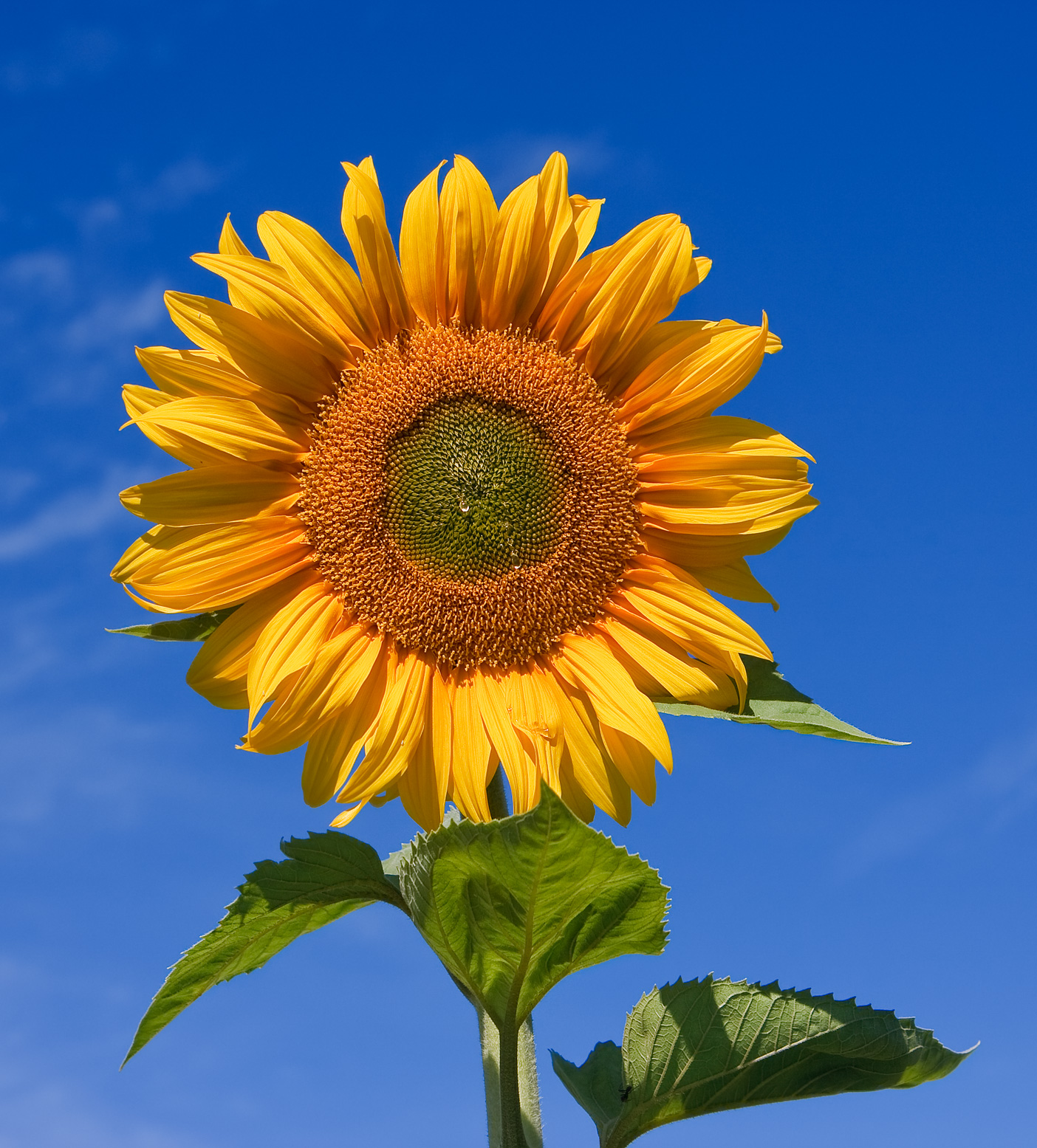
The plant has an erect rough-hairy stem, reaching typical heights of 3 metres (10 feet). The tallest sunflower on record achieved 9.17 m (30 ft 1 in). Sunflower leaves are broad, coarsely toothed, rough and mostly alternate; those near the bottom are largest and commonly heart-shaped.
The plant flowers in summer. What is often called the "flower" of the sunflower is actually a "flower head" (pseudanthium), 7.5–12.5 centimetres (3–5 in) wide, of numerous small individual five-petaled flowers ("florets"). The outer flowers, which resemble petals, are called ray flowers. Each "petal" consists of a ligule composed of fused petals of an asymmetrical ray flower. They are sexually sterile and may be yellow, red, orange, or other colors. The spirally arranged flowers in the center of the head are called disk flowers. These mature into fruit (sunflower "seeds").
The prairie sunflower (H. petiolaris) is similar in appearance to the wild common sunflower; the scales in its central disk are tipped by white hairs.
A common misconception is that flowering sunflower heads track the Sun across the sky. Although immature flower buds exhibit this behaviour, the mature flowering heads point in a fixed (and typically easterly) direction throughout the day. This old misconception was disputed in 1597 by the English botanist John Gerard, who grew sunflowers in his famous herbal garden: "[some] have reported it to turn with the Sun, the which I could never observe, although I have endeavored to find out the truth of it." The uniform alignment of sunflower heads in a field might give some people the false impression that the flowers are tracking the Sun.
This alignment results from heliotropism in an earlier development stage, the young flower stage, before full maturity of flower heads (anthesis). Young sunflowers orient themselves in the direction of the sun. At dawn, the head of the flower faces east and moves west throughout the day. When sunflowers reach full maturity, they no longer follow the sun and continuously face east. Young flowers reorient overnight to face east in anticipation of the morning. Their heliotropic motion is a circadian rhythm, synchronized by the sun, which continues if the sun disappears on cloudy days or if plants are moved to constant light. They are able to regulate their circadian rhythm in response to the blue-light emitted by a light source. If a sunflower plant in the bud stage is rotated 180°, the bud will be turning away from the sun for a few days, as resynchronization with the sun takes time.
When growth of the flower stalk stops and the flower is mature, the heliotropism also stops and the flower faces east from that moment onward. This eastward orientation allows rapid warming in the morning, and as a result, an increase in pollinator visits. Sunflowers do not have a pulvinus below their inflorescence. A pulvinus is a flexible segment in the leaf stalks (petiole) of some plant species and functions as a 'joint'. It effectuates leaf motion due to reversible changes in turgor pressure which occurs without growth. The sensitive plant's closing leaves are a good example of reversible leaf movement via pulvinuli.
Generally, each floret is oriented toward the next by approximately the golden angle, 137.5°, producing a pattern of interconnecting spirals, where the number of left spirals and the number of right spirals are successive Fibonacci numbers. Typically, there are 34 spirals in one direction and 55 in the other; however, in a very large sunflower head there could be 89 in one direction and 144 in the other. This pattern produces the most efficient packing of seeds mathematically possible within the flower head.
Hub AI
Common sunflower AI simulator
(@Common sunflower_simulator)
Common sunflower
The common sunflower (Helianthus annuus) is a species of large annual forb of the daisy family Asteraceae. The common sunflower is harvested for its edible oily seeds, which are often eaten as a snack food. They are also used in the production of cooking oil, as food for livestock, as bird food, and as plantings in domestic gardens for aesthetics. Wild plants are known for their multiple flower heads, whereas the domestic sunflower often possesses a single large flower head atop an unbranched stem.
The plant has an erect rough-hairy stem, reaching typical heights of 3 metres (10 feet). The tallest sunflower on record achieved 9.17 m (30 ft 1 in). Sunflower leaves are broad, coarsely toothed, rough and mostly alternate; those near the bottom are largest and commonly heart-shaped.
The plant flowers in summer. What is often called the "flower" of the sunflower is actually a "flower head" (pseudanthium), 7.5–12.5 centimetres (3–5 in) wide, of numerous small individual five-petaled flowers ("florets"). The outer flowers, which resemble petals, are called ray flowers. Each "petal" consists of a ligule composed of fused petals of an asymmetrical ray flower. They are sexually sterile and may be yellow, red, orange, or other colors. The spirally arranged flowers in the center of the head are called disk flowers. These mature into fruit (sunflower "seeds").
The prairie sunflower (H. petiolaris) is similar in appearance to the wild common sunflower; the scales in its central disk are tipped by white hairs.
A common misconception is that flowering sunflower heads track the Sun across the sky. Although immature flower buds exhibit this behaviour, the mature flowering heads point in a fixed (and typically easterly) direction throughout the day. This old misconception was disputed in 1597 by the English botanist John Gerard, who grew sunflowers in his famous herbal garden: "[some] have reported it to turn with the Sun, the which I could never observe, although I have endeavored to find out the truth of it." The uniform alignment of sunflower heads in a field might give some people the false impression that the flowers are tracking the Sun.
This alignment results from heliotropism in an earlier development stage, the young flower stage, before full maturity of flower heads (anthesis). Young sunflowers orient themselves in the direction of the sun. At dawn, the head of the flower faces east and moves west throughout the day. When sunflowers reach full maturity, they no longer follow the sun and continuously face east. Young flowers reorient overnight to face east in anticipation of the morning. Their heliotropic motion is a circadian rhythm, synchronized by the sun, which continues if the sun disappears on cloudy days or if plants are moved to constant light. They are able to regulate their circadian rhythm in response to the blue-light emitted by a light source. If a sunflower plant in the bud stage is rotated 180°, the bud will be turning away from the sun for a few days, as resynchronization with the sun takes time.
When growth of the flower stalk stops and the flower is mature, the heliotropism also stops and the flower faces east from that moment onward. This eastward orientation allows rapid warming in the morning, and as a result, an increase in pollinator visits. Sunflowers do not have a pulvinus below their inflorescence. A pulvinus is a flexible segment in the leaf stalks (petiole) of some plant species and functions as a 'joint'. It effectuates leaf motion due to reversible changes in turgor pressure which occurs without growth. The sensitive plant's closing leaves are a good example of reversible leaf movement via pulvinuli.
Generally, each floret is oriented toward the next by approximately the golden angle, 137.5°, producing a pattern of interconnecting spirals, where the number of left spirals and the number of right spirals are successive Fibonacci numbers. Typically, there are 34 spirals in one direction and 55 in the other; however, in a very large sunflower head there could be 89 in one direction and 144 in the other. This pattern produces the most efficient packing of seeds mathematically possible within the flower head.
Recent media