


Community hub
Recent from talks
Contribute something
Nothing was collected or created yet.
Anthesis
View on Wikipedia
Anthesis is the period during which a flower is fully open and functional. It may also refer to the onset of that period.[1]
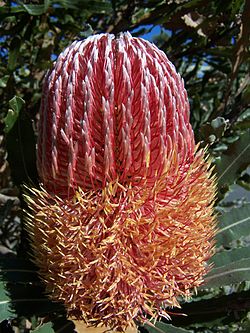
The onset of anthesis is spectacular in some species. In Banksia species, for example, anthesis involves the extension of the style far beyond the upper perianth parts. Anthesis of flowers is sequential within an inflorescence, so when the style and perianth are different colours, the result is a striking colour change that gradually sweeps along the inflorescence.[2]
Flowers with diurnal anthesis generally are brightly colored in order to attract diurnal insects, such as butterflies. Flowers with nocturnal anthesis generally are white or less colorful, and as such, they contrast more strongly with the night. These flowers typically attract nocturnal insects including many moth species.
References
[edit]- ^ University of Wisconsin Extension (2009-07-30), Anthesis (Flowering) in Wheat, archived from the original on 2021-12-21, retrieved 2019-06-02
- ^ Bhattacharya, Kashinath; Datta, Badal Kumar (January 1992). "Anthesis and pollen release : anthesis and pollen release of some plants of west bengal, india". Grana. 31 (1): 67–71. Bibcode:1992Grana..31...67B. doi:10.1080/00173139209427828. ISSN 0017-3134.
| Authority control databases: National |
|---|

 | This plant physiology article is a stub. You can help Wikipedia by expanding it. |
Anthesis
View on GrokipediaDefinition and Terminology
Botanical Definition
In botany, anthesis refers to the period during which a flower is fully open and functional, specifically enabling pollination by exposing reproductive structures for pollen release or reception.[1] This phase marks the flower's maturity, where it transitions from bud to a state optimized for reproductive success, and it can denote either the precise onset of opening or the entire duration until functionality declines.[11] Unlike the broader term "blooming," which often describes the general visual expansion of floral parts or the collective opening of an inflorescence, anthesis emphasizes the functional readiness for pollination and may occur sequentially within inflorescences, where individual flowers open one after another to extend the overall reproductive window.[12] Key characteristics of anthesis include the dehiscence of anthers, releasing viable pollen, and the receptivity of the stigma to incoming pollen, typically accompanied by the full expansion of petals and sepals to attract pollinators.[13] Anther dehiscence often begins immediately upon or shortly after opening, ensuring pollen availability, while stigma receptivity aligns temporally to maximize cross-pollination opportunities.[14] These features collectively render the flower pollinator-accessible, with structural changes like petal unfurling enhancing visibility and accessibility. The duration of anthesis varies widely across species, reflecting adaptations to pollinator behavior and environmental conditions; for instance, ephemeral flowers such as those in Ipomoea tricolor remain open for less than a day, closing by evening after morning opening, whereas species like roses (Rosa spp.) maintain functionality for several days post-opening.[15] This range—from hours in short-lived blooms to days in longer-persisting ones—allows diverse strategies for reproductive assurance.[16]Etymology and Historical Usage
The term "anthesis" originates from the Ancient Greek ἄνθησις (ánthēsis), denoting "flowering" or "blooming," derived from the root ἄνθος (ánthos), meaning "flower."[17] This etymology reflects its early association with the process of floral development and expansion in botanical contexts.[2] The earliest documented use of "anthesis" in scientific literature appears in 1783, in the posthumous edition of Carl Linnaeus's Systema Vegetabilium, where it describes the maturation and opening of flowers as a key reproductive stage.[18] Initially employed in 18th-century botany to broadly signify the onset of flowering, the term gained precision over time, shifting from a general descriptor of blooming to the specific phase when a flower is fully expanded and functional for pollination. In 19th- and 20th-century botanical texts, "anthesis" increasingly focused on the pollination window, as seen in Charles Darwin's The Effects of Cross and Self Fertilisation in the Vegetable Kingdom (1876), where he uses it to analyze timing in cross-pollination experiments across species.[19] This evolution distinguished it from related terms like "efflorescence," which denotes the overall season or state of flowering without emphasizing reproductive readiness, and "dehiscence," which refers narrowly to the splitting of anthers or fruits to release pollen or seeds.Biological Mechanisms
Stages of Flower Opening
Pre-anthesis preparation involves the swelling of flower buds primarily through cell expansion and increased turgor pressure within petal cells. This process is driven by water uptake and osmotic adjustments, where solutes such as sugars accumulate to generate the necessary pressure for volumetric growth, transforming compact buds into structures ready for opening.[20] In grasses like wheat, for instance, lodicules swell due to sugar influx, contributing to overall bud expansion.[21] The initial opening of the flower marks the onset of anthesis, characterized by petal unfolding resulting from differential growth rates between the abaxial (outer) and adaxial (inner) surfaces of the petals. This asymmetry creates bending forces that peel back the petals, often supplemented by hygroscopic movements in species with specialized tissues, where changes in humidity trigger reversible swelling or contraction.[20] In mango flowers, anthesis is marked by petals becoming perpendicular to the ovary axis.[10] Full expansion follows rapidly, with the corolla achieving its maximum size typically within 1-24 hours after the onset of opening, depending on species-specific growth kinetics and environmental conditions during this phase. This stage ensures the flower is fully receptive for pollination, with petals providing an expanded display area. In many angiosperms, such as certain lilies, the differential expansion completes the blooming process efficiently within this timeframe.[22] The closure phase of anthesis often occurs post-pollination in sensitive species, where wilting of petals signals the end of receptivity and initiates senescence. This wilting is triggered by hormonal signals following successful fertilization, leading to loss of turgor and tissue breakdown, which can happen within hours to days.[23] Observable signs of flower opening include changes in color and the release of scents that coincide with the structural expansion. Petal coloration may shift from closed-bud hues to brighter tones to attract pollinators, as seen in mango where petals turn yellow upon full opening.[10] Simultaneously, volatile compounds are emitted, peaking during anthesis to guide pollinators; in evening primroses, scent release aligns precisely with petal unfolding.[24] These cues briefly overlap with pollen presentation but primarily indicate the flower's functional state.Pollen Release and Stigma Receptivity
During anthesis, anther dehiscence occurs as the primary mechanism for pollen release in angiosperms, typically involving the splitting of the anther wall to expose pollen grains. The most common form is longitudinal dehiscence, where the anther theca splits along its long axis through specialized stomial cells that degenerate to form slits, allowing pollen dispersal; this process is regulated by enzymatic degradation of the septum and endothecium thickening for tension. In some families, such as Solanaceae and Ericaceae, poricidal dehiscence predominates, where pollen is released through apical pores rather than slits, often triggered by hygroscopic movements in response to humidity changes. These mechanisms ensure efficient pollen exposure coinciding with flower opening, maximizing pollination opportunities.[25][26][25] Pollen viability peaks during the active phase of anthesis, when dispersal is highest, but declines rapidly afterward due to desiccation, oxidation, and microbial activity. In many species, viability remains above 80% within the first 12-24 hours post-dehiscence, dropping significantly by 48-72 hours as pollen grains lose water and structural integrity. For instance, in dragon fruit (Hylocereus undatus), pollen maintains high viability (over 90%) throughout the 12-hour anthesis window, but falls below 50% within days after. This temporal pattern aligns pollen release with optimal environmental conditions for transfer, such as pollinator activity.[27][28][29] Stigma maturation during anthesis involves the development of receptivity through the secretion of a specialized exudate that facilitates pollen adhesion, hydration, and germination. This exudate, produced by stigmatic papillae in wet-stigma species, is a viscous fluid rich in water, sugars, proteins, lipids, and amino acids, creating a nutrient-rich matrix that promotes pollen tube emergence. In dry-stigma species, maturation instead enhances surface proteins for pollen recognition without copious secretion. The process typically peaks mid-anthesis, ensuring the female phase aligns with viable pollen availability.[30][31][30] In hermaphroditic flowers, synchronization of male and female phases during anthesis often occurs through dichogamy, temporally separating anther dehiscence and stigma receptivity to reduce self-pollination while overlapping sufficiently for geitonogamy or outcrossing. Protandrous species, such as many Apiaceae, exhibit anther dehiscence 1-2 days before stigma receptivity, with phases overlapping briefly at the end of the male stage; protogynous species reverse this order. This alignment, lasting hours to days, optimizes resource allocation and pollinator-mediated gene flow.[32][33][34] The duration of anthesis, encompassing peak pollen release and stigma receptivity, varies but typically spans 12-48 hours per flower in many crops, allowing a narrow window for successful fertilization. In wheat (Triticum aestivum), individual florets remain receptive for about 24-36 hours, though the overall spike anthesis extends 3-5 days as flowering progresses acropetally and basipetally. Similar short durations occur in other cereals like rice, emphasizing the brief synchrony required for pollination success.[35][35][36]Variation Across Plant Groups
Anthesis in Angiosperms
In angiosperms, anthesis typically involves temporal separation of male and female reproductive functions through dichogamy, which promotes outcrossing by reducing self-pollination. Dichogamy manifests as protandry, where anthers dehisce and release pollen before the stigma becomes receptive, or protogyny, where the stigma is receptive prior to anther maturation. Protandry is more prevalent in biotically pollinated species, occurring in approximately twice as many cases as protogyny among British flora, while protogyny predominates as the ancestral form in basal angiosperms, approaching 100% in early-diverging lineages.[37][38] Within inflorescences, anthesis often follows organized sequences that optimize pollination efficiency. Acropetal succession, where flowers open from base to tip, is common in racemes and spikes, ensuring progressive exposure to pollinators. In contrast, basipetal sequences, with opening from tip to base, prevail in cymes and umbels, allowing earlier-maturing apical flowers to attract pollinators before lower ones. These patterns vary by inflorescence architecture, contributing to the reproductive success of most angiosperms by coordinating flower presentation with pollinator activity.[39][40] Examples illustrate diverse anthesis timing across angiosperms. In many orchids, synchronous anthesis within inflorescences creates large floral displays that enhance pollinator attraction and visitation rates, a strategy observed in New Zealand epiphytic species to boost reproductive output. Conversely, sunflowers exhibit staggered anthesis in their capitula, with florets maturing sequentially over 5–10 days, extending the pollination window and maximizing pollen dispersal despite individual floret longevity.[41][42] Adaptations during anthesis further refine pollinator interactions, with nectar production often peaking shortly after flower opening to reward visitors. In many species, nectar accumulation reaches maximum levels 8–16 hours post-anthesis, sustaining inflorescence attractiveness over several days. Ultraviolet (UV) patterns, visible to pollinators like bees, also become prominent at anthesis, guiding insects to reproductive structures through contrasting absorbance on petals.[13][43] Anthesis diversity in angiosperms ranges from non-opening cleistogamous flowers, which self-pollinate without perianth expansion to ensure autogamy in resource-limited conditions, to explosive mechanisms in families like Lamiaceae and Fabaceae, where flowers or anthers burst open upon pollinator contact to forcibly eject pollen. Cleistogamy, as in Lamium amplexicaule, contrasts with chasmogamous norms by bypassing anthesis entirely, while explosive release in buzz-pollinated taxa enhances cross-pollination efficiency.[44][45]Anthesis in Non-Flowering Plants
In gymnosperms, the term "anthesis" is applied in an extended sense to describe the critical phase of reproduction when male structures release pollen and female ovules become receptive, analogous to the flowering process in angiosperms. This period facilitates pollination without the protective enclosure of petals or other floral organs typical of flowering plants. Unlike angiosperms, gymnosperm anthesis emphasizes the exposure of naked seeds and reliance on environmental vectors for pollen transfer.[46] In conifers, the gymnosperm group most familiar to temperate ecosystems, anthesis corresponds to the opening of pollen cones (microstrobili) and the receptivity of seed cones (megastrobili). For instance, in Pinus sylvestris (Scots pine), female strobili become receptive in early summer when their scales spread apart, exposing ovules that secrete a sticky pollination drop to capture airborne pollen; this overlaps with the dehiscence of male cones, which shed pollen from microsporangia over a few days.[47][48] These events are synchronized to maximize wind-mediated pollen dispersal, with female receptivity often preceding male pollen release by 1–3 days in a protogynous pattern.[48] The timing of microsporangia shedding thus marks the onset of anthesis, ensuring pollen viability during peak dispersal conditions.[46] Cycads exemplify anthesis in more specialized gymnosperms, where male cones release pollen in bursts coordinated with female cone receptivity, often involving insect vectors in a push-pull dynamic driven by volatile odors and thermogenesis. Following pollination during this phase, flagellate sperm are released from pollen tubes to fertilize the egg, a primitive trait retained from ancient lineages.[49] In Gnetales, such as Ephedra species, anthesis involves the formation of a sugary pollination drop at the nucellus tip, which emerges through a micropylar tube to trap pollen, while some taxa exhibit vessel-like xylem structures that enhance water transport during reproductive stress.[50] These groups highlight variations within gymnosperms, including biotic pollination in contrast to the predominantly abiotic mode in conifers. Key differences from angiosperm anthesis include the absence of petals or perianth for visual attraction and a greater dependence on wind or opportunistic insects rather than specialized biotic pollinators, reflecting the evolutionary retention of exposed ovules.[46] Fossil evidence from ancient seed ferns (pteridosperms), such as those from the Middle Pennsylvanian period, reveals anthesis-like events through the secretion of pollination drops from micropyles and pollen capture by feathery extensions on ovules, indicating early mechanisms for seed fertilization predating modern gymnosperms by over 300 million years.[51]Influencing Factors
Environmental Influences
Environmental factors significantly influence the timing and duration of anthesis in plants, acting as external cues that synchronize reproductive development with favorable conditions for pollination and seed set. Temperature is a primary abiotic regulator, with optimal ranges typically between 15°C and 25°C for many temperate species, promoting efficient flower opening and pollen viability.[52] Within this range, increasing day and night temperatures accelerate development rates from bud visible stage to anthesis, as observed in Lilium longiflorum, where rates rose progressively from 14°C to 26°C.[52] However, exposure to high temperatures above these optima can impose heat stress, delaying anthesis onset; for instance, in poinsettia (Euphorbia pulcherrima), temperatures exceeding 24°C during inductive periods postponed flowering by altering photoperiodic responses.[53] Light and photoperiod exert precise control over anthesis timing, particularly in species sensitive to day length. Short-day plants, such as chrysanthemum (Chrysanthemum morifolium), initiate and complete anthesis under long nights (short days), with extensions beyond critical photoperiods inhibiting flower development.[54] In contrast, long-day plants like certain wheat cultivars (Triticum aestivum) accelerate anthesis under short nights, with photoperiod sensitivity reducing days to flowering by up to 20 days when day length exceeds 14 hours.[55] This differential response ensures alignment with seasonal light patterns, optimizing reproductive success in varied latitudes. Humidity and water availability are critical for maintaining cellular turgor required for petal expansion during anthesis. Adequate soil moisture supports hydraulic processes that drive flower opening, while drought stress disrupts these, often postponing anthesis by slowing vegetative growth and delaying reproductive phase transitions. In spring wheat, temporary pre-anthesis water deficits extended the interval to anthesis by reducing tiller development and biomass accumulation, with delays most pronounced when stress occurred from stem elongation to booting stages.[56] High humidity complements this by preventing desiccation of floral tissues, though excessive moisture can indirectly affect timing through pathogen pressure in susceptible species. Biotic interactions, particularly pollinator activity, modulate anthesis duration in animal-pollinated plants. In environments with reliable pollinator visitation, flowers exhibit shorter longevity to conserve resources, as seen in high-mountain plants like Saxifraga bryoides, where flower longevity is typically less than 12 days but can be prolonged in unpollinated flowers to compensate for pollinator scarcity or unfavorable weather in alpine environments, enhancing opportunities for pollen transfer.[57] Climate change amplifies these influences through rising temperatures and altered precipitation, leading to phenological shifts in anthesis timing. Warmer conditions have advanced flowering by 2-5 days per decade in European temperate crops like wheat, shortening the pre-anthesis growth period and potentially desynchronizing with pollinators.[58] Studies across Central Europe document earlier springs triggering anthesis up to 10-15 days ahead in response to prolonged warm spells, increasing vulnerability to subsequent heat stress during reproduction.[59] These shifts underscore the need for adaptive management to mitigate mismatches in plant-pollinator interactions under ongoing global warming.Genetic and Hormonal Regulation
The initiation and progression of anthesis are tightly regulated by a suite of plant hormones and genetic factors that coordinate floral development. Gibberellins (GAs) play a central role in promoting cell expansion and elongation in floral organs, facilitating the physical opening of flowers during anthesis. In species such as Arabidopsis thaliana and tomato (Solanum lycopersicum), bioactive GAs like GA3 and GA4 stimulate the growth of sepals, petals, and stamens, ensuring timely bloom. Conversely, ethylene acts primarily post-anthesis to trigger senescence, accelerating petal wilting and corolla deterioration in many angiosperms; this hormone's biosynthesis surges after pollination, coordinating the transition from reproductive maturity to programmed cell death in floral tissues.[60][61][62][63] At the genetic level, floral integrator genes such as LEAFY (LFY) serve as master regulators of anthesis timing by integrating developmental signals to activate downstream floral programs. In Arabidopsis, LFY expression gradually increases in the shoot apical meristem prior to flowering, promoting the transition to reproductive phase and synchronizing anthesis with optimal conditions; orthologs in other angiosperms, like Jatropha curcas, similarly orchestrate floral meristem identity and bloom onset. Key signaling pathways further refine this control: circadian clock components, including core oscillators like CCA1 and LHY, align anthesis with dawn by modulating floret maturation rhythms, as observed in sunflowers (Helianthus annuus) where clock disruptions desynchronize flower opening. Extensions of the ABC model of floral organ identity, incorporating D-class (e.g., SEEDSTICK) and E-class (SEPALLATA) genes, ensure proper specification of sepals, petals, stamens, and carpels before anthesis, with combinatorial activity establishing whorl-specific maturation.[64][65][66][67][68] Mutations in these regulatory elements highlight their necessity for timely anthesis. In GA-deficient Arabidopsis mutants, such as the dwarf and delayed-flowering 1 (ddf1) line impaired in GA3ox1 biosynthesis, flowering is significantly postponed due to reduced stem elongation and delayed floral induction, a phenotype rescued by exogenous GA application. Similarly, LFY loss-of-function mutants exhibit severe delays or failures in anthesis, underscoring its role in meristem determinacy. These regulators show remarkable evolutionary conservation across angiosperms, with LFY orthologs and ABC(DE)-class MADS-box genes maintaining similar functions from basal lineages like Amborella to core eudicots, enabling adaptive floral timing despite diversification in bloom strategies.[69][70][71][72]Ecological and Practical Importance
Role in Pollination Ecology
Anthesis plays a pivotal role in pollination ecology by ensuring temporal alignment between flower receptivity and pollinator activity, thereby maximizing reproductive success in plant-pollinator mutualisms. In many species, the timing of anthesis synchronizes with peak foraging periods of specific pollinators, such as diurnal insects, to optimize pollen transfer. For instance, in ragweed (Ambrosia artemisiifolia), anthesis exhibits bimodal patterns that align with diurnal pollinator activity, where asynchronous anther dehiscence across flowers enhances pollen dispersal efficiency during active hours. Similarly, in Ipomoea carnea, distinct diurnal anthesis patterns—morning, afternoon, or evening opening—correspond to the activity cycles of potential pollinators like bees or hawkmoths, demonstrating selective pressures for such synchronization. This temporal matching not only boosts visitation rates but also minimizes energy expenditure on floral displays outside optimal windows. To promote outcrossing and reduce self-pollination, anthesis often incorporates mechanisms like dichogamy and herkogamy, which spatially or temporally separate male and female functions within flowers. Dichogamy, where anthers mature before or after stigmas during anthesis, prevents geitonogamy (self-pollination between flowers on the same plant) by limiting pollen-stigma contact within the same bloom, thereby favoring cross-pollination. Herkogamy complements this by physically distancing anthers and stigmas, further discouraging autogamy and enhancing outcrossing rates, as observed in style-dimorphic Narcissus species where these traits during anthesis restrict selfing. In desert-adapted plants like some Boraginaceae, the combined effect of dichogamy and herkogamy during anthesis sustains reproductive isolation in unpredictable environments, contributing to higher outcrossing and genetic diversity. At the community level, anthesis phenology influences biodiversity by shaping pollinator dynamics and plant interactions across ecosystems. Mass flowering events, where synchronized anthesis occurs across populations, create resource pulses that support pollinator populations but can also lead to temporal mismatches if phenologies shift unevenly. For example, in diverse meadows, high plant biodiversity buffers phenological synchrony between flowers and bees, maintaining pollination services during peak anthesis periods and enhancing overall community stability. However, biodiversity loss can advance flowering times, compressing the anthesis season and potentially reducing temporal overlap with pollinators, which alters community structure and lowers reproductive success in remaining species. Evolutionary pressures have shaped anthesis timing to mitigate competition for pollinators and predation risks from florivores. Selection favors staggered or specialized anthesis to avoid overlap with co-flowering competitors, as seen in sympatric tree species where divergent flowering times reduce pollinator competition and promote coexistence. Additionally, anthesis often aligns to evade florivores; for instance, nocturnal opening in some species minimizes damage from diurnal herbivores, balancing attraction to pollinators against predation costs. These pressures drive adaptive shifts, such as earlier anthesis in response to reduced competitor density, enhancing fitness in dynamic environments. A notable case study involves bat-pollinated (chiropterophilous) flowers, which typically undergo anthesis at night to match the foraging activity of nectarivorous bats. In many such plants, like those in the Neotropics, flowers open in the early evening and remain viable for only one night, emitting strong odors detectable by echolocation to attract bats while minimizing interference from diurnal competitors. This nocturnal strategy not only ensures efficient pollen transfer but also exemplifies evolutionary specialization in pollination ecology, supporting biodiversity in tropical ecosystems.Applications in Agriculture and Horticulture
Understanding the timing of anthesis is essential for synchronizing hand-pollination in hybrid crop production, particularly in species like maize where tassel anthesis must align with silk emergence for optimal seed set. In hybrid maize breeding, manual pollination is performed by collecting pollen from male parent tassels at peak anthesis and applying it to receptive silks of the female parent, often requiring precise scheduling. This synchronization minimizes self-pollination and enhances hybrid vigor, as delays in pollination can reduce kernel set.[73] Predicting anthesis enables yield optimization by guiding the application of fertilizers and protective measures against environmental stresses, such as frost in fruit trees. In deciduous fruit orchards like apple and peach, anthesis typically occurs in early spring, making blossoms vulnerable to radiation frost that can damage reproductive tissues and reduce fruit set. Farmers use phenological models based on accumulated heat units (growing degree days) to forecast bloom timing, allowing pre-anthesis fertilizer applications to bolster carbohydrate reserves and post-bloom frost mitigation strategies like overhead irrigation to maintain yields. For instance, nitrogen foliar application at anthesis in wheat has been shown to improve grain yield through enhanced photosynthesis and spikelet fertility in certain genotypes.[74] In plant breeding, emasculation is routinely performed just prior to or at the onset of anthesis to prevent self-pollination and facilitate controlled cross-pollination. This technique involves the surgical removal of anthers from flower buds of the female parent using fine forceps, typically under a dissecting microscope, followed by bagging to exclude unwanted pollen; in crops like rice and wheat, emasculation is done 1-2 days before anthesis. The emasculated flowers are then pollinated with pollen from the male parent during peak stigma receptivity, enabling the development of new varieties with traits like disease resistance.[75] Pest control strategies often target the anthesis stage to disrupt insect vectors that feed on pollen and floral tissues, thereby protecting crop yields. In oilseed rape, pollen beetles (Brassicogethes aeneus) infest crops during the green-to-yellow bud and early flowering (anthesis) phases, feeding on anthers and causing yield losses through bud abortion. Integrated pest management recommends threshold-based insecticide applications, such as pyrethroids, when beetle densities reach levels varying by plant density (e.g., 7-25 per plant), combined with cultural practices like delayed sowing to desynchronize pest arrival with flowering.[76] Modern remote sensing tools facilitate large-scale anthesis detection in field crops, improving management efficiency without manual scouting. Satellite imagery from platforms like Sentinel-2, analyzed via vegetation indices such as NDVI, can help monitor phenological stages including anthesis in wheat by detecting spectral shifts associated with flowering. This enables precision agriculture applications, such as variable-rate fertilizer deployment timed to anthesis for enhanced nitrogen use efficiency. In hybrid wheat breeding, machine learning models integrated with multispectral data can predict anthesis dates, optimizing pollination logistics.[77][78]References
- https://en.wiktionary.org/wiki/anthesis