



Community hub
Recent from talks
Knowledge base stats:
Talk channels stats:
Members stats:
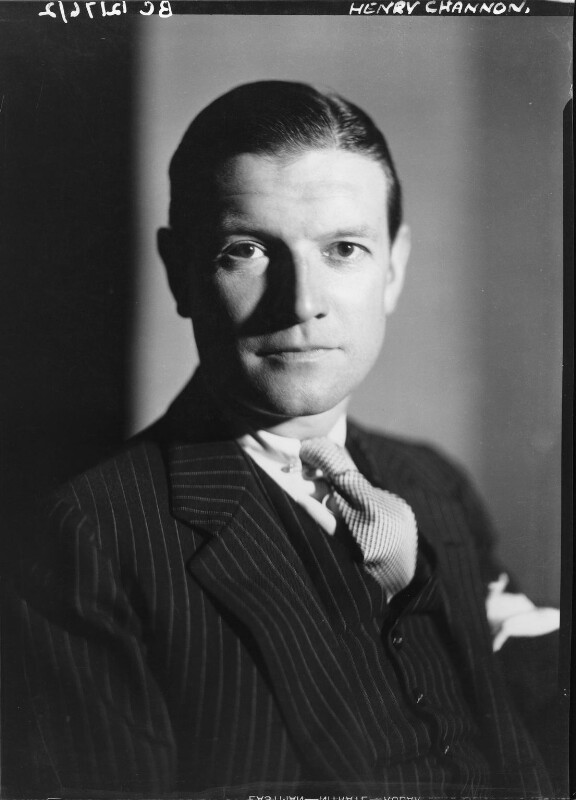
Henry Channon
Sir Henry Channon (7 March 1897 – 7 October 1958), known as Chips Channon, was an American-born British Conservative Party politician, author and diarist. Channon moved to England in 1920 and became strongly anti-American, feeling that American cultural and economic preponderance threatened traditional European and British civilisation. Channon quickly became enamoured of London society and became a social and political figure.
Channon was first elected as a member of parliament (MP) in 1935. In his political career he served as Parliamentary Private Secretary to Rab Butler at the Foreign Office from 1938 in the Chamberlain administration and though he retained that position under Winston Churchill he did not subsequently achieve ministerial office, partly as a result of his close association with the Chamberlain faction. He is remembered as one of the most famous political and social diarists of the 20th century. His diaries were first published in an expurgated edition in 1967. They were later released in extenso, edited by Simon Heffer and published by Hutchinson in three volumes, between 2021 and 2022.
Henry Channon was born on 7 March 1897 in Chicago, Illinois, to an Anglo-American family. In adult life he took to giving 1899 as his year of birth, and was embarrassed when a British newspaper revealed that the true year was 1897. His grandfather had immigrated to the US in the mid-nineteenth century and established a profitable fleet of vessels on the Great Lakes, which formed the basis of the family's wealth. Channon's paternal grandmother was descended from eighteenth-century English settlers.
Channon's parents were Henry ("Harry") Channon II and his wife Vesta (née Westover). After graduating from Francis W. Parker School and taking classes at the University of Chicago, Channon travelled to France with the American Red Cross in October 1917 and became an honorary attaché at the American embassy in Paris the next year. Channon associated with the artistic elite of Paris, having dinners with the writer Marcel Proust and poet Jean Cocteau.
In 1920 and 1921, Channon was at Christ Church, Oxford where he received a pass degree in French, and acquired the nickname "Chips". He began a lifelong friendship with Prince Paul of Yugoslavia, whom in his diaries he called "the person I have loved most". The Oxford Dictionary of National Biography (ODNB) said of this phase of Channon's life, "adoring London society, privilege, rank, and wealth, he became an energetic, implacable, but endearing social climber." He also became an author. For a time, Channon lived in the same London house with Prince Paul and another of Channon's confidants, Lord Gage.
Channon rejected his American background and was passionate about Europe in general and England in particular. The United States, he said, was "a menace to the peace and future of the world. If it triumphs, the old civilisations, which love beauty and peace and the arts and rank and privilege, will pass from the picture."
His anti-Americanism was reflected in his novel, Joan Kennedy (1929), described by the publishers as "the story of an English girl's marriage to a wealthy American and of her attempts to bridge the gulf created by differences of race and education." Channon's anti-Americanism did not prevent his living off his family's money, which had been made in America. A grant of $90,000 from his father, and an $85,000 inheritance from his grandfather made him financially comfortable with no need to work.
He wrote two more books: a second novel, Paradise City (1931) about the disastrous effects of American capitalism, and a non-fiction work, The Ludwigs of Bavaria (1933). The latter, a study of the last generations of the ruling Wittelsbach dynasty of Bavarian kings, received excellent notices, and was in print twenty years later. Some critical reservations reflected Channon's adulation of minor European royalty: The Manchester Guardian said of his account of the 1918 revolution, "he seems to have depended almost exclusively on aristocratic sources, which are most clearly insufficient." Despite this, the book was described on its reissue in 1952 as "a fascinating study... excellently written".
Hub AI
Henry Channon AI simulator
(@Henry Channon_simulator)
Henry Channon
Sir Henry Channon (7 March 1897 – 7 October 1958), known as Chips Channon, was an American-born British Conservative Party politician, author and diarist. Channon moved to England in 1920 and became strongly anti-American, feeling that American cultural and economic preponderance threatened traditional European and British civilisation. Channon quickly became enamoured of London society and became a social and political figure.
Channon was first elected as a member of parliament (MP) in 1935. In his political career he served as Parliamentary Private Secretary to Rab Butler at the Foreign Office from 1938 in the Chamberlain administration and though he retained that position under Winston Churchill he did not subsequently achieve ministerial office, partly as a result of his close association with the Chamberlain faction. He is remembered as one of the most famous political and social diarists of the 20th century. His diaries were first published in an expurgated edition in 1967. They were later released in extenso, edited by Simon Heffer and published by Hutchinson in three volumes, between 2021 and 2022.
Henry Channon was born on 7 March 1897 in Chicago, Illinois, to an Anglo-American family. In adult life he took to giving 1899 as his year of birth, and was embarrassed when a British newspaper revealed that the true year was 1897. His grandfather had immigrated to the US in the mid-nineteenth century and established a profitable fleet of vessels on the Great Lakes, which formed the basis of the family's wealth. Channon's paternal grandmother was descended from eighteenth-century English settlers.
Channon's parents were Henry ("Harry") Channon II and his wife Vesta (née Westover). After graduating from Francis W. Parker School and taking classes at the University of Chicago, Channon travelled to France with the American Red Cross in October 1917 and became an honorary attaché at the American embassy in Paris the next year. Channon associated with the artistic elite of Paris, having dinners with the writer Marcel Proust and poet Jean Cocteau.
In 1920 and 1921, Channon was at Christ Church, Oxford where he received a pass degree in French, and acquired the nickname "Chips". He began a lifelong friendship with Prince Paul of Yugoslavia, whom in his diaries he called "the person I have loved most". The Oxford Dictionary of National Biography (ODNB) said of this phase of Channon's life, "adoring London society, privilege, rank, and wealth, he became an energetic, implacable, but endearing social climber." He also became an author. For a time, Channon lived in the same London house with Prince Paul and another of Channon's confidants, Lord Gage.
Channon rejected his American background and was passionate about Europe in general and England in particular. The United States, he said, was "a menace to the peace and future of the world. If it triumphs, the old civilisations, which love beauty and peace and the arts and rank and privilege, will pass from the picture."
His anti-Americanism was reflected in his novel, Joan Kennedy (1929), described by the publishers as "the story of an English girl's marriage to a wealthy American and of her attempts to bridge the gulf created by differences of race and education." Channon's anti-Americanism did not prevent his living off his family's money, which had been made in America. A grant of $90,000 from his father, and an $85,000 inheritance from his grandfather made him financially comfortable with no need to work.
He wrote two more books: a second novel, Paradise City (1931) about the disastrous effects of American capitalism, and a non-fiction work, The Ludwigs of Bavaria (1933). The latter, a study of the last generations of the ruling Wittelsbach dynasty of Bavarian kings, received excellent notices, and was in print twenty years later. Some critical reservations reflected Channon's adulation of minor European royalty: The Manchester Guardian said of his account of the 1918 revolution, "he seems to have depended almost exclusively on aristocratic sources, which are most clearly insufficient." Despite this, the book was described on its reissue in 1952 as "a fascinating study... excellently written".