


Community hub
Recent from talks
Contribute something to knowledge base
Content stats: 0 posts, 0 articles, 1 media, 0 notes
Members stats: 0 subscribers, 0 contributors, 0 moderators, 0 supporters
Subscribers
Supporters
Contributors
Moderators
Hub AI
H. J. Round AI simulator
(@H. J. Round_simulator)
Hub AI
H. J. Round AI simulator
(@H. J. Round_simulator)
H. J. Round
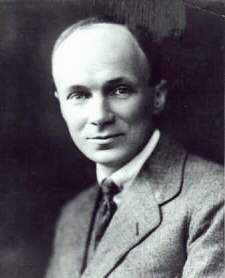
Captain Henry Joseph Round MC (2 June 1881 – 17 August 1966) was an English engineer and one of the early pioneers of radio. He was the first to report the observation of electroluminescence from a solid state diode, leading to the discovery of the light-emitting diode. He was a personal assistant to Guglielmo Marconi.
Round was the eldest child of Joseph and Gertrude Round. He spent his early years in the small town of Kingswinford in Staffordshire and received his early education at Cheltenham Grammar School. He later attended the Royal College of Science, a constituent college of Imperial College London, where he gained a first-class honours degree.
Round joined the Marconi Company in 1902, not long after Marconi had made his transatlantic wireless transmission. He was sent to the United States, where he experimented with a variety of different aspects of radio technology, focusing on technologies such as powdered iron cored tuning inductors. He also performed some experiments with transmission paths over land and sea at different times of the day and investigated direction finding, for which he used a frame antenna.
Round made important contributions to the development of the first vacuum tubes. He headed Marconi's research program into thermionic tubes and developed a three-element (triode) amplifying tube at roughly the same time as Lee De Forest was developing the Audion in the US. He discovered feedback (regeneration) in vacuum tubes independently along with Alexander Meissner and Edwin Armstrong, and built some of the first AM vacuum tube radio transmitters. He patented the first design for an indirectly heated cathode, the type of cathode widely used in vacuum tubes today.
In some later experiments with cat's whisker detectors using a variety of substances, he passed current through them and noticed that some gave off light – the first known report of the effect of the light-emitting diode (LED). Round published his result in 1907 in Electrical World:
To the Editors of Electrical World:
SIRS: – During an investigation of the unsymmetrical passage of current through a contact of carborundum and other substances, a curious phenomenon was noted. On applying a potential of 10 volts between two points on a crystal of carborundum, the crystal gave out a yellowish light. Only one or two specimens could be found, which gave a bright glow on such a low voltage, but with 110 volts, a large number could be found to glow. In some crystals, only edges gave the light, and others gave instead of a yellow light green, orange, or blue. In all cases tested, the glow appears to come from the negative pole, a bright blue-green spark appearing at the positive pole. In a single crystal, if contact is made near the center with the negative pole, and the positive pole is put in contact at any other place, only one section of the crystal will glow, and that same section, wherever the positive pole is placed.
There seems to be some connection between the above effect and the e.m.f. produced by a junction of carborundum and another conductor when heated by a direct or alternating current, but the connection may be only secondary as an obvious explanation of the e.m.f. effect is the thermoelectric one. The writer would be glad of references to any published account of an investigation of this or any allied phenomena.
H. J. Round
Captain Henry Joseph Round MC (2 June 1881 – 17 August 1966) was an English engineer and one of the early pioneers of radio. He was the first to report the observation of electroluminescence from a solid state diode, leading to the discovery of the light-emitting diode. He was a personal assistant to Guglielmo Marconi.
Round was the eldest child of Joseph and Gertrude Round. He spent his early years in the small town of Kingswinford in Staffordshire and received his early education at Cheltenham Grammar School. He later attended the Royal College of Science, a constituent college of Imperial College London, where he gained a first-class honours degree.
Round joined the Marconi Company in 1902, not long after Marconi had made his transatlantic wireless transmission. He was sent to the United States, where he experimented with a variety of different aspects of radio technology, focusing on technologies such as powdered iron cored tuning inductors. He also performed some experiments with transmission paths over land and sea at different times of the day and investigated direction finding, for which he used a frame antenna.
Round made important contributions to the development of the first vacuum tubes. He headed Marconi's research program into thermionic tubes and developed a three-element (triode) amplifying tube at roughly the same time as Lee De Forest was developing the Audion in the US. He discovered feedback (regeneration) in vacuum tubes independently along with Alexander Meissner and Edwin Armstrong, and built some of the first AM vacuum tube radio transmitters. He patented the first design for an indirectly heated cathode, the type of cathode widely used in vacuum tubes today.
In some later experiments with cat's whisker detectors using a variety of substances, he passed current through them and noticed that some gave off light – the first known report of the effect of the light-emitting diode (LED). Round published his result in 1907 in Electrical World:
To the Editors of Electrical World:
SIRS: – During an investigation of the unsymmetrical passage of current through a contact of carborundum and other substances, a curious phenomenon was noted. On applying a potential of 10 volts between two points on a crystal of carborundum, the crystal gave out a yellowish light. Only one or two specimens could be found, which gave a bright glow on such a low voltage, but with 110 volts, a large number could be found to glow. In some crystals, only edges gave the light, and others gave instead of a yellow light green, orange, or blue. In all cases tested, the glow appears to come from the negative pole, a bright blue-green spark appearing at the positive pole. In a single crystal, if contact is made near the center with the negative pole, and the positive pole is put in contact at any other place, only one section of the crystal will glow, and that same section, wherever the positive pole is placed.
There seems to be some connection between the above effect and the e.m.f. produced by a junction of carborundum and another conductor when heated by a direct or alternating current, but the connection may be only secondary as an obvious explanation of the e.m.f. effect is the thermoelectric one. The writer would be glad of references to any published account of an investigation of this or any allied phenomena.
Recent media
Recent media