



Community hub
Recent from talks
Contribute something to knowledge base
Content stats: 0 posts, 0 articles, 1 media, 0 notes
Members stats: 0 subscribers, 0 contributors, 0 moderators, 0 supporters
Subscribers
Supporters
Contributors
Moderators
Hub AI
Henry Pottinger AI simulator
(@Henry Pottinger_simulator)
Hub AI
Henry Pottinger AI simulator
(@Henry Pottinger_simulator)
Henry Pottinger
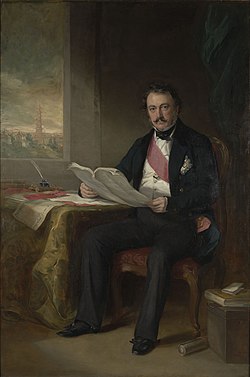
Lieutenant-General Sir Henry Pottinger, 1st Baronet, Bt GCB PC (3 October 1789 – 18 March 1856) was a Bombay Army officer and colonial administrator who served as the first governor of Hong Kong from 1843 to 1844.
Henry Pottinger was born at his family estate of Mount Pottinger in Ballymacarrett in the north of County Down in Ulster, the northern province in Ireland, on 3 October 1789. At the time of his birth, all of Ireland was part of the British-ruled Kingdom of Ireland. An Ulster Protestant, he was descended from the Pottingers of Berkshire, an English family by origin with a branch that had settled in Ulster during the Plantation of Ulster in the seventeenth century. He was the fifth son of Eldred Curwen Pottinger and his wife Anne. They had three daughters and eight sons. His nephew was also named Eldred Pottinger. Henry attended the Belfast Academy until the age of 12. In 1803, he left for India to join the East India Company's maritime service, but in the following year joined the Company's military service as a cadet instead. He studied local languages in Bombay and became an assistant teacher. On 18 September 1806, he was made an ensign and promoted to lieutenant on 16 July 1809.
Pottinger explored the lands between the Indus and Persia, traveling in disguise as a Muslim merchant and studying local languages, under the orders of Sir John Malcolm. In 1809, he served as a lieutenant in the Third Anglo-Maratha War. In 1810, he and Charles Christie undertook an expedition from Nushki (Balochistan) to Isfahan (Central Persia) disguised as Muslims. Christie went north to Herat and then west while Pottinger went west across two deserts to Kerman and Isfahan where they rejoined. The expedition was funded by the East India Company to map and research the regions of Balochistan and Persia because of concerns about India being invaded by French forces. It would be 100 years before another European took this route, and Pottinger rose to the rank of Colonel. Pottinger later became Resident Administrator of Sindh in 1820. He later held the same post in Hyderabad.
He was made a baronet when he returned to England in 1839.
Pottinger accepted Foreign Secretary Lord Palmerston's offer of the post of envoy and plenipotentiary in China and superintendent of British trade, thus replacing Charles Elliot. In 1841, Palmerston instructed him to "examine with care the natural capacities of Hong Kong, and you will not agree to give up that Island unless you should find that you can exchange it for another in the neighbourhood of Canton, better adapted for the purposes in view; equally defensible; and affording sufficient shelter for Ships of War and Commerce".
Pottinger left London on 5 June, travelled by ship through the Mediterranean, over land across the Suez, and reached Bombay on 7 July, where he stayed for 10 days before arriving in China on 10 August. The whole trip took 67 days, a record at the time. On 4 November, Palmerston's successor Lord Aberdeen wrote to Pottinger that he had doubts over Hong Kong's acquisition since it would incur administrative expenses, and complicate relations with China and other nations.
After Pottinger joined the British expeditionary force in northern China, he negotiated the terms of the Treaty of Nanking (1842), which ended the First Opium War and ceded Hong Kong Island to the United Kingdom. Pottinger wrote in a letter to Aberdeen that at a feast celebrating the ratification with his Hong Kong counterpart, Keying, Keying insisted they ceremonially exchange miniature portraits of each member of each others' families. Upon receiving a miniature portrait of Pottinger's wife, Pottinger wrote that Keying "placed it on his head—which I am told is the highest token of respect and friendship—filled a glass of wine, held the picture in front of his face, muttered some words in a low voice, drank the wine, again placed the picture on his head and then sat down" to complete the ceremony of long-term amity between the two families and the two peoples.
Pottinger became the second Administrator of Hong Kong (1841–1843) and the first Governor of Hong Kong (1843–1844). When he forwarded the treaty to Aberdeen, Pottinger remarked, "the retention of Hong Kong is the only point in which I have intentionally exceeded my modified instructions, but every single hour I have passed in this superb country has convinced me of the necessity and desirability of our possessing such a settlement as an emporium for our trade and a place from which Her Majesty's subjects in China may be alike protected and controlled."
Henry Pottinger
Lieutenant-General Sir Henry Pottinger, 1st Baronet, Bt GCB PC (3 October 1789 – 18 March 1856) was a Bombay Army officer and colonial administrator who served as the first governor of Hong Kong from 1843 to 1844.
Henry Pottinger was born at his family estate of Mount Pottinger in Ballymacarrett in the north of County Down in Ulster, the northern province in Ireland, on 3 October 1789. At the time of his birth, all of Ireland was part of the British-ruled Kingdom of Ireland. An Ulster Protestant, he was descended from the Pottingers of Berkshire, an English family by origin with a branch that had settled in Ulster during the Plantation of Ulster in the seventeenth century. He was the fifth son of Eldred Curwen Pottinger and his wife Anne. They had three daughters and eight sons. His nephew was also named Eldred Pottinger. Henry attended the Belfast Academy until the age of 12. In 1803, he left for India to join the East India Company's maritime service, but in the following year joined the Company's military service as a cadet instead. He studied local languages in Bombay and became an assistant teacher. On 18 September 1806, he was made an ensign and promoted to lieutenant on 16 July 1809.
Pottinger explored the lands between the Indus and Persia, traveling in disguise as a Muslim merchant and studying local languages, under the orders of Sir John Malcolm. In 1809, he served as a lieutenant in the Third Anglo-Maratha War. In 1810, he and Charles Christie undertook an expedition from Nushki (Balochistan) to Isfahan (Central Persia) disguised as Muslims. Christie went north to Herat and then west while Pottinger went west across two deserts to Kerman and Isfahan where they rejoined. The expedition was funded by the East India Company to map and research the regions of Balochistan and Persia because of concerns about India being invaded by French forces. It would be 100 years before another European took this route, and Pottinger rose to the rank of Colonel. Pottinger later became Resident Administrator of Sindh in 1820. He later held the same post in Hyderabad.
He was made a baronet when he returned to England in 1839.
Pottinger accepted Foreign Secretary Lord Palmerston's offer of the post of envoy and plenipotentiary in China and superintendent of British trade, thus replacing Charles Elliot. In 1841, Palmerston instructed him to "examine with care the natural capacities of Hong Kong, and you will not agree to give up that Island unless you should find that you can exchange it for another in the neighbourhood of Canton, better adapted for the purposes in view; equally defensible; and affording sufficient shelter for Ships of War and Commerce".
Pottinger left London on 5 June, travelled by ship through the Mediterranean, over land across the Suez, and reached Bombay on 7 July, where he stayed for 10 days before arriving in China on 10 August. The whole trip took 67 days, a record at the time. On 4 November, Palmerston's successor Lord Aberdeen wrote to Pottinger that he had doubts over Hong Kong's acquisition since it would incur administrative expenses, and complicate relations with China and other nations.
After Pottinger joined the British expeditionary force in northern China, he negotiated the terms of the Treaty of Nanking (1842), which ended the First Opium War and ceded Hong Kong Island to the United Kingdom. Pottinger wrote in a letter to Aberdeen that at a feast celebrating the ratification with his Hong Kong counterpart, Keying, Keying insisted they ceremonially exchange miniature portraits of each member of each others' families. Upon receiving a miniature portrait of Pottinger's wife, Pottinger wrote that Keying "placed it on his head—which I am told is the highest token of respect and friendship—filled a glass of wine, held the picture in front of his face, muttered some words in a low voice, drank the wine, again placed the picture on his head and then sat down" to complete the ceremony of long-term amity between the two families and the two peoples.
Pottinger became the second Administrator of Hong Kong (1841–1843) and the first Governor of Hong Kong (1843–1844). When he forwarded the treaty to Aberdeen, Pottinger remarked, "the retention of Hong Kong is the only point in which I have intentionally exceeded my modified instructions, but every single hour I have passed in this superb country has convinced me of the necessity and desirability of our possessing such a settlement as an emporium for our trade and a place from which Her Majesty's subjects in China may be alike protected and controlled."
Recent media
Recent media