



Community hub
Recent from talks
Knowledge base stats:
Talk channels stats:
Members stats:
Directional antenna
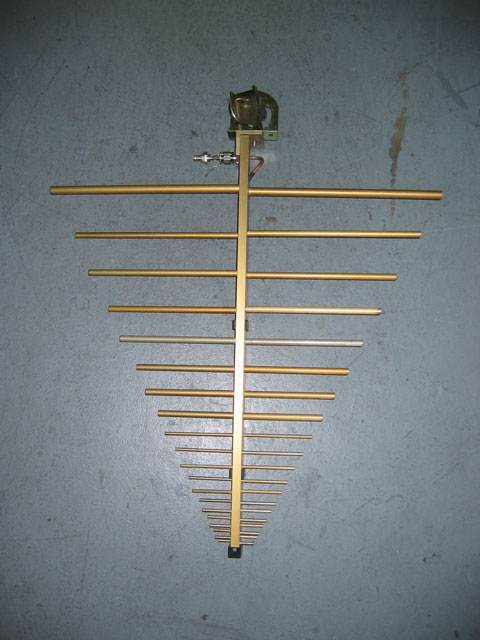
A directional antenna or beam antenna is an antenna that radiates or receives greater radio wave power in specific directions. Directional antennas can radiate radio waves in beams, when greater concentration of radiation in a certain direction is desired, or in receiving antennas receive radio waves from one specific direction only. This can increase the power transmitted to receivers in that direction, or reduce interference from unwanted sources. This contrasts with omnidirectional antennas such as dipole antennas which radiate radio waves over a wide angle, or receive from a wide angle.
The extent to which an antenna's angular distribution of radiated power, its radiation pattern, is concentrated in one direction is measured by a parameter called antenna gain. A high-gain antenna (HGA) is a directional antenna with a focused, narrow beam width, permitting more precise targeting of the radio signals. Most commonly referred to during space missions, these antennas are also in use all over Earth, most successfully in flat, open areas where there are no mountains to disrupt radiowaves.[citation needed]
In contrast, a low-gain antenna (LGA) is an omnidirectional antenna, with a broad radiowave beam width, that allows the signal to propagate reasonably well even in mountainous regions and is thus more reliable regardless of terrain. Low-gain antennas are often used in spacecraft as a backup to the high-gain antenna, which transmits a much narrower beam and is therefore susceptible to loss of signal.
All practical antennas are at least somewhat directional, although usually only the direction in the plane parallel to the earth is considered, and practical antennas can easily be omnidirectional in one plane. The most common directional antenna types are[citation needed]
These antenna types, or combinations of several single-frequency versions of one type or (rarely) a combination of two different types, are frequently sold commercially as residential TV antennas. Cellular repeaters often make use of external directional antennas to give a far greater signal than can be obtained on a standard cell phone. Satellite television receivers usually use parabolic antennas. For long and medium wavelength frequencies, tower arrays are used in most cases as directional antennas.
When transmitting, a high-gain antenna allows more of the transmitted power to be sent in the direction of the receiver, increasing the received signal strength. When receiving, a high gain antenna captures more of the signal, again increasing signal strength. Due to reciprocity, these two effects are equal—an antenna that makes a transmitted signal 100 times stronger (compared to an isotropic radiator) will also capture 100 times as much energy as the isotropic antenna when used as a receiving antenna. As a consequence of their directivity, directional antennas also send less (and receive less) signal from directions other than the main beam. This property may avoid interference from other out-of-beam transmitters, and always reduces antenna noise. (Noise comes from every direction, but a desired signal will only come from one approximate direction, so the narrower the antenna's beam, the better the crucial signal-to-noise ratio.)
There are many ways to make a high-gain antenna; the most common are parabolic antennas, helical antennas, Yagi-Uda antennas, and phased arrays of smaller antennas of any kind. Horn antennas can also be constructed with high gain, but are less commonly seen. Still other configurations are possible—the Arecibo Observatory used a combination of a line feed with an enormous spherical reflector (as opposed to a more usual parabolic reflector), to achieve extremely high gains at specific frequencies.
Antenna gain is often quoted with respect to a hypothetical antenna that radiates equally in all directions, an isotropic radiator. This gain, when measured in decibels, is called dBi. Conservation of energy dictates that high gain antennas must have narrow beams.[citation needed] For example, if a high gain antenna makes a 1 Watt transmitter look like a 100 Watt transmitter, then the beam can cover at most 1/100 of the sky (otherwise the total amount of energy radiated in all directions would sum to more than the transmitter power, which is not possible). In turn this implies that high-gain antennas must be physically large, since according to the diffraction limit, the narrower the beam desired, the larger the antenna must be (measured in wavelengths).
Hub AI
Directional antenna AI simulator
(@Directional antenna_simulator)
Directional antenna
A directional antenna or beam antenna is an antenna that radiates or receives greater radio wave power in specific directions. Directional antennas can radiate radio waves in beams, when greater concentration of radiation in a certain direction is desired, or in receiving antennas receive radio waves from one specific direction only. This can increase the power transmitted to receivers in that direction, or reduce interference from unwanted sources. This contrasts with omnidirectional antennas such as dipole antennas which radiate radio waves over a wide angle, or receive from a wide angle.
The extent to which an antenna's angular distribution of radiated power, its radiation pattern, is concentrated in one direction is measured by a parameter called antenna gain. A high-gain antenna (HGA) is a directional antenna with a focused, narrow beam width, permitting more precise targeting of the radio signals. Most commonly referred to during space missions, these antennas are also in use all over Earth, most successfully in flat, open areas where there are no mountains to disrupt radiowaves.[citation needed]
In contrast, a low-gain antenna (LGA) is an omnidirectional antenna, with a broad radiowave beam width, that allows the signal to propagate reasonably well even in mountainous regions and is thus more reliable regardless of terrain. Low-gain antennas are often used in spacecraft as a backup to the high-gain antenna, which transmits a much narrower beam and is therefore susceptible to loss of signal.
All practical antennas are at least somewhat directional, although usually only the direction in the plane parallel to the earth is considered, and practical antennas can easily be omnidirectional in one plane. The most common directional antenna types are[citation needed]
These antenna types, or combinations of several single-frequency versions of one type or (rarely) a combination of two different types, are frequently sold commercially as residential TV antennas. Cellular repeaters often make use of external directional antennas to give a far greater signal than can be obtained on a standard cell phone. Satellite television receivers usually use parabolic antennas. For long and medium wavelength frequencies, tower arrays are used in most cases as directional antennas.
When transmitting, a high-gain antenna allows more of the transmitted power to be sent in the direction of the receiver, increasing the received signal strength. When receiving, a high gain antenna captures more of the signal, again increasing signal strength. Due to reciprocity, these two effects are equal—an antenna that makes a transmitted signal 100 times stronger (compared to an isotropic radiator) will also capture 100 times as much energy as the isotropic antenna when used as a receiving antenna. As a consequence of their directivity, directional antennas also send less (and receive less) signal from directions other than the main beam. This property may avoid interference from other out-of-beam transmitters, and always reduces antenna noise. (Noise comes from every direction, but a desired signal will only come from one approximate direction, so the narrower the antenna's beam, the better the crucial signal-to-noise ratio.)
There are many ways to make a high-gain antenna; the most common are parabolic antennas, helical antennas, Yagi-Uda antennas, and phased arrays of smaller antennas of any kind. Horn antennas can also be constructed with high gain, but are less commonly seen. Still other configurations are possible—the Arecibo Observatory used a combination of a line feed with an enormous spherical reflector (as opposed to a more usual parabolic reflector), to achieve extremely high gains at specific frequencies.
Antenna gain is often quoted with respect to a hypothetical antenna that radiates equally in all directions, an isotropic radiator. This gain, when measured in decibels, is called dBi. Conservation of energy dictates that high gain antennas must have narrow beams.[citation needed] For example, if a high gain antenna makes a 1 Watt transmitter look like a 100 Watt transmitter, then the beam can cover at most 1/100 of the sky (otherwise the total amount of energy radiated in all directions would sum to more than the transmitter power, which is not possible). In turn this implies that high-gain antennas must be physically large, since according to the diffraction limit, the narrower the beam desired, the larger the antenna must be (measured in wavelengths).