Hubbry Logo
search
logo
2221006

Directional antenna

logo
Community Hub0 Subscribers
Read side by side
from Wikipedia
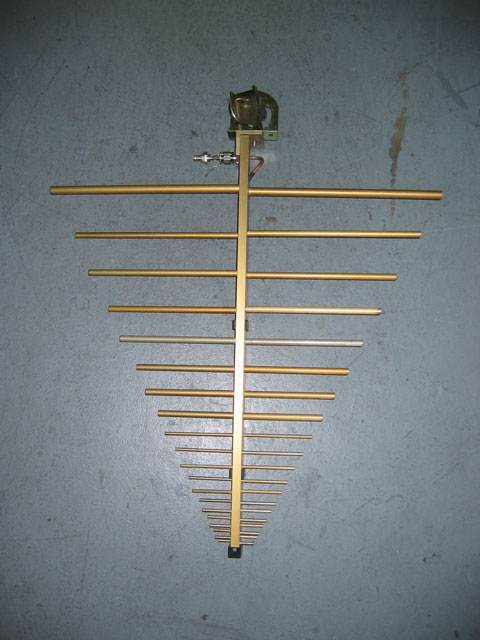
A multi-element, log-periodic dipole array
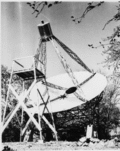
A 70-meter Cassegrain radio antenna at GDSCC, California
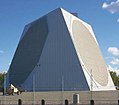
Patch antenna gain pattern

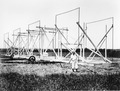
A directional antenna or beam antenna is an antenna that radiates or receives greater radio wave power in specific directions. Directional antennas can radiate radio waves in beams, when greater concentration of radiation in a certain direction is desired, or in receiving antennas receive radio waves from one specific direction only. This can increase the power transmitted to receivers in that direction, or reduce interference from unwanted sources. This contrasts with omnidirectional antennas such as dipole antennas which radiate radio waves over a wide angle, or receive from a wide angle.

The extent to which an antenna's angular distribution of radiated power, its radiation pattern, is concentrated in one direction is measured by a parameter called antenna gain. A high-gain antenna (HGA) is a directional antenna with a focused, narrow beam width, permitting more precise targeting of the radio signals.[1] Most commonly referred to during space missions,[2] these antennas are also in use all over Earth, most successfully in flat, open areas where there are no mountains to disrupt radiowaves.[citation needed]

In contrast, a low-gain antenna (LGA) is an omnidirectional antenna, with a broad radiowave beam width, that allows the signal to propagate reasonably well even in mountainous regions and is thus more reliable regardless of terrain. Low-gain antennas are often used in spacecraft as a backup to the high-gain antenna, which transmits a much narrower beam and is therefore susceptible to loss of signal.[3]

All practical antennas are at least somewhat directional, although usually only the direction in the plane parallel to the earth is considered, and practical antennas can easily be omnidirectional in one plane. The most common directional antenna types are[citation needed]

These antenna types, or combinations of several single-frequency versions of one type or (rarely) a combination of two different types, are frequently sold commercially as residential TV antennas. Cellular repeaters often make use of external directional antennas to give a far greater signal than can be obtained on a standard cell phone. Satellite television receivers usually use parabolic antennas. For long and medium wavelength frequencies, tower arrays are used in most cases as directional antennas.

Principle of operation

[edit]

When transmitting, a high-gain antenna allows more of the transmitted power to be sent in the direction of the receiver, increasing the received signal strength. When receiving, a high gain antenna captures more of the signal, again increasing signal strength. Due to reciprocity, these two effects are equal—an antenna that makes a transmitted signal 100 times stronger (compared to an isotropic radiator) will also capture 100 times as much energy as the isotropic antenna when used as a receiving antenna. As a consequence of their directivity, directional antennas also send less (and receive less) signal from directions other than the main beam. This property may avoid interference from other out-of-beam transmitters, and always reduces antenna noise. (Noise comes from every direction, but a desired signal will only come from one approximate direction, so the narrower the antenna's beam, the better the crucial signal-to-noise ratio.)

There are many ways to make a high-gain antenna; the most common are parabolic antennas, helical antennas, Yagi-Uda antennas, and phased arrays of smaller antennas of any kind. Horn antennas can also be constructed with high gain, but are less commonly seen. Still other configurations are possible—the Arecibo Observatory used a combination of a line feed with an enormous spherical reflector (as opposed to a more usual parabolic reflector), to achieve extremely high gains at specific frequencies.

Antenna gain

[edit]

Antenna gain is often quoted with respect to a hypothetical antenna that radiates equally in all directions, an isotropic radiator. This gain, when measured in decibels, is called dBi. Conservation of energy dictates that high gain antennas must have narrow beams.[citation needed] For example, if a high gain antenna makes a 1 Watt transmitter look like a 100 Watt transmitter, then the beam can cover at most 1/100 of the sky (otherwise the total amount of energy radiated in all directions would sum to more than the transmitter power, which is not possible). In turn this implies that high-gain antennas must be physically large, since according to the diffraction limit, the narrower the beam desired, the larger the antenna must be (measured in wavelengths).

Antenna gain can also be measured in dBd, which is gain in decibels compared to the maximum intensity direction of a half wave dipole. In the case of Yagi-type aerials this more or less equates to the gain one would expect from the aerial under test minus all its directors and reflector. It is important not to confuse dBi and dBd; the two differ by 2.15 dB, with the dBi figure being higher, since a dipole has 2.15 dB of gain with respect to an isotropic antenna.

Gain is also dependent on the number of elements and the tuning of those elements. Antennas can be tuned to be resonant over a wider spread of frequencies but, all other things being equal, this will mean the gain of the aerial is lower than one tuned for a single frequency or a group of frequencies. For example, in the case of wideband TV antennas the fall off in gain is particularly large at the bottom of the TV transmitting band. In the UK this bottom third of the TV band is known as group A.[citation needed]

Other factors which may also affect gain include aperture (the area the antenna collects signal from, almost entirely related to the size of the antenna but for small antennas can be increased by adding a ferrite rod), and efficiency (again, affected by size, but also resistivity of the materials used and impedance matching). These factors are easy to improve without adjusting other features of the antennas or coincidentally improved by the same factors that increase directivity, and so are typically not emphasized.

Applications

[edit]

High gain antennas are typically the largest component of deep space probes, and the highest gain radio antennas are physically enormous structures, such as the Arecibo Observatory. The Deep Space Network uses 35 m dishes at about 1 cm wavelengths. This combination gives the antenna gain of about 100,000,000 (or 80 dB, as normally measured), making the transmitter appear about 100 million times stronger, and a receiver about 100 million times more sensitive, provided the target is within the beam. This beam can cover at most one hundred millionth (10−8) of the sky, so very accurate pointing is required.

Use of high gain and millimeter-wave communication in WPAN gaining increases the probability of concurrent scheduling of non‐interfering transmissions in a localized area, which results in an immense increase in network throughput. However, the optimum scheduling of concurrent transmission is an NP-hard problem.[4]

[edit]

See also

[edit]

References

[edit]
[edit]
Revisions and contributorsEdit on WikipediaRead on Wikipedia
from Grokipedia
A directional antenna is an antenna that radiates or receives electromagnetic waves with greater intensity in specific directions compared to others, concentrating energy to achieve higher gain and improved signal-to-noise ratio in targeted areas while minimizing interference from other directions.[1] This contrasts with omnidirectional antennas, which radiate uniformly in all directions within a plane.[2] The fundamental principle governing directional antennas is directivity, defined as the ratio of the radiation intensity in a particular direction to the average radiation intensity over all directions, often expressed as $ D(\theta, \phi) = \frac{U(\theta, \phi)}{U_{\text{ave}}} $, where $ U $ is the radiation intensity.[1] Gain, a related metric, accounts for the antenna's radiation efficiency $ \eta $, given by $ G(\theta, \phi) = \eta \cdot D(\theta, \phi) $, which quantifies the antenna's ability to direct power effectively.[1] The effective aperture $ A_e(\theta, \phi) = \frac{G(\theta, \phi) \lambda^2}{4\pi} $ further describes receiving performance, where $ \lambda $ is the wavelength.[1] Phase errors across the antenna structure, such as surface tolerances in reflectors, can degrade gain exponentially, with $ G = G_0 e^{-(4\pi b / \lambda)^2} $ for root-mean-square deviation $ b $.[1] Directional antennas encompass various designs tailored to frequency bands and use cases, including wire antennas like the Yagi-Uda (featuring a driven element, reflector, and directors for moderate gain of 6–12 dB) and helical (axial mode for circular polarization and high directivity), as well as aperture antennas such as parabolic reflectors (achieving directivity up to $ 4\pi A / \lambda^2 $ for aperture area $ A $, with beamwidth approximately $ 1.02 \lambda / D $ for diameter $ D $) and uniformly illuminated circular apertures.[1] Other notable types include horn antennas, which transition from waveguides to free space for broadband operation, and log-periodic antennas, offering wide bandwidth and stable patterns across octaves.[3] These antennas are widely applied in scenarios requiring focused transmission or reception, such as long-range point-to-point communication, television and radio broadcasting, amateur radio operations, unmanned aerial vehicle (UAV) tracking, and wireless networks to enhance connectivity and reduce multipath interference.[4] In military contexts, they support precise signal directionality for radar and tactical communications, where careful alignment is essential to concentrate nearly all signal power in the intended direction.[2]

Fundamentals

Definition and Characteristics

A directional antenna is a type of antenna designed to concentrate electromagnetic energy into one or more preferred directions, thereby enhancing signal strength in those directions while suppressing radiation in others. This focus on directionality distinguishes it from antennas that radiate more uniformly, allowing for improved efficiency in targeted communication links. Key characteristics of directional antennas include their high directivity, which results in focused radiation patterns that prioritize signal propagation along specific axes. They are typically larger in physical size compared to omnidirectional antennas operating at the same frequency due to the need for elements that shape the beam, and they function effectively for both transmitting and receiving signals. Antenna gain serves as a primary measure of this directionality, quantifying how much power is concentrated in the main direction relative to an isotropic radiator. The radiation pattern of a directional antenna features a prominent main lobe in the primary direction of interest, with back lobes and side lobes minimized to reduce interference and energy loss. This pattern ensures that the majority of the radiated power is directed purposefully, optimizing performance in line-of-sight scenarios. The term "directional antenna" originated in early 20th-century radio engineering, with foundational patents for basic reflector designs appearing as early as the 1900s, marking the evolution from isotropic radiators to more controlled systems.

Comparison to Omnidirectional Antennas

Omnidirectional antennas radiate and receive signals uniformly in all directions within a horizontal plane, providing 360-degree coverage that is particularly suited for applications requiring broad, non-specific signal distribution, such as in mobile communications or general wireless networks.[5] A classic example is the dipole antenna, which exhibits this isotropic-like behavior in the azimuthal plane while having nulls in the orthogonal direction.[6] This uniform pattern ensures consistent signal availability across a wide area but results in lower power density in any single direction due to the energy being spread evenly.[5] In contrast, directional antennas concentrate their radiation into a narrower beam toward a specific target, achieving higher gain and signal strength in that direction at the expense of limited coverage elsewhere.[6] While omnidirectional designs deliver weaker but omnipresent signals, directional ones offer focused propagation that extends effective range and enhances performance over line-of-sight paths.[7] This difference in radiation patterns—broad and toroidal for omnidirectional versus narrow and lobe-like for directional—highlights their complementary roles, with the former prioritizing accessibility and the latter precision.[6] A primary trade-off lies in efficiency and interference management: directional antennas mitigate unwanted signals from off-axis sources, thereby improving the signal-to-noise ratio in the intended direction and reducing susceptibility to multipath fading or jamming.[5] Omnidirectional antennas, however, are more prone to interference across their expansive field, as they cannot discriminate between desired and extraneous signals.[6] Additionally, directional systems demand precise alignment between transmitter and receiver to maximize benefits, increasing deployment complexity compared to the plug-and-play simplicity of omnidirectional setups.[5] These factors make omnidirectional antennas ideal for dynamic environments needing isotropic coverage, while directional ones excel in fixed, point-to-point scenarios where targeted efficiency outweighs the need for ubiquity.[6]

Operating Principles

Radiation Mechanism

Directional antennas achieve directionality by manipulating electromagnetic waves emanating from a radiating source through processes such as interference, reflection, and diffraction, which concentrate the radiated energy in preferred directions while suppressing it in others. These mechanisms exploit the wave nature of electromagnetic fields, where time-varying currents on antenna elements generate oscillating electric and magnetic fields that propagate as transverse waves. In typical designs, a driven element—directly excited by the feed—serves as the primary source, while parasitic elements like reflectors and directors induce secondary currents through mutual coupling. The reflector, positioned behind the driven element, is tuned to produce a phase lag that reflects waves forward, whereas directors ahead create phase advances that guide the wavefront. These phase shifts ensure constructive interference along the desired propagation axis and destructive interference elsewhere. The underlying physics aligns with Huygens' principle, which posits that every point on a wavefront acts as a source of secondary spherical wavelets, with the new wavefront forming as their envelope. In antennas, the array of elements functions as these secondary sources; the spacing between them modulates the phase of the wavelets, steering the resultant wavefront and enhancing directionality. For a basic two-element array, directivity arises from the phase difference introduced by element spacing LL. The path length difference for waves propagating at angle θ\theta from the array axis is LcosθL \cos \theta, leading to a phase shift δ=2πLλcosθ\delta = \frac{2\pi L}{\lambda} \cos \theta, where λ\lambda is the wavelength. Constructive interference maximizes radiation in the broadside direction (θ=90\theta = 90^\circ).

Directivity and Beam Formation

Directivity in antennas quantifies the ability to concentrate radiation in a preferred direction compared to isotropic distribution. It is defined as the ratio of the maximum radiation intensity in a given direction to the average radiation intensity over all directions.[8] This measure, often expressed in decibels (dBi), highlights how directional antennas achieve higher values than omnidirectional ones by focusing energy, with the maximum directivity $ D_0 $ related to the beam solid angle $ \Omega_A $ via $ D_0 = 4\pi / \Omega_A $.[8] Beam formation in directional antennas relies on the principle of interference among radiated fields from multiple elements or structures. Constructive interference occurs in the main lobe through precise phasing of elements, where signals align in phase to reinforce the field strength in the desired direction.[9] Conversely, destructive interference is engineered in other directions to suppress side and back lobes, narrowing the beam and enhancing focus.[10] This phasing, achieved via physical spacing, lengths, or electronic delays, controls the radiation pattern's shape without altering total radiated power. The front-to-back ratio serves as a key indicator of directional isolation, defined as the ratio of the maximum directivity to the directivity in a specified rearward direction. In directional designs, this ratio typically exceeds 10 dB, with high-performance antennas often achieving 15 dB or more to minimize rearward radiation and interference. Polarization influences directivity by determining how the electric field orientation interacts with the propagating wave. Linear polarization aligns the field along a single axis, potentially maximizing directivity in aligned scenarios but suffering losses from misalignment.[8] Circular polarization, rotating the field in a helical pattern, can maintain effective directivity across varying orientations, though it often results in slightly lower peak values and wider beamwidths due to the dual orthogonal components.[11] In multipath environments, circular polarization enhances overall directivity by reducing depolarization effects compared to linear types.[12]

Performance Metrics

Antenna Gain

Antenna gain quantifies the antenna's capability to concentrate radiated power in a preferred direction compared to an isotropic radiator that distributes power uniformly. It is defined as the product of directivity DD and radiation efficiency η\eta, expressed as G=ηDG = \eta D, where directivity represents the theoretical maximum concentration of power and efficiency accounts for losses in converting input power to radiated power.[13] This metric effectively measures the increase in power density in the direction of maximum radiation relative to what an isotropic antenna would achieve with the same total input power.[14] The maximum gain is calculated by integrating the radiation intensity over the antenna's pattern to determine the total radiated power, then relating the peak intensity to the input power: G(dBi)=10log10(4πUmaxPin)G(\mathrm{dBi}) = 10 \log_{10} \left( \frac{4\pi U_{\max}}{P_{\mathrm{in}}} \right), where UmaxU_{\max} is the maximum radiation intensity and PinP_{\mathrm{in}} is the accepted input power.[15] This approach, derived from the radiation pattern, provides a practical assessment incorporating both directional focusing and real-world inefficiencies.[8] Several factors influence antenna gain in directional designs. The effective aperture size relative to the operating wavelength plays a primary role, as larger apertures capture or radiate more effectively, leading to higher gain values.[16] At higher frequencies, the shorter wavelength enables compact antennas to achieve comparable gain to larger low-frequency designs, facilitating miniaturization for given performance targets.[17] Additionally, losses from impedance mismatches between the antenna and feeding system diminish the realized gain by reducing the power transferred to the radiator, often quantified as realized gain Gr=G(1Γ2)G_r = G (1 - |\Gamma|^2), where Γ\Gamma is the reflection coefficient.[8] Higher gain directly enhances the effective isotropic radiated power (EIRP), defined as $ \mathrm{EIRP} = P_{\mathrm{in}} G $, which represents the total power an isotropic antenna would need to produce the same peak field strength in the main direction.[18] This amplification of effective output occurs without increasing the transmitter's input power, making gain a critical parameter for optimizing signal strength in directional systems.[19] Gain builds on directivity by incorporating practical efficiency losses, providing a more complete performance indicator for real antennas.[14]

Beamwidth and Side Lobes

In directional antennas, the half-power beamwidth (HPBW) is defined as the angular width of the main radiation lobe where the power density decreases to half (or -3 dB) of its maximum value.[20] This metric quantifies the angular spread of the primary beam, with narrower beamwidths indicating greater concentration of radiated energy. For typical directional antennas, HPBW ranges from approximately 10 to 70 degrees, depending on the antenna's aperture size relative to the operating wavelength.[21] An approximate formula for HPBW in aperture-type directional antennas is given by
HPBW70λD(degrees), \text{HPBW} \approx \frac{70 \lambda}{D} \quad \text{(degrees)},
where λ\lambda is the wavelength and DD is the aperture diameter in wavelengths; this relation highlights the inverse proportionality between beamwidth and physical size.[21] Side lobes refer to secondary peaks in the antenna's radiation pattern beyond the main lobe, representing unintended radiation directions that can lead to interference with other systems.[8] The first side lobe level (SLL), typically the strongest of these, is ideally suppressed to below -13 dB relative to the main lobe peak for uniform aperture distributions, though advanced designs aim for even lower levels to minimize energy loss and interference.[22] Nulls are specific directions in the radiation pattern where the radiated power approaches zero, serving as boundaries between lobes and enabling targeted suppression of signals in certain angles.[23] In array-based directional antennas, grating lobes emerge as additional high-intensity peaks due to element spacing exceeding half the wavelength, potentially mimicking the main beam and causing ambiguities; these can be mitigated through amplitude tapering across elements, which reduces their prominence without significantly broadening the main beam.[24]

Types and Designs

Yagi-Uda Antennas

The Yagi-Uda antenna consists of a single driven element, typically a half-wave dipole with a length of approximately 0.45 to 0.5 wavelengths, which is fed by the radio frequency signal.[25] A single reflector element, positioned behind the driven element, is slightly longer—often 5% longer than the driven element—to create inductive reactance.[26] Multiple director elements, usually one to twenty in number and shorter than the driven element (around 95% of its length), are placed in front to provide capacitive reactance.[25] These parasitic elements are mounted parallel to each other along a central boom, with typical spacing between the reflector and driven element ranging from 0.15 to 0.3 wavelengths, and directors spaced similarly ahead to achieve the desired gain.[25] In operation, the reflector induces a phase lag in the current, effectively reflecting energy backward and suppressing radiation in that direction to enhance forward directivity.[26] The directors, by contrast, create a phase lead that progressively accelerates the wavefront forward, forming a unidirectional end-fire beam through mutual coupling among the elements.[25] This configuration typically yields a gain of 6 to 15 dBi, depending on the number of directors, with a three-element version providing 5 to 6 dB and additional directors adding about 2 dB each until diminishing returns set in.[26] Standard designs exhibit a beamwidth of 40 to 60 degrees.[27] The antenna was developed in the late 1920s by Japanese engineers Hidetsugu Yagi and Shintaro Uda at Tohoku Imperial University, with Uda conducting much of the experimental work under Yagi's supervision; their 1928 publication described an array using one active element and multiple parasitic elements to achieve high directivity.[28] It gained widespread popularity for television reception in the 1950s, particularly for VHF channels, as rooftop installations became common for improved signal capture during the postwar TV boom.[29] In modern applications, Yagi-Uda antennas are optimized for UHF and VHF bands in amateur radio, wireless communications, and radar systems due to their compact size and directional performance.[30] Broadband variants incorporate log-periodic structures, such as multiple scaled dipole arrays as directors, to extend frequency coverage for applications like 4G/5G cellular and Wi-Fi.

Parabolic Reflector Antennas

Parabolic reflector antennas utilize a paraboloid-shaped surface to direct electromagnetic waves, focusing incoming signals to a single focal point or collimating outgoing waves into a parallel beam. The reflector is typically a rotationally symmetric dish formed by revolving a parabola around its axis, with the feed element positioned at the focal point to ensure that all rays reflect parallel to the axis, mimicking the principles of optical parabolic mirrors. This geometry enables high directivity by concentrating energy within a narrow beam, making it suitable for long-distance communications at microwave and higher frequencies.[31] The diameter of the parabolic reflector is a critical parameter, often ranging from 10 to 100 wavelengths (λ) at the operating frequency to achieve gains exceeding 20 dBi, with larger dimensions providing progressively higher directivity for applications requiring precise beam control. For instance, reflectors with diameters around 10λ yield moderate gains suitable for point-to-point links, while those approaching 100λ, common in radio astronomy, support beamwidths under 1 degree. This scaling ensures the aperture efficiently captures or transmits wavefronts, though practical sizes are limited by mechanical constraints and wind loading.[31][32] Feed systems illuminate the reflector surface to maximize energy transfer while minimizing losses. In the prime focus configuration, the feed—often a horn antenna—is placed directly at the focal point in front of the dish, providing straightforward illumination but exposing the feed to environmental factors and potentially blocking the aperture. The Cassegrain feed addresses compactness by employing a secondary hyperbolic subreflector positioned near the focal point to redirect waves from a primary feed located behind the main reflector, reducing the overall depth and improving blockage efficiency for space-constrained installations. Horn feeds are prevalent in both setups due to their controlled radiation pattern, which tapers to match the reflector's edge illumination and suppress spillover.[33][34][35] Performance characteristics include narrow beamwidths typically between 1 and 10 degrees, determined by the ratio of wavelength to diameter, enabling precise targeting over extended ranges. Aperture efficiency ranges from 50% to 70%, influenced by factors such as spillover losses—where feed radiation misses the reflector edges—and illumination taper, which balances edge brightness against spillover. Large dishes can achieve gains over 30 dBi, underscoring their role in high-gain scenarios, though efficiency degrades with mismatches in feed pattern or surface imperfections.[36][37][35] The evolution of parabolic reflector antennas traces back to optical applications in the 18th century, where parabolic mirrors were developed for telescopes to eliminate spherical aberration, as demonstrated by John Hadley's designs in the 1720s. Adaptation to radio frequencies began with Heinrich Hertz's experiments in 1888, using cylindrical parabolic reflectors to demonstrate electromagnetic wave propagation. Practical radio implementations emerged in the 1930s, exemplified by Grote Reber's 1937 parabolic dish—the first dedicated radio telescope—which advanced astronomical observations. By the 1960s, parabolic designs proliferated in satellite communications, with dishes deployed for early systems like Telstar, enabling global broadcasting and data relay.[38][39][40][41]

Applications and Limitations

Common Uses

Directional antennas are widely employed in broadcasting applications, particularly for television and radio transmission from towers. Yagi-Uda antennas, a common type of directional design, are used to provide targeted coverage over specific areas, allowing broadcasters to focus signals toward population centers while minimizing spillover into adjacent regions. This targeted approach helps reduce multipath interference, where signals bounce off buildings or terrain, by narrowing the radiation pattern to favor direct line-of-sight paths.[42][43] In wireless networks, directional antennas facilitate point-to-point links essential for Wi-Fi extensions and cellular backhaul infrastructure. These antennas enable high-capacity connections between remote sites, such as linking cell towers to core networks over distances where omnidirectional coverage would be inefficient. In modern 5G systems, directional principles underpin beamforming techniques, where base stations dynamically steer signals toward users to enhance data rates and reliability in millimeter-wave bands.[44][45][46] Radar and sensing systems rely on directional antennas for extended detection ranges, with phased array designs playing a pivotal role in military applications. Developed extensively after the 1940s, these arrays allow electronic beam steering without mechanical movement, enabling rapid scanning for aircraft, missiles, and other targets. The high gain of such antennas concentrates energy, improving signal-to-noise ratios for long-range sensing in defense scenarios.[47][48] Satellite communications utilize parabolic reflector antennas as large dishes for both consumer and scientific purposes. In television and internet services, these directional dishes on Earth and spacecraft focus signals to geostationary satellites, supporting global broadcasting and broadband access. NASA's Deep Space Network (DSN), operational since the 1960s, employs massive 70-meter parabolic antennas to communicate with probes in deep space, such as Voyager missions, where high-gain directionality is crucial for faint signal reception over billions of miles.[49][50]

Advantages and Challenges

Directional antennas offer several key advantages over omnidirectional designs, primarily through their ability to concentrate energy in specific directions. This focused radiation pattern enhances signal strength and extends effective communication range, allowing the same transmit power to cover greater distances compared to isotropic radiators. Additionally, by rejecting signals from off-axis directions, directional antennas significantly reduce interference from unwanted sources, improving overall link quality in dense environments. In crowded spectrum bands, this spatial selectivity enables higher spectrum efficiency by supporting concurrent transmissions via spatial reuse, thereby increasing network throughput without additional bandwidth allocation. Despite these benefits, directional antennas present notable challenges in deployment and operation. Precise pointing is essential to align the main beam with the target, as misalignment can degrade performance; in mobile applications, this often requires tracking motors to maintain orientation amid movement, adding mechanical complexity.[51] At high frequencies, such as those above 10 GHz, these antennas are particularly susceptible to weather effects like rain fade, where precipitation attenuates signals more severely than at lower bands, potentially disrupting links. Furthermore, achieving high directivity typically involves greater design and manufacturing complexity, resulting in higher costs compared to simpler omnidirectional alternatives.[52] Practical limitations further constrain the use of directional antennas. High-gain configurations are inherently narrowband, as increased directivity trades off bandwidth for focused energy, limiting their suitability for wideband applications.[16] Antenna size also scales inversely with operating frequency, necessitating larger structures at lower frequencies to maintain performance, which can pose integration challenges in compact systems.[53] To address alignment issues, active phased array antennas have emerged as a mitigation strategy, enabling electronic beam steering without mechanical parts. Development of these arrays began in the early 1970s for radar applications, with significant advancements in solid-state technology.[47] By the 2020s, they have become widespread in 5G networks, facilitating dynamic pointing and reducing reliance on physical tracking in mobile scenarios.[54]

References

User Avatar
No comments yet.