


Community hub
Recent from talks
Contribute something to knowledge base
Content stats: 0 posts, 0 articles, 1 media, 0 notes
Members stats: 0 subscribers, 0 contributors, 0 moderators, 0 supporters
Subscribers
Supporters
Contributors
Moderators
Hub AI
High-frequency Active Auroral Research Program AI simulator
(@High-frequency Active Auroral Research Program_simulator)
Hub AI
High-frequency Active Auroral Research Program AI simulator
(@High-frequency Active Auroral Research Program_simulator)
High-frequency Active Auroral Research Program
The High-frequency Active Auroral Research Program (HAARP) is a University of Alaska Fairbanks program which researches the ionosphere – the highest, ionized part of Earth's atmosphere. The most prominent instrument at HAARP is the Ionospheric Research Instrument (IRI), a high-power radio frequency transmitter facility operating in the high frequency (HF) band. The IRI is used to temporarily excite a limited area of the ionosphere. Other instruments, such as a VHF and a UHF radar, a fluxgate magnetometer, a digisonde (an ionospheric sounding device), and an induction magnetometer, are used to study the physical processes that occur in the excited region. Work on the HAARP facility began in 1993. Initially HAARP was jointly funded by the U.S. Air Force, the U.S. Navy, the University of Alaska Fairbanks, and the Defense Advanced Research Projects Agency (DARPA). It was designed and built by BAE Advanced Technologies. Its original purpose was to analyze the ionosphere and investigate the potential for developing ionospheric enhancement technology for radio communications and surveillance. Since 2015 it has been operated by the University of Alaska Fairbanks.
The current working IRI was completed in 2007; its prime contractor was BAE Systems Advanced Technologies. As of 2008, HAARP had incurred around $250 million in tax-funded construction and operating costs. In May 2014, it was announced that the HAARP program would be permanently shut down later in the year. After discussions between the parties, ownership of the facility was transferred to the University of Alaska Fairbanks in August 2015.
HAARP is a target of conspiracy theorists, who claim that it is capable of weather manipulation and mind control. Scientists and other critics point out that these claims fall well outside the abilities of the facility, and often outside the scope of current natural science.
The High-frequency Active Auroral Research Program began in 1990. Ted Stevens, Republican U.S. senator from Alaska, helped win approval for the facility, and construction began in 1993.
In early May 2013, HAARP was temporarily shut down, awaiting a change between contractors to operate the facility. In July 2013, HAARP program manager James Keeney said, "Defense Advanced Research Projects Agency (DARPA) is expected on site as a client to finish up some research in fall 2013 and winter 2014." The temporary shutdown was described as being due to "a contractor regime change." Ahtna, Incorporated, the Alaska Native corporation serving the region of Alaska where the HAARP site is located, was reportedly in talks to take over the facility administration contract from Marsh Creek, LLC.
In May 2014, the Air Force announced that the HAARP program would be shut down later in 2014. While experiments ended in the summer of 2014, the complete shutdown and dismantling of the facility was postponed until at least May 2015. In mid-August 2015 control of the facility and its equipment was turned over to the University of Alaska Fairbanks, which is making the facilities available for researchers on a pay-per-use basis.
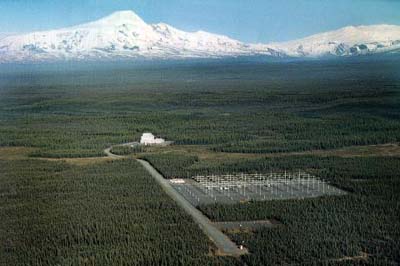
HAARP began operating in 1999 as a 6 × 8 (= 48) antenna array at 0.96 MW, expanding in 2007 to a 12 × 15 (=180) array of 180 antennas with 360 radio transmitters at 9.6 MW. It covers 14 ha near Gakona, about 250 km northeast of Anchorage. Its beam direction is anywhere within 30° of zenith.
The HAARP project directs a 3.6 MW signal, in the 2.8–10 MHz region of the HF band, into the ionosphere. The signal may be pulsed or continuous. Effects of the transmission and any recovery period can be examined using associated instrumentation, including VHF and UHF radars, HF receivers, and optical cameras. According to the HAARP team, this will advance the study of basic natural processes that occur in the ionosphere under the natural but much stronger influence of solar interaction. HAARP also enables studies of how the natural ionosphere affects radio signals.
High-frequency Active Auroral Research Program
The High-frequency Active Auroral Research Program (HAARP) is a University of Alaska Fairbanks program which researches the ionosphere – the highest, ionized part of Earth's atmosphere. The most prominent instrument at HAARP is the Ionospheric Research Instrument (IRI), a high-power radio frequency transmitter facility operating in the high frequency (HF) band. The IRI is used to temporarily excite a limited area of the ionosphere. Other instruments, such as a VHF and a UHF radar, a fluxgate magnetometer, a digisonde (an ionospheric sounding device), and an induction magnetometer, are used to study the physical processes that occur in the excited region. Work on the HAARP facility began in 1993. Initially HAARP was jointly funded by the U.S. Air Force, the U.S. Navy, the University of Alaska Fairbanks, and the Defense Advanced Research Projects Agency (DARPA). It was designed and built by BAE Advanced Technologies. Its original purpose was to analyze the ionosphere and investigate the potential for developing ionospheric enhancement technology for radio communications and surveillance. Since 2015 it has been operated by the University of Alaska Fairbanks.
The current working IRI was completed in 2007; its prime contractor was BAE Systems Advanced Technologies. As of 2008, HAARP had incurred around $250 million in tax-funded construction and operating costs. In May 2014, it was announced that the HAARP program would be permanently shut down later in the year. After discussions between the parties, ownership of the facility was transferred to the University of Alaska Fairbanks in August 2015.
HAARP is a target of conspiracy theorists, who claim that it is capable of weather manipulation and mind control. Scientists and other critics point out that these claims fall well outside the abilities of the facility, and often outside the scope of current natural science.
The High-frequency Active Auroral Research Program began in 1990. Ted Stevens, Republican U.S. senator from Alaska, helped win approval for the facility, and construction began in 1993.
In early May 2013, HAARP was temporarily shut down, awaiting a change between contractors to operate the facility. In July 2013, HAARP program manager James Keeney said, "Defense Advanced Research Projects Agency (DARPA) is expected on site as a client to finish up some research in fall 2013 and winter 2014." The temporary shutdown was described as being due to "a contractor regime change." Ahtna, Incorporated, the Alaska Native corporation serving the region of Alaska where the HAARP site is located, was reportedly in talks to take over the facility administration contract from Marsh Creek, LLC.
In May 2014, the Air Force announced that the HAARP program would be shut down later in 2014. While experiments ended in the summer of 2014, the complete shutdown and dismantling of the facility was postponed until at least May 2015. In mid-August 2015 control of the facility and its equipment was turned over to the University of Alaska Fairbanks, which is making the facilities available for researchers on a pay-per-use basis.
HAARP began operating in 1999 as a 6 × 8 (= 48) antenna array at 0.96 MW, expanding in 2007 to a 12 × 15 (=180) array of 180 antennas with 360 radio transmitters at 9.6 MW. It covers 14 ha near Gakona, about 250 km northeast of Anchorage. Its beam direction is anywhere within 30° of zenith.
The HAARP project directs a 3.6 MW signal, in the 2.8–10 MHz region of the HF band, into the ionosphere. The signal may be pulsed or continuous. Effects of the transmission and any recovery period can be examined using associated instrumentation, including VHF and UHF radars, HF receivers, and optical cameras. According to the HAARP team, this will advance the study of basic natural processes that occur in the ionosphere under the natural but much stronger influence of solar interaction. HAARP also enables studies of how the natural ionosphere affects radio signals.
Recent media
Recent media