



Community hub
Recent from talks
Knowledge base stats:
Talk channels stats:
Members stats:
Hilda mega-bonebed
The Hilda mega-bonebed is a complex of fourteen probable Centrosaurus apertus bonebeds discovered near the town of Hilda in Alberta, Canada. It was first described in the scientific literature by David Eberth, Donald Brinkman, and Vaia Barkas in 2010 after more than ten years of research. The Hilda mega-bonebed is significant because the behavior of the preserved dinosaurs themselves was the dominant cause of its existence, rather than the stratum's geological history like most bonebeds. It is also Canada's largest bonebed.
In 1959, Wann Langston, Jr. recorded evidence of a Centrosaurus bonebed near Hilda, Alberta. Later, between 1964 and 1966 Don Taylor of the Provincial Museum of Alberta (now called the Royal Alberta Museum) oversaw the collection of fossils from yet another bonebed in the same region. These prospective bonebeds attracted the attention of scientists working for the Royal Tyrell Museum in the 1990s because Hilda was an ideal location for maintaining physical continuity across the bonebeds' expanse. Physical continuity is important, because discontinuity in the rock strata can make it harder to tell if the bones were deposited at the same time or not.
Eberth and the other researchers considered Hilda a prime site for a continuous bonebed for two reasons, one related to its history, one related to its present geography. First, during the Cretaceous the area was situated closer to the Western Interior Seaway where more sediment would have been deposited than at Dinosaur Provincial Park. Secondly, the modern Hilda area lacks the rough badland terrain that breaks up many probably equivalent deposits in Dinosaur Provincial Park.
In 1996, the Royal Tyrell Museum finally performed a preliminary survey of the area studied by Langston and Taylor and entire new bonebeds were discovered. The next year, in 1997, research at Hilda began in earnest. In only two days, researchers discovered 14 separate bonebeds in one mudstone bed that extended for at least 7 km, with 3.7 km worth of visible outcrops. By the conclusion of the research program, the scientists mapped the bonebeds and excavated the bonebed cataloged as H97-04.
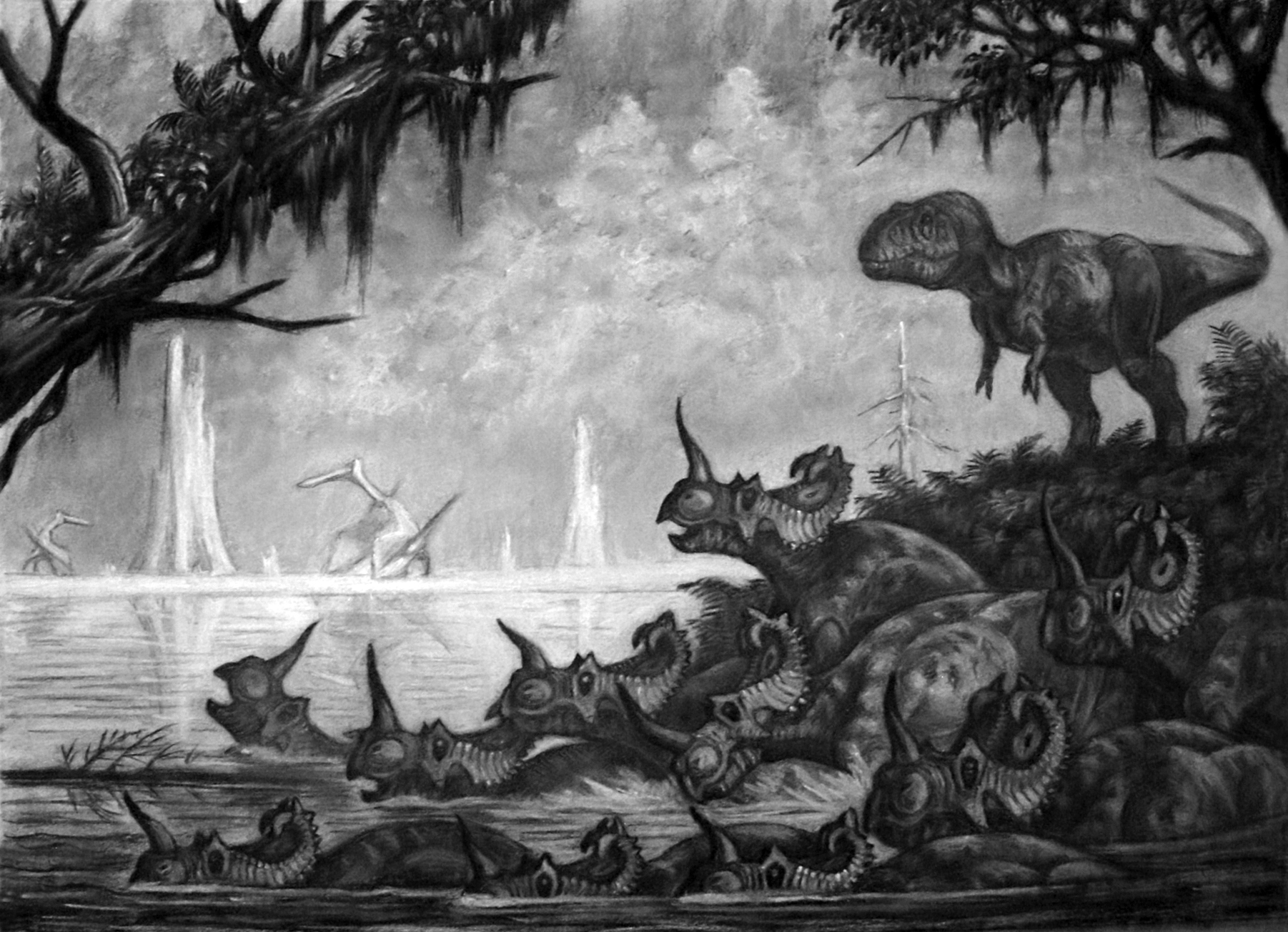
They concluded that the Hilda bonebeds formed simultaneously when a herd consisting of thousands of Centrosaurus apertus drowned in a flood. The researchers further speculated that some of the 17 Centrosaurus bonebeds of Dinosaur Provincial Park likely formed simultaneously in a manner analogous to the formation of the Hilda bonebeds, which the researchers estimated to be spread over 2.3 km2. The researchers only collected fossils and taphonomic data from the bonebed H97-04, although all the others were also examined to check the quality and number of preserved bones. The research at Hilda was so complex that over ten years passed from the start of the project until David A. Eberth, Donald B. Brinkman, and Vaia Barkas published a formal description in the scientific literature.
The mega-bonebed is located 25 kilometers west of the town of Hilda, Alberta in a "steep-walled" valley cut into the landscape by glaciers during the Pleistocene epoch. Northward through this valley's interior runs the South Saskatchewan River. The individual bonebeds in the complex are recognizable as dense concentrations of ceratopsid bones. Research on the bonebeds of Dinosaur Provincial Park has discovered that ceratopsian bonebeds preserved in mudstone deposits tended to be circular to ovular in shape when viewed from above, so the similar Hilda bonebeds probably were as well.
H97-04 is the largest of the fourteen bonebeds, at 150 m in width. If one assumes that H97-04's 150 m width is its longest linear dimension then it had an area of about 17,671 m2. Bonebeds other than H97-04 were less than 50 m wide. These individual component bonebeds tend to have areas of only a few hundred to a few thousand square feet and would have maximum areas of somewhat less than 2,000 square meters. The individual bonebeds at Hilda were generally smaller than those at Dinosaur Provincial Park.
The researchers estimated the entire Hilda complex to be 2.3 square kilometers in area based on the length of its north-south and east-west axes. This is the size of about 280 football fields, and is one of the largest dinosaur bonebeds ever discovered. Bonebeds left by such large animals over wide areas are a rare discovery. However, completely excavating the bonebed would be too huge and complex an undertaking to be practical.
Hub AI
Hilda mega-bonebed AI simulator
(@Hilda mega-bonebed_simulator)
Hilda mega-bonebed
The Hilda mega-bonebed is a complex of fourteen probable Centrosaurus apertus bonebeds discovered near the town of Hilda in Alberta, Canada. It was first described in the scientific literature by David Eberth, Donald Brinkman, and Vaia Barkas in 2010 after more than ten years of research. The Hilda mega-bonebed is significant because the behavior of the preserved dinosaurs themselves was the dominant cause of its existence, rather than the stratum's geological history like most bonebeds. It is also Canada's largest bonebed.
In 1959, Wann Langston, Jr. recorded evidence of a Centrosaurus bonebed near Hilda, Alberta. Later, between 1964 and 1966 Don Taylor of the Provincial Museum of Alberta (now called the Royal Alberta Museum) oversaw the collection of fossils from yet another bonebed in the same region. These prospective bonebeds attracted the attention of scientists working for the Royal Tyrell Museum in the 1990s because Hilda was an ideal location for maintaining physical continuity across the bonebeds' expanse. Physical continuity is important, because discontinuity in the rock strata can make it harder to tell if the bones were deposited at the same time or not.
Eberth and the other researchers considered Hilda a prime site for a continuous bonebed for two reasons, one related to its history, one related to its present geography. First, during the Cretaceous the area was situated closer to the Western Interior Seaway where more sediment would have been deposited than at Dinosaur Provincial Park. Secondly, the modern Hilda area lacks the rough badland terrain that breaks up many probably equivalent deposits in Dinosaur Provincial Park.
In 1996, the Royal Tyrell Museum finally performed a preliminary survey of the area studied by Langston and Taylor and entire new bonebeds were discovered. The next year, in 1997, research at Hilda began in earnest. In only two days, researchers discovered 14 separate bonebeds in one mudstone bed that extended for at least 7 km, with 3.7 km worth of visible outcrops. By the conclusion of the research program, the scientists mapped the bonebeds and excavated the bonebed cataloged as H97-04.
They concluded that the Hilda bonebeds formed simultaneously when a herd consisting of thousands of Centrosaurus apertus drowned in a flood. The researchers further speculated that some of the 17 Centrosaurus bonebeds of Dinosaur Provincial Park likely formed simultaneously in a manner analogous to the formation of the Hilda bonebeds, which the researchers estimated to be spread over 2.3 km2. The researchers only collected fossils and taphonomic data from the bonebed H97-04, although all the others were also examined to check the quality and number of preserved bones. The research at Hilda was so complex that over ten years passed from the start of the project until David A. Eberth, Donald B. Brinkman, and Vaia Barkas published a formal description in the scientific literature.
The mega-bonebed is located 25 kilometers west of the town of Hilda, Alberta in a "steep-walled" valley cut into the landscape by glaciers during the Pleistocene epoch. Northward through this valley's interior runs the South Saskatchewan River. The individual bonebeds in the complex are recognizable as dense concentrations of ceratopsid bones. Research on the bonebeds of Dinosaur Provincial Park has discovered that ceratopsian bonebeds preserved in mudstone deposits tended to be circular to ovular in shape when viewed from above, so the similar Hilda bonebeds probably were as well.
H97-04 is the largest of the fourteen bonebeds, at 150 m in width. If one assumes that H97-04's 150 m width is its longest linear dimension then it had an area of about 17,671 m2. Bonebeds other than H97-04 were less than 50 m wide. These individual component bonebeds tend to have areas of only a few hundred to a few thousand square feet and would have maximum areas of somewhat less than 2,000 square meters. The individual bonebeds at Hilda were generally smaller than those at Dinosaur Provincial Park.
The researchers estimated the entire Hilda complex to be 2.3 square kilometers in area based on the length of its north-south and east-west axes. This is the size of about 280 football fields, and is one of the largest dinosaur bonebeds ever discovered. Bonebeds left by such large animals over wide areas are a rare discovery. However, completely excavating the bonebed would be too huge and complex an undertaking to be practical.