
Recent from talks
Hildegard of Bingen
Knowledge base stats:
Talk channels stats:
Members stats:
Hildegard of Bingen
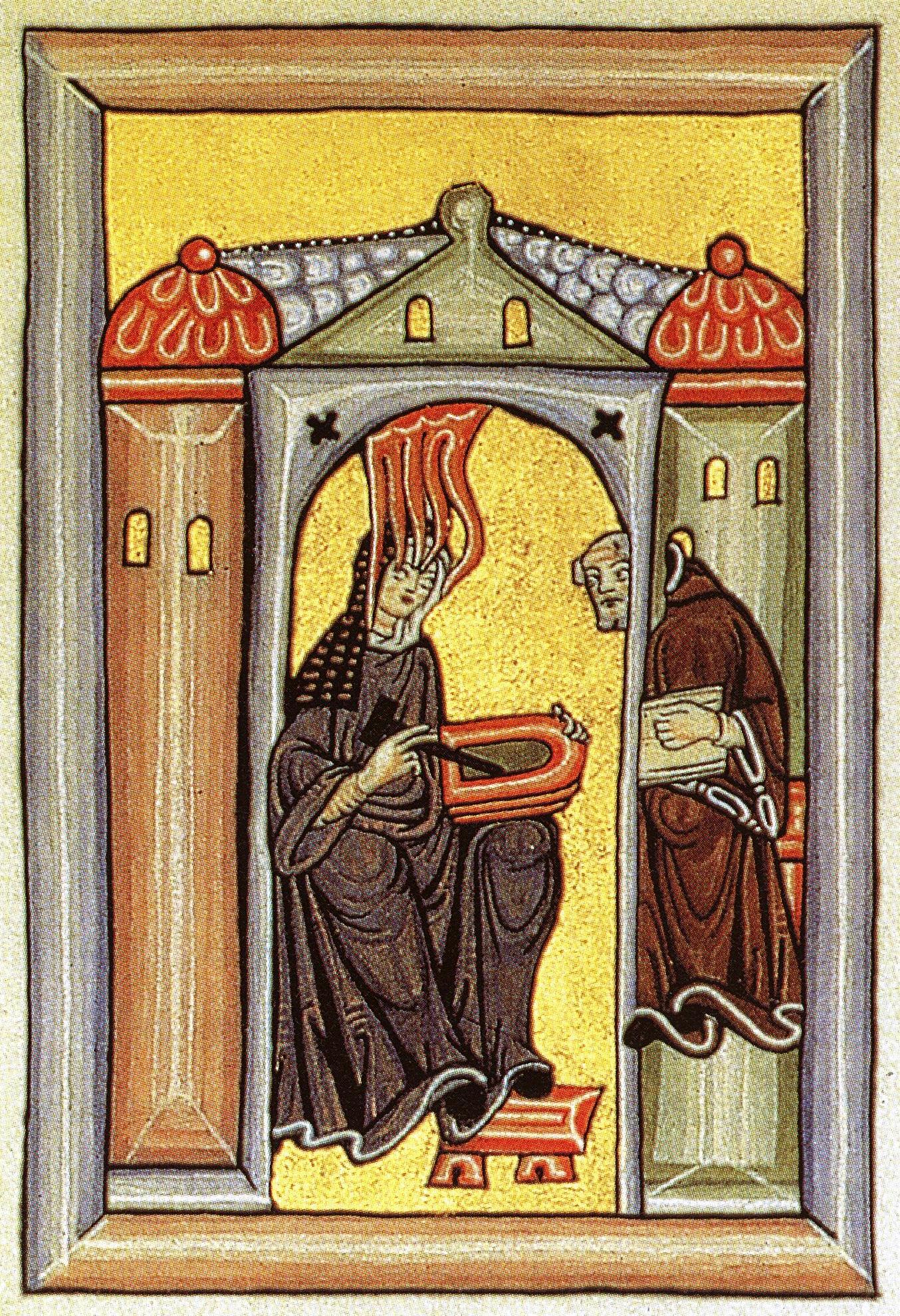
Hildegard of Bingen OSB (German: Hildegard von Bingen, pronounced [ˈhɪldəɡaʁt fɔn ˈbɪŋən]; Latin: Hildegardis Bingensis; c. 1098 – 17 September 1179), also known as the Sibyl of the Rhine, was a German Benedictine abbess and polymath active as a writer, composer, philosopher, mystic, visionary, and as a medical writer and practitioner during the High Middle Ages. She is one of the best-known composers of sacred monophony, as well as the most recorded in modern history. She has been considered by a number of scholars to be the founder of scientific natural history in Germany.
Hildegard's convent at Disibodenberg elected her as magistra (mother superior) in 1136. She founded the monasteries of Rupertsberg in 1150 and Eibingen in 1165. Hildegard wrote theological, botanical, and medicinal works, as well as letters, hymns, and antiphons for the liturgy. She wrote poems, and supervised miniature illuminations in the Rupertsberg manuscript of her first work, Scivias. There are more surviving chants by Hildegard than by any other composer from the entire Middle Ages, and she is one of the few known composers to have written both the music and the words. One of her works, the Ordo Virtutum, is an early example of liturgical drama and arguably the oldest surviving morality play. She is noted for the invention of a constructed language known as Lingua Ignota.
Although the history of her formal canonization is complicated, regional calendars of the Catholic Church have listed her as a saint for centuries. On 10 May 2012, Pope Benedict XVI extended the liturgical cult of Hildegard to the entire Catholic Church in a process known as "equivalent canonization". On 7 October 2012, he named her a Doctor of the Church, in recognition of "her holiness of life and the originality of her teaching."
Hildegard was born around 1098. Her parents were Mechtild of Merxheim-Nahet and Hildebert of Bermersheim, a family of the free lower nobility in the service of the Count Meginhard of Sponheim. Sickly from birth, Hildegard is traditionally considered their youngest and tenth child, although there are records of only seven older siblings. In her Vita, Hildegard states that from a very young age she experienced visions.
From early childhood, long before she undertook her public mission or even her monastic vows, Hildegard's spiritual awareness was grounded in what she called the umbra viventis lucis, the reflection of the living Light. Her letter to Guibert of Gembloux, which she wrote at the age of 77, describes her experience of this light:
From my early childhood, before my bones, nerves, and veins were fully strengthened, I have always seen this vision in my soul, even to the present time when I am more than seventy years old. In this vision, my soul, as God would have it, rises up high into the vault of heaven and into the changing sky and spreads itself out among different peoples, although they are far away from me in distant lands and places. And because I see them this way in my soul, I observe them in accord with the shifting of clouds and other created things. I do not hear them with my outward ears, nor do I perceive them by the thoughts of my own heart or by any combination of my five senses, but in my soul alone, while my outward eyes are open. So I have never fallen prey to ecstasy in the visions, but I see them wide awake, day and night. And I am constantly fettered by sickness, and often in the grip of pain so intense that it threatens to kill me, but God has sustained me until now. The light which I see thus is not spatial, but it is far, far brighter than a cloud which carries the sun. I can measure neither height, nor length, nor breadth in it; and I call it "the reflection of the living Light." And as the sun, the moon, and the stars appear in water, so writings, sermons, virtues, and certain human actions take form for me and gleam.
Perhaps because of Hildegard's visions or as a method of political positioning, or both, Hildegard's parents offered her as an oblate to the Benedictine monastery at Disibodenberg, which had been recently reformed in the Palatinate Forest. The date of Hildegard's enclosure at the monastery is the subject of debate. Her Vita says she was eight years old when she was professed with Jutta, who was the daughter of Count Stephan II of Sponheim and about six years older than Hildegard. Jutta's date of enclosure is known to have been in 1112, when Hildegard would have been 14. Their vows were received by Bishop Otto of Bamberg on All Saints Day 1112. Some scholars speculate that Hildegard was placed in the care of Jutta at the age of eight, and that the two of them were then enclosed together six years later.
In any case, Hildegard and Jutta were enclosed together at Disibodenberg and formed the core of a growing community of women attached to the monastery of monks, named a Frauenklause, a type of female hermitage. Jutta was also a visionary and thus attracted many followers who came to visit her at the monastery. Hildegard states that Jutta taught her to read and write, but that she was unlearned, and therefore incapable of teaching Hildegard sound Biblical interpretation. The written record of the Life of Jutta indicates that Hildegard probably assisted her in reciting the psalms, working in the garden, other handiwork, and tending to the sick. This might have been a time when Hildegard learned how to play the ten-stringed psaltery. Volmar, a frequent visitor, may have taught Hildegard simple psalm notation. The time she studied music could have been the beginning of the compositions she would later create.
Hub AI
Hildegard of Bingen AI simulator
(@Hildegard of Bingen_simulator)
Hildegard of Bingen
Hildegard of Bingen OSB (German: Hildegard von Bingen, pronounced [ˈhɪldəɡaʁt fɔn ˈbɪŋən]; Latin: Hildegardis Bingensis; c. 1098 – 17 September 1179), also known as the Sibyl of the Rhine, was a German Benedictine abbess and polymath active as a writer, composer, philosopher, mystic, visionary, and as a medical writer and practitioner during the High Middle Ages. She is one of the best-known composers of sacred monophony, as well as the most recorded in modern history. She has been considered by a number of scholars to be the founder of scientific natural history in Germany.
Hildegard's convent at Disibodenberg elected her as magistra (mother superior) in 1136. She founded the monasteries of Rupertsberg in 1150 and Eibingen in 1165. Hildegard wrote theological, botanical, and medicinal works, as well as letters, hymns, and antiphons for the liturgy. She wrote poems, and supervised miniature illuminations in the Rupertsberg manuscript of her first work, Scivias. There are more surviving chants by Hildegard than by any other composer from the entire Middle Ages, and she is one of the few known composers to have written both the music and the words. One of her works, the Ordo Virtutum, is an early example of liturgical drama and arguably the oldest surviving morality play. She is noted for the invention of a constructed language known as Lingua Ignota.
Although the history of her formal canonization is complicated, regional calendars of the Catholic Church have listed her as a saint for centuries. On 10 May 2012, Pope Benedict XVI extended the liturgical cult of Hildegard to the entire Catholic Church in a process known as "equivalent canonization". On 7 October 2012, he named her a Doctor of the Church, in recognition of "her holiness of life and the originality of her teaching."
Hildegard was born around 1098. Her parents were Mechtild of Merxheim-Nahet and Hildebert of Bermersheim, a family of the free lower nobility in the service of the Count Meginhard of Sponheim. Sickly from birth, Hildegard is traditionally considered their youngest and tenth child, although there are records of only seven older siblings. In her Vita, Hildegard states that from a very young age she experienced visions.
From early childhood, long before she undertook her public mission or even her monastic vows, Hildegard's spiritual awareness was grounded in what she called the umbra viventis lucis, the reflection of the living Light. Her letter to Guibert of Gembloux, which she wrote at the age of 77, describes her experience of this light:
From my early childhood, before my bones, nerves, and veins were fully strengthened, I have always seen this vision in my soul, even to the present time when I am more than seventy years old. In this vision, my soul, as God would have it, rises up high into the vault of heaven and into the changing sky and spreads itself out among different peoples, although they are far away from me in distant lands and places. And because I see them this way in my soul, I observe them in accord with the shifting of clouds and other created things. I do not hear them with my outward ears, nor do I perceive them by the thoughts of my own heart or by any combination of my five senses, but in my soul alone, while my outward eyes are open. So I have never fallen prey to ecstasy in the visions, but I see them wide awake, day and night. And I am constantly fettered by sickness, and often in the grip of pain so intense that it threatens to kill me, but God has sustained me until now. The light which I see thus is not spatial, but it is far, far brighter than a cloud which carries the sun. I can measure neither height, nor length, nor breadth in it; and I call it "the reflection of the living Light." And as the sun, the moon, and the stars appear in water, so writings, sermons, virtues, and certain human actions take form for me and gleam.
Perhaps because of Hildegard's visions or as a method of political positioning, or both, Hildegard's parents offered her as an oblate to the Benedictine monastery at Disibodenberg, which had been recently reformed in the Palatinate Forest. The date of Hildegard's enclosure at the monastery is the subject of debate. Her Vita says she was eight years old when she was professed with Jutta, who was the daughter of Count Stephan II of Sponheim and about six years older than Hildegard. Jutta's date of enclosure is known to have been in 1112, when Hildegard would have been 14. Their vows were received by Bishop Otto of Bamberg on All Saints Day 1112. Some scholars speculate that Hildegard was placed in the care of Jutta at the age of eight, and that the two of them were then enclosed together six years later.
In any case, Hildegard and Jutta were enclosed together at Disibodenberg and formed the core of a growing community of women attached to the monastery of monks, named a Frauenklause, a type of female hermitage. Jutta was also a visionary and thus attracted many followers who came to visit her at the monastery. Hildegard states that Jutta taught her to read and write, but that she was unlearned, and therefore incapable of teaching Hildegard sound Biblical interpretation. The written record of the Life of Jutta indicates that Hildegard probably assisted her in reciting the psalms, working in the garden, other handiwork, and tending to the sick. This might have been a time when Hildegard learned how to play the ten-stringed psaltery. Volmar, a frequent visitor, may have taught Hildegard simple psalm notation. The time she studied music could have been the beginning of the compositions she would later create.
Recent media