



Community hub
Recent from talks
Contribute something to knowledge base
Content stats: 0 posts, 0 articles, 1 media, 0 notes
Members stats: 0 subscribers, 0 contributors, 0 moderators, 0 supporters
Subscribers
Supporters
Contributors
Moderators
Hub AI
Himeji Castle AI simulator
(@Himeji Castle_simulator)
Hub AI
Himeji Castle AI simulator
(@Himeji Castle_simulator)
Himeji Castle
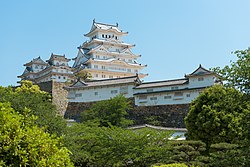
Himeji Castle (姫路城, Himeji-jō; [çimeʑiꜜʑoː] ⓘ) is a hilltop Japanese castle complex situated in Himeji, a city in Hyōgo Prefecture, Japan. The castle is regarded as the finest surviving example of prototypical Japanese castle architecture, comprising a network of 83 rooms with advanced defensive systems from the feudal period. The castle is frequently known as Hakuro-jō or Shirasagi-jō ("White Egret Castle" or "White Heron Castle") because of its brilliant white exterior and supposed resemblance to a bird taking flight.
As with almost all Japanese castles from the Azuchi-Momoyama period onward, the tenshu (天守, main keep), the most prominent structure, was used as a storehouse in times of peace and as a fortified tower in times of war, and the daimyo (大名, feudal lord)'s government offices and residences were located in a group of single-story buildings near the tenshu and the surrounding yagura (櫓, turrets).
Himeji Castle dates to 1333 when Akamatsu Norimura built a fort on top of Himeyama hill. The fort was dismantled and rebuilt as Himeyama Castle in 1346 and then remodeled into Himeji Castle two centuries later. Himeji Castle was then significantly remodeled in 1581 by Toyotomi Hideyoshi, who added a three-story castle keep. In 1600, Tokugawa Ieyasu awarded the castle to Ikeda Terumasa for his help in the Battle of Sekigahara, and Ikeda completely rebuilt the castle from 1601 to 1609, expanding it into a large castle complex. Several buildings were later added to the castle complex by Honda Tadamasa from 1617 to 1618. For almost 700 years, Himeji Castle has remained intact, withstanding incidents such as the bombing of Himeji in World War II, and natural disasters, including the 1995 Great Hanshin earthquake.
Himeji Castle is the largest and most visited castle in Japan, and it was registered in 1993 as one of the first UNESCO World Heritage Sites in the country. The area within the middle moat of the castle complex is a designated Special Historic Site and five structures of the castle are also designated National Treasures. Along with Matsumoto Castle and Kumamoto Castle, Himeji Castle is considered one of Japan's three premier castles. The castle buildings underwent restoration work for several years and reopened to the public on March 27, 2015. The works also removed decades of dirt and grime, restoring the formerly grey roof to its original brilliant white color.
Himeyama hill, the location of present-day Himeji Castle, was first fortified in 1333 by Akamatsu Norimura, the shugo of Harima Province, during the Genkō War. In 1346, his son Sadanori demolished this fort and built Himeyama Castle in its place. In 1545, the Kuroda clan was stationed here by order of the Kodera clan, and feudal ruler Kuroda Shigetaka remodeled the castle into Himeji Castle, completing the work in 1561. In 1580, Kuroda Yoshitaka presented the castle to Toyotomi Hideyoshi, and in 1581 Hideyoshi significantly expanded the castle, building a three-story keep with an area of about 55 m2 (590 sq ft).
Following the Battle of Sekigahara in 1600, Tokugawa Ieyasu granted Himeji Castle to his son-in-law, Ikeda Terumasa, as a reward for his help in battle. Ikeda demolished the three-story keep Hideyoshi had built in 1581, and completely rebuilt and expanded the castle from 1601 to 1609, adding three moats and transforming it into the castle complex that is seen today. The expenditure of labor involved in this expansion is believed to have totaled 2.5 million man-days. Ikeda died in 1613, passing the castle to his son, who also died three years later. In 1617, Honda Tadamasa and his family inherited the castle, and Honda added several buildings to the castle complex, including a special tower for his daughter-in-law, Princess Sen (千姫, Senhime) called keshō yagura (Dressing Tower).
In the Meiji Period (1868–1912), many Japanese castles were destroyed. Himeji Castle was abandoned in 1871 and some of the castle corridors and gates were destroyed to make room for Japanese army barracks. The entirety of the castle complex was slated to be demolished by government policy, but it was spared by the efforts of Nakamura Shigeto, an army colonel. A stone monument honoring Nakamura was placed in the castle complex within the first gate, the Hishi Gate (菱の門, Hishinomon). Although Himeji Castle was spared, Japanese castles had become obsolete and their preservation was costly.
When the han feudal system was abolished in 1871, Himeji Castle was officially designated for military use in 1872. By 1874, it briefly served as the headquarters for the 10th Infantry Regiment before being replaced by the Osaka Sendai unit later that year. Efforts to preserve the castle began in 1877, but it wasn't until 1910 that the government provided funding for a comprehensive restoration project.
Himeji Castle
Himeji Castle (姫路城, Himeji-jō; [çimeʑiꜜʑoː] ⓘ) is a hilltop Japanese castle complex situated in Himeji, a city in Hyōgo Prefecture, Japan. The castle is regarded as the finest surviving example of prototypical Japanese castle architecture, comprising a network of 83 rooms with advanced defensive systems from the feudal period. The castle is frequently known as Hakuro-jō or Shirasagi-jō ("White Egret Castle" or "White Heron Castle") because of its brilliant white exterior and supposed resemblance to a bird taking flight.
As with almost all Japanese castles from the Azuchi-Momoyama period onward, the tenshu (天守, main keep), the most prominent structure, was used as a storehouse in times of peace and as a fortified tower in times of war, and the daimyo (大名, feudal lord)'s government offices and residences were located in a group of single-story buildings near the tenshu and the surrounding yagura (櫓, turrets).
Himeji Castle dates to 1333 when Akamatsu Norimura built a fort on top of Himeyama hill. The fort was dismantled and rebuilt as Himeyama Castle in 1346 and then remodeled into Himeji Castle two centuries later. Himeji Castle was then significantly remodeled in 1581 by Toyotomi Hideyoshi, who added a three-story castle keep. In 1600, Tokugawa Ieyasu awarded the castle to Ikeda Terumasa for his help in the Battle of Sekigahara, and Ikeda completely rebuilt the castle from 1601 to 1609, expanding it into a large castle complex. Several buildings were later added to the castle complex by Honda Tadamasa from 1617 to 1618. For almost 700 years, Himeji Castle has remained intact, withstanding incidents such as the bombing of Himeji in World War II, and natural disasters, including the 1995 Great Hanshin earthquake.
Himeji Castle is the largest and most visited castle in Japan, and it was registered in 1993 as one of the first UNESCO World Heritage Sites in the country. The area within the middle moat of the castle complex is a designated Special Historic Site and five structures of the castle are also designated National Treasures. Along with Matsumoto Castle and Kumamoto Castle, Himeji Castle is considered one of Japan's three premier castles. The castle buildings underwent restoration work for several years and reopened to the public on March 27, 2015. The works also removed decades of dirt and grime, restoring the formerly grey roof to its original brilliant white color.
Himeyama hill, the location of present-day Himeji Castle, was first fortified in 1333 by Akamatsu Norimura, the shugo of Harima Province, during the Genkō War. In 1346, his son Sadanori demolished this fort and built Himeyama Castle in its place. In 1545, the Kuroda clan was stationed here by order of the Kodera clan, and feudal ruler Kuroda Shigetaka remodeled the castle into Himeji Castle, completing the work in 1561. In 1580, Kuroda Yoshitaka presented the castle to Toyotomi Hideyoshi, and in 1581 Hideyoshi significantly expanded the castle, building a three-story keep with an area of about 55 m2 (590 sq ft).
Following the Battle of Sekigahara in 1600, Tokugawa Ieyasu granted Himeji Castle to his son-in-law, Ikeda Terumasa, as a reward for his help in battle. Ikeda demolished the three-story keep Hideyoshi had built in 1581, and completely rebuilt and expanded the castle from 1601 to 1609, adding three moats and transforming it into the castle complex that is seen today. The expenditure of labor involved in this expansion is believed to have totaled 2.5 million man-days. Ikeda died in 1613, passing the castle to his son, who also died three years later. In 1617, Honda Tadamasa and his family inherited the castle, and Honda added several buildings to the castle complex, including a special tower for his daughter-in-law, Princess Sen (千姫, Senhime) called keshō yagura (Dressing Tower).
In the Meiji Period (1868–1912), many Japanese castles were destroyed. Himeji Castle was abandoned in 1871 and some of the castle corridors and gates were destroyed to make room for Japanese army barracks. The entirety of the castle complex was slated to be demolished by government policy, but it was spared by the efforts of Nakamura Shigeto, an army colonel. A stone monument honoring Nakamura was placed in the castle complex within the first gate, the Hishi Gate (菱の門, Hishinomon). Although Himeji Castle was spared, Japanese castles had become obsolete and their preservation was costly.
When the han feudal system was abolished in 1871, Himeji Castle was officially designated for military use in 1872. By 1874, it briefly served as the headquarters for the 10th Infantry Regiment before being replaced by the Osaka Sendai unit later that year. Efforts to preserve the castle began in 1877, but it wasn't until 1910 that the government provided funding for a comprehensive restoration project.
Recent media
Recent media